Home » Jazz Articles » Live Review » Moldejazz 2026
Moldejazz 2026
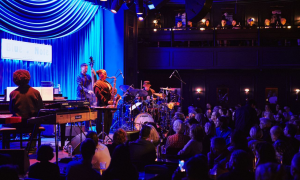
Every musician was a soloist. The first was Sanyu (Sanyu Christine Nsubuga), a singer of Irish-Ugandan origin based in Oslo, entirely at ease across the whole repertoire and with a strong stage presence. A voice to follow, already well established in northern Europe. It is always a great pleasure to mention the solos of Aksel Rønning (alto saxophone, flute), Erlend Vangen Kongtorp, (tenor saxophone, flute), and Jenny Frøysa, (baritone sax, bass clarinet), some of the most captivating young wind players in Norway, particularly at ease in a big band context. Mention should also go to Øyvind Mathisen, Ola Lømo Ellingsen on trumpet and Even Brodwall on french horn. The bass and drums of Andreas Svabø and Bjørn André Syverinsen were terribly effective. In fact, every musician in the Cosmic Swing Orchestra is well worth following very closely.
With some relief for the AAJ contributor, who dodged a bullet in spring in another Cosmic Swing Orchestra performance at the Trondheim JazzFest, The Jazz Togetherness Show, the orchestra and its leader only came off the stage towards the audience at the end of the concert. An ovation close to delirium. The pieces played that Saturday will appear on the album Optimism Over Despair, due out in 2027. It will be produced by Lars Horntveth, of Jaga Jazzist reviewed below. Noted?
Quintet chemistry
Sverre Sæbø Quintet: Winds of Ornette
For the AAJ contributor, who knew a good many of the other names, this was perhaps the discovery of Moldejazz. Bassist Sverre Sæbø could be seen on Monday and Tuesday with Esperanza Spalding; here he was on Wednesday with his quintet squeezed onto the basement stage of Fuzzy Platebar, that very cool café in the centre of Molde filled with vinyls and posters from past concerts.The quintet has no piano, which lightens it considerably. The inspiration is to be sought on the side of Ornette Coleman and Don Cherry, even in the absence of a trumpet. The sound is that of wind through an open window. Sæbø says he is inspired by Charles Mingus and Henry Grimes. The Mingus side was apparent here, with a very beautiful woody bass sound—but the AAJ contributor had to slip away before the end. The drums of Amund Nordstrøm also have that beautiful woody sound which brings Billy Higgins and Ed Blackwell together. Nordstrøm's drumming is hugely effective, the drums rolling in contact with the bass, the cymbals flying. Norway really is the land of drummers. The combination of the three wind players is clever: with three you form a whole section, and a soloist can be doubled by a subtle counterpoint. They are Heidi Kvelvane (alto saxophone), who drinks readily at the source of Ornette Coleman, Aksel Røed (tenor saxophone), and Andreas Hatzikiriakidis (trumpet). Magnificent.
Langendorf United: Habesha Jazz and the Undercover Beast
Having just written enthusiastically about his great discovery of Moldejazz, the AAJ contributor must now retract a little to make room on the podium for Lina Langendorf and her quintet, Langendorf United, who came on the Thursday to present their album Undercover Beast (Sing A Song Fighter, 2025).After the very mekurian vibrato (Getatchew Mekuria, The Ex & Guests) of Alabaster DePlume's saxophone at Moldejazz 2025, here we are in 2026 further still, on the basaltic highlands of Ethiopia. Langendorf is habesha. The AAJ reviewer knows what that is: he was told so too. It is no small thing. Habesha is the Amharic name for the Ethiopians of the highlands and, by extension, ultimately for all Ethiopians and Eritreans. Playing in Addis Ababa, Langendorf astonished her audience, who pinned that name on her. White outside, Black inside: a habesha in disguise! To be taken as an absolute honor, and a very particular emotion when that description lands on you from Ethiopians themselves, you, with your white skin.
From the very first piece (so-ma-li), after a minute of introduction in which one sensed that something was about to happen, an Ethiopian rhythm (the ethnic group to be identified by a specialist) surged up through Andreas Werliin (drums), who I was told, astonishingly, has never set foot in Addis Ababa. Werliin was supported in his fantastic task by Ole Morten Vågan (bass), artistic director of the Trondheim Jazz Orchestra between 2017 and 2025 and one of the most solid bass players around. When melody, in the Tizita minor scale, close to the western aeolian scale, was played on tenor by Langendorf, one suddenly felt transported into one of these cultural restaurants in Addis or elsewhere. Langendorf radiated incredible energy. At the centre of the Storyville stage, she turned left and right like a weathervane to listen to her musicians and look them in the face with the air of someone who cannot quite believe it. Either towards Daniel Bingert (keyboards, guitar) on the left, or towards Vågan and Martin Hederos (keyboards, viola) on her right. Sometimes behind, towards Werliin's temple of rhythm.
And so it went for an hour and a half, before an audience open-mouthed or dancing, depending on each person's degree of extroversion, but reconciled on the applause meter.
Synthesizers have been part of ethio-jazz since, one might almost say, the invention of electricity. Bingert and Hederos push the electronics further. Bingert is in a way the melodic guarantor of the electron. Turning the many knobs of his keyboards in every direction, Hederos is wild. It was more or less impossible to photograph his face: he was everywhere at once above his keyboards. He nevertheless found the time, now and then, to pick up his viola and draw a well-judged improvisation from it.
The Storyville Plassen audience was lucky that day. It was a journey, but no tourism: a genuine experience. Ethio-jazz, cut short in its momentum since the Derg (1974), is being reborn in Scandinavia (Langendorf is Swedish) with unexpected vigor.
By the way, why Undercover Beast? Langendorf explained to the audience:
"It was a title I was given in Addis when I was there in Ethiopia in Addis Ababa. I was jamming one night and after the jamming, the drummer came up and said: 'You're an undercover beast!' Then I wrote about it on Facebook and said: Now I've got my first, world-class and best artist name! I'm going to go out and print t-shirts and merch!"
Fewer, finer
Cécile McLorin Salvant
Cecile McLorin Salvant was back in Norway for a concert on the Wednesday in the main hall of Bjørnsonhuset, after two concerts described as unforgettable five and ten years earlier. It was not difficult to understand why. Sung by McLorin Salvant, any song, whatever style it originally came from (there were many... ), seems to be sung for the first time. The concert drew on part of Oh Snap (Nonesuch Records, 2025), with "I Am a Volcano," "Take This Stone," "Second Guessing," "Anything but Now" and "Oh Snap." She was accompanied on piano by Sullivan Fortner, with Yasushi Nakamura on bass and Kyle Poole on drums.On "Anything but Now," a fast-tempo composition by McLorin Salvant, Fortner, a demiurge transfigured into Bud Powell, almost carried the audience off to Massey Hall in 1953 (The Complete Jazz at Massey Hall , Fantasy Jazz, 2005)). On the album Oh Snap, Fortner has a short solo only. Concert wins. "Oh Snap," the song, with its markedly binary rhythm, is almost a pop song, in which Fortner delivered an astonishing improvisation, a kind of mirror playing. Concert—album: 2—0. "Until," by Sting, was a superb moment, with a deep, resonant drum solo from Poole that propelled McLorin Salvant, and then Fortner, towards a stirring close.
McLorin Salvant and her team finally floored the audience with a dramatic rendering of the text of Aeschylus's Oresteia (500 b.c.): "Black Wing and Silver Hue," a Harrison Birtwistle composition for the Greek chorus, referring to the two birds that announce to Agamemnon that it is time to go to war, at the very beginning of the play. For us, the audience, it was time, unfortunately, to get our feet back on the ground!
Shabaka
A concert in a single sweep, one long story. Shabaka Hutchings (flutes, tenor saxophone, clarinet, Soma TERRA, electronics) gave a solo concert on the Friday at Storyville Plassen before an audience that was concentrated and, judging by the looks on their faces, no doubt impressed as well. A parenthesis of spirituality. Shabaka was seated facing a small table, with that extraordinary synthesizer the Soma TERRA on his left, first in a row of four, and a fifth synthesizer in front of the others. No sound was pre-recorded. The delicate, sometimes fragile melodies followed one another and were quietly memorized into an improvised live symphony. Then the winds arrived and left again one after another. First a native American harmony double flute, then the tenor saxophone, where one was happy to find Shabaka's heralding, gently dramatic style; this melodic and harmonic talent he has to half- open a door onto an event that everyone is free to imagine. And one suddenly realized how much Shabaka's music had been missed; there is an urgent need to listen to it more often in future. Then the clarinet, another flute, wood or metal... Meanwhile, the electronic patterns have recast themselves and set off around the world. Magic.Daniel Herskedal
Daniel Herskedal (tuba, bass trumpet, electronics) gave a solo concert on the Saturday evening in a full Molde cathedral (900 seats). Magnificent music of silent winter. Marja Mortensson, a Sami singer from that indigenous people of northern Scandinavia, came on stage to duet with him on a joik, a tune in the traditional music style of the Sami people. The two have already worked together on several albums.Herskedal's concert was sandwiched between the Cosmic Swing Orchestra and Berliner's trio, so that one clearly had to choose sides, especially at 795 NOK (83 USD as of today), a solo performance twice as expensive as most of the festival's non-commercial concerts. To be clear: the young to the cosmos and the trio, the old to the church with Herskedal. Was the audience intrinsically different, was the clash unavoidable? Perhaps. In any case, whether solo or in duo, the 23 minutes the AAJ contributor was able to devote to Herskedal were sublime from the first minute to the last. Mortensson was a major discovery. One can get an idea of her hypnotic talent from the album Mojhtestasse (Vuelie, 2018), reviewed by Ian Patterson.
Sasha Berliner Arts & Sciences
Walking briskly from Herskedal's concert, it was possible not to miss, on the Saturday evening, the lesson in Art and Science at Storyville. What are the sciences doing in the art of Sasha Berliner? Berliner's vibraphone art is considerable, but perhaps what it lacked was electronics. That has now been done: in her new project, with Pablo Held on piano, Simon Jermyn on bass, and Anthony Fung on drums, she controls an electronic vibraphone from a laptop, set at a right angle to the traditional vibraphone and, it would seem, with a range extended by an octave. The sound is in the end fairly close to what can be obtained from electronic keyboards.The acoustic vibraphone is just as interesting: it is the one Gary Burton used to play when he was recording for ECM in Oslo, acquired by Storyville. On Burton's vibraphone, moreover, Berliner played compositions (including "Why Not" by George Cables) and highly melodic improvisations whose sometimes Burtonian flavour was quick to awaken nostalgia. But rather than settling into a defined style, Berliner flows into the pieces and, depending on the instrument, electronic or acoustic, develops her (our) music by bringing out the atmosphere thus suggested.
We also passed by Thelonious Monk with "Green Chimneys." For the encore, Berliner offered either a Chick Corea piece or one of her new compositions. Both! Well, no: the audience called for Corea. Fair enough, but a pity all the same.
The Arts & Sciences project will be on Berliner's next album, to be released in early 2027.
Michala Østergaard Trio
Several well-known pianists appeared during the festival. We begin with the trio of Michala Østergaard-Nielsen (drums, percussion) with Marilyn Crispell (piano) and Thommy Andersson (double bass), on the Wednesday afternoon at Teatret Vårt in front of an audience that was sparse at first. Then the front rows swelled with a small army of young festival musicians and volunteers, for whom concerts are free within the limit of the remaining seats.The concert was given in an introspective tone. A sequence of a dozen or so miniatures, some with a rather existential connotation and leaving space for a few fine solos from each of the musicians. The performance began with a slow, meditative solo from Crispell, joined by Andersson and Østergaard, setting up a calm atmosphere prolonged by the second piece, which began with a solo from Andersson. The intimate atmosphere thickened a little later with two compositions from Østergaard's soundpiece Can One Listen to Death: "The Threshold," about the transition between two psychological and physical states following the death of her mother, then "The Believer." "The Underworld," next, remains grave, with dark bowed playing from Andersson. The final piece, "A Smile of a Butterfly," remained meditative, and the encore was a short contemplative piece with Ravelian harmonies.
The trio recorded an album two days before, it is eagerly awaited.
Alexander von Schlippenbach and Paal Nilssen-Love
Paal Nilssen-Love (drums, percussion) likes duos. A few days before Moldejazz 2026 he was at the Kongsberg festival with the immense Akira Sakata (alto saxophone, clarinet, vocals). This Saturday, in the early afternoon, he was at Teatret Vårt with another giant of the piano, Alexander von Schlippenbach (88 years old). Free jazz comes naturally to von Schlippenbach, fed by a Monk aquifer that carries along dissolved fragments of contemporary music. Ideas follow one another Cecil Taylor—style, but if Taylor was fundamentally influenced by Béla Bartók, von Schlippenbach was influenced by Bernd Alois Zimmermann, and that changes the outcome.The tableaux follow one another; Thelonious Monk put his head round the door from time to time, long enough to be visible to all, but not long enough to thwart the flow of the painter. The piano of the Yosuke Yamashita of the turn of the 1980s (post-trio with Sakata, pre-New York Trio) sometimes knocked at the shutters. Contemporary music, by comparison, stayed in the landscape beyond the window. Lennie Tristano defined jazz by its feeling: von Schlippenbach's piano is feeling and consolidated intuition. Von Schlippenbach and Nilssen-Love are in continuous mutual understanding; it is not that one or the other underlines or prompts, the two move forward side by side with a controlling gaze. Refreshingly youthful!
Espen Berg Trio
Espen Berg is one of those pianists whose style resolutely frees itself from fashion, and anchors itself in a kind of 21st-century impressionism explored through improvisation. A technique and a refined science of harmony that impress. This Friday Teatret Vårt was full. Berg flatters the latent romanticism of many music lovers, whether of a lifetime or of an hour. Festivalgoers go to hear Berg the way they go to hear the trumpet of Mathias Eick (at Moldejazz 2025): a must, well beyond jazz enthusiasts. Some might find Berg's piano a little repetitive, every theme being destined to follow, inexorably, variants of the same impressionist patterns. Others will retort that this is precisely what one is looking for. The first will answer: perhaps, but are all those notes really indispensable? Where has the musicality gone, the kind found in abundance in Joachim Kühn, another romantic? A thorny debate but, in the end, what matters is that there are happy people. Erroll Garner could not be reproached for playing all the time in the style of Erroll Garner. In any case, Bárður Reinert Poulsen (bass) filled his role perfectly, and Simon Albertsen (drums), highly melodic, delivered some gripping solos.Longest Cable Award: Attributed to Jaga Jazzist
The power of artists is essentially a matter of transmission, is it not? They have no special or stronger emotions, but they transmit them better, as Michel Petrucciani once said. So the question arises most naturally: how do they manage not to trip over the cables lying about all over the stage?It was high time to launch the award for the greatest mileage of cable on stage without bringing the musicians down. Having declared the ambition of measuring the cabling of every concert millimetre by millimetre, the prize went, simply on sight of the endless bundles of cable crossing the very large stage of Teatret Vårt on Friday at midnight, without debate and therefore without contest, to Jaga Jazzist. A network whose density and complexity recalled the mycelial networks of the Wood Wide Web by Maria Dybbroe, but which managed with great science to avoid the spaces in which the musicians move. Congratulations!
Jaga Jazzist is a band formed in 1994 that plays chameleon music (John Kelman drew up a non-exhaustive list of adjectives in Jaga Jazzist: '94—'14), around Lars Horntveth (guitar, keyboards, tenor saxophone, bass clarinet), his sister Line Horntveth (tuba) and his brother Martin Horntveth (drums). The band leaves no room for long solos; there is no star. The overall sound always takes precedence and highlights the cohesion of the group rather than individual players. The multi-instrumentalism of Lars Horntveth and Andreas Mjøs (vibraphone, keyboards, guitar), who moved quickly from one instrument to another, blended with the keyboards of Øystein Moen and the guitar of Marcus Forsgren, Line Horntveth, Erik Johannessen (trombone) and Even Ormestad (bass) taking care of the low register. Martin Horntveth underpinned the whole thing firmly and handled the interaction with an audience (many young people for a band more than 30 years old) won over in advance, with warmth and humour.
Separating out each player's contribution was not easy, which is no doubt intended. Nor was it easy to identify what is composed and what is improvised: also a compliment. In the end, the general impression was of a musicality one would happily travel with to the end of the night, very happily. The swirling, constantly changing lights against a vast backdrop striped in black and white produced a slightly psychedelic atmosphere, and the whole thing was very effective. The impression of a formidable machine for sound, light and groove, one that will be listened to again with pleasure, with fewer lights—an album taking up the pieces played here seems to be planned for spring 2027.
The Longest Cable Award went to a performance for which one would have wished the night to be the longest as well. Who next year?
Jam Sessions at the Chateau: A Historic Setting for Incubating the Next Generation
In the formal French garden of the Molde chateau (chateauet), on the slope above the fjord, Kroa (The Pub) of the culture house is home to the lungs of Moldejazz every evening. It is a parallelepiped of limited external charm, set below the chateau but able to hold about 100 people, half of them standing. The stage is the width of the room, and there is a tiny bar on the other side. The main source is elsewhere.The chateau itself is a large neo-baroque residence built in 1916-1918 by the great Norwegian architect Sverre Pedersen, assisted by Carl J. Moe, for an industrialist in the clothing trade (the Møre og Romsdal region was renowned until the turn of the 20th century for its textile industry). At the time, the chateau was surrounded by wooden family houses with gardens and, further off, fields. Kroa opens onto the garden, laid out two years later.
At this time of year, the redcurrants and gooseberries are beginning to ripen, but they are not accessible to the jam session crowd. Instead it enjoys the scent of the Banks roses (or a variety close to Rosa banksiae 'Alba Plena'), on the chateau facade, in intense bloom in this season. Especially when those scents are not covered by the smell of beer, since just below is the second epicentre of the jam sessions, where the musicians, the students of the Molde cultural school and the knowing public gather: the garden fountain, inspired by Auguste Rodin, Girl with fish (the water comes out of the fish's mouth), sculpted by Robert Rasmussen (1879-1965). Kroa on one side of the fountain, refreshment stand on the other. Every condition is in place for first-class jam sessions all night long.
The jam sessions started at 11:30 p.m. and had to finish at 3 a.m. because of the neighbours. A different band opened the jam session each evening— the leader chosen from among the stars of the day. So very experienced musicians rubbed shoulders with students on the country's jazz courses (mainly Trondheim, Oslo, Bergen, Stavanger), students on the national jazz stream (landslinja for jazz—see above), aged between 16 and 19, students from other Norwegian towns, and sometimes even younger pupils. Drummer Rino Sivathas and pianist Isak Austnes Brekken were those in charge of the jam sessions at Moldejazz.
On Monday evening, the jam was opened by Tuva Halse (violin), Isak Hungnes (piano), Tarald Kongshaug (bass) and Sivathas. The beginning of the week is often less crowded, and that was the case this Monday. But it is always interesting to see how musicians who have forged their own style, or at least found their direction, cope with themes that are essentially bebop, Ellingtonian or Monkian. One of the compositions played that evening was "Ornithology" (Charlie Parker). Kongshaug is a solid and terrifically efficient bassist, the jam session musician par excellence. Hungnes, whom we saw in the Jazzintro competition, seemed to be developing a "jam-compatible" style. Sivathas, by contrast, shows with Speak Volumes, an album released the month before the festival, a style fusing jazz, hip-hop and electronic music. That evening he was to be found as an ideal jam session drummer, on the side of Tony Williams' explosive energy. Halse has forged a subtle style in which the quality of the bow's touch is paramount, placed at the service of the most demanding ECM-compatible jazz. On "Ornithology," that touch largely faded, bowing to the need for power and a steady beat. The phrasing became more complex, the melody broke free, stretched, twisted and reached a paroxysm through technical feats made possible by a robust classical technique: another side of the artist was revealed (not seen in her discography but could be worth seeing was big time to launch one day).
After three or four numbers, the musicians began to take turns, and so on Tuesday, after the jam had been opened by Karl Bjorå (guitar), Brekken (piano), Johannes Elnan (bass) and Sivathas (drums), Isaiah Collier and Riley Mulherkar (trumpet), who had played at Moldejazz during daytime, arrived on stage at Kroa and played with Ellinor Drevvatne, 17-years old, a violinist from the cultural school of the town of Mo i Rana, in the Nordland region of Norway, and Miriam Jiménez Franke, 14, a trombonist from the Talent Development Programme of the Norwegian Academy of Music in Oslo.
Around 1:30 a.m., Esperanza Spalding (bass, vocals) joined Brekken, guitarist Konstantin Helmers and drummer Eirik Lervåg Sæther, together with the musicians and dancers she had played with earlier that day on the grass of the island of Hjertøya: Charlotte Dos Santos (vocals), Sarah Camille Osmundsen (vocals, voice), Ester Thunander (fiddle, vocals), Sidiki Camara (percussion), and Ornilia Ubisse and Jeffrey Young (dance). Spalding involved the audience in a general breathing exercise for three minutes. Everyone breathed in and out together, the exhalation generating a sound that each person offered to the others in the room. The moment then evolved, drawing in the musicians on stage as well as some wind players in the audience, for a sequence of improvisation and dance. At that moment, the two students, Drevvatne and Jiménez joined the band as wind players, as well as Niklas Meek, a student of the landslinja for jazz, to back the vocals of Spalding, Dos Santos and Osmundsen.
On Thursday, Halse, who was playing during the day with Maria Dybbroe and OJKOS and was due to play in the very distant Tromsø the following day, took the time for a lightning return to Kroa in the middle of the night for a violin duo with Drevvatne, with Petter Dalane on piano, Andreas Svabø on bass and Steinar Heide Bø on drums. After the statement of the theme, Drevvatne, visibly nervous (who would not be?), took an improvisation showing the quality of sound she had already achieved. After a solo from Dalane, Halse took a solo whose complexity and refinement increased steadily until the applause, showing evident pleasure in playing with Drevvatne. After trading fours, the two violinists concluded the theme together, concluding an extraordinary lesson in live improvisation for the student, but also for the audience, which saw the demonstration that good jazz comes above all through the joy of giving one's utmost while playing together.
As for Jiménez Franke, she attended all five jam sessions. On the Saturday night (a session opened by Sasha Berliner on vibraphone, Jørgen Bjelkerud on trombone, Brekken on piano, Bárður Reinert Poulsen on bass and Sivathas on drums), she caused a sensation during a tune in which musicians and audience alike were intrigued by an improvisation that started somewhat held back, as though she were searching for something. Miriam had after all been there for five days—not counting Moldejazz 2025, when she was 13—and this was unusual. Suddenly an enormous sound, a genuine bellow, surged out of the bell of the trombone, surprising everyone, and the rest of the improvisation was a deluge of good energy. The end of her improvisation triggered an ovation. She was seen later that evening leaping onto the stage in the middle of "Straight, No Chaser" (Thelonious Monk) with, among others, Paal Nilssen-Love on drums, who was in Molde that day for his duo with von Schlippenbach.
During the evening, Jiménez Franke was approached by Erling Aksdal, the long-standing head of the NTNU jazz bachelor's degree (another guru), who encouraged her to continue along this path and then to apply for that ultra-selective course: only five per cent of applicants are accepted.
Such are the nights of Moldejazz: future talents emerge in contact with young musicians and with the greatest names alike, in a relaxed and joyful atmosphere. A brilliant application of educational principles in Norway, where young people are encouraged to follow their own path without pressure, so as to develop their talents at their own pace, favoring cooperation rather than competition.
Among the other notable events of these jam sessions, one could note on Wednesday the strong impression made on the visiting American musicians by the young Swiss Anatole Muster (accordion-MIDI controller), who opened the session with Åsmund Skjeldal Waage (vibraphone), Brekken on piano, Loreen Sima on bass and Bø on drums. At one point, Waage was caught in the act of improvising on piano with just two fingers on each hand, the way Lionel Hampton used to, producing that same type of extraordinary swing. On Tuesday, the session was opened by Åsne Fossmark on tenor saxophone, Sondre Moshagen on piano, Gard Kronborg on bass and Sivathas on drums, and many very young talents had the chance to express themselves. On Friday the session was opened by Jakob Nordli Leirvik (vocals) with a dream section: Brekken on piano, Adriana Døsvik on bass, and Simon Albertsen on drums. It provided the chance to hear a curious trio of pianists, in which Espen Berg took the piano, Dalane became the singer and Brekken the drummer.
The line-up included plenty of other performances not to be missed. Non omnia possumus omnes, said Virgil of an ancient cutting contest, and the programme was rich enough to keep one happily occupied full-time, and then some, from the very first moment to the very last.
And even before that: the traditional jazz mass at Molde Cathedral, on the Sunday before the festival opened, had already offered the pleasure of hearing Sondre Ferstad (harmonica, violin with a lovely tone), a native of the peaceful village of Skodje across the fjord, whom we had discovered at the Trondheim Jazz Festival in 2024, and the Steinkopf Trio, with particularly beautiful improvising from the all-too-rare Oda Kristine Steinkopf on double bass. Moldejazz offers this unique combination of concerts of the highest caliber by established artists, and jazz education for the young from the earliest age. The two strands meet harmoniously, shaping the jazz of tomorrow.
We very much look forward to discovering the line-up the festival's new management will concoct for us in 2027... perhaps already with a new jazz camp?
 FOLLOW Daniel Mège
and get notified whenever a new article published.
Scientists search by day, musicians find by night.
About Cosmic Swing Orchestra
Tags
PREVIOUS / NEXT


Become a Sustaining Member

Since 1995, All About Jazz has championed jazz as an art form and supported the musicians who create it. Over three decades, it has grown into one of the world's leading jazz resources, serving hundreds of thousands of readers, musicians, presenters and industry professionals each month.
Help Build the Future of All About Jazz
Your support helps us continue building All About Jazz for the next generation—expanding our editorial coverage, preserving jazz history, developing new community features and creating better ways to discover the music and the people behind it.
Become a sustaining member for as little as $20 per year and you'll immediately enjoy an ad-free experience along with access to subscriber features and future articles for a full year.
Together, we're not simply sustaining All About Jazz—we're building its future. Thank you for being part of the journey.