Home » Jazz Articles » Live Review » Isaiah Collier Plays Coltrane: Live at Jazz Alley in Seattle
Isaiah Collier Plays Coltrane: Live at Jazz Alley in Seattle
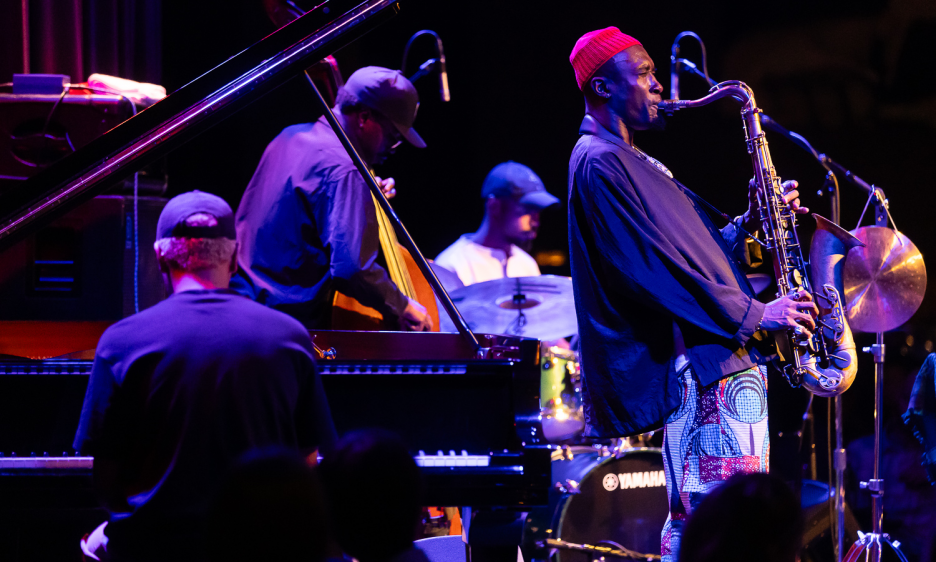
Courtesy Lisa Hagen Glynn

Collier to his great credit, can burn brightly, utilizing the entire range of his instrument--and a few notches more in altimssimo. He can play with a rare intensity, but he can also summon the romantic elements of Coltrane's love for ballads and his impeccable way of presenting them.
Jazz Alley
Seattle, WA
September 29, 2026
The final wave of Coltrane 100 performances are rolling in, after the year-long blitz of celebrating his genius and legacy. Chicago-born tenor master Isaiah Collier landed at Seattle's renowned Jazz Alley this week, his first two-nighter there after a few years of attempting to do just that. His patience and our waiting proved to be worth the trouble on opening night-with the foursome delivering a scorching two-hour-plus set that closed to a vibrant standing ovation. With a sizable crowd in the spacious 400-seat room, Collier's appearance seemed long overdue, he having last appeared in Seattle in April, 2025 at the Black and Tan Hall in Hillman City courtesy of Earshot Jazz Festival. His Jazz Alley hit put him front and center with the mainstream Seattle jazz audience, represented by both young and older patrons perhaps more influenced by the Coltrane attachment than to Collier himself. By the end of the evening, that had changed, with those previously unaware of the saxophonist's powerful approach, now well informed. Collier learned first-hand of the crowd's deep appreciation for the quartet's efforts, seemingly shaking hands and connecting verbally with each and every audience member. "This is a town where riders thank the bus driver while departing," someone quipped in witnessing the beautiful sight of a grateful crowd deeply moved by what had just taken place.
For those in the know, Collier's deep attachment to the Coltrane sound didn't come as a surprise. With masters such as Joe Lovano, Melissa Aldana, and naturally, Ravi Coltrane, on tour bearing the Coltrane 100 mark, Collier may in fact be the most suitable of the lot to do the same. His fire, his grace, his actual saxophone sound is reminiscent of the master, no doubt, yet it has its layers of originality that on this evening dismissed any notion of tribute. His sound, his approach, embraced the spirit of creativity Coltrane lived on a daily basis, teaming up with a trio of musicians who had gained the same understanding. The foursome never "covered" any tune, they simply played being moved by the spirit and legacy with which they were now fully engaged. Beginning with "One Down, One Up" from an obscure Coltrane EP titled, Dear Old Stockholm (Impulse, 1993), the band came out swinging, driven by fleet drummer Tim Regis and bassist Conway Campbell Jr.. Collier from the start was using the entire range of his instrument in rapid-fire brilliance, including a stunning mastery of the altissimo range. Pianist Davis Whitfield quietly set the pace, comping sparsely and sometimes not at all, leaving Collier in a trio, and eventually a one-on-one with drummer Regis. His solo work was fluid, seemingly moving the direction of the music at will. With Collier's choice of an opener, and the ability of the band to swing in a flexible harmonic framework, the house knew this was not to be a straight tribute gig. The cats came to play, and they did just that. Not only that, but of all the Coltrane 100 gigs that have gone down in Seattle and elsewhere, this one seemed to have the potential to be the most fun. The band had been on the road for a full year performing, and still they found ways to create, to innovate and still deliver the message of Coltrane's legacy.
"Inchworm" has always seemed a curious choice for Coltrane, a Frank Loesser tune that became a classic from the film Hans Christian Andersen, and star Danny Kaye. As a jazz improvisation vehicle, the bouncy tune lends a recognizable, simple theme that melodically dances like an upward looking chant. The Collier-led quartet treated it much the same as the classic Coltrane foursome, with solos beginning innocently enough, then rising to the heights of soaring, atmospheric sounds burning with intensity. This early in the set, the room felt about to lift off, the recognizable theme providing immediate focus for an audience buckling-up for what would be a two-hour journey.
Next, the quartet blew through a medley that started with the classic ballad, "Central Park West," then building intensity through "But Not For Me," before leaving orbit with "Giant Steps." Both Collier and Whitfield tore through the changes of "Steps," with each chorus gracing the almost notorious chord changes with long, flowing lines that seemed to ignore the complexity of the harmony in favor of melodic invention. It would be a solid assumption to believe that at this point of the set, Regis may have seemed to be the key to the whole continuum of the band. Coltrane's music, no matter how adventurous, had the key element of swing—not always as a groove, often as a current that moves everything in the same direction. That quality of the quartet allowed them to be purely interpretive in an original way. The band's foray into "Spiritual" seemed to lure all of the players' individual traits into a deeply spiritual, highly collective, engagement of sound as a whole entity.
Collier's sound crept eerily close to that of Coltrane, yet it wasn't long before his own sound rose to the surface. It is clear that on this tour, the tenorist is exercising in the music and sounds that inspired him to get to the point where he could even think of having that ever-elusive original sound every player seeks. From the intro of the tune that included a beautiful bowed contribution from Campbell, Collier's keen attention to the master's attributes were a huge factor, as was another factor each shares. Collier is from Chicago, a city that, like Coltrane's Philly, is deeply engaged with the blues. Collier's long tones between rapid-fire runs sound like anguished cries; his long solo on "Spiritual" sang like a mantra of spiritual healing.
Getting back to Coltrane's actual sound, it is interesting to note that the closest the performance came to the quartet sounding like their predecessors from 60 years past, was in playing ballads. Collier to his great credit, can burn brightly, utilizing the entire range of his instrument—and a few notches more in altimssimo. He can play with a rare intensity, but he can also summon the romantic elements of Coltrane's love for ballads and his impeccable way of presenting them.
Now two hours in at a venue that generally hosts a 90-minute set including encore, one would not suppose that the evening would end with a ballad. Collier, glancing towards the sound board, announced they would play one more, this time digging into another of Coltrane's explorations of familiar film scores, "My Favorite Things." The tune was a giant 1961 hit for the master, one that on record brought his sound into the homes of many who would otherwise never engage it. Performed on soprano saxophone by Coltrane, Collier stuck to tenor for his attempt, introducing the melody in that tonal range note by note before ascending to melodic heavens beyond. Whitfield's solo work included a powerful chordal attack somewhat reminiscent of McCoy Tyner's work on the tune, though comps aside, offered his own unique use of harmony supporting his single-note runs as well as those of Collier. Bassist Campbell, who performed all evening with subtle nuance gained within a definite guiding groove, seemed to have the quartet in tow and in step with Regis' stellar playing. It all was working, the room absolutely exploding in applause with the final note.
With the crowd exiting into the Tuesday rainy night each offered their thanks and gratitude. A smiling and clearly touched Collier accepted their greetings graciously. Those that are dedicated Coltrane believers, whether they well knew Collier or not, walked out not only satisfied, but thankful for the fact that this marvelous quartet did not play in disguise as Coltrane Quartet tributers or impersonators. They were purely themselves approaching not just the music, but the spirit of Coltrane 100 years after his birth.
About Isaiah Collier

Tags
PREVIOUS / NEXT
Isaiah Collier Concerts
Become a Sustaining Member

Since 1995, All About Jazz has championed jazz as an art form and supported the musicians who create it. Over three decades, it has grown into one of the world's leading jazz resources, serving hundreds of thousands of readers, musicians, presenters and industry professionals each month.
Help Build the Future of All About Jazz
Your support helps us continue building All About Jazz for the next generation—expanding our editorial coverage, preserving jazz history, developing new community features and creating better ways to discover the music and the people behind it.
Become a sustaining member for as little as $20 per year and you'll immediately enjoy an ad-free experience along with access to subscriber features and future articles for a full year.
Together, we're not simply sustaining All About Jazz—we're building its future. Thank you for being part of the journey.