Home » Jazz Articles » Live Review » Gregory Porter and China Moses at JAZZMI 2026: Two Voice...
Gregory Porter and China Moses at JAZZMI 2026: Two Voices, Two Musical Worlds
Courtesy Giovanni Guadalupi
Singing is about more than technical ability: it is about finding an individual voice and using it to communicate something meaningful.
Alcatraz and Teatro della Triennale
Milan, Italy
October 19 to November 8, 2026
Now in its eleventh edition, JAZZMI has become an important fixture on Milan's cultural calendar, bringing the city to life each autumn with an ambitious program of jazz concerts, original productions and special projects. Running from October 19 to November 8, 2026, JAZZMI once again brought together internationally acclaimed artists, established Italian musicians and emerging talents, transforming theaters, clubs and cultural spaces across the city into meeting points for different musical languages.
With its openness to experimentation and its ability to connect jazz traditions with contemporary sounds, JAZZMI continues to reflect the vitality and evolving nature of the genre. This year's program also paid tribute to the centenaries of Miles Davis and John Coltrane, two figures whose influence continues to shape the music.
Gregory Porter
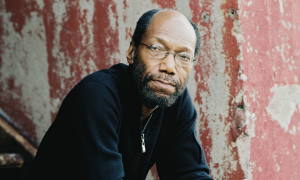
Against this broad musical backdrop, two consecutive evenings offered contrasting perspectives on the art of jazz singing. On November 3, Gregory Porter performed at Alcatraz, and was followed the next evening by China Moses at Teatro della Triennale. Both artists draw on the rich legacy of African American music, particularly jazz, soul and blues, but approach the stage with distinctly different sensibilities. Porter favors restraint and emotional precision; Moses embraces spontaneity, personal storytelling and a more expansive relationship with her audience.Porter possesses one of the most recognizable voices in contemporary jazz. Deep, warm and resonant, his baritone combines the intimacy of a seasoned crooner with the spiritual intensity of gospel. At Alcatraz, he delivered a performance that felt surprisingly intimate despite the scale of the venue, holding the audience's attention through the sheer expressive power of his voice.
Porter's strength lies in knowing precisely how much a song needs. Rather than relying on vocal acrobatics or unnecessary displays of virtuosity, he builds his interpretations through subtle dynamic shifts, impeccable timing and an instinctive understanding of phrasing. Every note seems considered, yet nothing feels calculated. His delivery is controlled without ever diminishing its emotional impact.
The repertoire moved between social commentary and more personal reflections. "On My Way to Harlem" and "Musical Genocide" highlighted his commitment to preserving African American musical heritage. The latter, in particular, carries a pointed message about the dangers of commercial homogenization and the gradual erosion of traditions that have shaped generations of musicians.
On the more intimate side, "Hey Laura," "No Love Dying" and "Real Good Hands" brought out his natural affinity for the great American crooner tradition. These are passing references, however: Porter has developed a musical identity that is entirely his own.
The atmosphere became more animated with "Liquid Spirit," "Revival Song" and "Don't Lose Your Steam," where gospel-inflected rhythms encouraged the audience to participate. In one particularly effective moment, Porter divided the crowd into women and men, inviting each group to respond in turn and turning the venue into an impromptu choir. It was a simple but engaging demonstration of his ability to bring an audience into the music.
His approach is rooted in a tradition where melody, storytelling and emotional communication take precedence. The social consciousness evident in *Take Me to the Alley*, with its themes of marginalization, compassion and solidarity, is an integral part of his artistic identity. For Porter, music is not simply entertainment; it is also a means of preserving cultural memory and giving a voice to experiences that might otherwise go unheard.
The musicians accompanying Porter also deserve special recognition: Chip Crawford on piano, Emanuel Harrold on drums, Jahmal Nichols on bass, Tivon Pennicott on saxophone and Ondrej Pivec on Hammond organ. Each brought a distinctive voice to the ensemble, contributing to a musical dialogue that was as sensitive as it was compelling.
Crawford's piano, Pennicott's expressive saxophone and Pivec's rich Hammond textures added color and depth to the arrangements, while Harrold and Nichols provided a supple, deeply rooted rhythmic foundation. Their collective musicianship and natural interplay created the ideal setting for Porter's voice, moving seamlessly between intimate ballads and gospel-inflected grooves. It was a cohesive and accomplished ensemble, whose contribution went well beyond simply accompanying the singer.
Throughout the evening, he demonstrated that the power of a great singer is not measured by vocal range or technical display, but by the ability to make every phrase meaningful. His performance was a compelling reminder that restraint, in the right hands, can be as powerful as exuberance.
China Moses
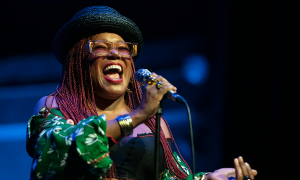
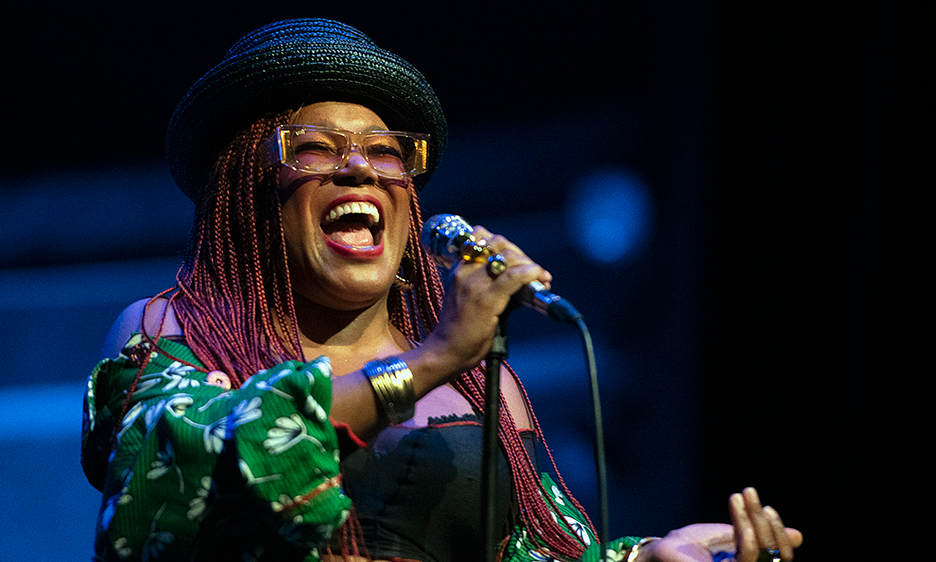
The following evening, China Moses brought a very different kind of energy to Teatro della Triennale. With a commanding stage presence, a generous personality and a natural inclination toward audience interaction, she is central to her performances. With more than 800 shows behind her, she is clearly an experienced performer who knows how to hold a stage and create an immediate connection with the people in front of her.Throughout the evening, Moses invited the audience into her world, weaving personal reflections and anecdotes between songs. Her words touched on racism, music's ability to transcend barriers, the loss of a friend to cancer and the end of an important relationship. These were sincere and often moving moments, offering insight into the experiences and emotions that inform her artistic identity.
Her willingness to share such personal stories gave the concert an intimate, almost confessional dimension, even if, at times, the extended conversations slightly altered its musical pace. A more concise approach might have allowed the songs to flow more continuously, but this openness is also part of what makes her such an engaging and individual performer.
It was through the music that Moses revealed some of her most compelling qualities. Her ability to move between soul, blues and jazz demonstrated a genuine affinity for these traditions, bringing them together with instinct, freedom and a strong sense of groove. The blues, in particular, seemed to offer her a natural language for expressing deeper emotions, transforming personal experiences into musical expression.
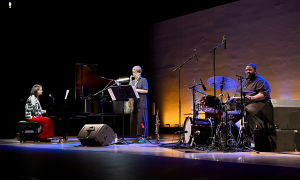
"French Blues" was a particular highlight. Beginning as an intimate duo with guitarist Jerome Cornelis, the song gradually expanded to include the full band: Insxght on keyboards, Immanuel Simelane on bass and Lox on drums. The transition brought a welcome shift in intensity, revealing the musicians' chemistry and Moses's ability to shape a performance through attentive interplay.
Her vocal command was equally impressive. Moving effortlessly between different tonal colors, she displayed considerable range and control, while one of her most interesting qualities was her instinct for musical counterpoint. Rather than simply placing her voice above the accompaniment, she often engaged directly with the instruments, responding to their phrases and creating spontaneous exchanges. Her interactions with the musicians, sometimes playful and unguarded, brought a welcome sense of spontaneity to the performance.
Moses is an artist who clearly gives everything to a performance. Her emotional openness, generosity and determination to involve the audience remained evident throughout, right through the numerous encores. The concert revealed a singer with a strong individual identity, an expressive voice and a sophisticated understanding of the musical languages she inhabits.
While a slightly different balance between conversation and music might have given the performance greater continuity, her personality and musical instinct made for an engaging and often rewarding evening.
Porter and Moses offered two contrasting interpretations of the jazz vocalist's role. Porter builds his performances around the eloquence of restraint, allowing his baritone and carefully shaped phrasing to communicate with remarkable economy. Moses takes a more expansive route, combining musical expression with personal storytelling and direct engagement with her audience.
Their approaches may differ, but both are connected to the enduring traditions of jazz, soul and blues, and to the expressive heritage of African American music. Both also demonstrate that singing is about more than technical ability: it is about finding an individual voice and using it to communicate something meaningful.
Porter finds eloquence in a perfectly placed note; Moses in the freedom to move between music and personal experience. One leaves space for the music to speak, while the other invites the audience into the stories behind it. Two different sensibilities, each offering its own perspective on the enduring power of the human voice.
 FOLLOW Giovanni Guadalupi
and get notified whenever a new article published.
Photographing is a way of living and perceiving oneself and others.
About China Moses

Tags
PREVIOUS / NEXT
China Moses Concerts

Become a Sustaining Member

Since 1995, All About Jazz has championed jazz as an art form and supported the musicians who create it. Over three decades, it has grown into one of the world's leading jazz resources, serving hundreds of thousands of readers, musicians, presenters and industry professionals each month.
Help Build the Future of All About Jazz
Your support helps us continue building All About Jazz for the next generation—expanding our editorial coverage, preserving jazz history, developing new community features and creating better ways to discover the music and the people behind it.
Become a sustaining member for as little as $20 per year and you'll immediately enjoy an ad-free experience along with access to subscriber features and future articles for a full year.
Together, we're not simply sustaining All About Jazz—we're building its future. Thank you for being part of the journey.