Home » Jazz Articles » Album Review » Stanley Cowell Trio: Illusion Suite
Stanley Cowell Trio: Illusion Suite
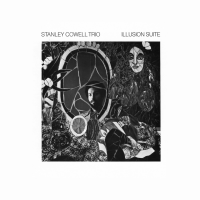
By this session on November 29, 1972, Cowell had cofounded Strata-East Records with his frequent collaborator, trumpeter Charles Tolliver (see article), released two albums as a leader and recorded as a sideman with Bobby Hutcherson, Marion Brown and Max Roach. Illusion Suite is a glorious one-off, Cowell's only recording for ECM. While his style may seem distinct from the mature label's penchant for icy ambiance, it fits in well with its considerably knottier early fare. While the six songs are presented as separate tracks, new liner notes by pianist Ethan Iverson make the case that "suite" was meant literally: when two of its songs were re-recorded later, they appeared with "(Illusion Suite)" appended to their titles. Iverson also suggests that the "illusion" here may reflect the sleight-of-hand use of modern studio overdubbing, with Clarke sometimes layering an acoustic bass part on top of an electric Fender and the leader freely moving between acoustic piano, Fender Rhodes and African thumb piano.
Opener "Maimoun" (which, along with the later "Miss Viki," references actress Viki-Maimoun McLaughlin, Cowell's romantic partner), is a beautiful, flowing modal piece that opens with a John Coltrane-esque octave fanfare, soon followed by Clarke's electric bass pulse, overdubbed high-register arco double-bass, and Hopps' graceful rimshot swing. As Cowell begins his solo, the electric bass drops out and Clarke picks up the groove on his acoustic instrument. Several minutes of gorgeous interplay fly by until an overdubbed triangle heralds Clarke's bass solo, under which Cowell adds quiet acoustic and electric piano figures and zither-like string brushes before the arco bass returns for a reprise of the opening. New York poet Ibn Mukhtarr Mustapha is the titular inspiration for the next tune, which begins with two-handed pentatonic runs up and down the grand piano accompanied by Clarke's fluttering double-bass. As Hopps lays down a killer Afro-Cuban groove, Cowell switches to the Rhodes for a rhythmic solo that ends with a vamp in 6/8 that is picked up by Clarke as Cowell grabs his thumb piano and Hopps engages in some wonderful tom work. "Cal Massey," a minor blues referencing the Philadelphia trumpeter and composer, exhibits Cowell's concept of "radial symmetry" in which the two hands move in mirror image to each other from a central starting point. This produces a thrilling, thorny thicket of sound. Hopps has a chance to shine here, soloing over Clarke's sparse bass interjections in a way that recalls Cowell's main theme, with China-cymbal punctuation.
The aforementioned "Miss Viki" is a rather loose funk track reminiscent of the grooves on Miles Davis's contemporaneous recordings such as On The Corner (Columbia Records, 1972) and Get Up With It (Columbia Records, 1974). Hopps may not be entirely at home here, as his playing is at times awkward and slightly out of sync; then again, the chaotic feel may be an intentional accompaniment to Cowell's acoustic piano scrabbles and overdubbed wah-wah Rhodes. The expansive "Emil Dannenberg," referencing Cowell's classical piano teacher at Oberlin Conservatory, recalls the dramatic discords of Bartók, if they were played, that is, by Thelonious Monk or Bud Powell. Hopps focuses on using his hi-hat pedal orchestrally, interjecting snare flourishes with his brushes and never quite settling comfortably into a groove. It somehow all hangs together miraculously. The album closes with the aptly-named "Astral Spiritual," the loveliest composition here. The song feels suspended in space, shifting between dreamy modal work similar to Pharoah Sanders's sound world and some thrillingly free playing by the trio. Clarke is in constant motion, and his sympathetic bass runs combine with Hopps' free playing to send the track into the stratosphere.
This welcome Luminessence reissue of Illusion Suite makes a strong case for Cowell's talent as a player and composer, provides an early example of Clarke's bass mastery, and exemplifies ECM's commitment to adventurous jazz music.
 FOLLOW Joshua Weiner
and get notified whenever a new article published.
Joshua Weiner enjoys his day job as a professor and dean but wishes it left more time for music.
Track Listing
Maimoun; Ibn Mukhtarr Mustapha; Cal Massey; Miss Viki; Emil Danenberg; Astral Spiritual
Personnel


Album information
Title: Illusion Suite | Year Released: 1973 | Record Label: ECM Records
PREVIOUS / NEXT


About Stanley Cowell Trio
Tags
Become a Sustaining Member

Since 1995, All About Jazz has championed jazz as an art form and supported the musicians who create it. Over three decades, it has grown into one of the world's leading jazz resources, serving hundreds of thousands of readers, musicians, presenters and industry professionals each month.
Help Build the Future of All About Jazz
Your support helps us continue building All About Jazz for the next generation—expanding our editorial coverage, preserving jazz history, developing new community features and creating better ways to discover the music and the people behind it.
Become a sustaining member for as little as $20 per year and you'll immediately enjoy an ad-free experience along with access to subscriber features and future articles for a full year.
Together, we're not simply sustaining All About Jazz—we're building its future. Thank you for being part of the journey.