Home » Jazz Articles » Interview » Bill Bruford And Pete Roth: A One-Of-A-Kind Juxtaposition
Bill Bruford And Pete Roth: A One-Of-A-Kind Juxtaposition

Courtesy Rob Blackham
Sometimes people talk about things falling apart, like a house of cards, and everything goes wrong. I think in this case, a whole pack of cards came together, built a card house, and everything went right.
—Bill Bruford
Much celebrated for his integral and stylized drum contributions to progressive rock bands such as Yes, King Crimson, U.K., and Genesis, as well as for leading his own jazz/rock and jazz ensembles, Bruford and Earthworks, Bruford seemed to have brought an impressive 41-year career to something of an unanticipated conclusion (he was only 60 at the time).
And unlike many other well-known figures, as time went on, Bruford's retirement seemed permanent. He dove into academia, obtained a degree, wrote papers and books, and even (gulp) started selling off his drums. By all accounts, it seemed we had indeed heard Mr. Bruford's last ringing snare hit.
Then, without preface or warning, Bruford came out of retirement in 2022, not for a reunion with any of his iconic former musical colleagues, but to play in a jazz trio led by a little-known, German-born guitarist named Pete Roth.
The questions did abound. Chief among them, who was this guitarist, several decades Bruford's junior? And why does a drum legend come out of retirement to be a member of The Pete Roth Trio?
Messrs. Roth and Bruford would likely tell you that the most complete answers to those questions lie in the Pete Roth Trio's new CD/DVD release, Group Chat (Cherry Red Records, 2026), but thankfully, they both sat down with All About Jazz for a conversation anyway. Our interview took place via Zoom in September 2026.
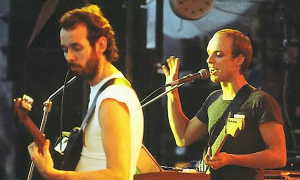
[Note: Bassist Mike Pratt (pictured on the left) was unable to be included in our interview due to scheduling difficulties.]
All About Jazz: Pete, as you are much less of a known quantity than Bill, could you start by talking a bit about your musical origins and upbringing?
Pete Roth: Well, just to be upfront, it's pretty hard to be a more well-known quantity than Bill...
Bill Bruford: (laughs)
AAJ: Fair enough.
PR: I was born in Germany in the Black Forest—a small town outside Baden-Baden. I grew up in a musical family. My dad was a semi-professional whose main instrument was piano, and he played all his life. My grandparents were also both musicians, so there was always music around growing up. I played in the town orchestra when I was 13 or 14. They had some big band-type material, which was great. I got experience reading music, playing with a conductor, and just being in the room with other musicians, which was great.
AAJ: When did you start performing with your own groups?
PR: At age 11. Almost immediately, really. We had a practice room in the cellar where my dad rehearsed with his band. There was an organ and drums and amps and basses all set up down there. It was beautiful. My mates would come over, and we would all just pick something up. In the end, we all formed a band. And then broke up. That happened about fifteen times (laughs), but we would play and write music. Probably half of my fondest memories come from those moments where we would jam on a single chord for four hours, just trying to make some sense of it.
At about 17 or 18, I took some private lessons for the first time. I had played quite a bit by that time, but that set me off on a much straighter path when it came to music. From that teacher, I got a lot of great suggestions and listening recommendations that put me further into what became my love for jazz and improvised music. That, in turn, led me to study in England and then, of course, meeting Bill.
AAJ: How did meeting Bill come about?
PR: When I moved to England, I studied to obtain a degree in music, and Bill was a lecturer where I was studying. At one point, Bill was looking for a drum tech, and I managed to clear the extremely high bar that Bill set when he asked, "Can you be on time?"
BB: Basically, all we needed was punctuality. (laughs)
PR: (laughs) In Germany, I was average when it came to punctuality. In England, I excelled.
BB: He had never set up a drum kit before. I don't think he even knew what a drum kit was...
PR: I was awful [as a drum tech]. Two years of Bill having to reshuffle his drum kit every time I set it up. (laughs) I still have visions of him moving his kit around.
AAJ: Was this during a period with Earthworks?
BB: It was. I was hiring for an Earthworks UK tour. I think Pete got his introduction to the music business, in all its glory and ugliness as well, on that particular tour. But we learned together. I learned about Pete, and he learned about me.
AAJ: Soon after that, you retired, Bill. I know you have talked about this before at length, but could you remind us what your reasons for retiring were?
BB: Well, the simplest one was burnout. I didn't go crazy; they didn't take me off to the funny farm, or anything. I was just very, very tired. Not a tiredness like you needed to go to bed. It was a tiredness to the tips of your toes—and you can't stand the thought of one more phone call.
It suffices to say, I had just had enough, and I had to get away from public performance. It was public performance that was tiring me out. There is, of course, a logistical reason for that. It takes longer and longer these days to get anywhere. You know, getting a band to Madrid for a one-nighter from the UK—when everyone else in the band is playing the night before in different locations... It can be tricky. As a band leader, it's, "Will the band be there? What if the bassist doesn't show? What are you going to do?" I took all that stuff too much to heart, I suppose, and I was very tired.
So there came a perfect time—my 60th year, in 2009—when I decided to do something parallel to performance. Not [to engage in] performance itself, but I wanted to look at it and study the psychology of performance. So I wrote a book on creativity and performance (Uncharted: Creativity and the Expert Drummer, University of Michigan Press, 2018), as an academic.
AAJ: So, basically your fatigue stemmed not from playing per se, but from being a bandleader.
BB: Very much so. As Robert Fripp will tell you, we all play much better as sidemen than as leaders. If you could be a sideman in your own band, that would be terrific. It's just that a lot of other things are going on in your brain when you're leading. I admire guys who do it effortlessly, but me, I don't find it so effortless. I can do it, and I can do it for a long time, but I will be tired at the end of it.
So, yeah, I took a break. The closest thing to it was studying it, so I made an academic study of lots of expert drummers, such as Peter Erskine, Cindy Blackman Santana, Mark Guiliana, and other great people. And being privileged enough to be counted among that group of people, I was able to get access to them.
AAJ: So what was the catalyst for stepping out of retirement?
BB: Well, after five years or so, I had a PhD after my name, and that was cool. And for another five to seven years, I did essentially pro bono academic work—which is tough lifting. Whether you're writing a chapter for The Cambridge Companion to Percussion or "The Cultural Psychology of the Drum Kit," like I did, after seven years, it's going to hurt a little bit.
So after twelve years of this in all, I had been just kind of mulling around the drum set in my office. Every night I would wish it a good night as I turned out the light and went to bed. And every morning I would turn the light on and say, "Hello" to it, but never touched it. As these years rolled past, I eventually tired of academia. Then one day, I had this blinding determination that I absolutely had to pick up the sticks and play. I knew it would be a long slog, and it did take a couple of years to get back in shape, for sure. There are some fine motor functions that get rusty if you don't use them.
So it took a while to get back up to speed. Fortunately, Pete was very handy and close—and he was available. Suddenly a rehearsal room turned up, and we had a place we could play, and there was a really nice bassist named Mike Pratt, who's currently in the band.
Sometimes people talk about things falling apart, like a house of cards, and everything goes wrong. I think in this case, a whole pack of cards came together, built a card house, and everything went right. It all felt a bit like that. From my headspace, I saw all these things and wanted to avail myself of them before Pete decided I wasn't good enough for his band. (laughs)
PR: Yeah, that'll be the day. (laughs)
AAJ: So, just curious, but coming back into it after all those years, did you find anything from your academic experience informing your playing?
BB: (Sighs) Ooh, I couldn't point to that. I mean, everything informs my playing. I'm the person I am, and the person I am is partly a result of playing with Pete, partly the way I hold the drumsticks, and partly a result of knowing what Cindy Blackman Santana thinks. It's that kind of thing, and it's all part of me.
So what you get when you turn up and listen to the Pete Roth Trio, the guy on drums is just the sum of his parts. It's a thousand small decisions over many years as to what to play and when. That's what makes you the player you are. Pete's in that same process, and we're all in that same process. And hopefully, in my case, I'd like to become more and more "Bill" as time rolls on.
So eventually, you're sitting next to Max Roach or Roy Haynes, and they just are Max or Roy. They couldn't be anybody else, and it's as a result of all the decisions they've made over so many years.
AAJ: Pete, it's fair to say that Bill is a pretty good catch as a drummer. I take it that you jumped at the chance of having him in your group?
PR: You could say that. (laughs) [Bill and I] met at a great time. There was a beauty in Bill's last Earthworks phase. That band was terrific, absolutely amazing. I was so lucky; it was just in that time when the two [last incarnations of Earthworks] bands switched over. There was Steve Hamilton on piano, Mark Hodgson on bass, and then they went over to Gwilym Simcock and Laurence Cottle. Tim Garland was on sax in both bands. It was just a whole host of amazing musicians, and Bill, of course, was in the middle of all of this. So, [when it came our time to play together], I was under no illusions that Bill could handle the sticks properly. (laughs)
BB: (To Roth) But I don't think either of us would have known then that, twenty-five years later, we would be in a band together—with me calling you the boss.
PR: (laughs) All of that is true, but what a joy. It's amazing. But first off, Bill, you say you don't know how the years of academic study have informed your playing. I think, from all I know about you, you have an inquisitive mind, and you are by default a natural teacher, so every day we step into the band room, we learn so much from each other. There's so much knowledge that comes my way, for sure, whether it's musical, or about business, or conceptual. I love it, and it's a real privilege and pleasure.
BB: Something else [about coming back from retirement] that I should point out. When I stopped, everything was pretty much still analog. When I came back into the kitchen, everything was digital, and I had no idea. I mean, obviously I had recorded digitally, but I had no idea what YouTube was. It was fantastic to have access to all these brilliant musicians and bands. It was very exciting. But the speed at which the industry moved was now twice as fast as when I left. So you need to have somebody who is under 25 in the band—like Pete—who can work the digital end. That's the thing. (laughs)
AAJ: And is that something you excel at, Pete?
PR: Oh, I love it. I love technology, no question. I have children as well, so I get constant updates. Every six months they want me to upgrade. (laughs) To be fair, Bill, you are pretty "switched on," but there's a lot going on now. You blink and you've missed it.
BB: Pete and I have just signed up for a distribution deal for Group Chat, and we were sent the record company's "protocol for social media." Now, I'm all for a protocol for social media, but this is fifty pages long, and it goes on and on about what the musicians—us—are obliged to do.
It used to be, in my day, the musicians were obliged to just play the instruments and shut up. That was the best thing you could do then. Now you have to spend 80% of the hours of your day doing the ugly job of self-promotion, because everyone's hunting for a pair of ears to listen.
AAJ: Pete, when you released the first two albums under your own name, you were working with a larger group, yes?
PR: Not much larger, one a quartet and one a quartet with an added percussionist. One was saxophone-led, and one was two guitars, with Nicolas Meier and me.
AAJ: What I'm getting at is that there is sometimes a big difference between being in or leading a trio versus a quartet, even in just carrying the harmonic and melodic load. Bill, I don't recall you ever playing in the trio format previously.
BB: It never really occurred to me, but you're right. I have never played in a trio before. [In this trio] we are very intimate and very close as musicians. We like to be physically close on stage.
We also deliberately play small places. The music works better in places with three or four hundred seats. Beyond that, it gets very difficult to expect people to enjoy very intimate music. We also ask the lighting guy to throw a little light on the audience so we can see them reacting to the music. It's the exact opposite of stadium rock, and that makes me happy.
A lot of [the music] is quite loose and can go in a number of different directions. And the drum kit, being a very powerful instrument, can be a key determining factor in what is going to happen. I can stop the music dead, pretty much. I can halve its volume immediately by silencing myself.
The drums are very strong in the formation of the particular piece of music we're working on, and I love that. Coming from a bigger, more composed thing—like, say, King Crimson, or something like that—it affords me a lot of freedom. The assumption is that if I stop playing, then the other two guys will have a lovely time playing without me, and they will continue and finish the composition in a different, but interesting way.
AAJ: Do you find that the space afforded by the trio format inherently coaxes a more melodic role from the drums?
PR: But Bill is such a melodic drummer anyway. And he and I have talked about this many times, but Bill's melodic sense on the drums is so much higher than anyone else I have played with. Many times I have played with drummers who are thinking about ways that they can make the rhythm as interesting as possible. And that's great. They think about rhythm as having to do with how deep the pocket is and how everything sits on everything. That in itself becomes a mantra for some.
What I feed off when I play with Bill is exactly that melodic sense he has—that idea of speaking a phrase that has a dynamic, a sensitivity. It's a kind of speech that pulls you in or delivers something big. Bill does that all the time, and that's something very different from most drummers I've played with.
AAJ: Well, there are certainly multiple avenues of melodicism in your trio, as evidenced on the new live release, Group Chat. There are even several sections in the audio where it is unclear who is soloing and who is comping, the guitar or the bass.
BB: Oh, good. I'm so glad you were slightly confused by that. It's one of our secret weapons. We have a lovely second soloist in bassist Mike Pratt, and he has a wonderful array of sounds which can afford him a great melodic place in the music.
AAJ: I'd like to ask about another stand-out on Group Chat—namely "Improvisation on the Largo from Dvořák's Symphony #9." It's a brilliant track, extrapolated from decidedly unusual source material. It begs asking about the band's process for choosing material and your game plan for approaching pieces like that.
PR: Well, it's a mixed bag. The Dvořák piece Bill brought along and said, "Why don't we do something where we arrive somewhere at the end of a piece, but we do not agree on who starts it or how we get there." We don't have a key or a time signature, but we do have the source material. There's a bit of melody and some harmony that goes with it, and those are our building blocks; that's the sand pit. We're not allowed to move out of that sand pit, but you can get to the edge and bring a toy or two into it. So by the end, the idea is to hopefully arrive majestically into this very beautiful melody of the Largo. That's the concept, and with that particular piece, every single night it is different.
BB: The idea there is that we know where we are going, but the listener doesn't. So there are a number of ways we can handle material and work together, and I think one of the great pleasures of this group is finding those ways that not everyone else is doing. Look, we're not reinventing the wheel here, but I think we have a little corner that is somewhere between progressive rock, jazz, and improv that we are busily trying to make our own.
AAJ: Well, that was another thing about Group Chat and the other videos of the band out there—just how loose everything is—and that's meant in a good way. In light of much of Bill's musical history being rather regimented, compositionally—being in bands like Yes, King Crimson and Genesis—it's refreshing to hear the three of you come together in something that is, by design, so rather loose and free.
PR: Well, I think you have hit the nail on the head there. A lot of the conversations when we formed the band were centered around what we would not do. There was no point in doing this again. There was no point in doing things that even in our own language have become like throwaway phrases. It was always about being loose; it was always about being fresh.
BB: It has to do with interaction. One of the great nightmares of progressive rock was this thing about doing the same thing every night. With Genesis, you had this feeling that if I, the drummer, fell off the stage and died, nobody would notice. You had that feeling. Now, of course, they would have noticed, and they are very sweet guys and all, but you were standing forty-five meters away from the next guy in a 20,000-seat room. You just felt like if you stopped playing, no one would notice, and I didn't care for that feeling. Whereas in PRT, everybody is going to notice and change if I don't play—and I like that, for sure. You say something, I say something—and the way you say it is really important.
AAJ: Do each of you bring in compositions that are designed to be "loosened" or even deconstructed by the group?
PR: Apart from the Dvořák piece, there are only three compositions on the record that aren't group compositions: "Dancing With Grace," "Summertime," and "Original Sin." All the others were written collectively. I'm in this fortunate position in this band where it can be like it was when I was 12, playing with my mates. We can sit around in a rehearsal room and say, "What happens if we play this chord, or that chord?"
I haven't played in another band like this, and I haven't written for another band like this. [In this group] I am contributing, but contributing as a reaction to everyone else. Somebody might give a stipulation, "Hey, why don't you think differently about this?" or "Forget about your jazz background and just think sonically." Suddenly I'm off on a journey on really thin ground, and I have to dig deep. I love that. It's a wonderful challenge, and I think it is the only way a group like this can happen—leaving ego aside and having everything that comes out being a [communal] result.
It's quite different from what I used to do. You had a bunch of session musicians coming in, your sheet music is prepared. You're up until 2 AM making sure everything is printed out and marked up correctly. You explain to everyone how you want it so they can somehow interpret what's in your head. We don't do any of that. And I don't think there is any other way we could achieve something so unique.
AAJ: So would it be anathema for PRT to do a studio album?
PR: At least concerning this particular set of music we've written, it really is best live. You need an audience; you need reaction and interaction. You need a vibe. And it's supposed to be rough; it's supposed to be edgy—because that's where the fun is.
AAJ: Were the tracks on Group Chat culled from one live performance or several?
PR: They all come from the same block—a small tour we did in Europe over six weeks.
AAJ: Well, if you are amenable to live recording, it is probably the most cost-effective route for musicians these days—short of recording in your bedroom.
BB: Absolutely. The other way is very expensive. It takes a lot longer, and it may not work out as well as one good night in Madrid. I haven't made a studio album since I did The Sound of Surprise (Discipline Global Mobile, 2001) with Earthworks. It's all live these days, and I think that's a great thing, actually.
AAJ: Bill, it sounds fairly evident that you have found coming out of retirement to play in this group... would revitalizing be the proper word?
BB: Oh sure. Playing a musical instrument is a wonderful thing. It definitely keeps the brain sharp. I mean, I'm 108 years old now, so... (laughs) No, it's really good playing in a band. Travel can be a pain, but if that's the only downside, you can count me in.
AAJ: So what lies ahead for the group?
BB: We've got a pretty good schedule ahead of us. There's a tour of Japan in March and another round in Europe. After that, we're going to take a pause and have a think. Maybe do some more composing.
See, when the band was unknown, we were 80 percent music and 20 percent administration. Now, three years later, a lot of people know about us and there are a lot of questions and a lot of stuff. Now it's 20 percent music and 80 percent administration. I'd like to get back to the time when we were in the rehearsal room, figuring it all out again.
AAJ: That said, you are historically one of the few drummers who composes. Short of bringing in existing material, do you see yourself composing again for this group?
BB: No. I like our group process. I'm unlikely to sit at a piano and do an "Original Sin," or "If Summer Had Its Ghosts," or something. I have written quite a lot of music in my day, but I'm not sure all of it was worth it. I've over-written, too, sometimes because I was terrified people wouldn't know what to play. The great art of the jazz composer is to leave enough room for things to happen. Leaving space, leaving things out in composition is really important, and I'm really happy in the environment I'm in now, doing this kind of music.
AAJ: Has this group altered your compositional frame of mind from where it was before, Pete?
PR: The process we have is very democratic. You can bring anything in, but it will get dismissed if it doesn't fit within the framework of the band. I've had plenty of good ideas that would have flown in any other band I've played in, and we played them, but they just didn't make the cut.
But the other thing in this process is that we talk a lot—about concepts—about ideas that are bigger than four bars of the melody and a couple of chords. So that depth is something I don't think that I've had massive thoughts on before.
Previously, I was often writing some things that were maybe technically impressive to stroke my own ego, or try to impress the other musicians in the room. But now, I think I've probably lost a good bit of that.
We serve the music and make a sound that pleases us. We hope somebody else likes it, too, but that's not really why we do it. What comes out is our own sound and because it's so unique and I enjoy it so much, I try not to question it too much because it all seems to work.
 FOLLOW Mike Jacobs
and get notified whenever a new article published.
Mike Jacobs is a serious music addict, writer and a composing/occasionally-performing musician.
About Pete Roth

Tags
PREVIOUS / NEXT


Pete Roth Concerts
Become a Sustaining Member

Since 1995, All About Jazz has championed jazz as an art form and supported the musicians who create it. Over three decades, it has grown into one of the world's leading jazz resources, serving hundreds of thousands of readers, musicians, presenters and industry professionals each month.
Help Build the Future of All About Jazz
Your support helps us continue building All About Jazz for the next generation—expanding our editorial coverage, preserving jazz history, developing new community features and creating better ways to discover the music and the people behind it.
Become a sustaining member for as little as $20 per year and you'll immediately enjoy an ad-free experience along with access to subscriber features and future articles for a full year.
Together, we're not simply sustaining All About Jazz—we're building its future. Thank you for being part of the journey.