Home » Jazz Articles » Interview » Enrico Rava: The Secret Corners of a Master
Enrico Rava: The Secret Corners of a Master
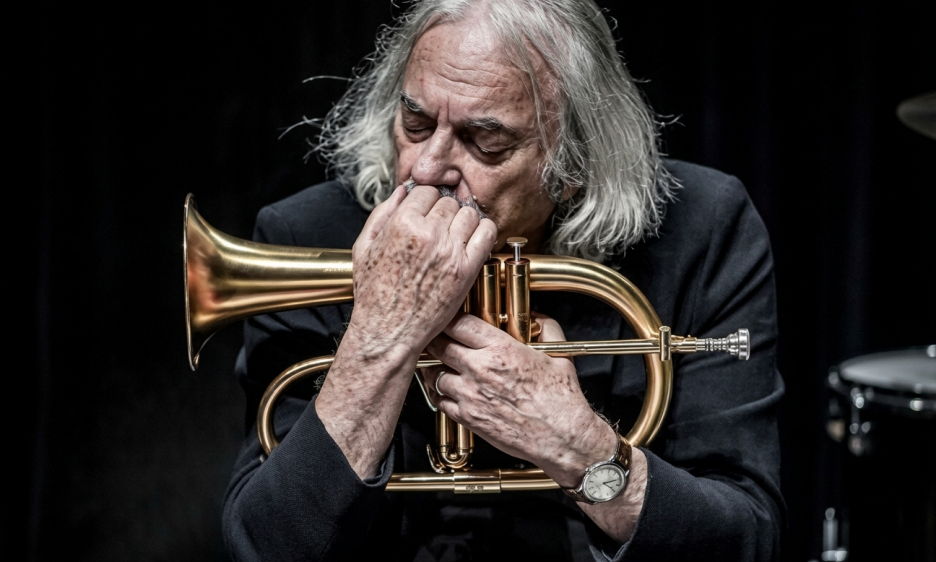
Courtesy Roberto Cifarelli
I’ve always believed in the innocence of the note.
—Enrico Rava
With so many anecdotes, encounters and digressions to draw on, the challenge was not finding topics to discuss, but deciding where to begin and what to leave out. We settled onto a sofa. I pulled vinyl records, CDs and old trumpets out of my bags. From there, the conversation took on a life of its own.
All About Jazz: Let's start with Corners. The album features Joe Lovano, of course, but also contributions from all the members of the Fearless Five, with compositions by individual band members and different musical languages intertwining. How did the album come about, and how did the collaborative approach to writing develop?
Enrico Rava: Last year, I was a guest with Fearless Five at the Bergamo Jazz Festival in Italy, where Joe is the artistic director. He joined us for two or three tunes. We had a great time, and afterward we said to each other, "Why don't we make an album?" That's how it all started.
When Manfred Eicher heard that we were recording, he called me because he was interested in the project. We reached an agreement with Parco della Musica and recorded at their Auditorium, in Rome.
For the occasion, I asked each musician to bring in one of their own compositions, in addition to Joe's pieces and three of mine. As far as I'm concerned, it's quite an unusual album: there are six composers, each with their own world. That makes everything more unpredictable and brings a few surprises, such as the song sung by drummer Evita Polidoro [Ed. note: "Le mie gambe"].
AAJ: That piece made a strong impression on me, not least because it's sung in Italian. What's remarkable is how naturally it fits into the album's musical trajectory.
ER: Of course, because although we're very different, we're still six people who speak the same language. There are differences, but we share the same vision.
AAJ: Another thing that intrigues me is your choice of compositions, particularly two that have appeared on previous recordings: "Certi angoli segreti" and "Bowery Dance." "Hitchcock at the Beach," meanwhile, revisits the title of an older tune, but the music is different.
ER: "Hitchcock at the Beach" was a piece I had written in two parts. For an earlier release that came out with La Repubblica [Ed. note: Jazzitaliano Live 2006], I used the first part. This time, I had the second part in mind, so it's a composition that was never released before. I recorded "Bowery Dance" many years ago for Andanada, with Franco D'Andrea, Pietro Tonolo, Bruno Tommaso and Bruce Ditmas. My wife really likes that composition, and she was the one who asked me to play it with Fearless Five. I had been using it to close our concerts, and it seemed like a good idea to include it on the album because it has a different feel, closer to the blues, amid all those ballads.
AAJ: Speaking of sound, how did the recording session at the Auditorium go?
ER: It was a very relaxed session, although there was a little adrenaline and nervousness at the beginning. We recorded practically live, all together in the Teatro Piccolo hall at the Auditorium, without separate booths, just a few small screens between us.
We had never rehearsed the pieces the other musicians brought in: we read through them and recorded them straight away. Apart from "Certi angoli segreti," for which we did two takes and Manfred chose the second, almost everything came out well on the first try. I preferred to preserve the freshness of the initial performances.
AAJ: How did you settle on the title Corners?
ER: The title I had in mind was + 1, to highlight the addition of Joe Lovano to Fearless Five. That suggestion caused a bit of consternation in Munich, so I said, "Okay, let's call it Corners!" as a nod to the title "Certi angoli segreti" [Ed. note: corners is the English translation of "angoli"].
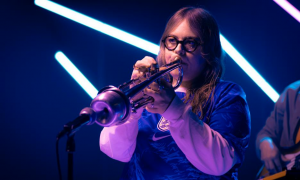
AAJ: Fearless Five features Francesco Diodati on guitar, Francesco Ponticelli on double bass, Matteo Paggi on trombone, and Evita Polidoro on drums and vocals. As happened in the past with Stefano Bollani, Paolo Fresu and other musicians who have played in your groups over the years, they all studied at your summer workshops at Siena Jazz before joining your projects. They were emerging musicians who have since become major names in contemporary jazz. How did this project come about, and why the name Fearless Five?
ER: The name's idea came from my agent, and I liked it a lot. In several interviews, I've said that I consider myself lucky to belong to an environment made up of young people and musicians who devote themselves passionately to their instruments, read books, watch films and cultivate a sense of beauty. In a cultural world often submerged in banality and vulgarity, we are like a little island of happiness. It takes a bit of courage to resist and keep making this music. That's how the idea of "Fearless Five" came about, and I thought it was perfect.
AAJ: Throughout your career, you've set virtuosity aside in favor of simplicity and essentiality. Today you work with young musicians who are exceptionally well prepared, and technically accomplished. Do you ask them to shed some of that virtuosity when you work together, in order to focus on what's essential?
ER: No, everyone should do what feels right to them. Take Matteo Paggi, my trombonist, for example. His technique is astonishing. The only thing I tell him, occasionally, is to be judicious with certain articulations that don't sound particularly jazzy, but that's just a suggestion. Everyone should express their own nature.
AAJ: You've recorded beautiful ballads, and you've also tackled the melodic repertoire of Italian singer-songwriters, bringing out its poetry and making it effective without ever lapsing into banality or sentimentality. Where does that sensitivity come from?
ER: It comes from the music I've always loved listening to. I listened to a great deal of music even before I started playing. I was never interested in virtuosity for its own sake. I liked Ravel, Chet Baker, Miles Davis, Bix Beiderbecke and Louis Armstrong. When I started playing, I tried to play that music.
As a self-taught musician, I did everything backward. I didn't study with a teacher who taught me scales; I learned by playing tunes such as "Solar," "Four," "Tune Up" and "I Can't Get Started." At first, I didn't even know where the notes were on my instrument. I played almost entirely by ear. Since I had no passion for technique for its own sake, I never worked on it. If my idol had been Clifford Brown, perhaps I would have tried to develop that kind of fluidity. But my idols were Miles and Chet, so what interested me was playing a moving melody and working on sound and expression.
AAJ: When you compose and write a melody, how do you approach the writing? Do you already have the group's spaces and improvisational possibilities in mind?
ER: Sometimes, yes. Although I haven't written much for a while now, I used to think about the writing in terms of the group. The thing is, when I compose, I do everything at the piano. And since I'm not a pianist, my compositions are shaped by the fact that I can play just enough piano to get my ideas down. I have a strong melodic sense: I sit at the piano, find a chord and a phrase comes to me, or I start with a rhythm. In the past, when I had to prepare an album, I'd sit down for a couple of days and write five or six pieces specifically for that lineup. But my writing has always been guided by the attempt to realize what I want to hear with the means available to me at the time. I learned on the job, through experience, as my life as a musician unfolded.
Let me tell you a story. I had become very close friends with Gil Evans, and when he came to Rome for a project, he wanted me and Lee Konitz as soloists. We were supposed to play with the orchestra of the Italy's national public broadcasting company, RAI. I told him, "I'd be delighted to do it, but don't ask me to play in the section, because that's not my thing." He said, "Don't worry, you just play the solos." On the morning of the rehearsal, he asked me, "Enrico, can you do me a favor? The fourth trumpet player isn't here this morning, and I want to hear how this arrangement sounds. Could you fill in? Just for this rehearsal... " I replied, "I'd be happy to, but I should warn you that by the time everyone else reaches the end of the page, I'll still be trying to decipher the fifth bar." He said, "So it's true that you read terribly!" I said yes, and he added, "Strange, because I read terribly too. I can write anything, but when it comes to reading it, forget it. My mother could sight-read anything, but I never learned how." I told him, "Same here. My mother, who was a pianist, used to bring me sheet music to read, difficult stuff, even when she was already eighty."
I can do what I can do. What I can't do, I can't do. I would never be able to play like Flavio Boltro or Fabrizio Bosso, who can sight-read anything without a problem. Just thinking about it makes me feel ill. I can do what I can do because that's how I learned to play. I learned to play the things I wanted to play as and when I wanted to play them. And when I couldn't do something, I learned how to do it. That's why I say I learned everything backward.
AAJ: A craftsman's approach to music. What's also fascinating is your ability, which you've continued to nurture over the years, to bring different generations of musicians into dialogue. Italy has many outstanding trumpeters today, each with a distinct approach. You mentioned Boltro and Bosso a moment ago, but I'm also thinking of younger players such as Jacopo Fagioli, Iacopo Teolis and Paolo Petrecca, who lives in the Netherlands and recently played with you in a concert that brought three generations of musicians together on stage: you, Giovanni Falzone and Paolo.
ER: Italy has extraordinary musicians today. In terms of technique and flexibility on the instrument, Fabrizio is unsurpassed. Giovanni Falzone makes beautiful music and has incredible energy on stage. There are musicians such as Fulvio Sigurta and Stefano Onorati, who released an excellent album a couple of years ago, Extended Singularity, for which I wrote the liner notes. And there are many young musicians who are exceptionally well prepared, such as Fagioli, Teolis and Francesco Frattini. Compared with when I started out, the average level of technical proficiency today is extremely high, and these musicians can play just about anything.
AAJ: And yet you often emphasize that jazz's "golden age" remains unique.
ER: The period from the 1920s to the 1960s was an unrepeatable moment, like the Renaissance in painting: an improbable concentration of absolute geniuses. There are phenomenal musicians today, but that golden age of innovation in musical language has come to an end. The last truly great revolution in the language of jazz was Ornette Coleman's in 1959. Since then, musicians have worked with and reworked what had already been invented. That doesn't mean the music is over; it simply means that the historical moment and the world have changed.
AAJ: What do you think of now music, total improvisation and the conductions developed by Lawrence "Butch" Morris?
ER: All of that, too, derives from or develops the innovative ideas of Ornette.
AAJ: As for music as a vehicle for messages or ideologies, what's your view?
ER: I've always believed in the innocence of the note. Whenever people have tried to politicize art or force an ideological message onto it, the artistic result has suffered. In the 1970s, people used to say that free jazz was "left-wing" and traditional jazz was "the music of the CIA." It was absurd, and it even led to great musicians being heckled. I remember people trying to prevent Chet from playing because they accused him of taking advantage of Afro-American music and musicians! Music should move and evoke emotions. Beauty lies in the sound and in the moment, not in the ideological labels people attach to it.
All About Jazz: Let's return to Siena Jazz. The last time we met was there. As you did every year, you were leading your exclusive workshop for the most talented young musicians. If I remember correctly, it was perhaps the year before the group with Esmeralda Sella on piano, or with Matteo Paggi, who is now your trombonist. Franco Caroni was still the artistic director, so we're talking about at least two or three years ago. We started talking about instruments, and I've been curious about something ever since: did you ever get the chance to try that 1950s Martin that, if I remember correctly, Ambrosetti was supposed to bring you at a concert in Rome?
Enrico Rava: Yes. I alternate between trumpet and flugelhorn, but a few weeks ago, at the concerto with the Orchestra del Teatro Regio di Bologna, I played only trumpet, a Yamaha 8310, which is truly fantastic. Andrea Tofanelli recommended it to me.
AAJ: I also wanted to show you a Yamaha 6330, which I've been playing a lot lately. It's beautifully in tune and perfect for big-band work. Here, though, is a Martin, a cornet that must be a century old. I've pieced together some of its history by starting with the mouthpiece: a Bach New York from the 1920s.
ER: That kind of mouthpiece is better for the cornet. Franco Ambrosetti gave me a whole bunch of original 1950s Heim mouthpieces, the same kind Miles used. But I prefer my knockoff Heim..
AAJ: Are you still using that one?
ER: I've been using it for years. Anyway, at my age, the lighter the instrument, the happier I am.
AAJ: I can understand that. But in recent years you've often played the Van Laar flugelhorn, a beautiful instrument, the same one Paolo Fresu uses.
ER: Wonderful. The best there is. Mine, though, is the Haak model, named after Haak van Rooyen, a great Dutch trumpeter who played almost exclusively flugelhorn. Compared with Paolo's model, which has a slightly larger bell, I prefer a smaller one. Since I don't play trumpet as much anymore, that allows me to get a kind of "trumpet effect" out of it, if I want to. Mine is gold-plated, which is good both for its appearance and its sound. The raw-finish ones, which I can't stand because of the green oxidation, tend to fall apart, whereas mine looks as though I bought it yesterday.
AAJ: Moving on to breath control, I wanted to ask how it has changed for you as you've moved from trumpet to flugelhorn and back to trumpet, while pursuing an increasingly essential, clean sound. Have you noticed an evolution or an aesthetic adjustment between the sound you had at thirty and the one you have today?
ER: Look, I don't approach things with that degree of sophistication. For me, it's simply a battle between the days when I feel good and the days when I feel bad. On a bad day, I put the instrument to my lips and it's as though I've lost my memory: my embouchure, my position, I can't find the right spot anymore. I used to talk about this often with trombonist Dino Piana, who was a very close friend of mine. He had the same problem. Some days you put the mouthpiece to your lips and everything works; other days, nothing will go right. With experience, you learn to adjust, but that's as far as I take it.
Beyond that, the essential thing is that, as a self-taught player, I was probably doing everything wrong, but it was what came naturally to me from the beginning. At one point, I started playing only flugelhorn because I could put it to my lips and play, whereas the trumpet mouthpiece wouldn't work for me. But, then again, I recently I listened to some recordings I'd made fifteen or twenty years ago on trumpet, including the albums for Label Bleu and, for example, the duets with Stefano Bollani on Montréal Diary /B. I sounded good, and I liked what I heard. So I said to myself, "Fuck, that was beautiful!" After all, the instrument I'd fallen in love with as a kid was the trumpet. I didn't even know the flugelhorn existed. So I called Andrea Tofanelli, who works for Yamaha, and asked for his advice. He recommended the Bobby Shew model. It's very light, easy to blow and beautifully in tune. And now that I'm playing it, I feel completely at ease.
AAJ: From that period in the early 2000s, after your move away from Label Bleu and your return to ECM, there's also The Words and the Days...
ER: That's one of the albums I like most. But think of Animals (1987), released twenty years earlier by Gala. I think it's one of my best albums ever. And the young musicians on it play incredibly well: Furio Di Castri, Mauro Beggio, who was sixteen, and Augusto Mancinelli. Just two or three months ago, I spoke with Roberto Catucci and Luciano Linzi at Parco della Musica to see whether we could recover Animals and reissue it on their label. We play a beautiful version of "Old Devil Moon" that I called "Moon Revisited" because there's no melody, just improvisation over the chord changes. I've never played that tune as well as I did there. The albums I love most are that one, The Words and the Days, Easy Living and Carmen.
AAJ: Carmen was an extraordinary recording.
ER: For me, it's one of my most successful projects. There's "Séguedille (Près des remparts de Séville)," with a truly astonishing arrangement by Bruno Tommaso. But when Rava L'opéra Va came out, it was something entirely new and gave me tremendous visibility; every newspaper wrote about it. When Carmen came out, however, it was my second project of that kind, so it passed with much less notice. A shame, because musically it's much better.
AAJ: Earlier, we were talking about Martin trumpets...
ER: I started out with Martins. My first trumpets were Martins, and they were stolen from me. When I started playing, everyone wanted one. Miles played one, as did Chet Baker, Dizzy Gillespie and Art Farmer. But things were different in Italy back then. There was Gaetano Gimelli, the RAI's principal trumpet player, whose brother worked on ships and traveled back and forth between Genoa and New York. You would order a trumpet through Gaetano, his brother would buy it in America and bring it back. You couldn't choose one or try it out. I ordered a flugelhorn that way, too. You know that Miles played a Martin flugelhorn on Miles Ahead and Porgy and Bess.
AAJ: On those albums, Miles alternated between trumpet, often with a mute, and flugelhorn, depending on the timbral requirements of Gil Evans's arrangements.
ER: Chet recorded a lot of albums on flugelhorn, too.
AAJ: I remember some of his albums from the 1960s with George Coleman's quintet.
ER: Once, when I was playing with Gato Barbieri's group in Rome, we were about to begin a long engagement at the Meo Patacca club. After rehearsal, someone stole my trumpet from my car. A disaster! I called Cicci Santucci, to whom I had sold my Martin flugelhorn, and asked whether he had a trumpet I could borrow. He had one that he literally used as a lampstand! He gave it to me, I cleaned it up, and it had an incredible sound. It was a Bach Vernon, much better than my Martin. I played it for a couple of months, trying not to let him realize how good it was so that I could buy it from him. But then he caught on and refused to sell it. In the meantime, I ordered another one, which was stolen years later in New York by a trumpet player I had lent it to try out. I never saw it again.
After that, I had a Schilke, a King Silver, and eventually bought a Bach from Randy Brecker, which I played for years. In 1988, while touring the United States with George Gruntz, I went to Manny's in New York with Marvin Stamm, an exceptional lead trumpet player who also worked for Yamaha. Since he knew his way around instruments, I asked him, "Come with me and choose one for me. I'd take a month to figure out whether I liked a new trumpet, but if you try them, you'll find the best one straight away." In the end, I chose the Bach Centennial. At the same time, I bought another one from Franco Ambrosetti, who had an identical instrument. Miles once went to hear him and said he was the only White player who played like a Black musician. Later, Miles asked his manager to speak to Daniel Humair, Franco's drummer, to find out what trumpet he was playing. It was beautiful, decorated with gold details. I played that Bach until quite recently. Only in the last few years did it begin to feel a little heavy. Now I'm very happy with this Yamaha 8310.
AAJ: What do you do on those evenings when you can't get the right response from your lips? Do you push harder, or do you look for another way through?
ER: I let the others do most of the playing! I play less. That's what my wife Lidia always tells me: "People love you just the same. If you're not feeling your best, let the others play." At my age, just managing to get a sound out of the instrument is already a miracle. Lately, I've felt a great deal of affection from audiences, so if I play brilliantly one night, they're happy; if I'm not quite at my best, they're understanding.
AAJ: I remember that at Siena Jazz, after we talked about your Selmer, which had been sold to you as Louis Armstrong's former instrument, you picked up your Van Laar flugelhorn and said, "Now I'll show you what an eighty-year-old sounds like." You played "My Funny Valentine" and "Stella by Starlight." It was a magical moment. Your stories always point to something instinctive in your relationship with the instrument, and yet a particular magic of sound continues to emerge in your recent groups, too.
ER: What I call magic is the key. If it's there, it's there. If it isn't, it isn't. It's that thing where you listen to a Miles solo and it's astonishing. Then you hear another musician, someone who plays incredibly well, reproduce that exact same solo, note for note, perhaps even with Miles's sound, and nothing happens. These days, I've been listening to a lot of Dizzy Gillespie again. To me, he was an alien. When he was younger, and even into his fifties and early sixties, he did things that were brilliant, incomprehensible and technically impossible. Nobody has ever played like him since. You listen and think, "How the hell did he come up with that? Where did it come from?" Someone like him is born once a century.
In classical music, there's Sergei Nakariakov, someone like him is born only once every hundred years. He could play "Carnival of Venice" perfectly, with double, triple and quadruple tonguing, all so cleanly articulated... evem though afterwards you might find yourself asking: why would someone with that kind of talent and technique, someone who can do things nobody else can do, choose to play something as ugly as "Carnival of Venice?"
The same goes for the great classical musicians who came before him, virtuosos such as Maurice André. Even though none of them could play like Nakariakov! Returning to Gillespie, the only two musicians who really managed to imitate him were Jon Faddis and Arturo Sandoval. Arturo is a special case: he's an astonishing virtuoso. I remember once in Prague, when I was playing with Cecil Taylor, we ran into Sandoval in the hotel elevator. He invited us to his room at three in the morning, picked up his trumpet and started playing things across four octaves, so softly that he didn't wake anyone up. His technique and control were incredible. Of course, virtuosity in itself has value, even if it's not what fascinates me most. I'd rather hear two notes from Chet. But reaching that level of technical mastery is extraordinary all the same.
AAJ: Do you know that video circulating online of a 1990 concert, with a trumpet duel—a "battle," as people would call it today—in which the players face off over a blues? There's Arturo Sandoval, Jon Faddis, James Morrison and a thirty-year-old Wynton Marsalis, who stays relaxed and doesn't resort to flashy virtuosity despite being surrounded by those giants.
ER: Yes, then Sandoval comes in and plays a billion notes. But I think the one who beats them all is James Morrison, who is absolutely phenomenal and can play anything and everything!
AAJ: To wrap up, if you had to point a young person today toward something that feels distinctly yours, something that defines you and could serve as an introduction or portrait of who Enrico Rava is what would you recommend?
ER: The only honest introduction would be an album. I wouldn't have anything to tell them. Perhaps I'd give them The Words and the Days, because it represents me in every way: how I write, how I think, how I play, what I feel. That album represents about eighty percent of who I am. Because, of course, there's another part of me, the part I keep inside, and that remains secret.
And so we part, with that final sentence spoken as Enrico rises from the sofa where we've been sitting. I look up at him, at those slightly misty eyes that, all by themselves, tell more than anything we've said to each other.
 FOLLOW Marco Iacoboni
and get notified whenever a new article published.
I try to tell a story, the story of my passions
About Enrico Rava

Tags
PREVIOUS / NEXT
Become a Sustaining Member

Since 1995, All About Jazz has championed jazz as an art form and supported the musicians who create it. Over three decades, it has grown into one of the world's leading jazz resources, serving hundreds of thousands of readers, musicians, presenters and industry professionals each month.
Help Build the Future of All About Jazz
Your support helps us continue building All About Jazz for the next generation—expanding our editorial coverage, preserving jazz history, developing new community features and creating better ways to discover the music and the people behind it.
Become a sustaining member for as little as $20 per year and you'll immediately enjoy an ad-free experience along with access to subscriber features and future articles for a full year.
Together, we're not simply sustaining All About Jazz—we're building its future. Thank you for being part of the journey.