Home » Jazz Articles » Profile » Groove Orbit » 801 Live at 50: A Short-Term Experiment with a Long-Lasting Legacy
801 Live at 50: A Short-Term Experiment with a Long-Lasting Legacy
It seems everyone secretly likes this record.
—Phil Manzanera
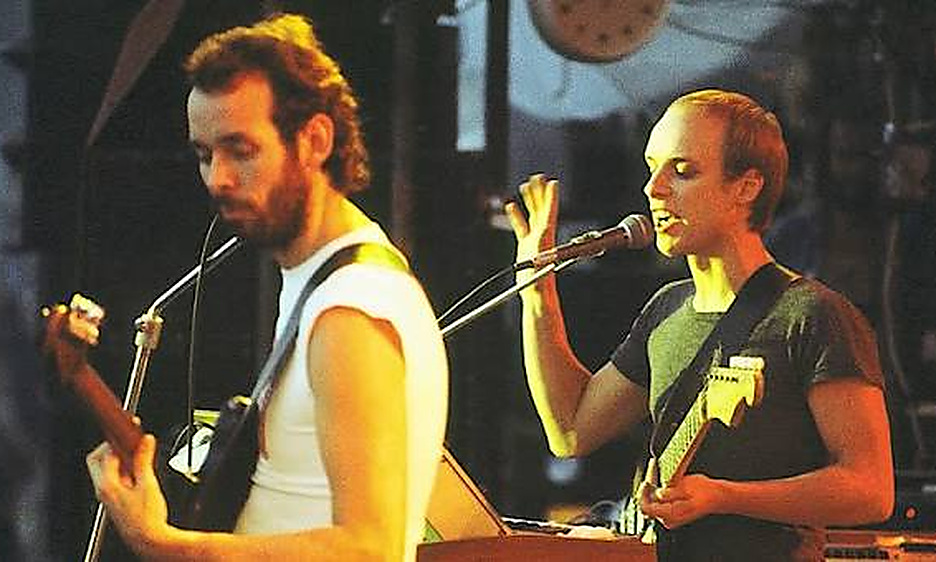
 801 is possibly best described by journalist Dave Simpson as "a ground-breaking ambient rock supergroup formed by Brian Eno and Phil Manzanera who slayed the Reading Festival in 1976 and imploded soon after, leaving a myriad of musical possibilities unresolved." The group, which took its name from an Eno song, was a short-lived project conceived by Roxy Music guitarist Phil Manzanera, along with bassist Bill MacCormick and his brother Ian MacCormick, known professionally as Ian MacDonald (not to be confused with Ian McDonald, who was a member of King Crimson and later Foreigner).
Although the term supergroup is frequently used in reference to 801, it is actually something of a misnomer. While technically correct considering the level of talent among its members, 801 actually came across as something of an anti-supergroup. Many so-called supergroups seem more concerned with marketing than with music, whether as a result of personal choice or of record-label marketing. As a result, the group's appeal frequently centers more on the personalities than on the music. This was certainly not the case with 801. They were more of a musical experiment, whose mantra (not that they had a mantra) would be to work hard, have fun, and go home.
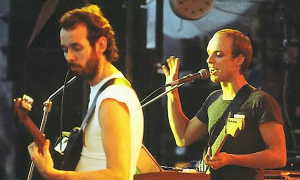
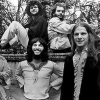
The band included guitarist Manzanera from Roxy Music, multi-instrumentalist Eno who worked on Roxy Music's first two albums and was beginning a solo career, Bill MacCormick on bass from Matching Mole, keyboardist Francis Monkman of Curved Air, guitarist Lloyd Watson from The Soul Mates, and Simon Phillips who was just starting as a session drummer. Each of these players was exceptionally talented but stylistically diverse, which was more or less the plan, and it was precisely this configuration that gave the group its distinctive musical character.
As Manzanera explained in his autobiography, "our mad idea was to combine what we described as musicians and non-musicians to see what happened." Some members would be technically excellent musicians while others were self-taught and more instinctive players, who were "concerned with the texture of the music and with creating new and original sounds." The result was an unusual combination of talented musicians whose varied backgrounds were rooted in everything from progressive rock, jazz, blues, ambient, avant-garde, and Latin music. Although 801 existed for only a few weeks, its musical roots stretched back several years.
In 1975, Roxy Music scored its biggest hit to date with "Love Is The Drug." For many bands, a popular hit would fuel more touring and recording, but this was not the case for them. In four years, they had recorded five albums and were frequently touring and making television appearances. Even though they were on good terms overall as bandmates and continued touring into early 1976, the group's members were ready for some time apart to work on solo projects.
Manzanera, however, decided to work on two projects simultaneously. In early 1975, he started work on his first solo album, Diamond Head (Atco 1975). At the same time, he reunited the members of Quiet Sun, his pre-Roxy Music band, which included Bill MacCormick, Dave Jarrett, and Charles Hayward, to record Mainstream (Antilles, 1975).
Diamond Head also featured several other Manzanera associates on the recording. He brought in musicians he knew through Roxy, such as Eno, Andy Mackay, Paul Thompson, and Eddie Jobson, along with a gathering of exceptional session musicians working in London at the time. Both albums were recorded during January and February 1975.
801 Live might never have happened without these two recording sessions. Diamond Head helped Manzanera find his sound and Mainstream helped him connect that sound with his past.
Quiet Sun formed in the early seventies, and it featured a group of friends from Dulwich College in London: Phil Manzanera on guitar, Bill MacCormick on bass, Charles Hayward on drums, and Dave Jarrett on keyboards. The band was heavily inspired by Soft Machine and recorded a demo tape featuring compositions in complex time signatures such as 12/8 or 13/8. They sent the demo tapes to practically every major record label in England, and all were rejected.
The group disbanded after MacCormick got an offer to join Robert Wyatt's band Matching Mole, and Manzanera joined Roxy Music. However, Manzanera's solo efforts allowed the group to finally release an album on Antilles Records in 1975, which was, ironically, a subsidiary of Island Records, one of the labels that had rejected them a few years earlier. Manzanera says in his autobiography that "up until that point, Quiet Sun had felt somehow like unfinished business from schooldays, and I felt a need to return to it and give it the high-quality production the music deserved."
Shortly after Mainstream, Manzanera, Eno, and the MacCormick brothers devised a plan. They were going to put together a band, but it would be different from most bands. The entire idea behind it ran counter to the logic of most musical ventures. As Manzanera describes it, "Brian Eno and I had already been looking for another project to work on together, so off we went with the MacCormick brothers to a friend's country idyll in Shropshire where we planned and plotted." This was sort of their equivalent of the cliché of the band "getting their heads together" in the country routine that was so prevalent during the seventies. "We had an idea to try something completely new and different, which was that we would form a band and make some music, on the understanding that the whole thing would start and end within a strictly limited time. We'd perform a very small number of gigs, and then go our separate ways."
They spent several weeks rehearsing for a planned tour of England and Europe. During the planning stages, they were trying to figure out the band's lineup. Of course there was Manzanera on guitar, MacCormick on bass, and Eno on synthesizer and keyboards, but who else? Eno suggested guitarist Lloyd Watson, whom he had met when Watson opened for Roxy Music. Watson was an exceptional blues guitarist, and he and Eno became close friends and had recorded together in the years since their initial meeting. Watson was actually in the hospital when he got the call to join the band, and his sister wrote in a letter that he told the doctor, "fire up the scalpel young man, I've got a tour and album to make."
Watson later recalled, "We did three weeks of solid rehearsal at Island, and it was rehearsed note for note. It was quite hard work." They also recruited Francis Monkman and Simon Phillips, who were skilled technical players. As Watson explained, "Phil often said in the band Francis Monkman and Simon Phillips were the two most musically gifted members, he and Bill MacCormick were the anchors in the middle, and there was Eno, the non-musician, and me doing my bits."
Due to last-minute problems, the European tour was canceled, but they did play three shows in England. The Queen Elizabeth Hall performance became 801 Live, a recording distinguished not only by its performances but also by its remarkable sound quality. 801 Live featured an early use of direct-injection recording, which, as Manzanera explains, uses a "closed mic approach to recording, in which all outputs from the vocal microphones, guitar amps and other instruments (except the drums) were fed directly to the mobile studio mixing desk, rather than being recorded via microphones and/or signals fed out the front-of-house PA mixer." The result is a higher level of fidelity than most live recordings at the time.
Beyond its groundbreaking recording techniques, 801 Live stood out for its musical diversity. The band wasn't confined to any particular genre, which made its music difficult to classify. As Manzanera explained in his autobiography, this was a combination of "pop with some blues, traces of punk, prog rock, and ambient music; exactly the eclectic mix that we'd aspired to achieve from the outset. Other tracks written by Brian, Charles and Bill allowed us to try out a whole range of different sounds and textures." The album featured songs from Eno's solo albums, Diamond Head, and Quiet Sun, as well as two cover songs, both of which were very effective choices.
The most notable cover is The Beatles' "Tomorrow Never Knows" from Revolver (Capitol 1966), listed here as "TNK." Although the album starts with the short guitar instrumental from Diamond Head, "Lagrima," "TNK" essentially kicks off the album, and the powerful bass lines dominate the song in the best possible way. "TNK" also allows Eno to incorporate subtle elements of musique concrète.
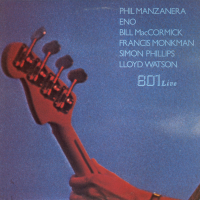
Interestingly, the album cover features a close-up shot of MacCormick's bass head, which seems to suggest the role the instrument plays in the overall recording. Of course, it also conveys the impression of live recording by focusing on an instrument rather than the musicians.
The album would not be quite the same without "TNK," but it wasn't the first song that came to mind. As MacCormick explains in his autobiography, they considered songs by Creedence Clearwater Revival and even an extended version of "In-A-Gadda-Da-Vida," but nothing seemed quite right. "Then, out of the blue I came rushing in: 'Tomorrow Never Knows,' I suggested tentatively. People looked at the floor, shuffled their feet and looked away. Someone, perhaps Brian, coughed politely. The air seemed heavy with embarrassment, or so it seemed. It was, in fact, the moment when three other people were saying to themselves: 'Bugger, why didn't I think of that?' (Well, that's what I reckon)."
Considering the level of studio manipulation and effects used in making the original, it is no surprise that this song is not among the most commonly covered Beatles songs. However, 801 manages to honor the original while creating something distinctly its own. Eno's experience with electronic music and experimental sound textures made him a natural fit for a song that had been so adventurous in its original conception.
The other cover they selected for the album was The Kinks' "You Really Got Me." Its quirky, slightly humorous delivery by Eno seems almost a precursor to new wave music that would come a few years later. Similarly, a song like "Third Uncle" sounds closely aligned with some of the punk rock that was popular in Britain at the time.
Progressive rock, however, still makes up a good portion of 801 Live. One of the more adventurous selections is "East of Asteroid," a blend (not a medley) of two pre-existing songs: "East of Echo" and "Mummy Was An Asteroid, Daddy Was A Small Nonstick Kitchen Utensil." Here, two worlds seem to intersect. The song's complex song structure, with its shifting time signatures, although predominantly in 13/8, seems as if it was taken directly from the prog rock playbook (not that such a thing actually exists). It also has a strong Latin feel, which echoes Manzanera's youth.
Of course, Eno would good-naturedly complain about having to play songs like this. Bill MacCormick is quoted on the Pienemmät Purot website as saying, "One of the great treats was trying to get Brian to play in odd time signatures. 'It goes like this, Brian 1-2-3-4-5-6.' He used to get quite ratty when we would count it for him, and say 'I can't do it!' But eventually he got it." Rehearsing for 801 Live was a challenging experience for every player involved, and eventually, they all got it, so the hours of practice ultimately paid off. As Manzanera said later, "the audience loved the show, and it has turned out to be one of the highlights of my fifty years in music."
Reviewing the album, Angus MacKinnon observed that "the name of the 801 game is energy," an energy that persists through even the most complex musical passages. "Watson's slide is a satisfying foil for Manzanera's more acrimonious playing. MacCormick (whose bass is at once intricate and warm-blooded) and Phillips are the kind of rhythm section most bands can only dream about having aboard. Monkman's electric piano and clavinet balance out against Eno's more wayward contributions."
On one level, 801 was intended only as a short-term musical group. However, they produced an album that continues to resonate with listeners. As Phil Manzanera remarked in an interview, "it seems everyone secretly likes this record." In a recent Facebook comment, MacCormick expressed hope that a new version of 801 Live, drawn from the original 24-track recordings, would appear in late 2027. For a group that existed for only a few weeks, 801 has developed an enduring reputation that continues to grow. In 2026, a podcaster asked Phil Manzanera what the most fulfilling project of his career was, and without hesitation, he replied: "801 Live."
 FOLLOW Kyle Simpler
and get notified whenever a new article published.
Longtime jazz listener
About 801
Tags
PREVIOUS / NEXT
Become a Sustaining Member

Since 1995, All About Jazz has championed jazz as an art form and supported the musicians who create it. Over three decades, it has grown into one of the world's leading jazz resources, serving hundreds of thousands of readers, musicians, presenters and industry professionals each month.
Help Build the Future of All About Jazz
Your support helps us continue building All About Jazz for the next generation—expanding our editorial coverage, preserving jazz history, developing new community features and creating better ways to discover the music and the people behind it.
Become a sustaining member for as little as $20 per year and you'll immediately enjoy an ad-free experience along with access to subscriber features and future articles for a full year.
Together, we're not simply sustaining All About Jazz—we're building its future. Thank you for being part of the journey.