Home » Jazz Articles » Groove Orbit » A Time Capsule in Sound: Jim Pugh’s New American Symphonies
A Time Capsule in Sound: Jim Pugh’s New American Symphonies
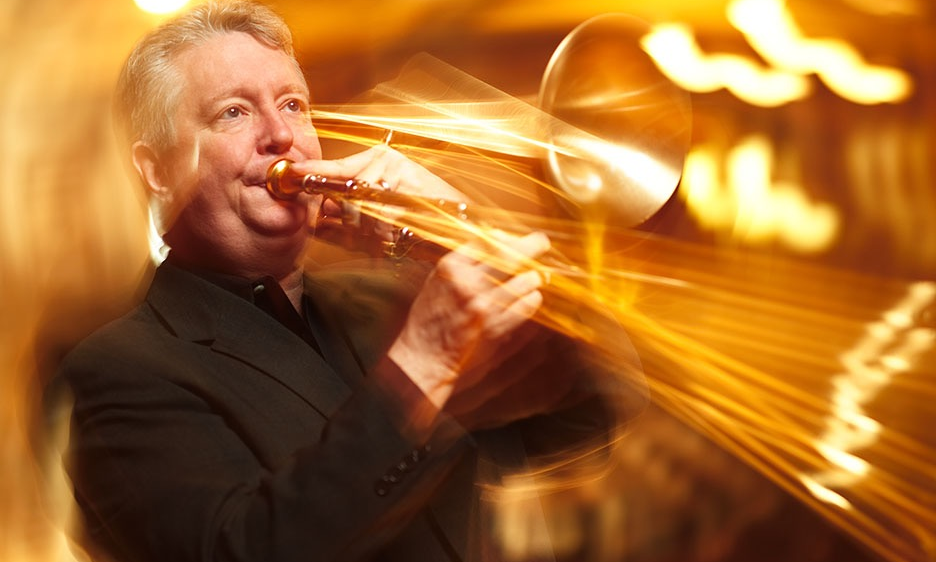
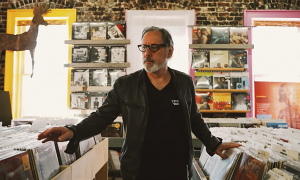
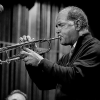
Courtesy Shore Fire Media
If you close your eyes and listen to the first movement, you can hear where jazz would eventually arrive some 35 or 40 years later.
—Jim Pugh
To get the full picture, however, we have to go back several decades.
By the late 1930s, swing bands dominated American popular music, and Tommy Dorsey had established himself as one of its leading performers. Not only was Dorsey an exceptional trombonist, but his orchestra was one of the country's leading big bands. The growing popularity of jazz led many classical composers to incorporate jazz elements into their works, and American composer Roy Harris was one such case. He had an idea for an ambitious piece that would combine jazz and classical music, and Tommy Dorsey's orchestra seemed an ideal vehicle for a workshop of his crossover composition. Dorsey was receptive and agreed to introduce the work to his band for rehearsal.
The work, entitled American Symphony, consisted of only two movements when he brought it to Dorsey. Harris envisioned the piece around the time he was completing most of what would become his celebrated Third Symphony.
Harris took a somewhat unique approach to composition, likely influenced by his time training with the noted French composition teacher Nadia Boulanger. Boulanger emphasized building a foundation in tradition but also finding your own voice as a composer.
Boulanger's influence is evident in much of Harris's work. In a similar fashion to his contemporary Charles Ives, Harris often incorporated traditional American folk melodies into his work. With American Symphony, he saw the possibilities of incorporating elements of jazz into the piece as well.
Of course, Harris was not forging a new path in this regard. As trombonist Jim Pugh points out, many classical composers were writing music for jazz orchestras around this time. Igor Stravinsky wrote Ebony Concerto for Woody Herman in 1945, and Béla Bartók wrote Contrasts for Benny Goodman in 1938. Although many of these compositions were not specifically jazz, they seemed to bring elements of jazz and classical somewhat closer together.
At the time, Dorsey was the equivalent of a modern-day rock star, and his orchestra seemed like the perfect vehicle for Harris's work. American Symphony was a complex, large-scale composition featuring Dorsey as trombone soloist. According to research by Brian Lamb, Harris apparently envisioned a three-movement work, with the first movement intended as a showcase for his wife, Johana, playing piano, and the second movement as a feature for Dorsey.
It seemed like a good idea on paper, but the collaboration did not get far.
The rehearsal began in the early morning hours after Dorsey's band had finished a lengthy concert engagement. The musicians were tired, and not overly enthusiastic about rehearsing a difficult score in the middle of the night after a taxing performance. Johana Harris, on the other hand, was optimistic about the piece, but her performance suffered from the band's overall resistance, and Dorsey ultimately abandoned the project. Shortly after the unfortunate rehearsal, Harris apparently saw little reason to continue working on the piece, so he shelved the project, leaving American Symphony unfinished.
It might have gone completely unnoticed had it not been for another trombonist with a keen eye.
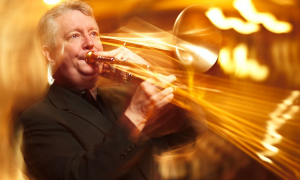
Decades after the failed attempt with the Dorsey orchestra, trombonist Jim Pugh was reading Meryle Secrest's biography of Leonard Bernstein, Leonard Bernstein: A Life, when he noticed a brief mention of Harris's 1938 trombone symphony. When he saw the mention of Harris's work, he immediately took notice and started checking into it. No one in the trombone community knew anything about this piece, so Pugh made it his mission to track it down.
However, the circumstances surrounding American Symphony's disappearance and rediscovery raise some intriguing questions: Was Harris writing music unsuited for the particular musicians selected to work on the piece? Or perhaps his composition was somehow out of place for the time in which it was written?
Pugh hears something else when he listens to it now. "If you close your eyes and listen to the first movement, you can hear where jazz would eventually arrive some 35 or 40 years later," he says, describing the music as "this remarkable little time capsule that slipped through the cracks of history."
That description seems accurate overall for Harris's music. American Symphony was not, strictly speaking, a jazz or swing composition. Lamb notes that much of its foundation actually derives from traditional folk material or Harris's reinterpretations of folk-inspired themes. What made it unique, however, was the application of his own compositional approach, which seemed well suited to a jazz ensemble. Well, at least in theory.
Some of Harris's compositional approaches might actually be a lot to take in for a group of jazz musicians. Take his concept of "autogenesis," for example. Rather than constructing a composition from a succession of independent musical ideas, Harris sought an organic development in which new material grows from what directly precedes it or relates back to an earlier generating motif. A phrase might then emerge from a figure heard in the preceding measure, while another could develop from the original musical "seed." The resulting work continually refers to and regenerates itself. This kind of stuff probably didn't sit too well with a bunch of musicians rehearsing at 2:00 am after playing a lengthy gig!
However, the principle suited Harris's larger conception of American concert music. He was deeply concerned with establishing a musical language that did not simply follow standard expectations. Before Boulanger, his studies with Arthur Farwell exposed him to ideas about a distinctly American musical culture and to the poetry of Walt Whitman, whose expansive vision of American life would remain important to Harris.
By the end of the 1930s, Harris's reputation had risen dramatically. His Third Symphony, premiered by Serge Koussevitzky and the Boston Symphony Orchestra on February 24, 1939, became the work most closely associated with him and eventually one of the landmarks of the American symphonic repertoire.
Against that background, the fate of American Symphony becomes even more curious. Harris was not an obscure composer when he approached the Dorsey orchestra. He was approaching the height of his reputation, and the abandoned Dorsey project may represent another path his music might have taken, but we will never know for certain. Harris's experiment nevertheless almost remained lost in time, stranded in 1938.
Decades later, when Jim Pugh encountered the surviving music and realized its possibilities, the music finally took shape. What originally seemed too awkward for a major swing orchestra now sounded strangely contemporary. Pugh's description of the score as a time capsule is particularly apt because American Symphony did not change during those intervening years. The musical world around it did. As Pugh describes, many of the techniques used in the piece became standard jazz language later in the hands of players like Chick Corea and Eddie Palmieri.
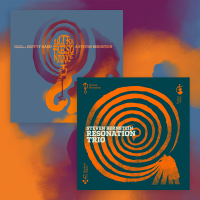
The rediscovery and release of Harris's work on New American Symphonies does more than preserve a historical artifact. It places Harris's music in a contemporary setting, where the borders between jazz and concert composition, along with the expectations placed on the musicians moving between those traditions, are considerably different from those that confronted Dorsey's orchestra in 1938.
There is another kind of history behind New American Symphonies as well. Pugh and recording engineer Jim Anderson bring a musical relationship stretching back more than six decades. The two first became friends when they were both in middle school band in Butler, Pennsylvania. Pugh played trombone, and Anderson played French horn. They bonded over their shared love of music. But even from the earliest days, Jim Anderson's interest gravitated toward recording.
During high school, when Pugh had trombone lessons, Anderson would tag along, but he would hang out at the local record shop during the sessions. Anderson's fascination with sound, however, was not limited to simply listening to recordings. Pugh and Anderson would frequently go to a local drive-in movie theater. At the time, drive-ins were notorious for cheap speakers you could clip to your car window. Anderson would bring his own speakers and a toolkit to rewire the existing setup to achieve better sound quality.
Their early interests led them both to pursue successful careers. Pugh, of course, became a first-call session player, and Anderson became an award-winning audio engineer. Anderson's work, in association with his wife, Ulrike Schwarz, has mainly focused on jazz artists such as Jane Ira Bloom and Patricia Barber, as well as recordings by classical and world music artists. Anderson and Schwarz's innovations in immersive audio have resulted in multiple Grammy Award wins and nominations, and the sound quality of New American Symphonies is rich and captivating.
Along with the studio technology, Anderson and Pugh's friendship and shared history help make New American Symphonies another point along a remarkably long collaboration. And their chemistry is in full swing on this project.
Along with the Harris composition, New American Symphonies also brings another composer's work into the conversation. As a result, it goes beyond simply reenvisioning a once-abandoned musical project; it is also an opportunity to showcase a modern-day work that serves as a worthwhile companion to Harris's composition.
Scott Ninmer was one of Pugh's students, and he wrote the opening section of the symphony as a thank-you gift for his former teacher. Pugh said, "I probably learned more from him than he did from me." Pugh loved the piece but thought it had an amorphous ending; he really wanted it to continue and suggested that Ninmer add more to it. Pugh loved Ninmer's completed work and wanted to record it. There was only one problem: the work was not long enough to fill an entire album.
Pugh discussed the problem with Anderson, who suggested pairing it with the Harris piece they had recorded earlier. As Schwarz explained about the Harris work, "everyone was expecting a third movement, and there is no third movement, but that Night Suite sounds really nice if we follow it up with it." This turned out to be a perfect choice because Ninmer's composition proved an ideal pairing for Harris. It does not imitate or attempt to complete Harris's unfinished work, nor do the two pieces even belong to the same musical world. Their juxtaposition, however, creates another way of hearing the older work.
The entire project became a process of discovery. When Pugh first encountered the Harris piece, it sparked his curiosity. He recorded it in 1995 mainly just to find out what it sounded like. He had not planned on releasing it as an album. Later, when he recorded the Ninmer piece, they realized how effectively it worked in relation to the Harris work. As Pugh describes it, "the idea that the Harris piece ends up with a single floating note, and Scott's piece starts with a single note being repeated." The note ending the Harris movement and the note beginning Night Suite work together as if they were planned. "It's almost like Scott's piece resolves the line Roy Harris left."
The album sounds fantastic. Anderson and Schwarz were able to take the earlier recording and bring it into the 21st century. However, as Anderson explained, "the engineering job is quite easy when you're working with players of the caliber of Jim Pugh and his fellow musicians."
It is also worth noting that there were almost no overdubs on the sessions. As Anderson explained, they did not need to agonize over the sound. "We basically walked in, hit record, and they were playing."
New American Symphonies shows how a lost composition can now sit alongside a contemporary composition without seeming like an archaeological discovery. Even though Harris wrote his work in the 1930s, it still sounds more at home today than it did when it was first written. American Symphony did not change during those intervening years. The musical world around it did. Perhaps the term "labor of love" is often overused, but for New American Symphonies, it seems like a perfect description.
 FOLLOW Kyle Simpler
and get notified whenever a new article published.
FOLLOW Kyle Simpler
and get notified whenever a new article published.
Longtime jazz listener
About Jim Pugh

Tags
PREVIOUS / NEXT

Become a Sustaining Member

Since 1995, All About Jazz has championed jazz as an art form and supported the musicians who create it. Over three decades, it has grown into one of the world's leading jazz resources, serving hundreds of thousands of readers, musicians, presenters and industry professionals each month.
Help Build the Future of All About Jazz
Your support helps us continue building All About Jazz for the next generation—expanding our editorial coverage, preserving jazz history, developing new community features and creating better ways to discover the music and the people behind it.
Become a sustaining member for as little as $20 per year and you'll immediately enjoy an ad-free experience along with access to subscriber features and future articles for a full year.
Together, we're not simply sustaining All About Jazz—we're building its future. Thank you for being part of the journey.