Home » Jazz Articles » Live Review » Arcanum at Victoria Nasjonal Jazzscene, Oslo
Arcanum at Victoria Nasjonal Jazzscene, Oslo
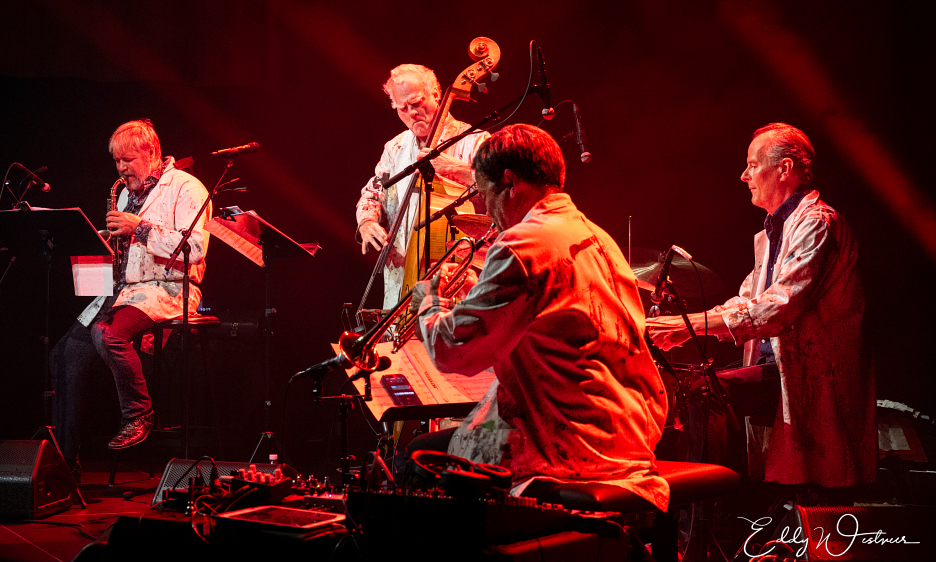
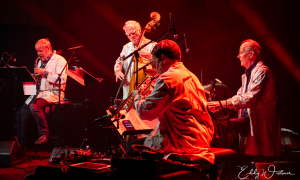
Courtesy Eddy Westveer
Victoria Nasjonal Jazzscene
Oslo, Norway
October 9, 2026
Forget the hermetic allusions suggested by their name; forget the content of their first and only album, even though part of their live set is based on it; and forget, above all, preconceived notions about national characteristics and artistic approaches. An Arcanum performance shatters every stereotype and established mold we might associate with its members, its music, or the stylistic identity of the label that houses them. So forget, too, the perceived frostiness and enigmatic seriousness that permeate nearly every cover of the ECM Records label and carry over into much of its music.
Congeniality
Arcanum is a project that took shape in 2023, bringing together four stellar figures from the Scandinavian and European jazz scenes: Norwegians Trygve Seim on saxophones and Arve Henriksen on trumpets, electronics, and vocals; Swede Anders Jormin on double bass; and Finn Markku Ounaskari on drums. All four had previously played together on several albums led by the fascinating kantele player and vocalist Sinikka Langeland, but this is their first independent collaboration.The spontaneous musical creativity that dominates their studio recording Arcanum (ECM Records, 2025) reaches its full potential in a live performance that is overwhelming, surprising, and occasionally exuberant. Their European tour brought them to Oslo, specifically to the welcoming Victoria, a venue that, before becoming the home of the Norwegian foundation Nasjonal Jazzscene in 2008, had served as a cinema, theater, and entertainment hall. History is palpable within its walls, in its warm design and intimate lighting. Yet none of this compromises its functionality, superb sound system, or suitably discreet stage lighting.
Forerunner
The easiest thing would be to claim that Arcanum's main inspiration comes from the musical principles of Ornette Coleman. Certainly, his enormous legacy is present, whether directly, as in Jormin's arrangement of Coleman's "What Reason Could I Give," or in many other details, from the ensemble's instrumentation to the harmolodic shaping of original compositions and collective improvisations.But there is much more. There is also the folk-like or tribal melodic simplicity of Albert Ayler, and his deep connection between ancestral roots and abrasive atonal explorations. Then there is Jan Garbarek, whose influence hovers over the wide-open sonic spaces the band creates and breathes life into some of Seim's phrasing. Seim also professes admiration for a distinguished expatriate who left an indelible mark on Scandinavia in the 1960s and liked to call himself "Ben Gordonsen."
Above all, however, are four extraordinary, fully developed musical personalities, as distinctive as they are eager to find common ground.
Poise
Perhaps especially motivated by the opportunity to play on home ground, Arcanum displayed an abundance of rapport, enthusiasm, and commitment, far removed from anything routine, which the audience clearly appreciated.Beyond the musical enjoyment, it was fascinating to observe the group's internal dynamics. Their interaction rested on a constant exchange of glances, especially between Henriksen and Seim during their shared passages. These exchanges became playful provocations, frequently capped by knowing smiles and admiring gestures from the trumpeter, while Jormin wove a visual web connecting him to every member of the quartet.
If their performance had to be defined by a single word, it would be the aforementioned "surprising." That description holds true even for listeners thoroughly familiar with their individual and shared discographies, including their eponymous album.
Compared with the sophisticated experimentation and often introspective restraint of their debut recording, their live performance delivered a direct impact on the ears, the gut, and the emotions. Onstage, the same music took on a new life, constantly transforming itself, whether moving from atmospheric passages to moments of almost brutal intensity or shifting from solemn seriousness to Art Ensemble Of Chicago-like theatricality.
Henriksen's role was crucial here, with his exhortations, strange humming, recitations, and furious vocalizations ranging from animal howls to a subversive crooner's delivery. At one point, he brandished a flag that, we imagined, served as the emblem of this unclassifiable ensemble.
The multi-instrumentalist divided his attention among three types of trumpet: a conventional trumpet, a pocket trumpet, and a customized, bell-less, electrified instrument. He used the latter in a thunderous climax alongside Seim's saxophone and Ounaskari's powerful percussion, with Jormin simply looking on. It was undoubtedly one of the wildest moments of the concert.
Henriksen also controlled the electronics (laptop, keyboard, and pedals) and took the lead in directing the other musicians. Yet he was at his most captivating when he deployed his unmistakable, intensely evocative sound, with its warm, tangible, impressionistic brushstrokes capable of producing a piercing, burning lyricism.
Seim, for his part, favored the alto saxophone, producing long, piercing high notes, richly textured with breath. His dazzling command of microtonality and legato, combined with his rich tone, frequently evoked the Armenian duduk and the grainy sound of a kemenche. This enticing sonic tapestry provided a natural setting for Henriksen's trumpet.
Seim alternated between alto and tenor saxophones, at times modifying the latter with an apparently customized neck, playing it without a mouthpiece, or using only the mouthpiece itself. One such moment led to a lighthearted free-improvisation passage with Henriksen, whose humorous antics drew laughter from much of the audience.
Motive For Its Use
With this extensive range of techniques at their disposal, the two horn players devoted themselves more to weaving a dense, ever-changing melodic and harmonic tapestry than to individual display. Solos were relatively few and generally brief.Together, they established an expansive soundscape in which ambiguous choral passages and penetrating musical ideas unfolded, punctuated by the ever-insightful Jormin and Ounaskari's playing, which alternated between delicacy and forcefulness.
Through this sonic landscape emerged several tracks from their album, sometimes preceded by intriguing introductions, at other times linked by solo sketches or exploratory passages. Everything flowed into a continuous musical whole in which improvisation was the determining factor and pauses between pieces were rare.
The Face Of The Bass
If Henriksen was the organizer and Seim the instigator and indispensable accomplice, Jormin was the group's unifying force.The Swedish bassist was majestic, firmly focused on the ensemble's essential rhythmic foundation while contributing equally to its harmony and melody. From the deepest register of his instrument, he produced those distinctive, gravitational notes—one of his many trademarks—that opened up stimulating and unexpected atmospheres.
His solos were the most readily identifiable as such, combining clear, imaginative phrasing with a mastery of harmonics and bowing techniques. At one point, he even introduced a touch of electrification to deliver a brief, almost funky passage.
His authority was unquestionable, and his musical stature imposing.
Music Always / Just For You
In a brief conversation after the concert, we asked Jormin about the evening's repertoire. He admitted that it was impossible to provide a precise set list, explaining that much of the performance had been improvised, although it drew on certain ideas and tracks from the album.Such was the case with "Nokitpyrt," which opened the concert after a lengthy introduction initiated by Jormin's bow. The piece fused Eastern musical influences with atonality before flowing into its elusive, distinctly Coleman-like melody, with Ounaskari playing à la Tony Williams. Electronics and Henriksen's moans eventually brought the piece back to its main motif.
This was followed by an overlapping performance of "Armon Lapset" and "Folkesong" (or something resembling them), in which distant echoes of a perpetually wounded Middle East seemed to emerge once again. Electronics then led the music into a fruitful dialogue between saxophone and trumpet, punctuated by Ounaskari's forceful playing.
The passage ended with Henriksen invoking the Miles Davis of Aura (Columbia Records, 2000), though with a more powerful rhythmic foundation and phrasing built on short lines, characteristic of Davis in his later years.
That was not the evening's only Davis moment. There was also a wonderfully slowed-down interpretation of Wayne Shorter's "Nefertiti," featuring sonic textures that held their own against those of its illustrious creators.
But if any musician's presence was felt throughout the evening, directly or indirectly, it was Coleman.
After a lyrical duet between Seim and Jormin and several intricate motifs reminiscent of Keith Jarrett's European Quartet—which included two Norwegians, the aforementioned Garbarek and Jon Christensen—the melody of "What Reason Could I Give" clearly emerged.
The performance featured Seim on tenor saxophone and a formidable solo by Ounaskari, urged on by a cowbell that Henriksen struck obsessively. Seim then introduced a somewhat more pastoral atmosphere, while the increasingly playful Henriksen contributed peculiar vocal sounds that provoked laughter from the audience. An improvised passage and a pop-tinged ending followed.
Peace / Folk Tale
There were few spoken introductions to the pieces, but Jormin's introduction to a Ukrainian folk song stood out.He alluded to the current state of American politics, reactions to the Nobel Peace Prize (awarded just hours earlier that same day, only a few minutes' walk from the venue), and the children who continue to die in the many parts of the world devastated by armed conflict while such matters are debated and speculated upon.
He dedicated a heartfelt rendition of the song to those children. The tune connected directly with "Elegy," one of the most conventional yet emotionally raw pieces on the quartet's only album to date.
Henriksen introduced the almost classical motif, Jormin delivered a moving masterclass in his solo, and Seim brought the piece to a close with a sound somewhere between incisive and imploring.
Beauty Is A Rare Thing
Of course, there was much more, though little of it was easy to identify: more urgent improvisation, driven by the modified instruments already described; more disarming lyricism, supported by Ounaskari's metallic subtlety; more atonality unleashed upon the attentive audience through the piercing upper registers of both horns; and more thunderous commentary and extravagant shouts from Henriksen.The supposed Nordic coldness gave way to a deeply human warmth. At the end of the concert, the musicians came down from the stage—or the audience went up onto it—to chat with friends and strangers alike, free of any hint of diva-like behavior or aloofness.
Henriksen demonstrated his electronic equipment to interested young people, Seim greeted acquaintances and admirers with obvious pleasure, and Ounaskari wandered among the tables and seats with a drink in hand, many of which remained occupied long after the performance had ended.
The exceptionally kind and efficient staff went out of their way to accommodate our requests (special thanks to Henrik Mehl, Øyvind Kalvenes, and Victoria's director, Øyvind Larsen).
The only coldness, as intangible as it was real, was the kind waiting for us outside, on Oslo's lively, stately, but almost glacial Karl Johans gate.
 FOLLOW Artur Moral
and get notified whenever a new article published.
An Absolute Listener
About Arcanum

Tags
PREVIOUS / NEXT
Become a Sustaining Member

Since 1995, All About Jazz has championed jazz as an art form and supported the musicians who create it. Over three decades, it has grown into one of the world's leading jazz resources, serving hundreds of thousands of readers, musicians, presenters and industry professionals each month.
Help Build the Future of All About Jazz
Your support helps us continue building All About Jazz for the next generation—expanding our editorial coverage, preserving jazz history, developing new community features and creating better ways to discover the music and the people behind it.
Become a sustaining member for as little as $20 per year and you'll immediately enjoy an ad-free experience along with access to subscriber features and future articles for a full year.
Together, we're not simply sustaining All About Jazz—we're building its future. Thank you for being part of the journey.