Home » Jazz Articles » Cool Vic Files » Case File: The Walkin' Papers
Case File: The Walkin' Papers

I was halfway through a respectable cup of coffee when a letter arrived from a reader who'd been listening to Miles Davis's "Walkin.'" He'd come across an earlier recording called "Gravy" by Gene Ammons. Same tune, he figured. Different title. Different composer.
Was somebody playing games with the credits?
I put down my coffee.
Now there was a question worth losing an afternoon over.
I knew "Walkin.'" Everybody with a working pair of ears and a weakness for the blues knows "Walkin.'" But "Gravy" was another matter. I pulled out my notes, made two telephone calls, and found what I was looking for.
April 26, 1950. New York City. Gene Ammons and Sonny Stitt in a studio with Bill Massey, Bennie Green, Duke Jordan, Tommy Potter, and Art Blakey.
Seven musicians who could make a blues sound like an argument worth having.
And there it was. "Gravy."
I listened once. Then again.
Something was cooking, all right.
Four years later, on April 29, 1954, Miles Davis walked into Rudy Van Gelder's studio in Hackensack, New Jersey, with J.J. Johnson, Lucky Thompson, Horace Silver, Percy Heath, and Kenny Clarke.
They recorded "Walkin,'" a performance that helped put hard bop on the map. Miles took that blues for a long stroll, and the rest of the band knew exactly where to put their feet.
The recording became a standard. The kind of number musicians call at a jam session when nobody wants to spend fifteen minutes discussing what to play.
But the composer credit wasn't what I expected.
Richard Carpenter.
I wrote the name on a sheet of paper and drew a circle around it.
Listen to those two performances. Forget the tempos and the personalities for a minute. Listen to the tune underneath.
Hear it?
Good. You're hired.
The earlier Ammons recording was associated with Jimmy Mundy, a composer and arranger who knew his way around a big band. By the time Miles recorded "Walkin,'" Carpenter's name was on the composition.
Four titles would eventually enter the discussion: "Gravy," "Walkin,'" "Weirdo," and "Sid's Ahead."
Four titles, two composers, and enough conflicting credits to keep a lawyer in silk pajamas for a decade.
I circled Mundy's name. Carpenter's, too.
Something didn't add up. I had a pretty good idea what it was, but ideas don't hold up in court. Paper does.
Lulu arrived that afternoon wearing a blue scarf I'd last seen in Copenhagen. She put a folder on my desk.
"Richard Carpenter," she said. "Manager. Music business. Connected to some interesting people."
"Interesting good or interesting bad?"
"Depends who you ask."
"That's usually the expensive kind."
Carpenter's name turned up in some uncomfortable chapters of jazz history, particularly in accounts of his dealings with musicians. But a man's reputation isn't evidence that he helped himself to somebody else's composition.
I needed something better than gossip.
We started with the records.
Miles had recorded "Weirdo" in March 1954, and "Sid's Ahead" appeared on Milestones in 1958. The family resemblance was worth examining, although the recordings and their credits had histories of their own.
I spread the discographical notes across my desk.
"Same tune?" Lulu asked.
"That's what we're here to find out. A melody can change clothes without changing its face. Doesn't mean every fellow wearing a similar suit is the same man."
She studied the pages while I made another call.
The next useful name was Bill Kirchner, saxophonist, arranger, and jazz historian. He'd written liner notes for a reissue of the Ammons-Stitt recordings and had interviewed pianist Junior Mance.
Mance remembered Jimmy Mundy.
Not as a name on a record label. As a man he'd stayed with, talked music with, and watched working on a composition called "Gravy."
Now that got my attention.
"Junior Mance," I said. "There's a man worth listening to."
"You believe him?"
"I believe he remembers what he saw. That's more than I can say for half the people who've sat across this desk."
"So we're getting somewhere?"
"We were getting somewhere before you arrived, sweetheart. Now we're getting there faster."
She smiled and went back to her folder.
Mance wasn't passing along a rumor he'd picked up in a nightclub. He was describing something he'd witnessed. Memories can play tricks after fifty years, but a recollection that specific deserved more than a shrug.
It also deserved corroboration.
There was the matter of publishing. Musicians sometimes sold rights for ready cash, and the business had never been famous for its generosity. A fellow could write a tune on Monday, sign something on Tuesday, and spend the next thirty years wondering why somebody else was collecting the checks.
But selling publishing rights and surrendering authorship aren't necessarily the same thing.
I wanted to know which had happened here.
If either.
I once spent eleven days in Vilnius trying to buy an Artie Shaw concert poster from a Lithuanian accordion salesman named Kazimieras.
Peculiar fellow. Ate pickled herring for breakfast and claimed his aunt had once been engaged to Shaw.
The poster advertised a performance at a ballroom that, according to Kazimieras, had burned down before the war. Magnificent lettering. Gold on crimson. Artie looked like he'd just received some very bad news from his accountant.
Kazimieras kept it in a wooden wardrobe between two fur coats and a framed photograph of a horse.
He wouldn't discuss a price until I'd tried his homemade cherry cordial. Then he insisted I meet his brother, who repaired accordions in a cellar beneath a bakery. The brother had eleven fingers, or so Kazimieras claimed. I counted ten, but the fellow was moving them pretty fast.
On the sixth day, a woman arrived claiming to be Kazimieras's aunt. She was ninety-three, wore enormous amber earrings, and said she'd never met Artie Shaw in her life.
Kazimieras explained that she was the wrong aunt.
On the ninth day, he admitted the poster was a reproduction. A very fine reproduction, he assured me, made by a printer in Kaunas who specialized in circus advertisements and municipal election notices.
I wasn't particularly disappointed. I'd grown fond of the thing.
Unfortunately, he'd already sold it to a dentist from Riga.
I left Vilnius with a battered accordion, two jars of pickled herring, and a handwritten invitation to a wedding in Šiauliai. I attended the wedding. Lovely affair. The bride's father played a spirited version of "Begin the Beguine" on a concertina, although he insisted it was a Lithuanian folk song about a fisherman.
I still have the accordion. It lives in a closet beside a pair of Italian shoes I haven't worn since 1987.
The next name in my notes was Don Sickler.
A trumpeter and music publisher, Sickler had worked extensively with the music of Tadd Dameron. According to James Gavin's biography of Chet Baker, Deep in a Dream, Sickler examined a copyright certificate associated with a composition originally titled "Gravey."
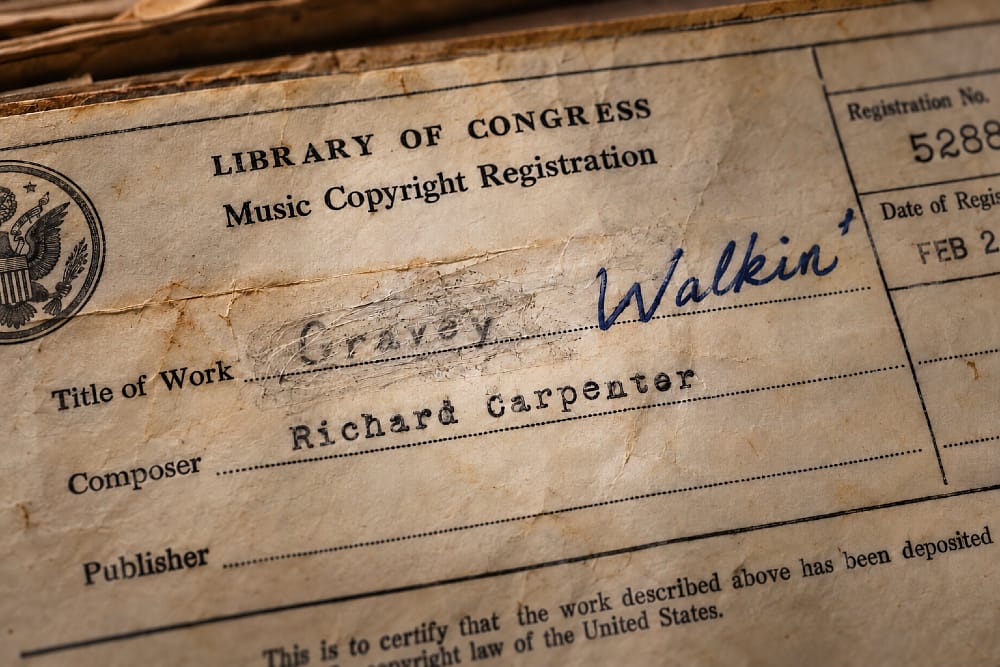 Artistic Reconstruction
Gavin reported something peculiar about that certificate. The original title appeared to have been partly erased, with "Walkin'" written over it and Carpenter identified as composer.
I read the account twice.
Then I read it again.
"Well, I'll be damned."
"What?" Lulu asked.
"Somebody's been doing some fancy penmanship. At least that's what Gavin reports."
"Can we see the certificate?"
"That's my next question."
An altered document would be a serious matter. But I hadn't examined the original, and I wasn't about to accuse anybody of tampering with it on the strength of a secondhand description. Who made the changes? When? Under whose authority?
Those questions mattered.
Lulu had been checking our own backyard.
"Here's something," she said, sliding a printout across the desk.
An old All About Jazz review from March 2004. Some fellow named C. Michael Bailey had written about Gavin's Deep in a Dream. Right there in the review was Richard Carpenter, identified as Baker's manager and the composer of "Walkin.'"
"Twenty-two years ago," I said. "And we're just getting around to asking questions?"
"Some of us have been asking questions, Vic."
"Don't get personal."
I went back to Bailey's review of Deep in a Dream. Interesting read, although the Carpenter reference was brief. The review wasn't evidence of what happened to the copyright, but it pointed us toward Gavin's account.
I wrote SICKLER—CERTIFICATE on a fresh sheet of paper and underlined it.
A fellow could spend his whole life investigating jazz credits. Labels disagree. Musicians disagree. Sometimes everybody agrees until somebody finds an old contract in a shoebox.
And sometimes there's no shoebox.
There was another tune from the 1950 Ammons-Stitt session, "Chabootie." Its credits had their own peculiar history, with Mundy's and Carpenter's names appearing in different accounts.
I opened another folder.
Then closed it.
One case at a time.
By evening I had a respectable collection of facts, several unanswered questions, and a theory I wasn't ready to put into words.
Ammons had recorded "Gravy" in 1950. Miles had made "Walkin'" famous in 1954. Junior Mance remembered watching Mundy work on the earlier composition. Carpenter's name appeared on the celebrated Miles recording. And Gavin had described a copyright document that deserved a much closer look.
What I didn't have was a reliable account of how the composer credit had changed—or a firsthand examination of the paperwork.
Lulu stood beside the record player.
"Well?"
"Well what?"
"Are you going to solve it?"
"I intend to."
"And if you can't?"
I looked at the two records on my desk.
"Then I intend to know exactly why I can't."
She nodded. She understood.
I put "Gravy" on the turntable.
There's something about a good blues. Twelve bars, a handful of notes, and enough room for a musician to tell you who he is. The music travels farther than the people who make it. Outlives them, too, if it's any good.
The names ought to travel with it.
I put the papers into a folder marked WALKIN'—OPEN.
Then I dropped the needle again.
Until next time, keep the spirit.
Got a case that won't stay buried? Send it to me.
 FOLLOW Cool Vic, The Music Dick
and get notified whenever a new article published.
I'm a Music Dick sepcializing in cold cases.
Tags
PREVIOUS / NEXT

Become a Sustaining Member

Since 1995, All About Jazz has championed jazz as an art form and supported the musicians who create it. Over three decades, it has grown into one of the world's leading jazz resources, serving hundreds of thousands of readers, musicians, presenters and industry professionals each month.
Help Build the Future of All About Jazz
Your support helps us continue building All About Jazz for the next generation—expanding our editorial coverage, preserving jazz history, developing new community features and creating better ways to discover the music and the people behind it.
Become a sustaining member for as little as $20 per year and you'll immediately enjoy an ad-free experience along with access to subscriber features and future articles for a full year.
Together, we're not simply sustaining All About Jazz—we're building its future. Thank you for being part of the journey.