Home » Jazz Articles » The Great American Songbook » The 1940s: WWII, Singers Take Center Stage
The 1940s: WWII, Singers Take Center Stage
Courtesy Pictorial Press
...A phenomenon of mass hysteria that is only seen two or three times in a century.
—Bruce Bliven on Frank Sinatra's Columbus Day concert in 1944
Reluctant at first to join the fighting, America had no choice after Japan's surprise attack on Pearl Harbor on Dec. 7, 1941—"a date which will live in infamy," FDR declared. Americans went overseas to battle Germany, Japan and Italy, including some of the biggest names in jazz —Glenn Miller, Artie Shaw, Clark Terry, Dave Brubeck, John Coltrane and Tony Bennett—and from motion pictures—Paul Newman, James Stewart, Clark Gable, Henry Fonda and Charles Bronson.
Irving Berlin, widely considered America's greatest songwriter, created the highly successful revue This Is the Army, which included his big hit from World War I, "Oh How I Hate to Get Up in the Morning."
Miller disappeared on December 15, 1944, while flying in a single-engine plane from the UK to Paris to perform a morale-boosting concert for Allied troops. Miller had volunteered as a band leader for the army and performed often for the troops.
Top box office star John Wayne was not allowed to serve for various reasons. In 1926, he had suffered a severe shoulder injury bodysurfing, a mishap that ended his USC football career. Republic Pictures, his studio, threatened to sue him if he joined the military since he was their only star (and a huge one). Stuck at home, Wayne did what he could by making many patriotic and morale-boosting movies.
The 1940s also took jazz in a different direction. The big band craze faded out, and vocalists took center stage with new styles and developed both great groups and solo acts. Crooning, bebop and vocal groups took over as the dominant jazz forms of the decade.
"In the Mood," written by Joe Garland and Andy Razaf, represented the big band craze of the 1930s and early '40s.
America joins the fight
After the Pearl Harbor attack and seeing Hitler invade several European countries, the U.S. changed its collective mind from neutrality to widespread patriotism. In the 1942 movie classic Casablanca, Humphrey Bogart's character Rick Blaine goes from cynical isolation to full participation. He starts out as a bitter loner—"I stick my neck out for nobody"—to joining the resistance. America did the same.Interestingly, Bogart—a sailor in World War I—tried to enlist in World War II in 1944 but was rejected because of his age (44).
The signature song of the movie is "As Time Goes By," written by Herman Hupfeld in 1931 and immortalized on the silver screen more than a decade later. The movie helped the song become a classic in the Great American Songbook.
Crooning and swooning
In the late 1920s, Bing Crosby introduced crooning—defined by Merriam-Webster as "to sing or speak in a gentle murmuring manner —and became its greatest practitioner. The invention of the microphone had enabled singers to sing much more softly than before.More than a decade after Crosby, Frank Sinatra followed in his footsteps. He joined the The Tommy Dorsey Orchestra in 1940 after performing for a few months with Harry James. Sinatra could not enlist in WWII because of a perforated eardrum and for psychiatric reasons, but he sang often at USO events to entertain troops.
One of Sinatra's early hits was in 1940, "I'll Never Smile Again," which was the first No. 1 song in Billboard history. This plaintive song reflects the anguish of separation from a loved one, a common theme of popular songs of the time. After a few years, Sinatra evolved his style from crooning to swinging.
The so-called Columbus Day Riot of 1944 cemented Sinatra as America's first teen idol. With teens out of school for the holiday, more than 30,000 "bobby-soxers" descended upon Times Square in New York City to cheer on their star heartthrob. New Republic writer Bruce Bliven called the event "a phenomenon of mass hysteria that is only seen two or three times in a century."
Sinatra collected 31 gold albums (500,000 sales or more) and 9 platinum (1 million) during his career and, for some, was America's greatest popular singer.
Another crooner of Italian origin was Perry Como, who sang from 1943 to 1987, sold more than 100 million records and has three stars on the Hollywood Walk of Fame for his achievements in radio, TV and music.
Superstar sisters
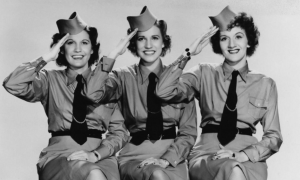
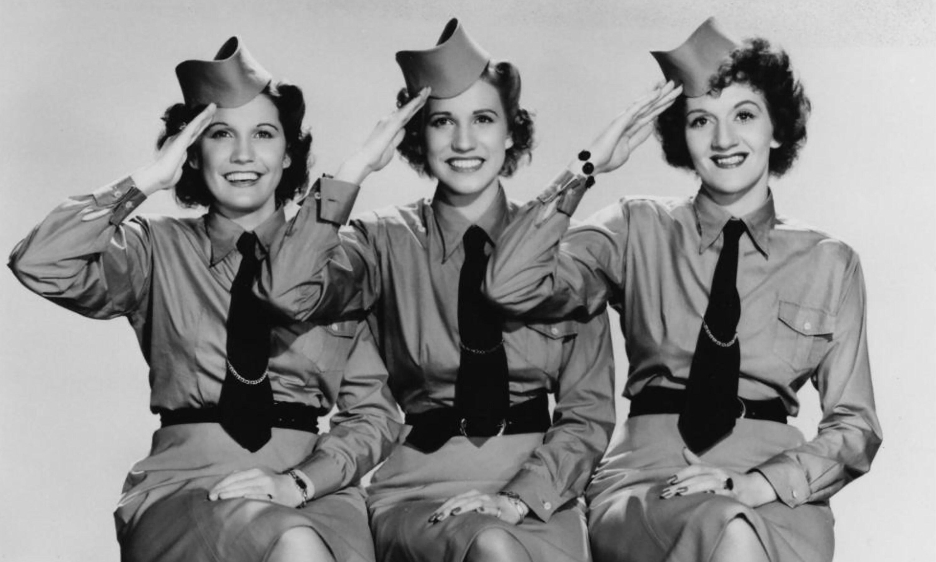
As Americans fought in Europe, North Africa and the Pacific, the The Andrews Sisters supplied plenty of smiles to soldiers. Laverne Andrews, Maxine Andrews and Patti Andrews—known as "America's Wartime Sweethearts"—entertained the troops with numerous USO tours, sang on Armed Forces Radio and visited military hospitals.The trio was the most successful female vocal group in American music history. They had 46 songs in the Billboard top 10—more than Elvis Presley and the Beatles—and sold about 80 million records.
The sisters also appeared in 17 Hollywood movies and were the first all-female vocal group to earn a platinum record. One critic said their close harmony and swing beat defined the 1940s.
Big band craze fades
The Big Band Era, or Swing Era, that erupted in popularity in the mid-1930s began to lose steam in the 1940s. Bands lost members to the military draft, a two-year union strike prohibited new recordings, and it became too expensive for clubs to bring in bands the size of 10 to 25 members.Singers who had gotten their start with bands went on their own to develop solo careers. Peggy Lee, who had gotten her start with Benny Goodman in 1941, had a very successful solo career that lasted until 1995, when she even performed in a wheelchair. She was an unusually creative performer, writing her own songs and producing her own shows, including arrangements.
One of her greatest hits was "Fever," a song originally written by Eddie Cooley and Otis Blackwell. For her version, Lee rewrote some lyrics and did her own arrangement, despite the objections of the record producers.
Her legendary 1958 version of the song earned three Grammy Award nominations at the inaugural 1959 ceremony —Record of the Year, Song of the Year and Best Vocal Performance, Female. Sadly, none of them won a Grammy.
Bebop begins
Some Black musicians grew fed up with white bands appropriating their music, watering it down and commercializing it. These African American artists developed a new jazz style and called it bebop. They intentionally made it complicated and difficult to reproduce. Broadly characterized by rapid tempos, complex harmonic structures, asymmetrical phrasing and improvisation, bebop became the favorite music of many jazz lovers.Bebop's stars are a roster of some of jazz's greatest legends. Charlie Parker's saxophone, Dizzy Gillespie's trumpet, Thelonious Monk's piano, Dexter Gordon's tenor sax, Bud Powell's piano and Max Roach's drums defined a jazz form created for listening, not dancing. Singer Billy Eckstine formed the first bebop big band, featuring Parker, Gillespie and Art Blakey. The group performed at ballrooms, nightclubs and theaters throughout the U.S.
A couple of years before forming his bebop band, Eckstine had spotted a young singer at an Amateur Night at the Apollo Theater and convinced his band leader at the time, Earl Hines, to hire her. Her name was Sarah Vaughan. She had an awesome voice with a four-octave range and the ability to color notes as she wished. She could easily have been an opera star. She learned and mastered bebop's improvisation technique and is widely considered among the "Big Three" of female jazz singers, along with Ella Fitzgerald and Billie Holiday.
Distinct styles a hit with audiences
Two other popular groups of the time were the Mills Brothers and The Ink Spots. Each had a distinct style that appealed to mainstream audiences.The Mills Brothers consisted of sibling Herbert Mills, Harry Millsand Donald Mills. A fourth brother, John Mills II , died in 1936, at which point John Mills, their father, became the fourth "brother." The group used their voices to mimic instruments such as trumpets, saxophones and tubas to go with barbershop harmonies and scat singing. They had only one instrument, an acoustic guitar, but that didn't prevent them from compiling 50 singles in the Billboard top 20.
In 1943, the Mills Brother had this No. 1 hit.
The Ink Spots showcased a style that preceded the popularity of doo-wop in the 1950s and 1960s. Lead singer William Kenney would kick off a song with the melody, and in the middle of the song bass singer Orville "Hoppy" Jones would speak—not really sing—the song's lines in a gentle and low voice.
Ink Spots had their breakout hit in 1939 and continued throughout the 1940s with a series of chart toppers. The group wound up with 18 hits in the top 10, six of them reaching No. 1.
Development of the LP
In 1948 a new recording format, the 10-inch vinyl LP, was developed. Musicians could record several songs in one disc instead of using the 78-shellac record only for one song. The vinyl disc had a better sound, but the LP enabled artists to create either long works ala Duke Ellington or short songs along a certain theme as Sinatra famously did.These first attempts were collections, Sinatra of some of his early hits in the crooning style and Doris Day with eight standard love songs.
The advent of the LP format had a profound effect on jazz and pop music. By recording so many standards at a time, it led to the development of the Great American Songbook, a collection of jazz pop standards that would become the established canon. However, the Songbook is not an official list, but rather common knowledge but still valid.
A singing and acting force
The decade ended with one of America's most optimistic and beloved entertainers, the multi-talented Doris Day.Day, born Doris Mary Anne Kappelhoff in Cincinnati, was one of the most talented—and perhaps underappreciated—talents the country has ever known. She had five No. 1 songs, recorded 31 studio albums, including concept albums, film soundtracks and compilations, and featured in 39 films. She became the queen of the rom-com genre and starred alongside some of Hollywood's greatest legends—Rock Hudson, Cary Grant, James Stewart, Clark Gable, James Garner, Jack Lemmon and Kirk Douglas.
Doris was No. 1 at the box office for four years, sharing the record with child actor Shirley Temple. Day capped her career with a five-year run of the Doris Day Show on CBS, from 1968 to 1973.
Day joined Les Brown and His Band of Renown as a teenager in 1940 and performed with him off and on until 1946. Day's World War II-themed song in 1945, "Sentimental Journey," became her first No. 1 hit. She had another No. 1 later that year, "My Dreams Are Getting Better All the Time." She signed with Columbia in 1947 and her first album, You're My Thrill, was released in 1949.
In her first movie, Romance on the High Seas, Day sang the song that earned on Oscar nomination, "It's Magic." Later in her movie career, she sang two songs that did win the Oscar—"Secret Love" from Calamity Jane in 1953, and "Que Sera, Sera (Whatever Will Be, Will Be)" from The Man Who Knew Too Much in 1956.
Conclusion
In our next episode, the 1950s, we discuss the development of the great American song book through the production of LP records. That is the concept album where songs are selected, according to a certain theme such as those by Sinatra, and we also talk about how rock 'n' roll became the country's most popular music and how jazz music had to take a backseat.
 FOLLOW Joan Merrill
and get notified whenever a new article published.
FOLLOW Joan Merrill
and get notified whenever a new article published.
Joan is an author, show producer, website creator, and talent manager
About The Andrews Sisters
Tags
PREVIOUS / NEXT
Become a Sustaining Member

Since 1995, All About Jazz has championed jazz as an art form and supported the musicians who create it. Over three decades, it has grown into one of the world's leading jazz resources, serving hundreds of thousands of readers, musicians, presenters and industry professionals each month.
Help Build the Future of All About Jazz
Your support helps us continue building All About Jazz for the next generation—expanding our editorial coverage, preserving jazz history, developing new community features and creating better ways to discover the music and the people behind it.
Become a sustaining member for as little as $20 per year and you'll immediately enjoy an ad-free experience along with access to subscriber features and future articles for a full year.
Together, we're not simply sustaining All About Jazz—we're building its future. Thank you for being part of the journey.