Home » Jazz Articles » The Great American Songbook » The 1930s: Soup Kitchens, Shirley Temple and Swing
The 1930s: Soup Kitchens, Shirley Temple and Swing
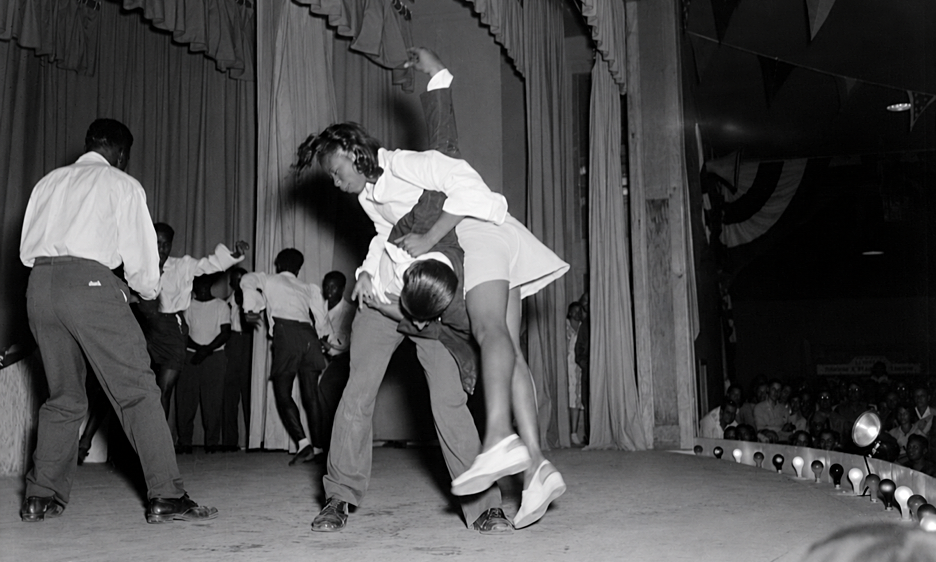
Courtesy The U.S. National Archives
If we had to flop, at least I’d do it my own way, playing the kind of music I wanted to.
—Benny Goodman on his Palomar show that changed music history
But as America swung through the decade, the country endured two horrendous disasters: the Great Depression that followed the stock market crash of 1929, and the Dust Bowl caused by drought, erosion and wind storms that drove millions of people off their lands in the Great Plains.
They packed up, jammed into their Model As and headed west for California, the "promised land." Their story was told in the classic novel, John Steinbeck's The Grapes of Wrath. Millions were unemployed and many homeless. They lived in tent cities and stood in line for bowls of soup.
But despite the hard times, America found inspiration in song and dance.
FDR helps save America
In the 1932 presidential election, New York's Democratic governor Franklin Delano Roosevelt defeated Herbert Hoover in a landslide that also produced Democratic majorities in the House and Senate.FDR, a distant cousin of former president Theodore Roosevelt, used a wheelchair after being afflicted with polio in 1921 and losing the use of his legs. He needed to project strength to a country demoralized by the Depression, so he hid his disability. He was never photographed in a wheelchair and when he appeared in public, he stood with the help of his son, James, aides, and the Secret Service.
Though FDR was an aristocrat, he connected with ordinary people perhaps more than any other president had. He spoke to them via radio with his regular "fireside chats." He was direct and honest and people trusted him.
As soon as he was elected, Roosevelt launched the New Deal, a wide range of economic, social and political programs to put people back to work and build needed infrastructure. Initiatives such as the Civilian Conservation Corps, Works Progress Administration, Tennessee Valley Authority and the Social Security Act built bridges, highways, dams, and parks, and gave millions of despondent Americans a sense of purpose and hope.
FDR was enormously successful in guiding the country through the Depression and World War II. He was elected an unprecedented four times with large majorities but died only a few months into his fourth term in 1944.
Roosevelt, along with predecessors Abraham Lincoln and George Washington, is considered among the greatest presidents in American history.
Escaping to entertainment
During the Great Depression, people sought ways to escape, but it had to be inexpensive. They could listen to the radio, play the new board game Monopoly or go to the movies for less than a quarter.Golden age of radio
The 1930s was the height of the Golden Age of Radio, when that medium was the main source of news and entertainment. Shows such as Amos 'n' Andy, The Jack Benny Program, Lux Radio Theatre, and The Burns and Allen Show filled the airwaves weekly as families gathered around the radio to listen to NBC and CBS broadcasts.Orson Welles' The War of the Worlds on October 30, 1938, gripped many listeners with fear, thinking that aliens from outer space had invaded the earth.
It is difficult to imagine now, but radio and even household electricity were new technologies in the 1930s. It's estimated that 12 million Americans owned radios at the beginning of the decade and more than 28 million by 1939.
Monopoly
The Parker Brothers—George Swinnerton, Charles Parker and Edward Parker—began mass-selling the board game Monopoly on February 6, 1935. Nearly 2 million games were sold over the next couple of years and, at its height, 35,000 were produced each week to keep up with demand.Ironically, the object of the game is to scoop up as much real estate as possible to drive the opponent into bankruptcy.
Going to the movies
For a quarter or less, people could go to the movies and immerse themselves in different worlds: the Deep South of Gone With the Wind, the colorful world of Munchkins in The Wizard of Oz, the Monument Valley of Stagecoach or the Senate floor in Mr. Smith Goes to Washington.People filled movie theaters around the country to watch the flickering screens and grab some respite from dreary economic realities and immerse themselves in an entertainment technology that became more and more fascinating. In 1930, 80 million people went to the movies every week—about 65% of the population.
Studios made an extra effort to entice people to their productions. Technicolor, which had been around since 1915, when a three- color system was developed to deliver big color and sound on the big screen. Audiences were stunned by colorful epics such as Gone WIth the Wind, The Wizard of Oz and The Adventures of Robin Hood.
Gone With the Wind and The Wizard of Oz came out in 1939, which is considered by many to be Hollywood's greatest year. Other landmark films that year included Mr. Smith Goes to Washington, Stagecoach, Wuthering Heights, Ninotchka, and Gunga Din.
Producers felt free to innovate, such as Walt Disney's full-length animated film, Snow White and the Seven Dwarfs. Disney was widely ridiculed, until the box office receipts poured in. People fell in love with Snow White and the dwarfs and the music was excellent. The movie's success also saved Walt Disney Studio from bankruptcy.
Little Girl Steals Our Hearts
Clark Gable, Gary Cooper, John Wayne, and Joan Crawford were larger than life on the silver screen, but no one stole the show quite like adorable, curly-haired Shirley Temple. She could act, sing on key and dance as well as Bill "Bojangles" Robinson, her dancing partner in four films.She became the No. 1 box office star in 1935 at age 6 and remained on top four straight years. She won a Juvenile Oscar in 1936 and actually saved the Fox Film Corporation (later named 20th Century Fox) from bankruptcy.
As she got older, her appeal waned but she made several more movies. In 1949, her final year on the silver screen, Temple was in four films.
After having two children with her second husband, Charles Alden Black, Temple served as a diplomat for four US presidents on and off from 1969 to 1992 and also became the first female U.S. Chief of Protocol.
She was one of a kind and there never will be another like her.
The King of Swing
The swing band led by Benny Goodman had a radio show on NBC in Los Angeles called Let's Dance,, so his music became familiar in Southern California.In 1935, when Goodman and the band arrived at the Palomar Ballroom for its concert on August 21, 1935, they were met by 11,000 people, mostly teenagers. People danced in the aisles to jazz that had never had such a hot beat.
The pivotal performance nearly didn't happen. Instead of playing the mellow jazz that the promoters had wanted him to play throughout the cross-country tour, Goodman and his band decided to bust out on the final night of the tour—and the crowd loved it.
As Goodman wrote in his autobiography, Kingdom of Swing, "The whole thing had gotten to the point where it was make or break. If we had to flop, at least I'd do it my own way, playing the kind of music I wanted to.
"I called out some of our big Fletcher Henderson arrangements for the next set and the boys seemed to get the idea. From the moment I kicked them off they dug in with some of the best playing I'd heard since we'd left New York."
It was the beginning of the Swing Era, and it proved that swing music was just what the doctor ordered to bolster people's spirits. Hundreds of bands formed to play the lively, energetic music that got people dancing.
King of the croon
Singer Bing Crosby started out as part of a trio called The Rhythm Boys in 1927 and also performed with the popular Paul Whiteman Band. Crosby went solo in 1931 and had nearly 70 top 20 recordings between 1931 and 1934 and made more than two dozen movies in the 1930s.Crosby had a massive influence in jazz singing. His conversational, laid-back style—along with his incredible voice—was imitated by many singers who followed him, including Frank Sinatra, Perry Como and Perry Como.
Crosby also helped revolutionize the recording industry by financing and adopting magnetic tape recording in the 1940s.
Rampant racism
Ethel Waters breaks barriers
The most prestigious club in Harlem in the 1930s was the Cotton Club, which hired only the best Black performers for its wealthy, white clientele. It was owned by gamblers but was elegant and produced lavish shows. The entertainers had to use the servants' entrance as it had a whites-only policy, which was typical in those days.In 1933, Ethel Waters headlined the club, no longer having to work in vaudeville and small clubs. She had reached star status.
The great Irving Berlin saw her there and decided to write a song for her to perform in his new Broadway revue, As Thousands Cheer. The song, "Suppertime," based on a news article about lynching, was a sensation.
Despite the positive reception for Waters from critics and audiences, her three white co-stars—Marilyn Miller, Clifton Webb and Helen Broderick—refused to take the curtain call bow with Waters because of Jim Crow social taboos.
After Berlin threatened to cancel the curtain calls for the remainder of the run, the white actors backed down. They and Waters took the bows together on stage thereafter. The show ran for 400 performances, from September 1933 to September 1934.
Waters would break more barriers as she integrated radio, Broadway, Hollywood and ultimately television when she was the first Black actor to have her own series, "Beulah."
She was cited as a major influence by many singers who followed, from Mahalia Jackson to Frank Sinatra, but acting was her major talent. She was nominated for an Academy Award for best supporting actress in the 1949 film, Pinky. She won a New York Drama Critics Circle Award for Broadway's The Member of the Wedding and also was nominated for a Prime Time Emmy Award for a Route 66 episode.
In preparing for her role as Berenice in The Member of the Wedding, Waters revised the scripts to make the character more dignified and nurturing. She added the song, "His Eye Is On the Sparrow," to present her as spiritual as well. She sang the song for author Carson McCullers, bringing her to tears.
Fighting discrimination all her life
Coincidentally, a beautiful girl of 16 was in the chorus when Waters headlined the Cotton Club—Lena Horne, in her first show business job.As Waters went on to her illustrious career, Horne charted her own path to stardom. She stayed at the club for two years, becoming a featured act, but she bitterly resented the whites-only policies and fought against segregation all her life.
She sang for a couple of bands, tried Hollywood, but settled on a solo career where she excelled. She appeared in the best venues, such as the Waldorf Astoria.
But she had to fight constantly against racial injustice. She was an active member of the NAACP and other such organizations. She was one of the liberals who frequented the integrated night club Cafe Society, meeting renaissance man Paul Robeson, author Langston Hughes and other free thinkers. Horne worked with Eleanor Roosevelt on an anti-lynching law.
Horne fought all her life for individual freedom. At the age of 64 and still beautiful, she produced her own Broadway show, The Lady and Her Music.
'A one in a century' voice
Marian Anderson was a renowned opera singer, whose voice was called by conductor Arturo Toscanini "one in a century." She toured extensively in Europe in the 1930s, performing for sophisticated audiences.After returning to America, she was asked to perform at Howard University, as she had done previously. However, this time there was such a demand for tickets that they had to find a larger venue. They settled on Constitution Hall in Washington DC.
However, the Daughters of the Revolution, which managed the venue, rejected the offer because of her race. This caused a huge outcry, even reaching the ears of First Lady Eleanor Roosevelt who was outraged. She arranged for Anderson to perform at the Lincoln Memorial on April 9, 1939. The show attracted 75,000 people with millions more listening to the radio broadcast. Roosevelt resigned from the DAR on February 26, 1939, in protest.
Anderson continued to perform and became active in the civil rights movement. She sang during the March on Washington on August 28, 1963, following Martin Luther King's "I Have a Dream" speech earlier that day. Her participation helped in passing the 1964 Civil Rights Act.
Strange Fruit
No song of the 1930s had the impact of "Strange Fruit," recorded and performed by Billie Holiday in 1939. The song, written and composed by Abel Meeropol, vividly describes a body that has been lynched, a harsh criticism of a government that allowed it to happen.And it did happen far too frequently. Appeals to Congress to pass anti-lynching laws were repeatedly rejected. More than 4,700 African Americans were lynched from 1882 to 1968, according to the NAACP.
The song was banned by some radio stations and nightclubs. The FBI, which had forbidden Holiday to sing it—a dictate she ignored— hounded her as a heroin user. They never let up, even confronting her on her deathbed.
It is a story that is central to my jazz mystery novel, And All That Madness, in which private investigator Casey McKie delves into the cold case of Holiday's death.
Hattie McDaniel
In 1939, the movie Gone With the Wind won eight Oscar awards, one of which went to Hattie McDaniel for best supporting actress for her role as Mammy—the first African American to receive an Academy Award.At the ceremony, she received enthusiastic applause and support, but despite the honor, she could not sit with the other award winners. She had to sit alone at a "blacks-only table" in the back. The hypocrisy of recognizing the talents of Black performers but then treating them with such disrespect was shameful.
Despite the racist treatment, McDaniel had a stellar career. She has two stars on the Hollywood Walk of Fame, was inducted into the Black Filmmakers Hall of Fame and became the first Black Oscar winner honored with a U.S. postage stamp.
She was also the first African American woman to sing on radio in the U.S., performing on Denver station KOA in 1925.
The big band craze
In the 1920s, jazz evolved from a mix of musical styles in New Orleans combining European harmonies and African American and Latin percussion styles. It was further developed by legendary musicians such as Duke Ellington and Louis Armstrong. Two of the major bands of the 1920s were Fletcher Henderson orchestra, an African American band, and Paul Whiteman's, in which all members were white.Bands in those days were groups of musicians who were interested in self-expression and did solos.
Swing bands, which became prominent in the 1930s, were a totally different matter. A swing band functions primarily as a single entity with the objective of playing dance music that swings. A big band is made up of 15-20 musicians divided into sections: trumpets, trombones, saxophones and clarinets. With a rhythm section with bass, drum and piano, the band's objective was to maintain a danceable rhythm.
The most popular bands of the swing era belonged to Goodman, a/k/a "The King of Swing," Ellington, Count Basie, Glenn Miller, Artie Shaw, Harry James, Harry James, Les Brown and Gene Krupa. They would sometimes use a vocalist to appease public demand, but the vocalist would sing only in the middle of a song, with the rest of the band performing before and after.
What often happened, perhaps to bands' chagrin, was that some vocalists became so popular that people wanted to hear them more than the band.
Big band leaders became celebrities. Movies were made about them, such as The Benny Goodman Story (1956) and The Glenn Miller Story (1954), which includes his biggest hits and which I recommend. Shaw, a renowned ladies' man, was married eight times, including to movie stars Lana Turner and Ava Gardner.
First lady of song
When Ella Fitzgerald was 15 in 1932, her mother died from injuries sustained in a car accident and her stepfather became abusive. She left home and was placed in an orphanage, which she left, living on the streets of Harlem for a time.She entered an Apollo Theater Amateur Night Contest on Nov. 21, 1934, planning to dance. But when she was called up to the stage, after a wonderful performance by a dance team, she chose to sing instead.
She was unkempt and disheveled and the audience jeered. The emcee encouraged her, so she sang in the style of Connie Boswell, a popular singer of the time.
She won the contest and was hired by drummer and band leader Chick Webb. Because she was still under 18, the state made Webb her guardian. She moved into a boarding house near the Savoy Ballroom, where the band worked.
She was a great asset for the band, having a huge hit with "A-Tisket, A-Tasket," among others. When Webb died in 1939, Ella took over the band and led it until it broke up in 1942.
She became the most admired vocalist of jazz and was called "the first lady of song." She had an uncanny ability to imitate instruments with her voice, but her ballads were pure and straight.
She was as perfect a singer as is possible.
A future utopia
In Flushing, New York, on April 30, 1939, the Worlds Fair opened for a six-month run. It was a magnificent exhibition of its theme, "The World of Tomorrow," with the Gershwin brothers writing a special song for it, called "Dawn of a New Day."The fair showcased a future utopia of houses and cars and a futuristic home with electrical kitchen appliances and forms of transportation—and even a talking robot—and showed an exciting new technology called television.
There were amusements like the parachute, jump and swing music dances—something for everyone. There were hundreds of exhibits from dozens of countries, US states and corporations. Many were elaborate: a model house, trains, futuristic cars. Thousands of spectators wandered from exhibit to exhibit with wonder in their eyes and could forget about their hardships for a while.
Including a second edition of the New York Worlds Fair in 1940, more than 44 million people visited.
Unfortunately, the utopia proposed by the world fair would have to wait. Mere months after the first fair in New York, Adolf Hitler and Germany invaded Poland on September 1, 1939, triggering the start of World War II. Despite its early reticence to join the fighting, America entered the war after the Japanese bombing of Pearl Harbor in 1941.
Conclusion
The 1930s were a remarkably eventful decade, and there were many more milestones not mentioned here: the building of the Golden Gate Bridge and the Empire State Building, Amelia Earhart's transatlantic flight and subsequent disappearance, the Hindenburg airship disaster and the first Superman comic book.But we will always remember the 1930s also for the development of swing music, which helped America survive one of the country's most difficult eras.
 FOLLOW Joan Merrill
and get notified whenever a new article published.
FOLLOW Joan Merrill
and get notified whenever a new article published.
Joan is an author, show producer, website creator, and talent manager
Tags
PREVIOUS / NEXT


Become a Sustaining Member

Since 1995, All About Jazz has championed jazz as an art form and supported the musicians who create it. Over three decades, it has grown into one of the world's leading jazz resources, serving hundreds of thousands of readers, musicians, presenters and industry professionals each month.
Help Build the Future of All About Jazz
Your support helps us continue building All About Jazz for the next generation—expanding our editorial coverage, preserving jazz history, developing new community features and creating better ways to discover the music and the people behind it.
Become a sustaining member for as little as $20 per year and you'll immediately enjoy an ad-free experience along with access to subscriber features and future articles for a full year.
Together, we're not simply sustaining All About Jazz—we're building its future. Thank you for being part of the journey.