Home » Jazz Articles » The Great American Songbook » The Great American Songbook Goes To The Movies
The Great American Songbook Goes To The Movies
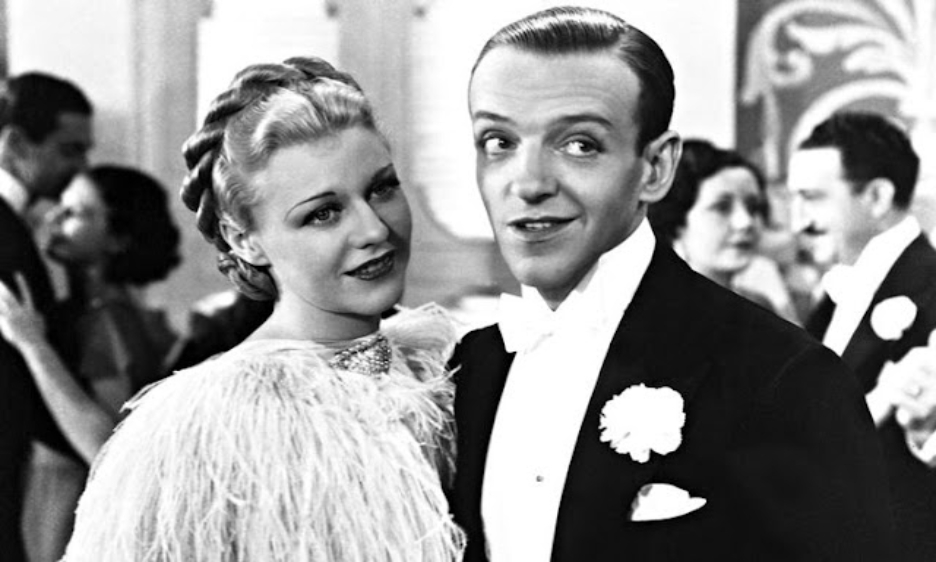
Courtesy glamamor.com
How Hollywood became the center for making musicals. It was the golden age from the '30s through the '50s.
The stock market crashed in 1929 and burst the popularity bubble of Broadway. Going to see a play or a musical was common practice in the Roaring Twenties. There were hundreds of them playing on the Great White Way and millions of Americans of all classes bought tickets. Then came Black Tuesday and the Great Depression. People could not afford Broadway anymore.
But out West in sunny California in a little town called Hollywood, motion pictures were undergoing a radical transformation due to a new technology that was developing—sound. The first talkie, The Jazz Singer, with Broadway star Al Jolson, came out in 1927 and was a sensation! Studios rushed to take advantage of this phenomenon, but it took a few years to perfect the technology. The musical Singing in the Rain presents this process amusingly.
At the same time, Hollywood studios had also introduced color—bright, pure color. These two tech technologies, color and sound, were best displayed in the musical. The best example might well be the 1939 movie, The Wizard of Oz, with its yellow brick road and multicolored horses. Not to mention the brightly colored musical segments.
The songs were wonderful—"Over the Rainbow," "Ding, Dong, the Witch is Dead," "Follow the Yellow Brick Road"—music by Harold Arlen and lyrics by Yip Harburg. Some critics say it is one of the best musicals ever made. The public would agree since it is the most watched movie of all time.
Hollywood became the center of musical production with studios putting their own stamp on their creations. MGM going for the spectacular. RKO showcasing the popular dancing duo Fred Astaire and Ginger Rogers. And Warner Brothers concentrating on stories about Broadway such as 42nd Street and Yankee Doodle Dandy.
The most prolific and successful of the early songwriters who had moved from Broadway to Hollywood, was probably Irving Berlin. He had the rare distinction of writing both words and music.
Was Irving Berlin a genius?
Berlin not only epitomized the American rags to riches story; he may well have been a bona fide genius.He came to America (New York's Lower East Side, where immigrants gathered) at the age of five with his parents and seven siblings, to escape antisemitic persecution in Eastern Europe.
When he was 13, his father died, leaving his wife and children to fend for themselves. Berlin left home so he would not be a burden on the family, lived in a ghetto and busked on the streets for pennies. He became a singing waiter at a Chinese restaurant, teaching himself after hours to play piano.
He wrote his first song when he was 19 and a few years later, came up with "Alexanders Ragtime Band," which was a huge hit, making him lots of money and earning him respect as a legitimate songwriter.
From then on, he went in only one direction: upwards!
Berlin became the most important songwriter in America. He wrote 20 Broadway musicals and 15 Hollywood films. He was an important contributor to the Great American Songbook and was responsible for some of our most iconic songs:
- "God Bless America"
- "White Christmas"
- "Easter Parade"
- Holiday Inn
- White Christmas
- Annie Get Your Gun
The story of how Berlin got the job of writing the music for Annie Get Your Gun attests to his genius credentials.
Jerome Kern, writing partner of lyricist Dorothy Fields, who had written the script for the musical with her brother Herbert, was tapped to write the music, but just as he began to work, he suddenly died. Producers Rodgers and Hammerstein thought immediately of Berlin and approached him. Berlin liked the idea but was fearful that he could not write songs to fit the country theme of the story. He was a city type, but he would give it a try and took the script home for the weekend.
He came back on Monday with three songs:
- "There's No Business Like Show Business"
- "You Can't Get A Man with a Gun"
- "Doing What Comes Naturally"
His lyrics rival Cole Porter songs for cleverness. Here is an example:
Berlin did not have the benefit of an Ivy League education, as did Porter. In fact, he had no formal education whatsoever. Berlin could not read or write music notations and could only play rudimentary piano in one key. He composed music in his mind and hired secretaries to transcribe his thoughts into music notation.
To write superb music in your mind seems to be genius.
MGM breaks racial barriers
At Bing Crosby's suggestion, the producers of High Society—a remake of the classic Philadelphia Story—hired his friend and sometime singing partner, Louis Armstrong. Further, against the producers' wishes, Crosby insisted Armstrong be given top billing along with himself, Frank Sinatra and Grace Kelly. Bing and Louis did a great song together called "That's Jazz."Lena Horne
After 70 years in show business, she was a legend, but when she started out, it was a time of racial discrimination. But due to her beauty and singing talent, she was given a long-term contract, the first American woman to receive one. At her insistence, the contract stipulated that she was not to be given the role of a servant. But when she did do a song, it was done as a separate scene that could be deleted for distribution in the south without affecting the story.Here's one of them, a Rogers and Hart song from Words and Music.
Ethel Waters
Ethel was the main star of the movie musical, Cabin in the Sky, which was adapted from the Broadway musical. Waters was a phenomenon, one of the most influential African-American entertainers whoever lived. She not only transformed just singing from a rough blues presentation to a smooth or mainstream style. In addition, she integrated Broadway, Hollywood and television. She was the first African-American to appear in an integrated cast of As Thousands Cheer.She also was the first African-American entertainer to have her own show on television and the second African-American actor to be nominated for an Oscar and the first to be nominated for a primetime Emmy. She also introduced several songs into the repertory, "Stormy Weather," for example. The song she sang in Cabin in the Skywas a huge hit.
Gotta dance
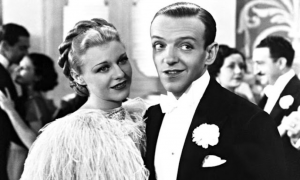
The Golden age of movie musicals had two male superstar dancers—Fred Astaire and Gene Kelly. They were alike in their spectacular talent and universal appeal, but they differed in their dance style.Astaire was the epitome of elegance and grace with his top hat, white tie and tails, whereas Kelly might will be seen in a T-shirt, jeans and sneakers. An Astaire dance was smooth and graceful, whereas Kelly considered dancing a kind of sport, was athletic and sometimes playful. Both were a joy to watch.
Astaire had a long and fruitful career beginning as a young man in a dance act with his sister Adele. They were international stars, but when Adele decided to get married, she quit show business.
Now on his own, Fred ended up in Hollywood. He did 31 musicals for RKO and later MGM. He met Ginger Rogers when they both appeared in the movie Flying Down to Rio and they decided to continue working together. They co-starred in 10 musicals and were enormously popular.
They had an interesting dynamic. Astaire played the eager suitor, while Rogers was rather aloof and sometimes disdainful. But when the danced together, that difference disappeared. She matched him movement by movement, step by step, and as she famously slid backwards and in high heels. The chemistry worked and people loved their movies. As do I. Video isn't this a lovely day
Composers were eager to have their songs included in an Astaire-Rogers movie because they would be introduced to millions of people. That team introduced more new songs than probably any other performers.
Best of friends
From the time they met while making the movie Top Hat, Irving Berlin and Fred Astaire were best friends and remained so the rest of their lives, doing six movies together:- Holiday Inn
- Blue Skies
- Carefree
- Follow the Fleet
- Top Hat
- Easter Parade
The Jewish Influence
A sizable portion of The Great American Songbook were written by children of Jewish immigrants, and they had a profound influence on the music.Five of the most talented among them had Jewish parents: Berlin, George Gershwin and Ira Gershwin, Jerome Kern, and Arlen. And there were more.
How did this happen?
It was a confluence of circumstances, the major one being the persecution of Jews, particularly in Eastern Europe, which motivated them to emigrate. They understood America was a country where there was little religious discrimination. It was also the land of opportunity where ambition coupled with hard work paid off.
The exodus of the Jews occurred mainly in the 1880s and they settled in New York. In the lower east side, which also happened to be where the burgeoning music business was located mainly in Tin Pan Alley. West 28th Street had got that nickname because it was lined with music publishing companies, each one seeming to have piano players who plunked out the music from their product, sheet music—a big business.
Before the advent of recording, music was distributed through notes on paper. Every household seemed to have a piano and someone to play it. If you walked down that block, you could hear tinny piano sounds emanating seemingly from every window. Some sharp journalist dubbed the street Tin Pan Alley and the name became descriptive for the popular music industry.
First-generation Jews gravitated to the music business because it welcomed them, whereas other companies did not.
Also, music itself was a draw. Jewish culture is steeped in music—even their prayers are vocalized by men called cantors. In fact, the fathers of Irving Berlin and Harold Ireland were cantors.
The effect was that the songs had a Jewish touch to them. They were influenced by European harmonies combined with jazz and blues elements. It was a new style of music, a very appealing one. Jewish music made use of the minor keys, which were sometimes used in the new music, creating a kind of melancholy feeling.
For example, "Summertime," from the opera Porgy and Bess by George Gershwin. It was sung in an operatic manner in the opera, but here we have a more modern, jazzy version by the "First Lady of Song," Ella Fitzgerald, who did more to codify the Great American Songbook than anyone else with her eight songbook albums, each devoted to a different composer.
It also demonstrates how these songs can be adapted to a jazz style. In fact, "Summertime" has probably been played in every style known to man. These songs are timeless and can be played almost every style.
However, not all the great songwriters were descendants of Jewish immigrants. Porter and Johnny Mercer, for example, were from well-established, wealthy families.
And let's not forget, musician composers, Hoagy Carmichael and Duke Ellington, who contributed some wonderful works to the Songbook. Whatever the case, music that came out of the first half of the 20th century known as the Great American Songbook has been called the classical music of America and is what some historians believe is the greatest popular music ever written.
Recommended musicals for Songbook fans
Aside from the ones mentioned above, here are some other recommended movie musicals:- MGM bio pics from the 40s (Their lives are fictionalized for the sake of drama, but the music productions are good)
- Till the Clouds Roll By (Jerome Kern, words and music by Rodgers and Hart)
- Rhapsody in Blue (Warner Brothers 1945 with Robert Alda)—Drama is fiction but music is superb!
- Night and Day (Cole Porter)—Highly fictionalized
- De-Lovely (More realistic life of Cole Porter with music by Elvis Costello, Diana Krall)
- I'll See You In My Dreams (Gus Kahn bio)—long on drama, short on music
- All Astaire-Rogers movies—Always charming!
- Romance on the High Seas
- My Dream Is Yours
- Tea for Two
- Lullaby of Broadway
- Calamity Jane—A tour de force
- Love Me or Leave Me (about 1930s torch singer Ruth Etting; an Oscar-worthy performance including 14 terrific music numbers.)
- The Pajama Game
- Billy Rose's Jumbo
That's entertainment!
This article has presented the highlights of the golden age of Hollywood musicals during the years 1930s to the 1950s. For the full picture of the era, I encourage you to watch the film That's Entertainment. It's full of surprises. For example, can you imagine Joan Crawford, Clark Gable, Cary Grant or Elizabeth Taylor singing and dancing in a musical?Well, they didn't particularly want to do them They were simply following orders. After the development of sound and color, studios churned out musicals as fast as they could, and they assigned their stars to do them. Of course, some were eager to strut their stuff—those who knew how to sing and dance—Gene Kelly, Judy Garland, Fred Astaire, and Ginger Rogers, for example.
Getting the movie is easy. Rent from your streaming channel (Prime, for example) for four bucks. THAT's entertainment!
 FOLLOW Joan Merrill
and get notified whenever a new article published.
FOLLOW Joan Merrill
and get notified whenever a new article published.
Joan is an author, show producer, website creator, and talent manager
About Cole Porter

Tags
PREVIOUS / NEXT

Become a Sustaining Member

Since 1995, All About Jazz has championed jazz as an art form and supported the musicians who create it. Over three decades, it has grown into one of the world's leading jazz resources, serving hundreds of thousands of readers, musicians, presenters and industry professionals each month.
Help Build the Future of All About Jazz
Your support helps us continue building All About Jazz for the next generation—expanding our editorial coverage, preserving jazz history, developing new community features and creating better ways to discover the music and the people behind it.
Become a sustaining member for as little as $20 per year and you'll immediately enjoy an ad-free experience along with access to subscriber features and future articles for a full year.
Together, we're not simply sustaining All About Jazz—we're building its future. Thank you for being part of the journey.