Home » Jazz Articles » Live Review » Joel Ross and Others at the 2026 Winter Jazzfest's Brook...
Joel Ross and Others at the 2026 Winter Jazzfest's Brooklyn Marathon
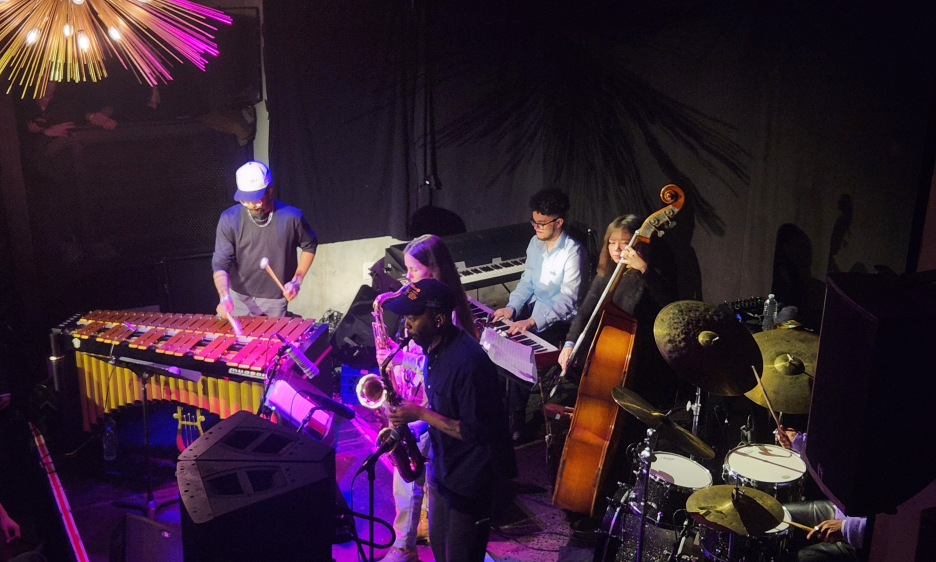
Ross’s seeming casualness stopped at his music, which was meticulously conceived and arranged.
Joel Ross and Others
Winter Jazzfest Brooklyn Marathon
New York, NY
January 10, 2026
New York's Winter JazzFest—to its credit—does not present stars of pop and other non-jazz genres to expand its audience and fill the festival coffers. But the January jazz mainstay is not averse to programming jazz-adjacent musicians or jazz artists who are dabbling in crossover projects that are shaded with non-jazz influences.
Both kinds of acts were particularly prevalent on Jazzfest's second 2026 marathon night, which—for a single all-you-can-hear ticket—allowed access to simultaneous programs at seven clubs in Brooklyn's Williamsburg neighborhood. While the hybrid performances this reviewer caught were all intriguing, they ranged in their levels of musical success.
The mild letdowns included Black Earth Sway, led by Nicole Mitchell. A short sample—necessarily, due to hefty delays on multiple subway lines to Brooklyn on Saturday evening—of Black Earth Sway's set at National Sawdust found the flutist boxed in by an electronics— dominant environment in which her usual brilliance di not shine. Ditto David Binney, whose electronic sampling was as much distraction as enhancement to a loud set at Superior Ingredients with his (drums and bass) Action Trio.
In the festival's rootsiest presentation, prominent Americana banjoist and singer Rhiannon Giddens brought her Silkroad Ensemble, the longtime world-music group she now leads, to Williamsburg Music Hall. Their short show was pleasant enough, but felt tentative and lost momentum even over its brief (45-minute) run time. (Several group members were missing, and Giddens disclosed that the performance was an early run-through of a presentation that Silkroad will tour beginning in March.)
The sets below were the most notable of the night.
Joel Ross
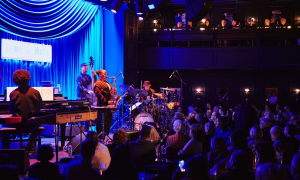
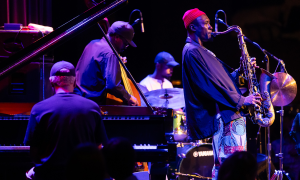
Joel Ross—tattooed and loose-limbed—was the rare Brooklyn Marathon performer who exuded cool to match the hipness of the Williamsburg neighborhood where the event was held. Ross's seeming casualness stopped at the music, though, which was meticulously conceived and arranged. The set, at Superior Ingredients, began in a swinging but twisty mode, with Ross's sextet of young players navigating the curves and complexities of his writing with ease.The entire ensemble impressed, but bassist Kanoa Mendenhall played particularly well. Proof that Linda May Han Oh is not the only outstanding female bassist in New York of Southeast Asian heritage, Mendenhall provided a rock-solid foundation to Ross, with a supple and warm sound. She is a player to watch in 2026.
The set, played with few interruptions, only got better as it went. About two-thirds of the way through, a gospelish tinge began to color the sound, as Ross moved to several pieces from his upcoming Blue Note Records album, Gospel Music. Ross (who, it turns out, was a cousin to the late singer and composer known as "The King of Gospel," James Cleveland) is a devout Christian who describes the album on his website as "a sonic interpretation of the biblical story and an exploration of [my] faith."
The gospel-hued jazz pieces played in Brooklyn were masterful and deeply felt, and perfectly synthesized two great American music genres. The upcoming album, out in late January, might just be the first to qualify as among both the best jazz and gospel recordings of a given year.
Elena & Samora Pinderhughes
Samora Pinderhughes, 34, and sister Elena Pinderhughes, 30, have made their marks individually over the years, as a sophisticated singer-songwriter and gifted jazz flutist respectively. Their set at National Sawdust marked a relatively rare joint appearance, and was a prelude to an upcoming recording by the siblings.Despite its brevity (it ran a little over 30 minutes), the concert was rich in surprises—beginning with Elena's voice, which we have heard little, if at all, previously. She possesses a lovely soprano that complements her brother's sweet tenor, with both sharing a similar timbre and intimacy. Their duets sounded almost like twin manifestations of the same voice.
The siblings traded the lead vocals, sometimes within the same song. The compositions themselves resembled Samora's solo efforts. That is, they were popular songs that were not traditional pop, and possessed some of the structural sophistication of jazz without overtly using the harmonic character of that music.
This was another concert with standout bass playing. One of three musicians who backed the siblings, Burniss Earl Travis II impressively used the versatility of his eight-string electric instrument. He provided both traditional bass-playing rhythmic and musical support and lead-like runs that leveraged the instrument's higher range.
The set's brevity also left admirers of Elena's flute playing wanting more. She played solos on only a few songs. While those revealed her gorgeous tone and skill with solo architecture, they were too little for a listener who has heard her jazz work with the likes of Kenny Barron, with whom she regularly plays, and Vijay Iyer—who made Pinderhughes a guest at a 2015 concert at the Whitney Museum of American Art at which her flute prowess dazzled, especially for a player who was then barely out of her teens.
Tomeka Reid Quartet
Among the encouraging signs from Winter Jazzfest was how many artists' sets were album launches—in spite of fierce financial headwinds involved in releasing a recording in 2026. The performance by cellist Tomeka Reid and her quartet at Baby's All Right was devoted to pieces from dance! skip! hop!, the fourth album from the foursome, which will be released in February.Like everything Reid does—including the septet project she brought to this year's Unity Jazz Festival—these new works were carefully conceived and thoroughly engrossing. Their conception drew in part from Reid's grounding in classical music, which imbued the quartet's set with some of the precision of chamber music. While improvisation was audibly woven through the program, in both ensemble and solo passages, a lot of the set was intricately composed, as the scores in front of the players revealed—with those of guitarist Mary Halvorson spread across a chair, in a charming and unfussy touch.
The quartet's decade-plus of playing together showed in the seamless empathy of the set. That included Reid and Halvorson, as the quartet's front— line players, collaborating in an extraordinary range of ways, often shifting roles with silken smoothness within a single piece.
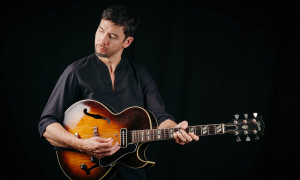
In a selection early in the set, for example, the two played in unison, with Reid bowing in sync with Halvorson's lead lines, before Halvorson smoothly transitioned to warm chording support, over which Reid played a solo. Then the roles switched, and Halvorson soloed—mostly using the warm traditional tone of her hollow-body guitar—as Reid played a repeating figure. The partners switched back to the unison playing to conclude the piece.
In a band this innovative, the rhythm section was predictably unconventional. Rather than, by default, locking in with drummer Tomas Fujiwara, bassist Jason Roebke sometimes offered a near-solo foundation for the interplay between Halvorson and Reid—including finding ways to stay out of Reid's way when she was using her cello in a more bass-like role.
Fujiwara tended to a restrained and subtle presence, at times offering gentle pulses but sometimes merely providing rhythmic embellishments as the rest of the band provided the onward momentum of the music.
The Quantum Blues Quartet
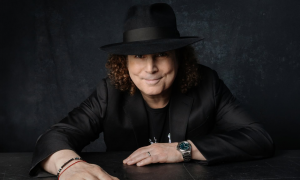
The name of this ensemble is a kind of joke, as keyboardist (and former The Late Show With David Letterman musical director) Paul Shaffer explained from the stage at the Music Hall of Williamsburg. Tisziji Munoz, the skilled guitarist around which the group is built, is, Shaffer said, "that rare rock guitarist who does not play the blues; Tisziji has his own scales."While such freedom from orthodoxy sounds intriguing, especially in combination with the quartet's entirely improvised approach, it comes with limitations. Without the blues—or much else, such as the more rigorous discipline of the best free jazz improvisers—to hold onto, the music sometimes drifted as it rambled from idea to idea, many of them kicked off by the ever-adaptable Shaffer. (The set reminded us, nearly a decade after the Letterman show ended, of what a fine and versatile musician the Canadian keysman is.)
Add in Munoz's psychedelic guitar style and sound, plus the musician's shamanlike vibe, and the set matched what one might have imagined at a 1960s acid-fueled free jam. There is a notable caveat, though: Musically speaking, the proto-jam bands of that era indeed used the blues to underpin much of their jamming. When they were not being bluesy, they employed such alternative structures as the modal figure the Grateful Dead repeatedly returned to during "Dark Star," their warhorse jamming vehicle.
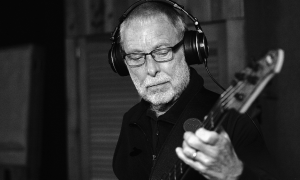
Those thematic touchstones were not present in the Quantum Quartet—until the band's encore, that is, when the set hit its high point. Ironically, given Shaffer's statement about Munoz's scale preferences, the peak came as the band switched to playing—yes—the blues. After an elegant solo opening on piano from Shaffer, Munoz offered a fluid blues solo. Shaffer switched to an organ sound for a soulful, and occasionally discordant, solo and bassist Don Pate calmed the pace, allowing Munoz to spin out another fine solo. Before things could grow dull, drummer Will Calhoun (of Living Colour fame) kicked up the tempo to take the jam home after 13 engaging minutes.
 FOLLOW Paul Reynolds
and get notified whenever a new article published.
FOLLOW Paul Reynolds
and get notified whenever a new article published.
Journalist and programmer in jazz, folk, country and other musics
About Joel Ross

Tags
PREVIOUS / NEXT

Joel Ross Concerts

Become a Sustaining Member

Since 1995, All About Jazz has championed jazz as an art form and supported the musicians who create it. Over three decades, it has grown into one of the world's leading jazz resources, serving hundreds of thousands of readers, musicians, presenters and industry professionals each month.
Help Build the Future of All About Jazz
Your support helps us continue building All About Jazz for the next generation—expanding our editorial coverage, preserving jazz history, developing new community features and creating better ways to discover the music and the people behind it.
Become a sustaining member for as little as $20 per year and you'll immediately enjoy an ad-free experience along with access to subscriber features and future articles for a full year.
Together, we're not simply sustaining All About Jazz—we're building its future. Thank you for being part of the journey.