Home » Jazz Articles » Live Review » Nels Cline and Others At 2026 Winter Jazzfest's Manhattan Marathon
Nels Cline and Others At 2026 Winter Jazzfest's Manhattan Marathon
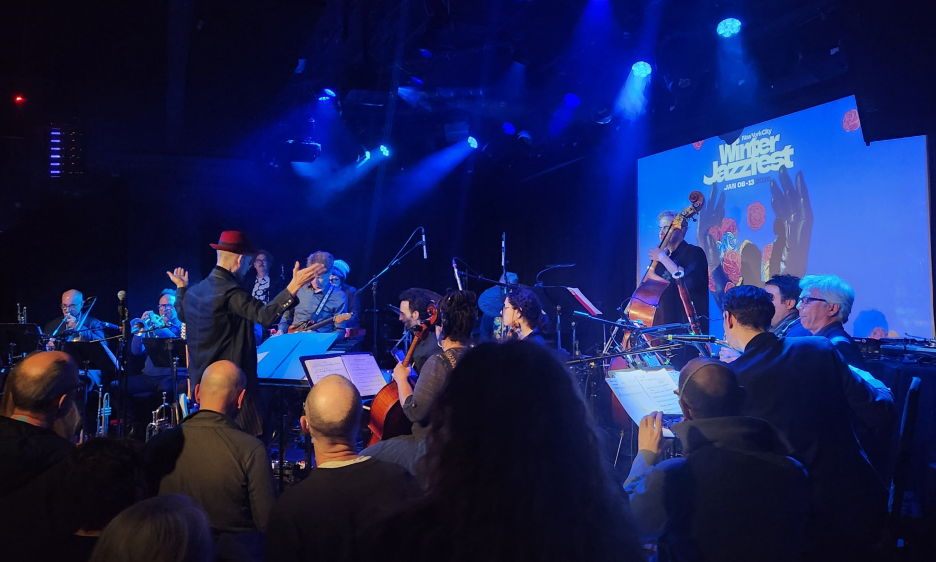
Courtesy Paul Reynolds
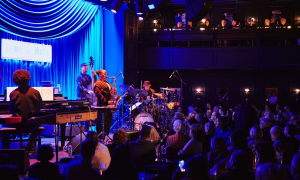
Winter Jazzfest’s neighborhood takeovers allow fans to buy a single ticket, for about the same as the cover charge and minimum at a top New York jazz club, and hop among up to eight stages over a night.
Nels Cline and More
Winter Jazzfest's Manhattan Marathon
New York, NY
January 9, 2026
Like New York's winters on the whole, the long nights of the city's Winter JazzFest demand hardiness. Moveable feasts that sprawl onto multiple stages in a neighborhood, the Jazzfest's celebrated marathons require braving New York's cold to trudge, for up to a mile, between clubs. And when you arrive at one, you may have to line up for a while and stand, rather than sit, in tight quarters once you get in.
The reward, though, is a festival like no other. Winter Jazzfest's neighborhood takeovers allow fans to buy a single ticket, for about the same as the cover charge and minimum at a top New York jazz club, and hop to as many as eight stages over the night, each running simultaneous programs from early evening to the wee hours.
Winter Jazzfest's programming is true to the genre, and to jazz's commitment to pushing boundaries and offering surprise—there are few or none of the seat-filling crossover or outright pop artists that so many festivals use to help balance the budget. The audience leans younger than a typical jazz crowd, giving hope for the continued vitality of the music. And while some casual fans choose to chat at the back of the rooms, most in the audiences are rapt in attention, even to the likes of a string quartet performing transcriptions of an avant-jazz saxophone quartet.
In 2026, as in past years, the first marathon night was on Friday in downtown Manhattan. In the main, the events skirt the neighborhood's storied jazz clubs—which mostly maintain business as usual, unassociated with the festival—in favor of venues that periodically present jazz among a host of other genres.
With dozens of sets a night, you can't possibly catch all the music, which makes rueing the shows you missed part of the Winter Jazzfest experience. Here are five notable performances this reviewer took in—in full sets, mostly—on his Manhattan Marathon night.
Nels Cline: Songs from Lovers, Conducted by Michael Leonhart
Opening the marathon was guitarist Nels Cline, in uncharacteristically quiet mode, reunited with trumpeter and arranger Michael Leonhart for selections from their chamber-jazz gem, Lovers (Blue Note Records, 2016) at Le Poisson Rouge—the one-time Village Gate, which has its own storied jazz history.Joined by more than 20 other musicians, including strings and horns, Cline played a mix of originals, lush American Songbook chestnuts, jazz standards and offbeat covers of Sonic Youth and Annette Peacock. This all-instrumental "mood music" (to use Cline's description) had an air of lush romanticism, with almost none of the noisy fretwork one comes to expect—and perhaps even fear—from the iconoclastic Cline.
Also unexpected was the welcome presence of Julian Lage as Cline's six-string sidekick. While Lage mostly played rhythm, Cline paused the ensemble at one point for a tender, lovely duet with Lage, to open "The Bond," written for Cline's wife, Yuka Honda. Honda's presence on the bandstand, playing electronics behind her husband, made the duet—and Cline's impassioned closing solo—all the more touching.
Patricia Brennan Tentet
Vibraphonist Patricia Brennan followed the Nels Cline set, filling the stage with her own orchestra-like presentation, also complete with strings and a conductor (Emilio Solia), to celebrate Of the Near and Far (Pyroclastic Records, 2025), the recent superb album she recorded with the same tentet.Inspired by Brennan's astronomy bug ("I take a telescope with me wherever I go," she said between selections), the pieces pitted her expansive and fluid vibes playing against a series of musical foils, including squalls of wah-wah psychedelic guitar from Miles Okazaki, dense pianistics from Jacob Sacks and repeating minimalist figures from the string quartet. Beneath it all—well, a lot of it anyway—ran a musical bed made distinctive by such sonic additions as subtle electronics and turntabling from Arktureye.
As ever, Brennan's writing was harmonically sophisticated—melodic and yet never pat or predictable—and informed by her fertile mind. Foreseeing the collision between our galaxy and Andromeda ("Don't worry—it'll be 2.5 billion years from now," she reassured us), Brennan's piece of the same name built towards a musical approximation of the eventual event through a dense web of interwoven strings, vibes and guitar. Brennan created the tender "Lyra," named for the constellation representing the lyre (harp) of Orpheus, to tell the tale of his tragic bid to save his wife Eurydice from the underworld.
For all its intellectual depth, Brennan's music was approachable and invested with feeling, and her warm and unpretentious introductions only added to the charm of the set.
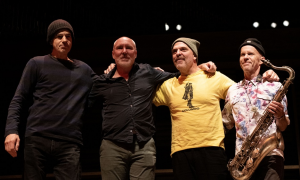
The Hemphill Stringtet
If ever a collision loomed between the ambitions of Winter Jazzfest and the reality of its venues, it came with an appearance—at Zinc Bar, the sole purely jazz venue of the marathon—by The Hemphill Stringtet, which is devoted to playing the compositions of the late avant-jazz composer Julius Hemphill. Scheduled between two mainstream jazz singers—Gabrielle Cavassa and Laura Anglade—the ensemble faced the challenge of commanding attention at a lush jazz venue with four classical string instruments and a repertoire that was about as far from the American Songbook as jazz stretches.Yet the performance worked wonderfully, which is a credit to both the ensemble and the audience. While cocktail chatter from the bar at the club leaked into the room, the audience at the tables was rapt and enthusiastic.
It helped that the repertoire swung more than might have been expected. The set began with "Revue," the Hemphill-penned earworm with which he and the rest of the World Saxophone Quartet opened their own performances. Then came the show's centerpiece: a suite, based on Charles Mingus compositions, commissioned by the Kronos Quartet but never performed by that group. While not all recognizable as Mingus ("these are as much Hemphill compositions as those of Charles Mingus," said violinist Sam Bardfeld in introducing the works), the three pieces had at least recognizable echoes of jazz. The last of them, based on "Better Get Hit In Your Soul," actually set toes tapping.
The quartet included cellist Tomeka Reid, who qualified as the MVP of this crowded New York jazz weekend. In addition to the Stringtet show, she and her septet presented an engrossing Ellington tribute on Thursday at the Unity Jazz Festival 2026 at Jazz At Lincoln Center, the uptown rival to Winter Jazzfest. She appeared again at Jazzfest, for a show on Saturday with her quartet, which included the don't-miss guitarist Mary Halvorson.
David Murray Quartet
Nearly five decades after he emerged as a brawny new voice on the tenor horn, David Murray showed, in a late-night set at Drom, that he's still capable of volcanic playing. His fiery tone intact, and fueled by bursts of circular breathing, Murray muscled his way through a set drawn mostly from Francesca (Intakt Records, 2025), his acclaimed album named for his wife and recorded with the same band as at Drom, except for Chris Beck standing in for drummer Russell Carter, who played on the recording.Pianist Marta Sánchez was, as ever, a welcome presence on the bandstand, even if the highly amplified sound of the black-box club drained some of the sonic richness from her concert grand. Sanchez's soloing was intricate but never showy, with a clarity and emotional directness that made you lean in every time she took the spotlight.
Perhaps due to the high-energy mood and challenging setting—with a standing crowd, some of whom were chattering at the back—Murray spent a little more time than one might have liked in his muscular top gear, and less in the mid-tempos that provide the richest moments of the "Francesca" album.
Speaking of Francesca, for one number, Francesca Cinelli Murray herself made a somewhat polarizing appearance—applauded by some, mocked by others—singing (and sometimes speaking) her French poetry, which leaned more to shrill high drama than warm Gallic romanticism.
James Brandon Lewis
To schedule James Brandon Lewis, who's a generation younger than David Murray, to immediately follow the 70-year-old at Drom was a programming masterstroke. It allowed the audience to hear the acclaimed new muscular voice in tenor saxophone right after a performance by the player who has epitomized a huge sax sound for decades.The contrast between the two tenorists was fascinating. Lewis builds his sound not so much on titanic flurries of notes, like Murray, but on sustained figures—riffs almost—from which he occasionally breaks out into controlled yet powerful solos. The contrast was accentuated on this night by Lewis's decision to play in a trio that lacks a chording instrument, which of course demands that the leader sustain sound almost continuously—hence the repeating figures.
The fact that Lewis's rhythm section uses an electric bassist—Josh Werner—who favors funk patterns tends to make Lewis's figures funky in themselves. At times, he sounded almost as much like, say, King Curtis as John Coltrane. The funk faded, though, when Lewis soloed. On these excursions, he unleashed an approach as expansive and articulate as his heroes John Coltrane and Albert Ayler, and with a creamy, slow-vibrato sound that's as rich as any on the scene today.
 FOLLOW Paul Reynolds
and get notified whenever a new article published.
FOLLOW Paul Reynolds
and get notified whenever a new article published.
Journalist and programmer in jazz, folk, country and other musics
About Nels Cline

Tags
PREVIOUS / NEXT
Become a Sustaining Member

Since 1995, All About Jazz has championed jazz as an art form and supported the musicians who create it. Over three decades, it has grown into one of the world's leading jazz resources, serving hundreds of thousands of readers, musicians, presenters and industry professionals each month.
Help Build the Future of All About Jazz
Your support helps us continue building All About Jazz for the next generation—expanding our editorial coverage, preserving jazz history, developing new community features and creating better ways to discover the music and the people behind it.
Become a sustaining member for as little as $20 per year and you'll immediately enjoy an ad-free experience along with access to subscriber features and future articles for a full year.
Together, we're not simply sustaining All About Jazz—we're building its future. Thank you for being part of the journey.