Home » Jazz Articles » Live Review » Obsolescence Quartet at The Treelawn Social Club
Obsolescence Quartet at The Treelawn Social Club
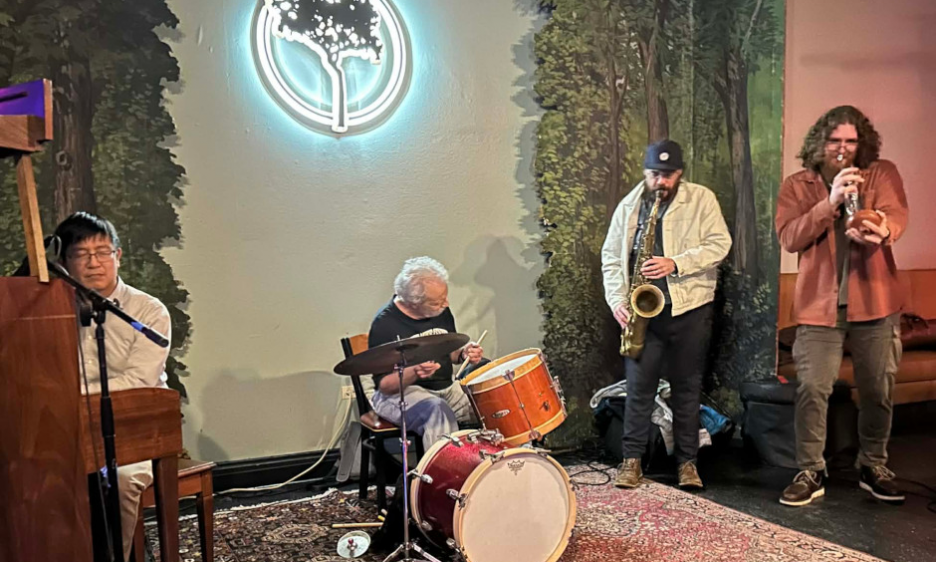
Courtesy Don Sebian
The Treelawn Social Club
Cleveland, OH
January 11, 2026
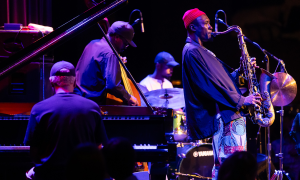
An evening of completely improvised music by top-level players is not an everyday thing in Cleveland. So the Sunday evening set by the cheekily named Obsolescence Quartet (an oblique reference to the effects on human creators of artificial intelligence) was self-recommending.
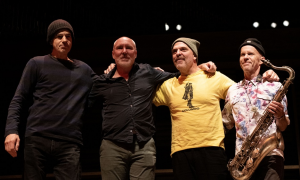
Chalk that up to the eminence of the musicians. On the front line, tenor saxophonist Joshua Smith, making an intermittent visit to his hometown, has roamed the borderlands between tightly composed music and free improvisation for years, most notably with bassist Jeremy Bleich and drummer Joe Tomino in the cooperative trio, Birth. Trumpeter Garrett Folger explores similar territory in a cooperative trio, Horizon , with pianist Anthony Fuoco and drummer Carmen Castaldi. Pianist Keigo Hirakawa—on weekend leave from his day job as professor of electrical engineering at the University of Dayton—is a longstanding collaborator of Smith's, with whom he recorded Hessler-Cabrillo Run Down (Self Produced, 2023), dedicated to Cleveland legend Harvey Pekar.
The fulcrum of the quartet was drummer Castaldi, who, from his minimum viable kit (a bass drum, a cymbal, and a snare drum), defined the sound of the band. Remarkably, he did this without in any way leading it. Instead, his contribution was collaborative to the point of self-effacement. Yet the slightest gestures, the addition or disengagement of the snares on his ancient, wooden-hooped parade drum, the change from sticks to brushes, had an Archimedean effect on the sound of the ensemble. His bass drum pedal was a sonic roux, thickening the texture and density of the music and putting muscle behind it.
Smith similarly engaged with matters of density. His big-shouldered tenor sound acted as a ballast for the unstructured and discursive music in the single, uninterrupted set. Ideas arose and receded in this conception like convection currents, but those ideas were as likely as not to come at Smith's instigation, as did the inspiration for convening the quartet.
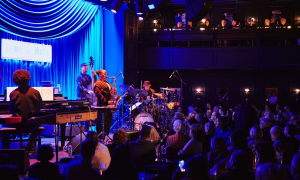
Smith played with Hirakawa the night before in a conventional horn-plus-rhythm quartet at Bop Stop under the pianist's leadership. The pianist has an admirable command of the post-bop language, but as he proved on this occasion, he is not bound by it. With no harmonic grid to mind or map out, Hirakawa mostly contributed texture—or so it seemed. Even in the relatively intimate Treelawn Social Club in the company of a quiet drummer, he was hard to hear before Smith moved a pair of orphaned microphones near the harp of the venue's upright.
Like Castaldi, his band mate in the ECM-y Horizon Trio, Folger is a colorist, and he used a variety of mutes—cup, Harmon, and plunger—to add crimson slashes and icy blue smears throughout the set. Most remarkably, he created a parlando effect of indeterminate pitches that were uncannily speechlike. His comfort zone is usually in the lower and middle ranges of his horn, which brings the quiet beauty of his tone to the fore. Yet he startled with lightning bolts of high, rapidly tongued passages. Folger is one of the most active players on the scene—there seems to be no gig he is not willing to take on—and each one marks his growth as an artist.
It would be convenient to categorize the Obsolescence Quartet as the union of two established duo partnerships, Smith and Hirakawa on the one hand and Castaldi and Folger on the other. But that would be reductive and glib. Anyone looking for the kind of deep integration and united purpose born of long experience together might have been disappointed.
The pleasure in hearing the Obsolescence Quartet arrived moment to moment. When so many bands—or maybe they are better characterized as projects—present music that can sound over-determined and stiffly executed, the kind of music making heard on a frigid Sunday evening in a former Slovenian social club was refreshing and satisfying. Let us hope it never becomes obsolete.
 FOLLOW John Chacona
and get notified whenever a new article published.
FOLLOW John Chacona
and get notified whenever a new article published.
John Chacona is a freelance journalist, content writer and producer in Cleveland.
About Joshua Smith
Tags
PREVIOUS / NEXT
Become a Sustaining Member

Since 1995, All About Jazz has championed jazz as an art form and supported the musicians who create it. Over three decades, it has grown into one of the world's leading jazz resources, serving hundreds of thousands of readers, musicians, presenters and industry professionals each month.
Help Build the Future of All About Jazz
Your support helps us continue building All About Jazz for the next generation—expanding our editorial coverage, preserving jazz history, developing new community features and creating better ways to discover the music and the people behind it.
Become a sustaining member for as little as $20 per year and you'll immediately enjoy an ad-free experience along with access to subscriber features and future articles for a full year.
Together, we're not simply sustaining All About Jazz—we're building its future. Thank you for being part of the journey.