Home » Jazz Articles » Live Review » The Maria Schneider Orchestra at Birdland
The Maria Schneider Orchestra at Birdland
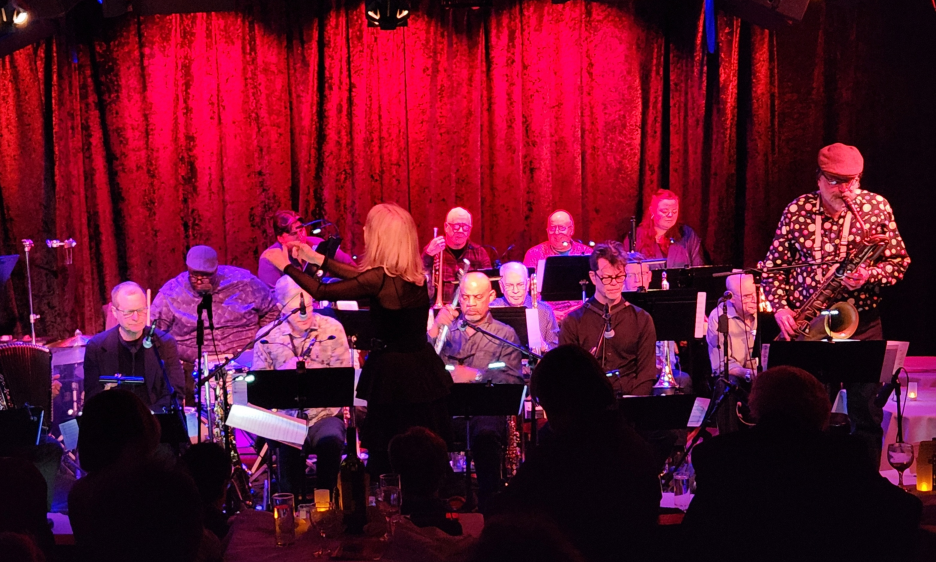
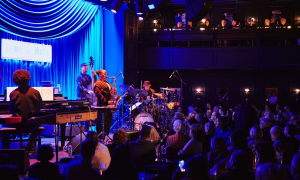
The set married the sophistication of jazz with homespun directness, through both Schneider's music, some of it inspired by her Minnesota hometown and her Midwestern charm.
A case in point came early in the set by her 18-piece orchestra—for which, as usual, Schneider conducted and composed all the material. She introduced a family in attendance from her hometown, complete with their young boys, Amos and Reuben. The acknowledgment set up a piece dedicated to Windom, MN—population around 4,000, at least when Schneider was growing up there in the 1960s and 1970s.
The piece, "Home," inspired by the childhood drive from town to her family's farm, was quintessential Schneider, featuring rich melodicism and narrative drive. It began with gently propulsive passages with varied textures, in part provided by some less-than-customary big-band instrumentation including electric guitar (Jeff Miles) and accordion (Julien Labro). Then, following the narrative she'd described in her introduction, the music slowed and turned more reflective, painting the view of Windham from a lookout that was partway on the journey.
Schneider captured the town's twinkling lights through burbling ensemble work, with multiple horns sustaining an amiable conversation. Then the piece quickened for the final drive to home, made more nostalgic through snippets of the music Schneider grew up with, including the refrain from "As Time Goes By" and hints of the Chopin compositions her mom would play on the household's piano.
Strong thematics ripple through Schneider's work, and the themes are often weightier, and darker, than a night drive across a rolling prairie, as several selections at Birdland portrayed. A piece drawn from Data Lords (ArtistShare, 2020), her twin-Grammy-winning 2020 album, was Schneider as activist, in her long-time campaign for artists' rights and fair compensation in the digital age—an initiative that means little of her work is available on streaming platforms such as Spotify.
The composer/arranger brought an approachable wondrousness even to that album's Cold-War themed "Sputnik"—which won her one of her Grammys, for Best Jazz Composition. Its spaciousness conjured up the open skies of the 1960s, when few but the U.S. and Russia had hardware circling the globe above us.
"American Crow"—now a gorgeous new performance/narrative video, linked at the bottom of the page—seeks to chart the fraying of American political discourse, Schneider says. It began wistfully, with the tender trumpet solo by Mike Rodriguez set against pillows of horns. Eventually, the harmoniousness was lost to a cacophony, meant to represent, in Schneider's words, how "we don't talk with, but more over one another." Finally, though, Miles's guitar longingly recalled the pastoral theme, a reprise that Schneider says is meant to question whether our country can find our way back to a more respectful dialogue.
Like the best big-band leaders, Schneider showcases her soloists, most of whom are longtime colleagues, including some notably undersung stalwarts of the New York scene. The compositions are tailored to these players' solo strengths. Prime examples at Birdland were two saxophone solos: a soothing, sustained baritone solo by Scott Robinson in "Sputnik" and a lyrical soprano excursion in the opening number by Steve Wilson, who has never sounded better.
These solos were so well-integrated into her pieces as to sound written, rather than improvised. Yet, in a brief chat after the set, Schneider said such excursions are in fact fully improvised. She said if they sound otherwise, it's because so many of her players "think compositionally."
The bright openness of Schneider's music—and her introductions, in which she favors phrases like "gosh" and "oh my goodness"—make her performances authentic and heartfelt, serious and yet approachable.
 FOLLOW Paul Reynolds
and get notified whenever a new article published.
FOLLOW Paul Reynolds
and get notified whenever a new article published.
Journalist and programmer in jazz, folk, country and other musics
About Maria Schneider

Tags
PREVIOUS / NEXT
Maria Schneider Concerts
Become a Sustaining Member

Since 1995, All About Jazz has championed jazz as an art form and supported the musicians who create it. Over three decades, it has grown into one of the world's leading jazz resources, serving hundreds of thousands of readers, musicians, presenters and industry professionals each month.
Help Build the Future of All About Jazz
Your support helps us continue building All About Jazz for the next generation—expanding our editorial coverage, preserving jazz history, developing new community features and creating better ways to discover the music and the people behind it.
Become a sustaining member for as little as $20 per year and you'll immediately enjoy an ad-free experience along with access to subscriber features and future articles for a full year.
Together, we're not simply sustaining All About Jazz—we're building its future. Thank you for being part of the journey.