Home » Jazz Articles » Jazz Fiction » To Boldly Swing
To Boldly Swing
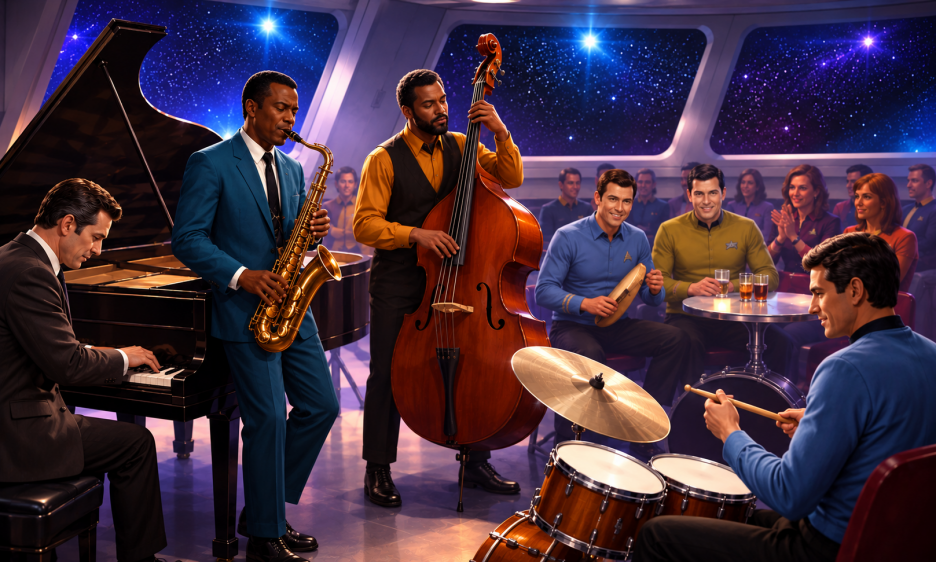
"Welcome aboard," said the transporter chief, smiling as if jazz bands materialized on Federation starships every day. Maybe they did. It was 2265, after all. Jazz had come a long way from smoky basements on Earth.
One shimmer later, my quartet and I were standing on the transporter pad: bass, drums, tenor sax, and me at the piano—though my piano would be provided, replicated to spec and tuned to perfection. The Federation was very good at details.
Captain James T. Kirk greeted us personally. I'd seen his image a thousand times, but in person he had that unmistakable presence—like a bandleader who didn't play an instrument but somehow kept everyone locked into the same groove.
"Glad to have you aboard," he said. "The crew's been looking forward to this. Long-range mission. We need music."
Music, I'd learned, was considered essential to morale across the Federation. Jazz musicians were cultural officers now, traveling ship to ship, planet to planet, playing concerts, brunches, late-night jam sessions in mess halls and observation lounges. Jazz had moved from national, to international, to planetary, to intergalactic. Somewhere along the way, it became universal.
Spock was the first officer I met after Kirk. He inclined his head slightly when introduced.
"I understand you are the bandleader," he said. "I have studied the harmonic structures of jazz extensively."
"Studied?" I smiled. "Careful, Mr. Spock. Jazz doesn't like to be studied too closely."
"On the contrary," he replied. "Improvisation, when executed properly, is a logical expression of real-time problem solving."
Later that evening, he surprised us all by bringing a Vulcan lute to the observation lounge. The instrument had a curved neck and strings that shimmered faintly under the stars.
"I will attempt to participate," he said.
Attempt was an understatement. Spock didn't swing the way a human did—his time feel was... precise—but his lines were daring, angular, and fearless. He played outside and then resolved with mathematical elegance. The crew gathered quickly. Bones shook his head but smiled. Uhura closed her eyes and nodded along. Even Kirk leaned against the bulkhead, tapping his foot.
"This cat's got ideas," my saxophonist whispered.
Our first official gig was a formal concert in the main recreation hall. The piano—black, gleaming, and somehow familiar—responded beautifully under my fingers. We opened with a standard, something from Earth's old songbook, and then let it stretch, breathe, evolve. The Enterprise glided through space as we played, stars streaking silently past the viewport, the universe keeping time.
After the show, Kirk raised a glass. "That," he said, "is why jazz survives."
A few days later, excitement found us.
The Enterprise encountered a Klingon vessel near the edge of a disputed sector. Red alert. Battle stations. Our instruments were stowed, our nerves humming louder than any amplifier. From our quarters, we felt the ship tense, like a rhythm section waiting for the downbeat.
Then—silence.
Negotiations followed. Tense ones. Eventually, a Klingon delegation boarded the Enterprise. Their reputation preceded them: fierce, proud, warriors to the core.
What history books hadn't fully captured was this: Klingons loved jazz.
One of them—tall, scarred, carrying something that looked suspiciously like a brass instrument—locked eyes with my drummer in the corridor.
"You play," he growled.
"Yeah," my drummer said. "We play."
The jam session that followed wasn't planned, sanctioned, or even particularly safe. It happened in a cargo bay, instruments hauled out alongside crates of supplies. Klingon percussion thundered like a battlefield chant. Their horn player bent notes until the air itself seemed to crack. We answered in kind.
Spock joined, of course.
What emerged wasn't Earth jazz or Klingon music—it was something else entirely. A shared language built in real time, full of tension, release, call and response. At one point, a Klingon bassist locked in with ours so tightly you'd swear they'd grown up in the same neighborhood.
When it ended, there was laughter. Actual laughter. A Klingon clapped me on the shoulder hard enough to nearly knock me over.
"Your music," he said, "has honor."
The next morning, Kirk thanked us. "You may have prevented a minor war," he said casually, like that sort of thing happened every day.
Our final day aboard the Enterprise was a brunch set—light, swinging, optimistic. Crew members drifted in and out, coffee cups in hand, smiling. Spock sat quietly, listening, his fingers occasionally tracing silent patterns on the table.
As we prepared to disembark, I looked back at the ship—this incredible vessel carrying exploration, diplomacy, science... and music into the unknown.
Jazz had always been about connection. About listening. About finding common ground in the moment. In 2265, on a starship traveling faster than light, it was still doing exactly that.
 FOLLOW Michael Ricci
and get notified whenever a new article published.
FOLLOW Michael Ricci
and get notified whenever a new article published.
Michael Ricci suffers from Chronic Curiosity Syndrome, accompanied by an incurable urge to build things.
Tags
PREVIOUS / NEXT

Become a Sustaining Member

Since 1995, All About Jazz has championed jazz as an art form and supported the musicians who create it. Over three decades, it has grown into one of the world's leading jazz resources, serving hundreds of thousands of readers, musicians, presenters and industry professionals each month.
Help Build the Future of All About Jazz
Your support helps us continue building All About Jazz for the next generation—expanding our editorial coverage, preserving jazz history, developing new community features and creating better ways to discover the music and the people behind it.
Become a sustaining member for as little as $20 per year and you'll immediately enjoy an ad-free experience along with access to subscriber features and future articles for a full year.
Together, we're not simply sustaining All About Jazz—we're building its future. Thank you for being part of the journey.