Home » Jazz Articles » Jazz Fiction » A Love Supreme at Carnegie Hall: Coltrane’s Night of Fir...
A Love Supreme at Carnegie Hall: Coltrane’s Night of Fire and Grace
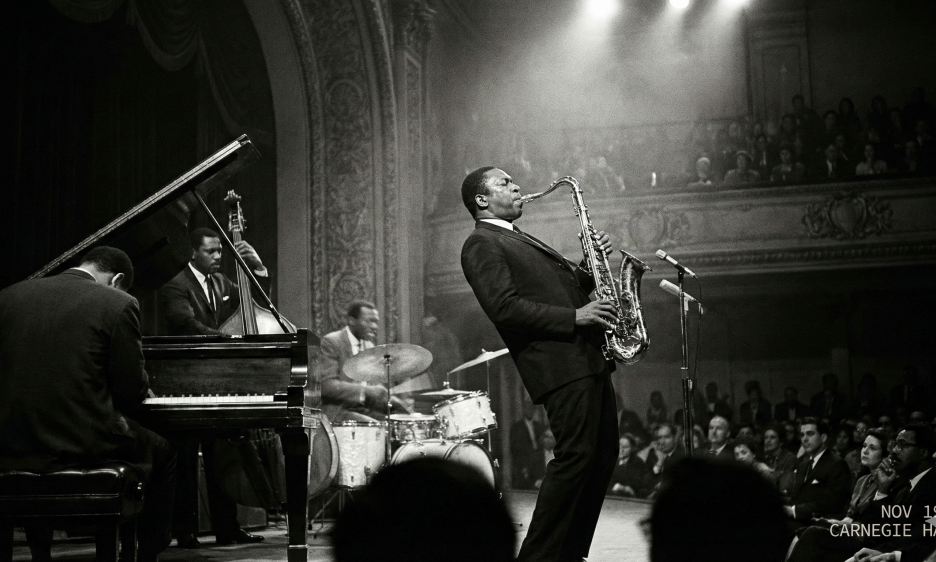
Courtesy AI
Something sacred broke open the air last night.
It began not with a note, but with a shimmer. Elvin Jones washed a mallet across a suspended gong, a metallic exhale that seemed to expand until it touched the gilded balconies of Carnegie Hall. The silence that followed was heavy, not empty—the kind of silence that waits for a prophecy. When John Coltrane stepped forward, flanked by McCoy Tyner and Jimmy Garrison, the tuxedoed formality of the venue felt suddenly brittle, ill-equipped to contain what was about to happen.
There was no count-off. Just the downbeat.
Part I: Acknowledgement
When Garrison's bass fingers locked into that four-note ostinato—E, F-sharp, E, B—it wasn't just a bass line; it was the earth shifting. It rumbled through the floorboards, vibrating against the soles of shoes. Then Coltrane entered. His tone was not the smooth mahogany of his early years; it was granite. Raw, vocal, and terrifyingly focused.As the motif took hold—a love su-preme, a love su-preme—the hall shrank. Tyner's left hand struck the keys with percussive violence, stacking quartal harmonies that built a cathedral of sound, only for Coltrane to scale its spire and leap off.
Part II: Resolution
By the second movement, the polite atmosphere of 57th Street had evaporated. The quartet was no longer playing a song; they were dismantling the room. Coltrane's horn was aflame, spitting multiphonics and overtones that sounded like two saxophones screaming at once. He wasn't just improvising; he was searching, rapidly tearing through chord changes as if looking for a door that hadn't been built yet.Tyner matched him, hammer for anvil, his brow glistening with sweat, his fingers blurring as he laid down thick, churning block chords that dared the soloist to go higher.
Part III: Pursuance
Then, the storm broke. Elvin Jones did not merely play the drums; he brawled with them. Pursuance launched with a drum solo that felt like a natural disaster contained in a five-piece kit. Jones was a blur of motion, his polyrhythms creating a dense, rolling thunder that seemed to suck the oxygen out of the room.When Coltrane re-entered, the speed was blinding. The music bordered on chaos, a "sheets of sound" approach that had turned into sheets of fire. I saw a man in the third row clutch the armrests of his velvet seat, knuckles white, as if bracing for impact. It was relentless. It was exhausting. It was magnificent.
Part IV: Psalm
And then, the fire turned to light.The transition to Psalm was not a deceleration, but a levitation. The rhythm section dropped away to a rumble of tympani mallets and bowed bass—a drone of ancient wood and wire. Coltrane began his recitation. He did not speak a word, yet he articulated every syllable of the poem he had written, his saxophone adopting the cadence of a preacher in deep prayer.
He bent notes until they wept. He stretched time. The ferocity of the previous hour distilled into a tone of such aching vulnerability that it felt intrusive to listen. Tyner's chords chimed like bells in a valley; Garrison's bow groaned with the weight of the earth.
When the final phrase dissolved into the upper rafters, the silence returned. But it was different now. It was the silence of a crater after an impact. For ten seconds, no one moved. No one coughed. The stillness was absolute.
Afterword
When the ovation finally came, it was not the polite applause of high society; it was a release of tension, a roar of survival and gratitude.It is difficult to file a standard review for what occurred last night. A Love Supreme is ostensibly a jazz suite. But in the hands of this quartet, on this night, it became a ritual. We did not just hear music; we witnessed a man trying to play his way out of the mortal coil, trying to speak to God in a language made of wind and reed.
For 90 minutes, Carnegie Hall ceased to be a concert venue. It was a witness. And we, the breathless congregation, will never be the same.
 FOLLOW Dave Kaufman
and get notified whenever a new article published.
FOLLOW Dave Kaufman
and get notified whenever a new article published.
Dave loves photographing both jazz and wildlife.
About John Coltrane

Tags
PREVIOUS / NEXT

Become a Sustaining Member

Since 1995, All About Jazz has championed jazz as an art form and supported the musicians who create it. Over three decades, it has grown into one of the world's leading jazz resources, serving hundreds of thousands of readers, musicians, presenters and industry professionals each month.
Help Build the Future of All About Jazz
Your support helps us continue building All About Jazz for the next generation—expanding our editorial coverage, preserving jazz history, developing new community features and creating better ways to discover the music and the people behind it.
Become a sustaining member for as little as $20 per year and you'll immediately enjoy an ad-free experience along with access to subscriber features and future articles for a full year.
Together, we're not simply sustaining All About Jazz—we're building its future. Thank you for being part of the journey.