Home » Jazz Articles » Book Review » The Philosophy Of Jazz
The Philosophy Of Jazz
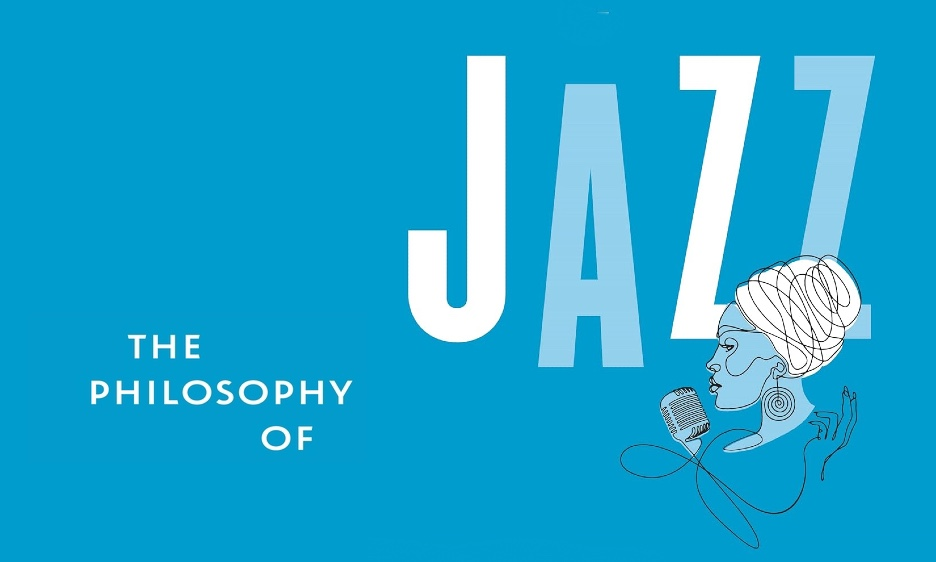
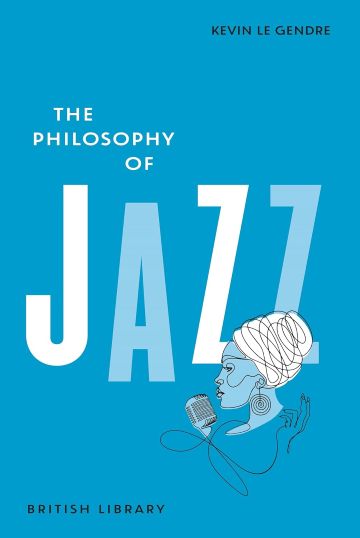 The Philosophy Of Jazz
Kevin Le Gendre
105 Pages
ISBN: 978 0 7123 5503 2
British Library
2025
If you had to recommend just one book on jazz history to a neophyte, which would it be? Ted Gioia's The History of Jazz (Oxford University Press, 1997) is rightly regarded as a definitive account, but at nearly 600 pages it may deter readers looking for a lighter introduction. What if the essential information could be distilled into something closer to 100 pages? That is precisely what Kevin Le Gendre achieves with The Philosophy of Jazz—a compact, engaging primer that explains the when, where, who, why, and how of jazz in clear, succinct language.
Beyond its utility as an overview, this slim but engaging book also grapples with the larger and more elusive question of what jazz actually is. It is a slippery concept, because, as jazz journalist and author Le Gendre explains, jazz represents wildly different things to different people.
Dance music, romance, bebop and swing, acoustic and electric jazz, hip-hop, and the New Thing all feature in his account. Le Gendre unpacks the form and content of jazz's many roots and branches, noting not only the diversity of styles but also the wide range of instrumentation and ensemble formats the music has embraced. As he observes, "Survey enough jazz ensembles and it soon becomes apparent that there really is no jazz band per se."
Within a few short, fact-packed pages, the reader comes to understand that jazz is more than a question of style, form, or content—it is a philosophy rooted in freedom of expression. This philosophy inevitably carries a socio-political dimension, and Le Gendre places the music, along with some of its key practitioners, within the broader historical framework of slavery, emancipation, and the ongoing Civil Rights movement in the United States and beyond.
Given the modest length of the book relative to the vastness of its subject, the author's focus is necessarily selective. While acknowledging the global identity of jazz—"International Jazz Day is an annual event that also happens every day"—Le Gendre is upfront about his primary geographical reference point being the United States and about pioneering Black musicians forming the backbone of his narrative.
The book is structured in three parts: the present, the past, and the fertile ground where the two intersect. It is telling that Le Gendre begins with jazz in the present. This opening section functions almost as a mission statement, asserting the music's immediacy and contemporary relevance. Drawing on figures such as Immanuel Wilkins and James Brandon Lewis, whose work exemplifies jazz's continued engagement with social and spiritual themes, alongside vocal innovator Cecile McLorin Salvant and boundary-pushing pianists such as Craig Taborn and Myra Melford, and steel pan virtuoso Leon Foster Thomas, Le Gendre assembles a persuasive roll call of 21st-century innovators. The message is clear: jazz is in robust health.
His discussion of big bands led by figures such as Etienne Charles, Orrin Evans, and Maria Schneider reinforces this point, highlighting the seemingly inexhaustible possibilities of the format. The enduring appeal of the big band, Le Gendre argues, lies in its capacity for scale and scope: "it enables jazz artists to fulfil a key tenet of the music—ambition."
Artists such as Jason Moran, who embrace multimedia collaborations, further demonstrate jazz's adaptability. As Le Gendre is careful to point out, however, the intersection of jazz with film, dance, and poetry is not a recent development but a practice almost as old as the music itself.
Turning to the past, Le Gendre pays homage to foundational figures including Jelly Roll Morton, Louis Armstrong, Duke Ellington, Thelonious Monk, and Charlie Parker, each emblematic of a crucial stage in jazz's evolution. Ragtime, he notes, "enshrined Black colloquialism as a notable phenomenon," while the instrumentation of early jazz reflected the African (banjo) and European (cornet) influences at play in the melting pot of New Orleans at the end of the 19th century.
Alongside African and European roots, early jazz absorbed Native American and Caribbean influences—plus ça change, plus c'est la même chose, n'est-ce pas?
The blues is accorded its rightful place as a cornerstone of jazz history. Le Gendre highlights the political, psychological, and emotional weight of the blues as sung by Ma Rainey, Mamie Smith, and Bessie Smith, among others. Against the backdrop of segregation and systemic racism in the United States, he invites reflection on the lyrical ingenuity and daring of Black blues artists:
"Considering that up until the 1860s anti-literacy laws prohibited slaves from learning to read and write, and that equality in public education remained a battleground for decades post-emancipation, what African Americans have achieved with language is remarkable."
If the blues forms jazz's foundation, then folk traditions from across the globe supply its bricks and mortar, depending on the individual artist. African, Brazilian, Caribbean, Asian, and European influences all find a place within jazz, as does hip-hop. From cornets to pedal boards and laptops, the music has rarely stood still. Citing trombonist George Lewis' use of computers in jazz as early as the 1970s, Le Gendre argues that "the idea of cutting-edge technology not only adding interesting effects to improvised music but being used as a means of improvisation is a norm."
If there is a single sentence in the book that encapsulates the philosophy of jazz, it is the idea of a music "pushing towards what has not been heard before, of making possible the seemingly impossible."
The final section of the book explores the bridge between past and present. From longstanding traditions of intergenerational mentorship to the enduring influence of jazz's trailblazers, the music repeatedly looks backwards in order to move forwards. A standard played in the 1940s can sound urgent and contemporary today- -"this alchemy of old begetting new." Such reinterpretations illuminate both eras: "So, Moran playing Monk says something about the way Moran hears drums in the age of hip-hop and how Monk heard drums in the age of bebop."
Similarly, the sampling of jazz records from the 1960s and 1970s by hip-hop DJs has revived interest in some of jazz's less celebrated figures while drawing the languages of hip-hop and jazz closer together. As Le Gendre succinctly puts it, "A new genre taught an old one about itself."
Across its 100 pages, The Philosophy of Jazz presents jazz not as a single style bound by formulas but as an approach to making improvised music. Almost anything is possible: any number of musicians, any combination of instruments, any rhythm, and whatever technology happens to be available. Jazz can be playful, exploratory, or—as pianist McCoy Tyner memorably put it—"as serious as your life."
 FOLLOW Ian Patterson
and get notified whenever a new article published.
FOLLOW Ian Patterson
and get notified whenever a new article published.
Ian is dedicated to the promotion of jazz and all creative music all over the world, and to catching just a little piece of it for himself.
About Immanuel Wilkins

Tags
PREVIOUS / NEXT


Become a Sustaining Member

Since 1995, All About Jazz has championed jazz as an art form and supported the musicians who create it. Over three decades, it has grown into one of the world's leading jazz resources, serving hundreds of thousands of readers, musicians, presenters and industry professionals each month.
Help Build the Future of All About Jazz
Your support helps us continue building All About Jazz for the next generation—expanding our editorial coverage, preserving jazz history, developing new community features and creating better ways to discover the music and the people behind it.
Become a sustaining member for as little as $20 per year and you'll immediately enjoy an ad-free experience along with access to subscriber features and future articles for a full year.
Together, we're not simply sustaining All About Jazz—we're building its future. Thank you for being part of the journey.