Home » Jazz Articles » Big Band in the Sky » Remembering Marilyn Mazur: Percussion Shaman
Remembering Marilyn Mazur: Percussion Shaman
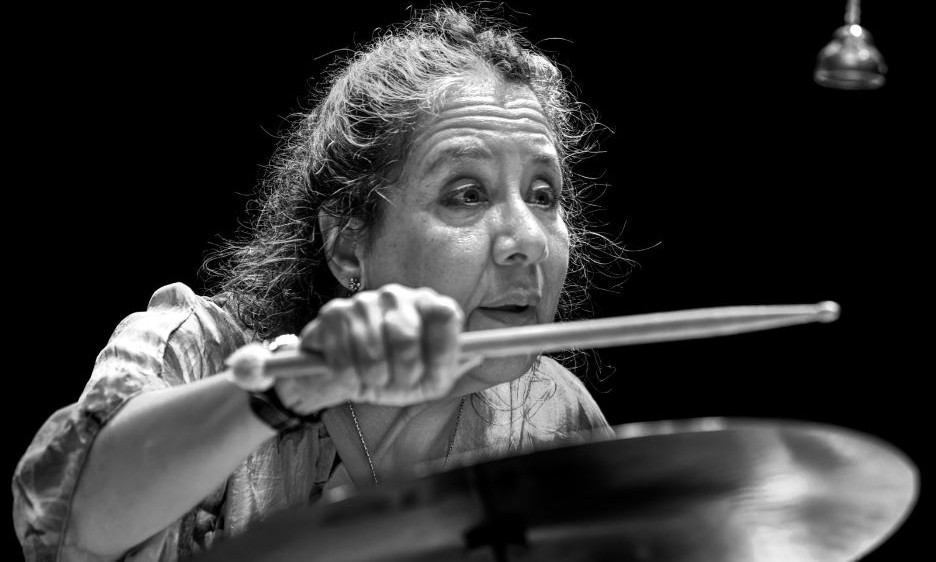
Courtesy Guy Fonck
Mazur was born in New York City in 1955 to a Polish mother and an Afro-American father. As she told All About Jazz in a 2015 interview, her ears were drawn to music while still a toddler. "What I remember is that my mother had a baby-book with percussion sounds and my family kept telling me that I was fascinated by them and wanted to hear them again and again... "
The family moved to Denmark when Mazur was six. In the new surroundings, her parents' record player became a source of fascination for the youngster. "I was 7 or 8 years old, and I would close the curtains and retire into a magical world to listen to Stravinsky's 'Le Sacre du printemps... ' I also think that 'Le Sacre du printemps' has inspired me a lot, because I was fascinated by the ritual aspect of music ever since."
As a child, Mazur took classical piano and ballet classes, joining a professional dance group in Copenhagen upon leaving school. She formed her first band, as a pianist, in 1973, but her switch to classical percussion and drums at the age of 19—she studied in the Conservatory in Copenhagen—would alter the course of her life.
So too would her first encounter with Miles Davis' Bitches Brew (Columbia Records, 1970), which a friend introduced her to. "Bitches Brew really set a mark for me," Mazur told AAJ's Adriana Carcu, because ever since I see music as a magical way of communication."
Mazur's first significant project as leader was the all-female, experimental music-theatre group, Primi Band—founded in the late '70s. It was the first of numerous celebrated groups she would lead, among which the long-running Future Song, the percussion-cum-vocals ensemble Percussion Paradise, Celestial Song, and Shamania—the latter comprised of 12 women.
Tone and timbre were just as important to Mazur as rhythm, and she employed a vast array of percussive instruments: clay drums; balafon; gongs, bells and chimes; waterphone; tuned log-drums; shakers and random objects. She incorporated dance, movement and global musical textures into her performances.
Vocals were another important component of Mazur's sonic landscape. Over the span of decades, she worked with vocalists such as Josefine Cronholm, Sissel Vera Pettersen, Ania Rybacka, the Ars Nova vocal ensemble, and Norma Winstone. As a musical element, the voice was sometimes central to her music. One of Mazur's most fascinating collaborations was with the Trondheim Voices, performing on the group's debut album Improvoicing (MNJ Records, 2010).
In the '80s, Mazur was a frequent collaborator with Danish avant-garde jazz guitarist Pierre Dørge, in the '90s with Swedish saxophonist Jan Garbarek, and in the 2000s with Japanese pianist Makiko Hirabayashi. But it was her appearance on Miles Davis' album Aura (Columbia Records, 1989)—recorded four years earlier—and her stints in the trumpeter's touring band between 1985-1988 that introduced Mazur to a wider audience.
Her own musical ambitions, however, saw her leave Davis' band and return home: "I wanted to move on with my own music, do my own thing, and I felt that if I waited any longer, I may not be able to do it at all."
In all, Mazur recorded around 20 albums as a leader. She composed music for children, arranged and conducted for orchestra, and worked with the cream of jazz musicians in Denmark and Scandinavia. In 2006, Mazur was the subject of a documentary by Danish film maker Christian Braad. The title, appropriately, was Queen of Percussion.
Marilyn Mazur (1955-2025) is survived by her husband, Klavs Hovman, and their son, Fabian Mazur.
 FOLLOW Ian Patterson
and get notified whenever a new article published.
FOLLOW Ian Patterson
and get notified whenever a new article published.
Ian is dedicated to the promotion of jazz and all creative music all over the world, and to catching just a little piece of it for himself.
About Marilyn Mazur

Tags
PREVIOUS / NEXT


Become a Sustaining Member

Since 1995, All About Jazz has championed jazz as an art form and supported the musicians who create it. Over three decades, it has grown into one of the world's leading jazz resources, serving hundreds of thousands of readers, musicians, presenters and industry professionals each month.
Help Build the Future of All About Jazz
Your support helps us continue building All About Jazz for the next generation—expanding our editorial coverage, preserving jazz history, developing new community features and creating better ways to discover the music and the people behind it.
Become a sustaining member for as little as $20 per year and you'll immediately enjoy an ad-free experience along with access to subscriber features and future articles for a full year.
Together, we're not simply sustaining All About Jazz—we're building its future. Thank you for being part of the journey.