Home » Jazz Articles » Big Band in the Sky » Remembering Jack DeJohnette: Unlimited Imagination
Remembering Jack DeJohnette: Unlimited Imagination
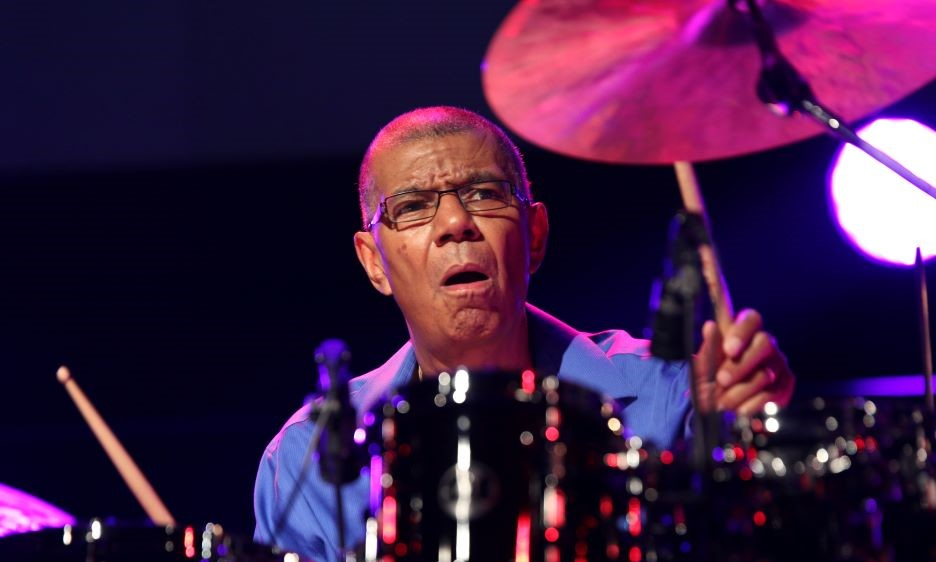
Courtesy Oliver Abels
I think musicians have to be more courageous. It's your voice, you know?
—Jack DeJohnette
DeJohnette belongs in the pantheon of great jazz drummers. If there were a Mount Rushmore of jazz drummers—and it would need to be one big old rock—Jack DeJohnette would certainly be there.
His unique and dynamic style incorporated elements of different eras of jazz, but also r&b and a drive that was closer to rock. No wonder Miles Davis recruited DeJohnette for Bitches Brew (Columbia, 1970)—a controversial and era-defining album that continues to make waves today.
In a 60-year career DeJohnette also played with Charles Lloyd, Abbey Lincoln, Betty Carter, Bill Evans, AACM founding members Muhal Richard Abrams and Roscoe Mitchell, John Scofield and Dave Holland, among many others. On occasion he would sit in with the Sun Ra Arkestra during the band's Chicago years.
His longevity and open-mindedness to music meant that DeJohnette's collaborations happily straddled jazz's generational mores and individual stylists. From Jackie McLean and Sonny Rollins to Wadada Leo Smith and Henry Threadgill, from McCoy Tyner to John Abercrombie, from Pat Metheny to Anouar Brahem and from Bill Frisell to Bruce Hornsby, DeJohnette's agility and tireless invention—he would tune the drums differently practically every time—lit up every setting he graced.
Ever versatile and boasting formidable technique, DeJohnette was in many ways the perfect modern drummer. "I love to play grooves," DeJohnette explained to All About Jazz in 2006. "Aside from swinging, and being abstract, I also love to be in the pocket and make a groove something substantial."
His contributions to numerous one-off projects, several short-lived groups and recurring collaborations were certainly substantial.
Unquestionably, however, his most celebrated and enduring collaboration was in the Keith Jarrett Trio—commonly referred to as the Keith Jarrett Standards Trio. For over 30 years, beginning in 1983, Jarrett, bassist Gary Peacock and DeJohnette wowed audiences around the world with their frequently sublime improvisational dialogs. Their studio recordings were rare, with around 20 live albums (at time of writing) a testament to the trio's natural environment of the stage. For an insight into what made the trio tick, dive into Karl Ackerman's The Keith Jarrett Trio: Ten Essential Recordings.
Born in Chicago, Illinois, on August 9, 1942, the young DeJohnette was introduced to jazz by his uncle, disc jockey Roy Wood. The piano was DeJohnette's first instrument, with the drummer telling All About Jazz in 2003 that Ahmad Jamal and his drummer Vernel Fournier were early influences. "Ahmad Jamal was always ahead of his time," DeJohnette noted.
Though DeJohnette played solo piano and the blues around Chicago's South Side, it was saxophonist/organist Eddie Harris who persuaded DeJohnette he was a better drummer than a pianist. DeJohnette wanted to play both instruments, but upon moving to New York in 1966—with the support of Muhal Richard Abrams—pianist/organist Big John Patton hired him as a drummer. From there DeJohnette never looked back. He later credited his piano studies as key to playing the drums in an orchestral manner.
Early ambition as a leader saw DeJohnette release The DeJohnette Complex (Milestone Records) in 1968. Nearly forty further albums under his own name would follow in the next five decades, including more than a dozen on Manfred Eicher's ECM Records label. DeJohnette never ceased to experiment. On his own Golden Beams label DeJohnette released the solo album Music in the Key of OM (2005), a soothing ambient exploration that married synthesizer drone, custom—made resonating bells and uncluttered improvisations based loosely on East Indian harmonies. The follow-up, Peace Time (Golden Beams, 2007) bagged DeJohnette a Grammy Award for Best New Age Album.
Throughout his career DeJohnette's drum set up was key to his distinctive sound. In a 2011 interview with pianist George Colligan (published at AAJ in 2013), DeJohnette spoke in detail about his approach to the drums: "I see myself as a colorist, not as a drummer, per se... I tune my drums in such a way so that no matter what I play, whatever I hit on it is a melody and that makes me think differently, it makes me think more melodically... the possibilities are only limited by your imagination."
Colligan knew DeJohnette as well as anybody, having played in the drummer's touring band for seven years. "Referring to Jack merely as a drummer is a massive understatement because he was transcendent of the drums," Colligan told All About Jazz in the wake of DeJohnette's passing.
"His drumming, of course, influenced countless drummers, but more importantly, he changed the way many musicians think about music. He changed how I think about music. Jack's approach as a collaborator in improvised music created a setting where the soloist can literally go in any direction, and Jack helped you go wherever you want to go. He is the epitome of which all of us who play music should aspire to; being great on our instrument but being able to see the total picture and elevate the bandstand."
So generous on the bandstand, it comes as no surprise that DeJohnette the man is remembered so warmly. "Jack was a genuinely humble and warm person," Colligan expanded. "He really loved to connect with people. Jack and his wife Lydia welcomed me into their home like I was part of the family. I'm forever grateful to personally experience some of the magic of Jack DeJohnette. He will be missed. All of us are richer for Jack's music."
DeJohnette's example should serve as a lesson to all aspiring jazz musicians who seek to follow this path. "I think the challenge for musicians is to have the courage to maintain their own voice," DeJohnette told Colligan. "I think musicians have to be more courageous. It's your voice, you know?"
Jack DeJohnette: August 9, 1942—October 26, 2025
 FOLLOW Ian Patterson
and get notified whenever a new article published.
FOLLOW Ian Patterson
and get notified whenever a new article published.
Ian is dedicated to the promotion of jazz and all creative music all over the world, and to catching just a little piece of it for himself.
About Jack DeJohnette

Tags
PREVIOUS / NEXT


Become a Sustaining Member

Since 1995, All About Jazz has championed jazz as an art form and supported the musicians who create it. Over three decades, it has grown into one of the world's leading jazz resources, serving hundreds of thousands of readers, musicians, presenters and industry professionals each month.
Help Build the Future of All About Jazz
Your support helps us continue building All About Jazz for the next generation—expanding our editorial coverage, preserving jazz history, developing new community features and creating better ways to discover the music and the people behind it.
Become a sustaining member for as little as $20 per year and you'll immediately enjoy an ad-free experience along with access to subscriber features and future articles for a full year.
Together, we're not simply sustaining All About Jazz—we're building its future. Thank you for being part of the journey.