Home » Jazz Articles » Big Band in the Sky » Abdullah Ibrahim: 1934–2026
Abdullah Ibrahim: 1934–2026
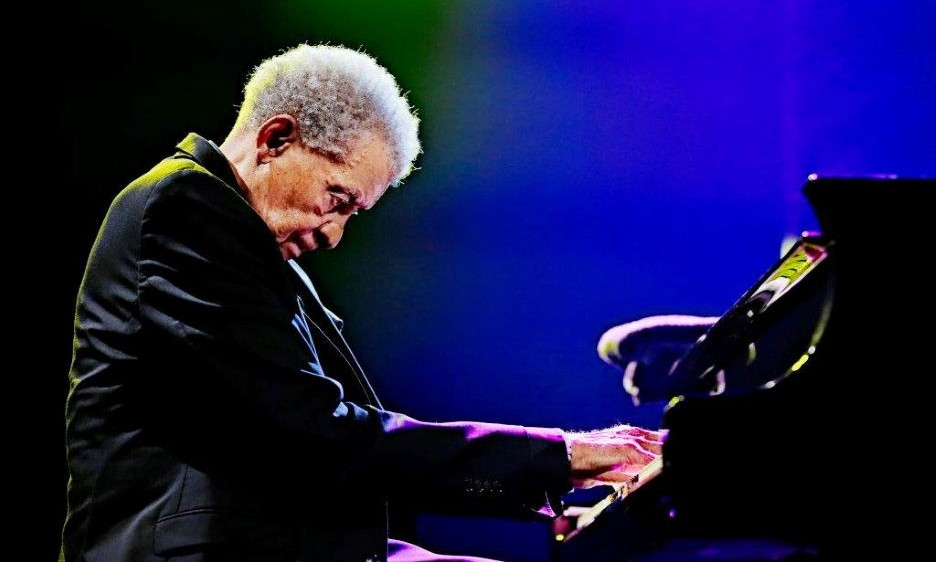
Courtesy Getty Images
The pianist who made a homeland’s music—from District Six to Congo Square.
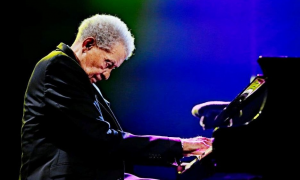
Frail but undimmed, Ibrahim last performed on 27 March at the Cape Town International Jazz Festival, in the city that made him.
He grew up around District Six, the inner-city quarter—mixed, Muslim, musical—that the apartheid state would later try to erase. As a boy he acquired the nickname "Dollar Brand," which he was to use as his professional name. His grandmother played piano for the local African Methodist Episcopal church and his mother led its choir; the Cape Town of his boyhood folded together Khoisan song, Christian hymn, Cape Malay melody, and the American jazz that arrived on sailors' records. He co-founded The Jazz Epistles—among them Kippie Moeketsi, Hugh Masekela Mosa Jonas Gwangwa—and their 1960 record, Jazz Epistle, Verse 1 was the first jazz album cut by Black South African musicians.
The Group Areas Act, introduced in South Africa following the National Party's 1948 victory, set about zoning Brand's whole world out of existence. Then came the Sharpeville massacre of 1960, the banning of the African National Congress, and a clampdown that gutted the country's cultural life. In 1962, Brand went into exile in Zurich with the singer Sathima Bea Benjamin, with whom he would have two children, one the New York rapper Jean Grae.
In 1963, Duke Ellington heard him play at the Africana Club and arranged a Paris session that produced Duke Ellington Presents the Dollar Brand Trio (Reprise, 1963). With Ellington's support, Brand played at the Newport Jazz Festival in 1965—the year he and Benjamin married—and then mostly settled for three decades in New York. In 1968, he embraced Islam and took the name Abdullah Ibrahim. His conversion, despite his Christian upbringing, was no surprise, given the deep Muslim presence in District Six rooted in its Cape Malay community. The 1950s and 1960s also saw many jazz musicians turn to Islam as an assertion of dignity and African identity, including Yusef Lateef (b. William Huddleston) and Ahmad Jamal (b. Frederick Jones)
Ibrahim's most enduring work was made at home. On a winter's day in 1974, back in Cape Town, he caught "Mannenberg" in a single take with the saxophonists Basil Coetzee and Robbie Jansen. The piece distilled everything in Ibrahim—a hymn-like vamp braiding marabi, langarm and the Cape's ghoema beat over a jazz foundation—and took its name from Manenberg, the Cape Flats township built to house families uprooted from District Six. (Ibrahim spelled the tune "Mannenberg," doubling the 'n' of the township's name.) District Six itself was declared white in 1966 and bulldozed—its sixty thousand people scattered across the Flats. The irony was that, despite being declared "for whites," the land sat empty for years. The song "Mannenberg" belonged to the people: through the 1980s, musicians made it the centerpiece of United Democratic Front rallies, and it became widely known as the country's unofficial anthem.
In New York he led a septet he named Ekaya—"home"—and composed through the 1980s, years of states of emergency and cultural boycott that he watched from exile. To write a hymn called "Mandela" while Nelson Mandela was still imprisoned was itself a political act. When Mandela walked free in 1990, Ibrahim came home, and in 1994 he played the inauguration.
Honors reached him steadily—an honorary doctorate from the University of the Witwatersrand and the Order of Ikhamanga in 2009; induction, in the United States, as a National Endowment for the Arts Jazz Master in 2019—though his greater monument was the work itself: songs—"Mannenberg," "The Wedding," "Sotho Blue," "African Marketplace," "Nisa," "Soweto," "Water from an Ancient Well"—that became, more than any other, the standards of South African jazz. And he composed for the cinema, too: scoring Claire Denis's debut feature, Chocolat (1988), released as the album Mindif (Tiptoe, 1988). In 2006, he launched a national South African Jazz Orchestra in Cape Town.
What made Ibrahim recognizable within a bar or two was a singular fusion: a devotional core, straight from church gospel and the looping cycles of the townships, wrapped in the warm, off-kilter harmony of Ellington and Thelonious Monk and shot through with the Cape's own idioms. He moved between a rumbling, percussive attack that one critic likened to a "force of nature" and a hushed, spacious balladry; in his hands, repetition became ritual. An American reviewer caught the deeper mystery—a musician deeply rooted yet sounding "like no one else."
Across his recordings the sound itself darkens: bright and treble-forward in the exile years—the solo African Piano (1969), the Ekaya records of the 1980s—it sinks, by his final decade, into the deep, bass-heavy stillness of the late trios. And his playing divides in two: driving "street" grooves with a strong, regular pulse, and rubato pieces whose beat all but dissolves. The most insistently pulsed of all—"Mannenberg" (1974) and "African Street Parade" (1997)—are his most rooted in the crowd and the street.
No piece traces that arc better than "Water from an Ancient Well." Ibrahim first recorded it in 1985 with the horn-rich septet Ekaya, returned to it on Cape Town Revisited (Tiptoe/Enja) in 1997, and reached for it once more on his final album—the same wistful melody, drawn from a little deeper each time, as its title suggests.
If one record holds the full story, it is the trio album Cape Town Revisited, cut at home in 1997. Earlier that year, South Africa's post-apartheid constitution came into force and, throughout the year, the Truth and Reconciliation Commission was at its height—a year of transition and reckoning that the album mirrors, looking at once to the past and the future. Its opening suite, "Cape Town to Congo Square," is the clearest statement Ibrahim ever made of where he believed his music came from—and its movement "District Six Carnival" keeps it rooted in apartheid. To set a carnival at the heart of this wound was to insist the district be remembered as it had lived—through its street parade, the ghoema-driven Kaapse Klopse, born of the single day of freedom once granted to the Cape's enslaved. But the album also has the songs "Someday Soon Sweet Samba" and "Eleventh Hour." The first looks forward. The second suggests a turning point.
The album reached across the water in its own political act. The drum had been outlawed across the American South after the Stono rebellion of 1739, feared as a means of summoning revolt. Congo Square, named for the Kongo people, was the one place in the United States where, until the city itself banned it in 1856, the enslaved were still permitted to drum and dance in the open—the seedbed of the New Orleans second line. Naming the Cape carnival beside it, Ibrahim set the dispossessed of District Six inside a global story of African survival, claiming for them a lineage that spans the whole diaspora—the second line and the Cape's ghoema, an ocean apart, answering each other.
It was in 2013 that I first talked with Ibrahim of staging in South Africa Tom Stoppard's Every Good Boy Deserves Favour—a play written for actors and a full orchestra, scored by Andre Previn, about a dissident confined to a Soviet psychiatric ward. Its theme of political imprisonment echoed everything his own music had resisted, and the live orchestra made it, for him, a musical undertaking as much as a theatrical one. The following year I saw him at Royal Festival Hall—the last time that I would listen to him play in public. We returned to the Stoppard project only last year; I had hoped to see him then, too, at his ninety-first-birthday retrospective at Jazz at Lincoln Center, but a commitment kept me from New York. The staging never happened.
Ibrahim's life almost exactly paralleled the arc of modern South Africa. He was born before the scourge of apartheid and endured its full course—the removals, political murders, Sharpeville and Soweto, the long exile, Mandela's release, and the democracy he helped inaugurate. He outlived, too, the dominance of the African National Congress: his last album, 3 (Gearbox) appeared in 2024, the year the ANC lost the majority it had held for 30 years and entered a fractious ten-party coalition. The apartheid map has barely shifted: the Cape Flats townships built for the people of District Six, Manenberg among them, are still poor and scarred. The dispossession that Ibrahim set to music has not yet been undone. He leaves a music in which a country can still hear itself—its grief, its defiance, and its long, unfinished hope.
 FOLLOW Kofi Adjepong-Boateng
and get notified whenever a new article published.
FOLLOW Kofi Adjepong-Boateng
and get notified whenever a new article published.
I grew up to Louis Armstrong, which says it all.
About Abdullah Ibrahim

Tags
PREVIOUS / NEXT

Become a Sustaining Member

Since 1995, All About Jazz has championed jazz as an art form and supported the musicians who create it. Over three decades, it has grown into one of the world's leading jazz resources, serving hundreds of thousands of readers, musicians, presenters and industry professionals each month.
Help Build the Future of All About Jazz
Your support helps us continue building All About Jazz for the next generation—expanding our editorial coverage, preserving jazz history, developing new community features and creating better ways to discover the music and the people behind it.
Become a sustaining member for as little as $20 per year and you'll immediately enjoy an ad-free experience along with access to subscriber features and future articles for a full year.
Together, we're not simply sustaining All About Jazz—we're building its future. Thank you for being part of the journey.