Home » Jazz Articles » Big Band in the Sky » Alan Greenspan, 1926–2026: The Reedman Who Conducted the Economy
Alan Greenspan, 1926–2026: The Reedman Who Conducted the Economy
He became the most powerful central banker on earth. He never stopped wishing he could have played like Stan Getz.
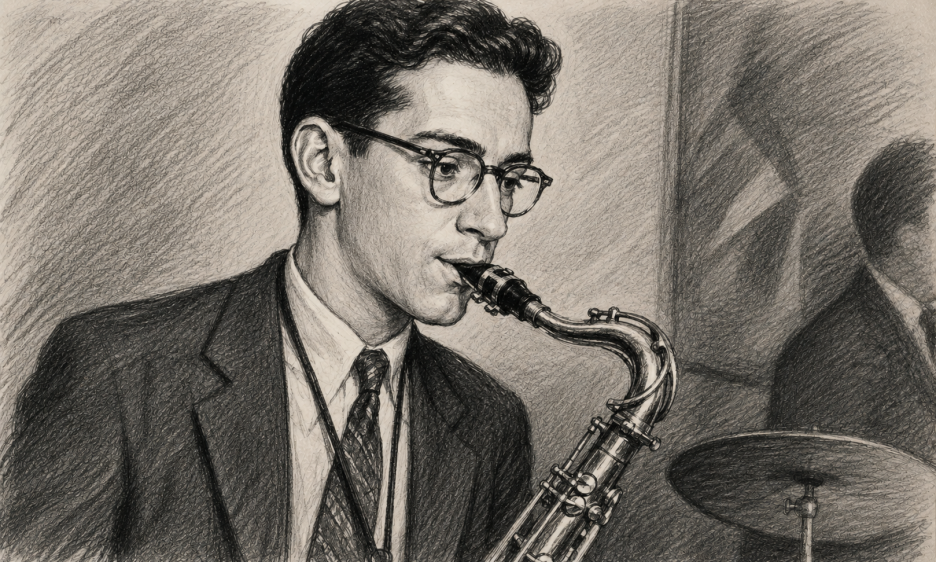
Alan Greenspan, who died on 22 June 2026 aged 100, chaired the Federal Reserve for nearly nineteen years and was canonised as "the Maestro," a pun before it was a tribute. Long before he conducted the world's largest economy, he was a clarinetist and tenor saxophonist, and walked away because, on the best nights beside Stan Getz, he could hear how far short of greatness he fell.
Born in Washington Heights to a musical mother, he took up the clarinet at George Washington High School and, by his own account, spent about a year playing alongside Getz. He studied at The Juilliard School (entering in the winter of 1943, gone by the first week of 1944), then took a paying chair with Henry Jerome and His Orchestra. Quincy Jones remembered the young Greenspan from that same New York scene, a kid who could read any room. Two young men off the same bandstands: one would conduct the world's finest musicians, the other its largest economy. All this lay ahead.
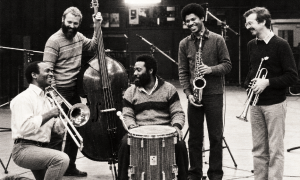
The band Greenspan joined sat several notches below Benny Goodman, Glenn Miller, or Artie Shaw—its theme "Nice People" closer to Guy Lombardo—until, late in 1944, Jerome gambled on the new music out of Harlem's after-hours clubs, the bebop of Dizzy Gillespie and Charlie Parker: "Salt Peanuts," "Groovin' High"—for listening not dancing. The surviving air-checks were issued under a billing no one could have predicted: "the first big band to play bebop." That honour usually goes to Billy Eckstine or Gillespie's band; but wherever it belongs, the personnel is astonishing. Through Jerome's roll passed Al Cohn; the future composer Johnny Mandel ("The Shadow of Your Smile"); the bop drummer Tiny Kahn; the painter-to-be Larry Rivers; the saxophonist Leonard Garment, bound for Nixon's White House—and, on tenor saxophone and bass clarinet, Greenspan, the teenager who would set the price of money for the world. But the most powerful man in finance left almost nothing you can play back, only air-checks, catching a section, not a soloist—simply because a shellac shortage stifled recordings before the band broke up in 1945.
He was the resident intellectual, the clarinetist who did his bandmates' tax returns and read economics. A good amateur but only an average professional, he knew what sealed it: the sound in the next chair. As he told CBS, the young Getz "pretty much determined that I was going to become an economist."
And no journeyman. Getz—the most gifted inheritor of Lester Young, the cool foil to the denser tenors of John Coltrane and Sonny Rollins—would join Woody Herman Second Herd, lay down the weightless tenor of "Early Autumn," then launch the bossa-nova wave of "The Girl from Ipanema." To measure yourself against that and know you'd never reach it takes a rare honesty; it pointed Greenspan toward the one instrument he could master.
He set down the horn and joined New York University, but the bandstand was not yet done with him. Garment had gone into law and become Nixon's law partner; in 1968 he drew his old band mate into the campaign as director of domestic-policy research. It was the bandstand, not just the textbook, that carried him into government—his first official post, chairman of the Council of Economic Advisers under Gerald Ford, from 1974 to 1977.
In 1987, Reagan made him Fed chairman, and for two decades, he conducted "the economic orchestra with a combination of facts and intuition," listening more than he spoke, waiting on the data, playing hunches. He never locked himself into a single model; he improvised within a structure, which is the only way for any soloist to survive.
In his 'Maestro' tag lay an irony. The economist, John Maynard Keynes, in A Treatise on Money, had written that "the central bank is the conductor of the orchestra and sets the tempo." A conductor imposes his reading; Greenspan's art was the reverse—not even a soloist but a section man, a doubler, who blended, supported and read the players around him. Colleagues on the Federal Open Market Committee saw the same: a chairman who led by listening, carried the room on facts, and was the ablest manager of consensus. The reedman's discipline proved sound training for a central bank.
Greenspan's nerve showed first in a crisis. On 19 October 1987, two months into the job, the Dow fell almost twenty-three per cent, its worst day ever. The next morning the Fed pledged to stand as "a source of liquidity to support the economic and financial system," then flooded the markets. Years later, in the American Economic Review, Greenspan admitted that the Fed's planning had proved all but useless against a crash; "far more traumatic than any ...[they] had identified."
His 1987 reflex was what the Fed had been built for. Paul Warburg, a father of the institution, had diagnosed the system's fragility in 1907 and prescribed a central bank to "fall back upon;" the Fed followed in 1913. There was even jazz in the Warburg bloodline: Paul's son James, writing as Paul James gave the lyric to "Can't We Be Friends?"—a standard recorded for decades. Where Warburg's son turned toward jazz, Greenspan ran the line in reverse, leaving the bandstand for the central bank the father had called for.
Out of that instinct grew a faith the markets always held: whenever the music faltered, the chairman would steady it. Traders called it the "Greenspan put," the way a rhythm section trusts a leader who always brings the band home. He pushed back only when the playing ran hot, warning in 1996 of "irrational exuberance": the market, to his ear, a soloist overblowing the changes. When the next crisis came—the Asian panic, Russia's 1998 default, the hedge fund LTCM's collapse—the Fed cut rates and brokered a rescue, and the put went global. To its critics, this bailout, even more than 1987's, licensed bolder risk-taking.
Greenspan liked, too, to pull down partitions: a force behind the 1999 Gramm-Leach-Bliley Act, which, like a bandleader merging two sections, took down the Glass-Steagall wall between commercial and investment banking. His easy-money confidence was later blamed for the 2008 bubble, and to Congress he conceded a "flaw" in his model. Sebastian Mallaby, in an occasionally critical biography, charted the arc "from maestro to villain," faulting him, in the end, for underestimating how wildly a financial system he no longer fully grasped could run. But that is a reckoning for the financial pages.
The music never left him. At a 2003 financial-literacy event, he told a room of children that music had been his first love. He had dreamed, he told students, of "playing with the likes of the Glenn Miller Orchestra or becoming another Benny Goodman." No list of his favourite records survives, only the bands he idolised, the players he worked beside, and his own band's book.
Jazz, said Andrea Mitchell, his wife, was the enthusiasm that outlasted the rest; what first drew him to her, he once said, was that "she liked the same music I did." He married her in 1997.
In the end, the metaphor everyone reached for was the true one. Greenspan spent his life as the soloist the room strained to hear, every phrase weighed, every silence deliberate—only the instrument turned out to be the global economy, and the world was made to keep his time. Stan Getz got the tenor saxophone. Alan Greenspan got everything else.
 FOLLOW Kofi Adjepong-Boateng
and get notified whenever a new article published.
FOLLOW Kofi Adjepong-Boateng
and get notified whenever a new article published.
I grew up to Louis Armstrong, which says it all.
Tags
PREVIOUS / NEXT

Become a Sustaining Member

Since 1995, All About Jazz has championed jazz as an art form and supported the musicians who create it. Over three decades, it has grown into one of the world's leading jazz resources, serving hundreds of thousands of readers, musicians, presenters and industry professionals each month.
Help Build the Future of All About Jazz
Your support helps us continue building All About Jazz for the next generation—expanding our editorial coverage, preserving jazz history, developing new community features and creating better ways to discover the music and the people behind it.
Become a sustaining member for as little as $20 per year and you'll immediately enjoy an ad-free experience along with access to subscriber features and future articles for a full year.
Together, we're not simply sustaining All About Jazz—we're building its future. Thank you for being part of the journey.