Home » Jazz Articles » Live Review » Unity Jazz Festival 2026 at Jazz At Lincoln Center
Unity Jazz Festival 2026 at Jazz At Lincoln Center
Courtesy Paul Reynolds
It does not rain—or snow—jazz in New York in the first week of January, it pours—or blizzards—the music.
Winter JazzFest, the longtime colossus that takes over clubs in downtown Manhattan and Brooklyn, has been joined in the past three years by the Unity Jazz Festival, which runs two marathon nights within the multiple spaces of the Jazz at Lincoln Center headquarters just north of midtown Manhattan. Further filling the New York jazz calendar that same weekend: a Jazz Congress conference and a Pyroclastic Records festival at Jazz Gallery, featuring the adventurous likes of Kris Davis and Patricia Brennan.
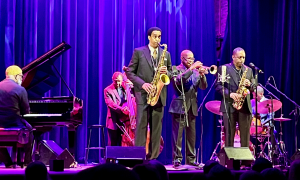
With Unity's second night overlapping with Jazzfest's January 9th marathon downtown, JALC scheduled Unity's centerpiece event on the festival's opening night: an all-star concert featuring recipients of the Jazz Legacies Fellowship Honors, a new accolade from the Mellon Foundation and Jazz Foundation to recognize and support acclaimed musicians who are 62 or older and have flown under the radar in terms of mainstream fame and, especially, fortune.
Elsewhere, Unity's lineup included twin tribute jams to figures the New York jazz community lost in 2025. The festival kicked off with one to celebrate the late percussionist Funmi Ononaiye, who also served as chief programmer for JALC. The night closed with another, in honor of Akika Tsuraga, the New York- based organist who died in September.
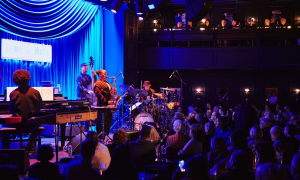
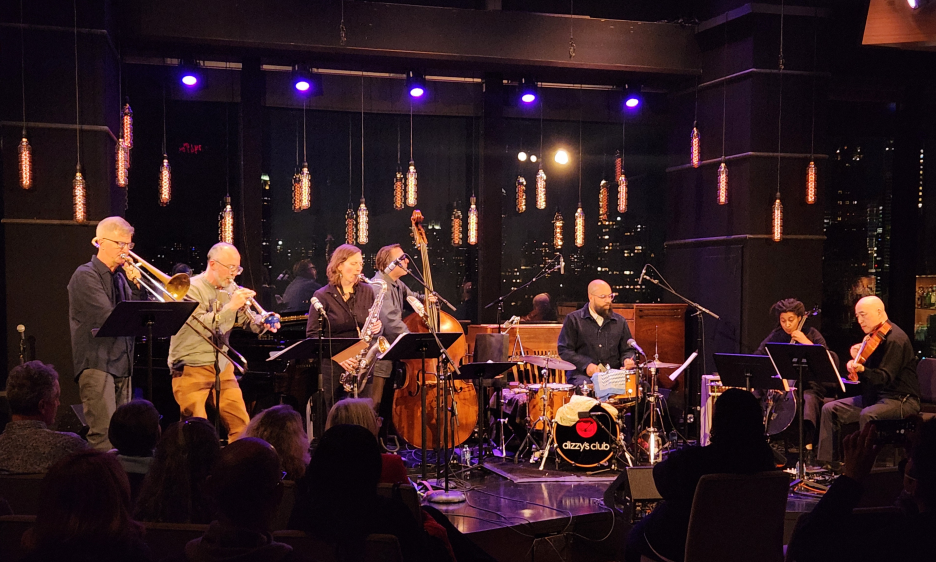
Unity this year swapped The Appel Room for the even-larger Rose Theater, and also staged simultaneous programs, for four-plus hours, at the Dizzy's Club, the Ertegun Atrium and the intimate Acoustic Lounge. The variety of programming, and the closeness of the venues, led to some startling contrasts. In mid-evening, one could experience a quietly contemplative duo improvisation in the Lounge and, after a two-minute walk down the hall, be bowled over at the Rose Theater by the joyousness of soca star Kes, who headlined both nights with exuberant performances before sold-out crowds that sang along with songs and waved Trinidadian flags.
Three sets stood out among the dozen of the Unity festival's first night.
The Jazz Legacies Fellowship All-Star Concert
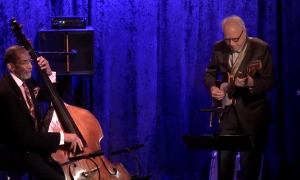
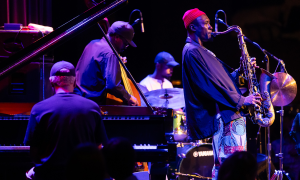
A full 17 of the 20 musicians for this new jazz-veterans award performed in 10 ensembles, some supplemented by non-recipients of the fellowship. Ranging in age from their sixties to eighties, plus 90-year-old Valerie Capers, the honorees who played and sang remained artistically vital, however frail some looked. Nowhere was this more evident than with the appearance by trumpeter Tom Harrell. Playing with Johnny O'Neal and Herlin Riley, and slumped over sideways in a chair, he played beautifully, in a performance that was moving both musically and visually.The performances hit a peak, musically and emotionally, with a 10-minute improvisation by Amina Claudine Myers on piano and Roscoe Mitchell on bass saxophone. Drawing from their four-plus decades of collaboration as fellow stalwarts in the Association for the Advancement of Creative Musicians (AACM), the burbling and reflective duet never flagged, or had a moment where the musical connection between the two was lost. After providing the concert's musical highlight, the two veterans—with a combined age of 168—embraced at mid-stage to provide the show's emotional peak, as well.
Rajna Swaminathan and Miles Ozazaki
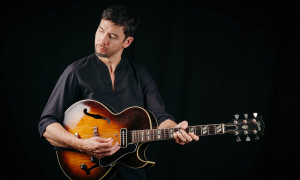
Rajna Swaminathan—playing mridangam, a traditional, double-headed barrel drum from South India, central to Carnatic music—duetted in the Lounge with the ever-adaptable guitarist Miles Okazaki. As expected, based on their duo album Eventide (Cygnus Recordings, 2022), the set was anything but mainstream, with each player drawing from multiple traditions to generally contemplative effect.Okazaki, playing a hollow-body electric guitar, showed few of the jazz influences that often arise in his performances with the likes of Bill Frisell, instead employing a range of styles and approaches in a seamless, and seemingly fully improvised, performance. At times, Okazaki sustained pulsing figures over which Swaminathan cannonaded percussive breaks. Elsewhere, his fingerpicking conjured up the melodic stylings of Alex de Grassi or the dissonances of guitar iconoclasts like John Fahey.
At times, their improvisations were pulseless, and resembled preludes to Indian ragas, before developing structure. Some of the loveliest passages came as Swaminathan accompanied the instrumentals with gentle and wordless singing. Occasionally, either of the two would drop away, allowing the other to solo for a few minutes. Swaminathan used these moments to fully demonstrate the gorgeous sonority of the mridangam. The drum is more guttural, and less frenetic, in sound than the twin tablas of North India, but allows a similar rapid-fire contrast of bass and treble notes.
Tomeka Reid Septet: In Tribute to Duke Ellington
Cellist Tomeka Reid was one of only a handful of artists (along with drummer Billy Hart, another fellowship recipient, and singer Veronica Swift) to grace stages in both the Unity and Winter Jazzfest events. Here, Reid's tribute to Duke Ellington was unexpectedly free of Ellington's music. Instead, it comprised a crackling suite of Reid compositions, commissioned in part by the Kennedy Center ("In 2024," she clarified) and inspired by Ellington's oeuvre and celebrated sidemen.Little about the music was overtly Ellingtonian. Rather, Reid channeled the spirit and some of the sonic features of the Ellington style, transposed to a septet comprising two brass, tenor sax, drums, bass, and two strings (Reid, along with Jason Kao Hwang on viola). Cornetist Taylor Ho Bynum, the group's leading soloist, extensively played with enhancements favored by Ellington's men, including the plunger mute made famous by Ellington's longtime trumpeter Cootie Williams. Trombonist Jeb Bishop also employed a plunger, in the style of Tricky Sam Nanton, another 20-plus-year Ellingtonian.
Together, the horns sometimes conjured up Ellingtonian textures, particularly when Reid's arrangements had them both playing together in low registers, as Ellington often favored, Unlike the Ellington orchestra, no clarinet was present to deepen the reediness of the sound but Reid effectively employed strings to a similar end—to create subtle textures to offset the brass.
As for the vibe, the septet conjured up the joy and esprit de corps that the Ellington band evidently exuded. This was ambitious music that never came across as ponderous or overly serious.
 FOLLOW Paul Reynolds
and get notified whenever a new article published.
FOLLOW Paul Reynolds
and get notified whenever a new article published.
Journalist and programmer in jazz, folk, country and other musics
About Tomeka Reid

Tags
PREVIOUS / NEXT

Tomeka Reid Concerts

Become a Sustaining Member

Since 1995, All About Jazz has championed jazz as an art form and supported the musicians who create it. Over three decades, it has grown into one of the world's leading jazz resources, serving hundreds of thousands of readers, musicians, presenters and industry professionals each month.
Help Build the Future of All About Jazz
Your support helps us continue building All About Jazz for the next generation—expanding our editorial coverage, preserving jazz history, developing new community features and creating better ways to discover the music and the people behind it.
Become a sustaining member for as little as $20 per year and you'll immediately enjoy an ad-free experience along with access to subscriber features and future articles for a full year.
Together, we're not simply sustaining All About Jazz—we're building its future. Thank you for being part of the journey.