Home » Jazz Articles » Interview » ‘I Thought I Composed That’: Terence Blanchard and the I...
‘I Thought I Composed That’: Terence Blanchard and the Inheritance of Jazz
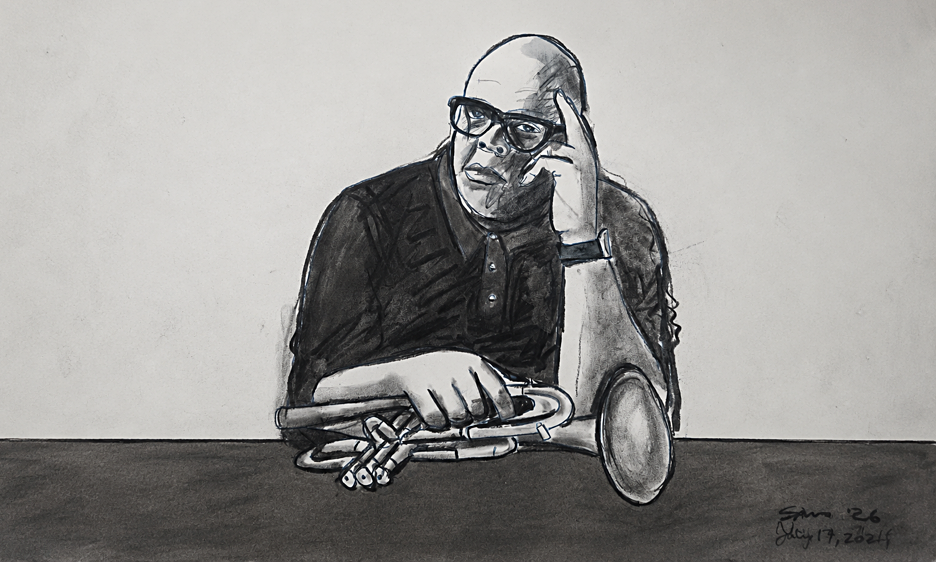
Courtesy Sam Nhlengetwa
Before a Miles and Coltrane centenary concert at Cadogan Hall, the trumpeter talked about what he inherited, what he chose—and what he carried without knowing it.
Ancestral. It is the word I have come for. For the past year I have tried to show, by shipping manifests, slave narratives, and acoustic measurement, what musicians assert more casually: that jazz has an African origin that can be traced rather than merely felt. The evidence points to two inheritances, not one. A melodic stream runs out of the Islamic savannah, the world of the griots and the long unaccompanied line, and gave the music its bent notes; a rhythmic stream runs out of Kongo and the coast, and gave it the locked pulse and the interlocking patterns above it. The signature is measurable: in African and American recordings alike, the note singers call blue sits, on average, about a quarter of a tone below where a piano would put it. And the rule that disciplines it all is easy to state but hard to obey: resemblance is not descent. A likeness proves nothing until the chain that carried it can be shown. But the archive has a limit, and I have come to ask a working master what my documents cannot. My son sits beside me; only afterwards does it strike me that this mattered: an interview about how music passes between generations, conducted across three of them.
So I put my central question to Blanchard directly. When he composes, how much is inheritance and how much creation?
"It's always a tough question to answer," he says, and then answers it better than the scholarship does. "We know we inherited this harmonic structure from Europeans. We inherited the rhythm thing and all of this other stuff from Africa, and then we put these things together and go: 'oh, I haven't heard that before.' And you think that it's new? And then you go on with your life, and ten years later somebody plays something from whenever, and you go: 'Hold on. I thought I composed that.'"
There, in four sentences, is the argument of the discipline called Atlantic history: the music as creole creation, European harmony and African rhythm and melody folded together so completely that even its makers cannot always tell which hand is moving. What the historian reconstructs from archives, the musician discovers with a shock mid-solo.
I had come meaning to place Blanchard on a spectrum, from a Miles Davis whose Kind Of Blue (Jazz Images, 1959) carries an Africa that never names itself to a Randy Weston or Kenny Garrett who compose theirs deliberately. He answered before I could ask and declined the line altogether.
For Blanchard, the shock occurred in Strasbourg when he was nineteen. But it originated earlier, in New Orleans, when he was ten or twelve and his cousin, on a new drum kit, was attempting the James Brown beat of the moment. Blanchard's father, an insurance man who sang opera at church recitals, got up and said, "'That's not how you play. I'll show y'all how to play,' and my dad started playing"—Blanchard beats the figure on the table as he tells it—"and we laughed. We thought that was some of the corniest stuff on the planet. And my dad got pissed off, and he said, 'Oh, y'all don't want to learn nothing.'"
Seven years later the boy who laughed is on a bandstand in Strasbourg with Art Blakey and the The Jazz Messengers, the hardest finishing school in jazz. "All of a sudden he calls Moanin.'" Once it gets to the bridge'—and here he sings the figure, the same rolling pattern his father played—"I almost couldn't play, bro. I was shocked." The beat his family had carried as a joke was waiting for him inside the canon. He had not learned it. He had inherited it, and Blakey showed him what he already owned.
This is how the African inheritance in this music works, and why it is so hard to see. It arrives not as a lesson but as a household—a table, a joke, a beat nobody labelled—and announces itself years later as recognition. It is what I have come to call descent: not a resemblance between continents but a chain of named hands—a father, a cousin's drum kit, a bandleader's bridge—each link findable, each carrier a person and not an abstraction.
And beneath the household story lies a documentary floor. New Orleans is the one American city where the African drum has an eyewitness record: the architect Benjamin Latrobe watched the ring dances of Congo Square in 1819 and wrote down what he saw. When the square was suppressed the drumming did not die; it moved indoors and into procession, surviving in the praise house, the shout, and the street beat still played at the city's funerals. I make no claim that the figure Blanchard's father played descends from the square; my own rule forbids it. But the way it reached him—carried in a body, passed in a living room, unlabelled—is the documented way the city's rhythm crossed two centuries: by family, not by institution. The beat that crossed the ocean in the holds crossed it again in a Jazz Messenger's hands, and ambushed its heir in Strasbourg.
Nobody knows who they are
Ask where his gifts come from and Blanchard reaches not for the famous names on his résumé but for people the histories do not record. "When I look back on my life, I think about the black men that were in my life who were very responsible for who I am right now. Nobody knows who they are." And women: Louise Winchester, the neighbourhood piano teacher who had him doing ear training at twelve. "Ms Winchester had us in the room, she's playing chords. What does this sound like? This is the third. This is a minor third." He rattles it off in her voice, the drill still in his body fifty years on. A twelve-year-old in a New Orleans parlour, taught to hear the third—the interval whose African bending my research measures, a quarter of a tone below the piano's placement, the same lean in savannah singing and in the blues—by a woman whom the archive never noticed."These are all people who didn't make no money," Blanchard says. "They were neighbourhood people. They just loved the art form, and if they saw talent in you, they gave you everything they had. It wasn't just me. They did that for everybody."
The most exact threads were kept by people the archive ignored, passed hand to hand below the sightline of the record. The greatest is still alive. Roger Dickerson, ninety-four, composer, Vienna-trained, back in New Orleans teaching children like Blanchard for next to nothing. "He's my musical daddy. I owe everything to this man." Dickerson built a whole system of composition disguised as a word game, "'If I could tell you, I would': write paragraphs using only those words, reorder them—'could would tell if'—then punctuate, one exclamation mark, two, three, a question mark. So that's phrasing and articulation. He taught me all of it with words, and then he showed me how to do it musically. That's what allowed me to write for movies and write operas." Years later Blanchard found Paul Hindemith's The Craft of Musical Composition and recognised the method. "I said, Roger, why didn't you give me this book? He said: 'you were a kid. You were fifteen. I wanted you to get the essence.'"
And Dickerson taught more than craft. At sixteen the lessons turned, Blanchard says, into something like therapy. "He goes, 'What do you see yourself doing in ten years?' and I had to give him an answer. I couldn't go 'hmm'—he'd say, 'no, no, tell me.' He was getting me to understand how to manifest things. I didn't know this." Later, excited by a book of Eastern philosophy, the teenager rushed to his teacher's house, and Dickerson took him to a back room where a mantelpiece held the spiritual masters he had never mentioned. "He said, 'I knew your parents. I grew up in the church with them. They were very religious, so I didn't want to step on their toes.' But a lot of the teaching was captured in that one question: 'what do you see yourself doing ten years from now?'" A man who carried Vienna in one hand and Vedanta in the other, metering out exactly as much of each as the son of a churchgoing family could hold.
Here is the transmission my own research keeps pointing at and can never quite touch: Vienna folded into New Orleans, Hindemith translated into a parlour game, the European inheritance carried into a black neighbourhood by a man who asked nothing for it—while the African inheritance rose through the same rooms in the drumming, the church singing, the father's opera records that the son did not know he was inheriting. "When I started writing opera," Blanchard says, "I realised where this melodic sense comes from." Both streams, one childhood. The music's creole nature is not a theory. It is a biography. It took another musician to make him see it. The late baritone Arthur Woodley, Blanchard says, was the one who named it for him. "'You've been hearing all this music all your life, damn, bro.'" He suspects the opera "had more influence on me than I would ever admit," so prevalent was it at the formative hour. The household was full of it: an aunt who taught piano and voice, her husband who sang beside the father, performances at church and recital the year round. The realisation had a witness, and the witness had a name, which is how this inheritance always travels.
What Art Blakey actually said
I had come with a trap. Blakey, Blanchard's teacher, made records steeped in African drumming, yet is widely quoted insisting the music owed Africa nothing. I asked about the contradiction. Blanchard cut me off. "No, no. That is not what Art Blakey said."What Blakey said, in his telling, is subtler and better. "Art Blakey used to say jazz wasn't invented in Africa, because if it was, people in Africa would be swinging. His point was that jazz was a confluence of all of those things, in America." When the percussionist Big Black ("The King of Congas," born Daniel Ray) insisted jazz was simply African, Blakey pushed back: "'Obviously the rhythm and the pulse and the melodic stuff comes from Africa. But we learned that harmonic stuff from Europeans. You have to give them their due.'"
The supposed denier held precisely the position the evidence supports: African rhythm, African melody, European chords, fused into something that exists nowhere else. And the man who held it was himself part of the older exchange—Blakey the Muslim convert who, Blanchard reminds us, "learned how to read the Qur'an in Arabic" and "would quote these things in Arabic and then tell us what they meant." He said, "'Art Blakey is my stage name. Abdullah Ibn Buhaina is my name.'"
A word of caution is owed here, and the scholar who presses it hardest is Kofi Agawu, who warns that "African rhythm," forever opposed to a supple European melody, is as much a category scholars built as one they found. The guard is worth stating because Blakey's formula could harden into exactly that myth, Africa the drum and Europe the mind. But notice that he did not let it. The same breath that gave Africa the pulse gave Europe the harmony and told his sidemen to give them their due. The confluence, not the caricature, is the claim, and it is the discipline this whole enquiry has tried to keep. It is also, almost word for word, the position of the modern scholarship. Gerhard Kubik, the ethnomusicologist whose four decades of African fieldwork anchor the melodic side of the case I have been assembling, concluded that the blues was a blend and not a transplant, different features from different regions of Africa meeting European harmony in the American South. The drummer on the bandstand and the scholar in the field reached the same doctrine by different roads, which is roughly what a true doctrine looks like.
A stranger echo runs underneath it. The melodic stream I have been tracing runs out of Islamic West Africa, the savannah whose singing was shaped by centuries of the call to prayer. Blakey found Islam by another road, a twentieth-century conversion, a faith chosen rather than carried. The echo by itself proves nothing, yet it is hard not to hear the rhyme: the drummer who insisted on the confluence, quoting the Qur'an in Arabic to his young trumpeters, reaching by choice for the tradition whose music had reached America in the holds of ships.
The hymn and the Woman King
Midway through, Blanchard leans forward and asks whether I know the story of Amazing Grace. "Apparently it was a tune that was hummed by slaves on a slave ship. The melody. And the guy who wrote the words had an epiphany about what he was doing, enslaving people. The meaningful line for me: 'I once was blind, but now I see.' That's a powerful line. Most black people don't know that story."As a historian, I must be honest about this beloved account, and about why hearing it moved me nonetheless. The documents tell a different story. John Newton, the slave-ship captain turned clergyman, wrote only the words, published in 1779; the tune we sing them to, New Britain, first appears in print in 1829 and was joined to his hymn by an American compiler in 1835, twenty-eight years after Newton's death. No melody crossed on his ships. And yet the legend is the music's own oral scripture, a way of saying something true: the African inheritance in the hymn is real. It lives not in the tune's origin but in the singing, the lined-out metre, the bent third, the melisma with which black congregations remade a white folk melody into something their ancestors would recognise. The legend puts Africa in the melody's past. The truth puts it in the voices.
Then, without knowing it, Blanchard handed me the finest evidence of the evening. Still on the hymn, he began to hum, and stopped himself. "What's really crazy for me—when I wrote the theme to The Woman King, I used the same kind of tone. I based it off the same kind of melodic scale. I didn't realise it, man."
Consider what he has described. Asked to score a film about the women warriors of Dahomey—to write Africa, deliberately, on commission—he reached without knowing it for the scale of the great Atlantic hymn, the sound the crossing made. The conscious project of re-creating Africa was underwritten by an inheritance that he carried unawares. And the coincidence cuts deeper than he knew: Dahomey was patron of some of the most elaborate court music in West Africa, and author of a great share of the captivity that carried such music west. Every argument I have been trying to construct from manifests and measurements was sitting in that one sentence, delivered with a laugh. This is not a paradox but a pattern. The Fon kings of Dahomey funded their court music, the drums and songs of the Annual Customs at Abomey, from the same wars that filled the barracoons. Blanchard had reached, unknowing, for a scale whose makers had been sold by the state that made it.
In the current
Near the end I offered him my scholarly distinction—an inheritance carried unconsciously against an Africa deliberately reached for—and he declined both, gently, for something better. He has been a Soka Gakkai Buddhist for decades. "When I'm with Herbie Hancock and the band chanting before the show, it gets into a rhythm, brother. That's energy that gets into the room." He talked about the ego—"the ego always says: this is me. No, it ain't me"—and about why his old teacher named the band as he did. "If you really believe in faith and energy and higher powers, that's why Art Blakey called his band the Jazz Messengers. You have to allow yourself to be used. You have to be humble." He described chanting with two or three hundred strangers at a Buddhist centre in Europe, Herbie beside him. "It's all different voices, and everybody's got the different pictures they're tuning into." Out of the many a single resonance. "That's why people say the universe is abundant. There's room in this universe for all of us." He meant it as faith, but it is also, unawares, a description of the music I have been chasing: separate voices, each aimed at its own place, combining into one sound that belongs to none of them alone. Dickerson had planted the seed half a century earlier, telling the fifteen-year-old that "there's different vibrations around the globe, and sometimes when you're in different parts of the world, you feel different things." Years later, Blanchard said, touring proved the teacher right. "I go to places in Africa, I go to places in France, and [it] feels familiar." The inheritance, felt on African ground; and France, of all places, where a bridge in Moanin' had once ambushed him."So for me," he said, "the thing I've come to is not to think about it that way. I think about it in a way that I'm blessed to be in the current of that."
He found the same conviction in recording the album that became Flow (Blue Note Records, 2005). The band ran out of prepared music. "Herbie said, 'You are jazzmen—go make some [stuff] up.' So that's what we did. And it came to us, just like that. That's when we started to understand." He mentions the book of that name, the psychology of effortless absorption, but his account is older than psychology: "Everybody thinks they have to fight and struggle to create, and that's not necessarily true. You've got to let go. When you try to control it, it's ego. Your ego is cutting your creativity off." He described the discipline that follows from this. He plays a finished record back until he forgets what he had intended by it. "When I start to forget what my early intentions were," only then can he hear what is actually there rather than what he meant to put there. Herbie gave him the shorter version of the same lesson: learn to tell yourself to be quiet. The point is not modesty. It is that the ego, listening for its own plan, cannot hear the thing that arrived on its own. The ego, he added, wants perfectionism, "and perfectionists are some of the most procrastinating people on the planet." I asked whether Miles was a perfectionist. "No. He cracked notes and he did all kind of stuff. I think he was a free spirit."
It is, I think, the exact word the scholarship has missed. Not inheritance, which sounds like probate; not re-creation, which sounds like a costume; but a river you are born into, which carried your father's beat to Strasbourg, Ms Winchester's thirds into the concert hall, a Dahomean scale into a Hollywood score, and the chants of the Yoruba and the Sahel, by ways now documented, into everything American music became. I had thought of the water as the Atlantic and the crossing as past tense. Blanchard's word corrects me. The water is still moving, and the sound is still in it. At one point, talking of all of it—the teachers, the theft, the survival—he turned from me to my son: "The thing is, you've got to learn how to not take everything as you see it." Then he went off to play Miles and John Coltrane for a full house, opening with Flow, another night's work in the current, passing it on. The image is older than my metaphor. In the Kongo thought that crossed with the enslaved, the sea itself—the kalunga line—is the boundary between the living and the dead, and the ancestors stand on the far shore. To say the water is still moving is only to say what that cosmology always said: the dead are not past, they are across, and the sound travels the water both ways.
On the way out I met Ravi Coltrane briefly and looked up again at the room we had talked in. Its Byzantine style reaches back through Constantinople to North Africa, to a church to which African saints had made important contributions: Moses the Black, the former slave turned desert father in Egypt; Augustine of Hippo, whose writings built Christian thought; Anthony the Great, from the Nile Valley, father of monasticism. Their faith travelled in stone, mosaic, and prayer, and theirs is the inheritance one sees, mostly without knowing it, in Cadogan Hall's arches and glass. The building had been telling the story all evening: an African inheritance carried unrecognised inside a European form, waiting for someone to ask where the music in the walls came from.
Terence Blanchard appeared with Ravi Coltrane in Miles Davis & John Coltrane at 100 at Cadogan Hall, London, on 9 July 2026. A new album is in preparation.
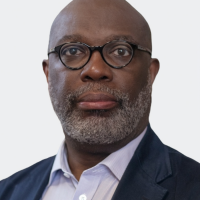 FOLLOW Kofi Adjepong-Boateng
and get notified whenever a new article published.
FOLLOW Kofi Adjepong-Boateng
and get notified whenever a new article published.
I grew up to Louis Armstrong, which says it all.
About Terence Blanchard

Tags
PREVIOUS / NEXT

Terence Blanchard Concerts

Become a Sustaining Member

Since 1995, All About Jazz has championed jazz as an art form and supported the musicians who create it. Over three decades, it has grown into one of the world's leading jazz resources, serving hundreds of thousands of readers, musicians, presenters and industry professionals each month.
Help Build the Future of All About Jazz
Your support helps us continue building All About Jazz for the next generation—expanding our editorial coverage, preserving jazz history, developing new community features and creating better ways to discover the music and the people behind it.
Become a sustaining member for as little as $20 per year and you'll immediately enjoy an ad-free experience along with access to subscriber features and future articles for a full year.
Together, we're not simply sustaining All About Jazz—we're building its future. Thank you for being part of the journey.