Home » Jazz Articles » Live Review » Moldejazz 2026
Moldejazz 2026
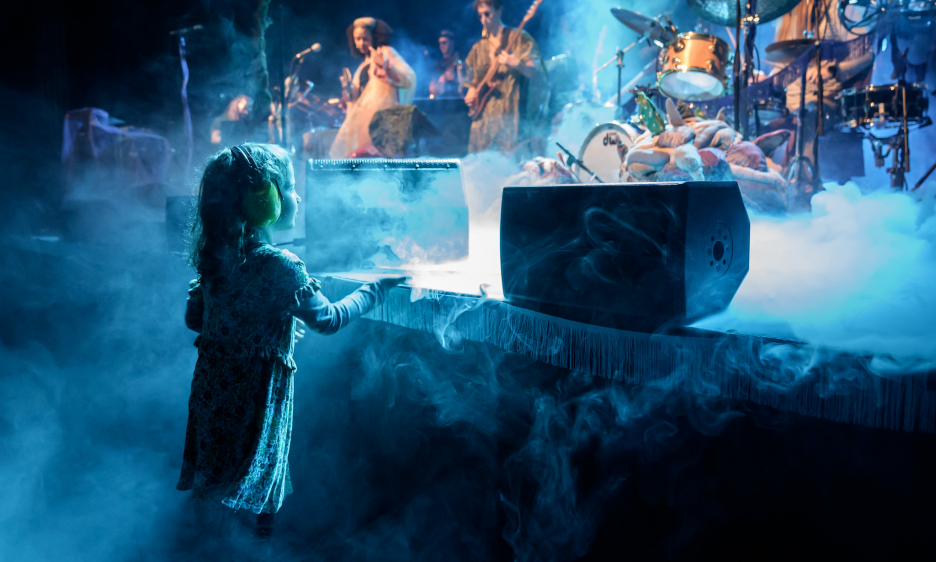
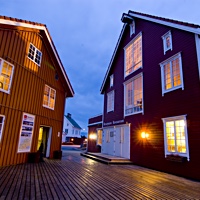
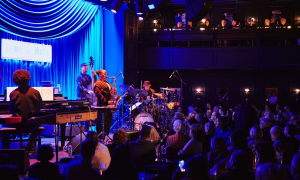
Courtesy Thor Egil Leirtrø
You can prepare for it a few days in advance, taking your cue from the Moldenser: running or, failing that, hiking along the crest lines above the fjord, resting in the mosses, lichens and thick, comfortable heather that lean against the rounded gneiss and playing on its foliation, at any hour of the day or night. A breathtaking landscape.
In Molde, every house faces the fjord, so that the 51 weeks of waiting for the next festival are themselves a show: the cinema of the sun, the stars, the clouds and, with luck, the northern lights, runs without a break. It can be surprising to see how the Moldenser still marvel at it, when it is in front of their eyes every day. Moldejazz is also part of their lives: car traffic is closed across the whole town centre and replaced by hundreds of smiling volunteers making sure everything runs smoothly. Here, if you are not a young volunteer at Moldejazz, you begin your life in the Jazz Lodge. You march in the Jazz Lodge parade until you are 20. You end up as a retired Moldejazz volunteer. Storyville Plassen, a jazz club since 1953 and a genuine cultural centre in its early days, has counted more than 5,000 members, that is one inhabitant in four or five. It was from the Storyville that the Molde International Jazz Festival was born in 1961, the oldest continuous jazz festival in Europe after Bled (later Ljubljana) in 1960.
Brilliant Past, Unstable Present, Glorious Future?
Heritage
From its earliest years the festival has hosted the greatest American, European and Japanese jazz stars and, in fact, every musician people were talking about, in Norway and abroad. The case that has stayed in everyone's memory is the one heard on Live in Molde (MJN Records, 2005), by Chick Corea, who came in 2000 to play with the Trondheim Jazz Orchestra on arrangements by Erlend Skomsvoll, whom he did not know. Neither did he know the arrangements themselves ('I don't know them yet,' Corea said on stage), nor the very young musicians, after just a single rehearsal. Off stage, Corea had trouble recovering from this event, described as the Miracle Concert of Molde.Moldejazz Today
Recent years have seen notable changes in the running of the festival, with the leadership changing almost every year and the programming turning towards headliners from outside the jazz sphere, as at other large festivals, leaving some long-standing observers skeptical. Many hopes, and therefore no doubt considerable pressure, now rest on the shoulders of Linda Melsom, the festival director who arrived in January 2026 and whose vision will take shape with the 2027 edition.The Mythic Molde Festival Jazz Camp: A Rebirth?
One challenge will be to solve the problem of accommodating festivalgoers. Hotel capacity is limited, and more so still when one remembers that the musicians and their accompanying staff also have to be housed, at a rate of around 10 concerts a day. Molde's hotels, whose rates are very high, have a total capacity of 500-600 rooms, which the Kviltorp campsite and a few guest rooms bring up to about a thousand. The number of festivalgoers is in the region of 25,000. You do the math.It is against these figures that the impact of the closure of a vast jazz camp, active until 2016, has to be measured. Festival veterans, like the young musicians who never knew it, look back with regret on that golden age when jazz obsessives from all over Norway came to pitch their tents in Molde in July. Countless informal jam sessions were added to the official programme. That population, young musicians and fans alike, who transformed the atmosphere of the town, is now largely kept away from the festival for financial reasons, while the audience of well-off couples with children seems to have been favoured for its economic returns.
For many, a renewed national and international appeal for Moldejazz will come through reclaiming the singularity of this jazz camp, through its reopening and its momentum.
Consider the following figures. As elsewhere in the world, the number of jazz festivals has grown considerably in Norway since the beginning of this century. So has the number of jazz clubs, generating increased competition. According to the latest annual report from Norsk jazzforum, the professional association of Norwegian jazz, the number of affiliated festivals and clubs doubled between 2000 and 2024. Yet over the same period, the number of musicians and students affiliated to Norsk jazzforum grew by 250% and 470% respectively. The number of large ensembles also rose by 250%. Assuming that most jazz musicians are affiliated to Norsk jazzforum, the number of musicians potentially interested in coming to pitch their tents at Moldejazz, but who do not come because of the limited and costly accommodation in Molde, is striking. And these figures do not even take into account partners, friends, plain fans.
Ideas are circulating about where to site a new jazz camp, reserved for 18-to 35-year-olds. Two of the most respected young musicians in the Norwegian jazz sphere, Isak Austnes Brekken and Selma Edwards Granly, have taken matters in hand, and approaches and steps that one easily imagines to be complex, since they involve many partners and rigorous logistics, are under way. One can only hope that the energy they are putting into the task will quickly be crowned with success. There is little doubt that the success of this initiative would reaffirm the singular identity of Moldejazz and... its eternal youth. Attracting large families is one thing, attracting the attention of the world is another.
Moldejazz 2026 counted 56 ticketed performances, six jam sessions, talks and interviews in 13 venues scattered across this small town during six days. Choices, sometimes involuntary, therefore had to be made. In retrospect, it seems that the AAJ contributor's leanings went above all towards the music of the young, from the age of 14 upwards, and since even that was not enough, given his persistent inability to be in several places at once, he had to sacrifice some artists who already have a strong international presence, such as Isaiah Collier, Nduduzo Makhathini, Brandee Younger, Eric Gales, Nate Smith and Emma-Jean Thackray.
The music for the opening ceremony was delivered by a quartet including three children of Molde: Tuva Halse (violin), Isak Hungnes (piano), and Rino Sivathas (drums), joined by Tarald Kongshaug (bass). Halse had chosen the highly appropriate "Invitation," a tune popularized in particular by John Coltrane and Joe Henderson. We will come back to them, since they were the same musicians who opened the jam session that very evening.
Esperanza Spalding, Artist in Residence
Esperanza Spalding, artist in residence of Moldejazz 2026, gave four performances. The first two, on Monday and Tuesday, were given the same description in the programme and involved almost the same artists. Staged performance is the right word for these two concerts, with theatrical staging, poetry (texts by the great Norwegian poet Olav H. Hauge), two dancers, and even some music!The first performance was the opening concert of the festival, on Monday, 13 July, in the main concert hall of Bjørnsonhuset, which the AAJ contributor missed. On Tuesday, the second performance was given by almost the same group of musicians and dancers, transported to the island of Hjertøya, a few minutes from Molde by boat.
According to the review by the excellent Ole Foss published the following day in the local paper, Romsdals Budstikke, Spalding's performance on the first day surprised, even disconcerted the audience, which was perhaps expecting the kind of exuberant fireworks that suits the opening of a festival.
It has to be said that the theme here was attachment to the land of one's ancestors and to the sometimes dramatic realities of emigration: a founding explosion of a very different kind. Genealogy allows Spalding to trace Norwegian ancestors back five generations, towards the end of the 19th century.
The dark interior of Bjørnsonhuset allowed for introspective lighting, in contrast with the soft green meadow of Hjertøya, a shift that changes how one and the same story is perceived. The shadows of the past from that first concert were here projected onto Hjertøya's welcoming greenery and warm sun.
The performance began with a table laid on the grass, around which everyone took their place for the meal. After a moment, the violin of Ester Thunander began to sing. The musical part of the project was under way. Spalding carried the story forward on bass, reciting a poem by the great Norwegian writer Olav H. Hauge. Behind her, Charlotte Dos Santos and Sarah Camille Osmundsen began a polyphony given its rhythm by the percussion of Sidiki Camara. Thunander's violin took over and everyone fell silent. The story began, with its twists and turns. The work would also unfold with Sverre Sæbø, a bassist we shall come back to, and two astonishing dancers, Ornilia Ubisse and Jeffrey Young. A video of the first concert reminded me of traditional dances I have seen in various places in Ethiopia. A great deal of virtuosic and precise energy in any case.
At Hjertøya, the backstage area was an old wooden barn, close to the small stone hut of Kurt Schwitters, the German Dadaist. Between 1930 and 1940, Schwitters gradually turned his hut into a Merz (merzhytte), a motley volume of collages and drawings, before fleeing the advance of the Nazi army. There is a parallel to be explored between the fate of Schwitters, a migrant of German nationality fleeing to Scotland in 1940, interned first in Edinburgh and then on the Isle of Man, and the emigration of Spalding's Norwegian ancestor, arriving in Arkansas, fleeing the poverty of 19th-century Norway and finding difficulties of another order once there. The shared yet always different recesses of the dramas of emigration, of which Spalding has made herself the echo.
The name of the next artist in residence was revealed by director Linda Melsom during her public interview with Audun Vinger as part of the festival Academy on the fifth day. It would be Marius Neset, news that delighted many of those present.
Jazz Education: the Molde Model
A Hotbed of Talent: Behind the Scene
Molde is a continuous flow of talent, more than its share of which is sent off to the Norwegian University of Science and Technology in Trondheim (NTNU) to pursue a jazz bachelor's degree whose acceptance rate is around five per cent. Those who come to mind (a shortened list), in order of birth, are Erling Aksdal (piano), Steinar Raknes (bass, from Otrøya, the nearby island), Ola Kvernberg (violin, from Fræna next to Molde, quickly caught up by Molde's jazz environment), Arne Torvik (piano), Daniel Herskedal (tuba, bass trumpet), Rino Sivathas (drums), Tuva Halse (violin, keyboards, vocals) and Isak Hungnes (piano). Most of them made their mark at Moldejazz 2026.This talent pool, for a town whose population has only just reached 23,000 (33,000 for the whole municipality), owes little to chance. Molde has developed a jazz culture of great renown. The system in place is original, and trying to understand the source of its formidable effectiveness is a source of fascination. Before illustrating the effects of this system with examples found at Moldejazz 2026, let us pause for a moment on the balance that has been struck in Molde—after all, it ultimately comes down to political will: other countries can take inspiration from this if the will is there. The robustness of the arrangement lies of course in the quality of the teaching but, upstream of that, in a harmonious interlocking of the associative, municipal, regional and national levels.
The arrangement, supported by the vitality and prestige of Moldejazz and of the jazz club from which it sprang, Storyville Plassen, is rooted in the vigor with which the municipality of Molde and the county of Møre og Romsdal implement the national objectives of the cultural schools (kulturskolene): "to learn, experience, create and convey cultural and artistic expression" from the earliest age. The municipality of Molde thus received the national title of School of Music and Performing Arts Municipality of the Year in 2019, a year after the regional authority of Møre og Romsdal opened a national jazz stream (landslinja for jazz) at the upper secondary school in Molde. The school delegates the teaching to the kulturskole, mainly in the form of evening classes given by a teaching team of a very high standard in jazz and rhythmic music. This team works closely with NTNU, which houses a music institute to which the bachelor's degree in "Music Performance—Jazz" is attached, made famous in Norway under the simple name of jazzlinja. This collaboration allows teachers from the jazzlinja to take part in the jazz teaching projects of the Molde cultural school.
In parallel, the Molde Concert Band association (Molde Janitsjar) allows young people aged 14 to 20 to join the Jazz Lodge marching band (already mentioned), where they are taught music through ear training and imitation.
Simple!
As if that were not enough, every year Moldejazz organizes jazz concerts for children, Rabbajazz—defined in the programme as being for ages 0 to 100.
Rabbajazz: Introducing Jazz to the Youngest Audiences with the Cosmic Swing Orchestra
Beginning, then, with children up to the age of 100, four concerts were presented during the week. Knowing the acting talent of Petter Dalane (piano) and his taste for dressing up, I gave preference to his Cosmic Swing Orchestra, on the Friday at Storyville. At a rate of one or two adults per family and two or three children, the audience was mostly made up of children, with free entry for soft toys.The Cosmic Swing Orchestra ("Norwegian jazz orchestra opening brains since 2018"), as its name suggests, borrows its staging and costumes from the world of Sun Ra, which delighted the grown-ups but also the little ones. The orchestra opened with a gospel-scented piece, on the mantra "Happiness and success." Communication with the children was instant, established with professionalism by Dalane, who here put to use, as in every Cosmic Swing Orchestra performance, the acting talent he developed through spiritual contact with the stand-up comedian Stewart Lee and fed by the experience of tons of jam sessions. The art of call and response was well tested, working through repetitions of short words and onomatopoeia and yes/no calls and answers. The children were invited to scream as loudly as possible while covering their ears. There followed a solo in which Even Brodwall (french horn) alternated instrumental improvisation with further shouts. More conventional pieces followed one another, from swing to rock, and one noted in passing a particularly successful improvisation, as so often, from Jenny Frøysa on baritone saxophone, followed by a double solo from two other heavyweights, Aksel Rønning and Erlend Vangen Kongtorp, swapping their saxophones for flutes on the piece "AJ" (for "Ahmad Jamal"). Storyville was packed, the children were delighted. The music remained demanding.
Engaging Young People: The Jazz Lodge
This is the most visible part of Moldejazz: a street parade of several dozen young amateur musicians from the Jazzlogen, crossing the old centre of Molde every day from 11 a.m., opening the festivities to the sounds of classic and New Orleans jazz. The repertoire has been rehearsed since January, with a method of learning by ear and by heart that follows the precepts of the Ytre Suløens Jass- ensemble, which also played at Moldejazz this year. This essentially traditional jazz orchestra has been going since 1973 and appeared with Leroy Jones (trumpet) at Molde Domkirke. It has been made an honorary citizen of the city of New Orleans. Those Jazz Lodge musicians who will need it during the parade are also taught the basic principles of improvisation. Of obviously limited importance to the musical reach of Moldejazz, the festival would no longer be the same without this parade. Could it still exist? Who would the roses blooming in the streets talk to?Developing Young Talent: Landslinja for Jazz with Jenny Frøysa and Johannes Lykkås
On the Saturday, the last day, the landslinja for jazz gave a concert under the direction of Jenny Frøysa, Assistant Professor at NTNU. Frøysa coaches the landslinja, travelling to Molde for two days twice a semester for that purpose and teaching there the aural learning method in which the NTNU jazz stream has specialized under the direction of Erling Aksdal. The landslinja students have also travelled to NTNU to meet the jazz bachelor students and jam with them.Storyville was packed. Among the many musicians, Niklas Meek (trombone), who is now beginning his third and final year at the landslinja and was a constant presence at the festival, particularly at the jam sessions, was perhaps the one who showed the most assurance. After a year working on standards, half of the compositions, written by Frøysa, had been rehearsed three afternoons a week from June onwards. The compositions were drawn from Jenny Frøysa's Artful Ensemble album , Pauline Boty: bring her out! (Particular Recordings Collective, 2026). This is the moment to flag up this thoroughly cheering, jubilant album.
The other compositions were written by Johannes Lykkås, who was on double bass that Saturday. An artist independent of the landslinja, Lykkås was in charge of its project this year. The previous year it was Dalane, and the year before that, the energetic free jazz/progressive rock trio I LIKE TO SLEEP, well worth discovering: Amund Storløkken Åse (amplified vibraphone, Mellotron, sampler, percussion), Nicolas Leirtrø (Stavem bass VI, drilled guitar, percussion) and Øyvind Leite (drums, percussion). The music of Dalane, Leirtrø and Leite also being represented at Moldejazz this year, see elsewhere in this article.
The compositions by Lykkås were rehearsed... once, during the festival week. Asked whether the concert had been a source of stress, Meek's answer was: no. They know one another well. They have all been working together for so long, and are so well versed in the standards. Have fun: the basic condition for learning and practicing jazz for Frøysa!
Storyville, on the top floor of the Plassen cultural centre, opens onto a vast terrace overlooking the town. It was tempting to make it the exit point for a musical column in the manner of Sun Ra Arkestra, which was duly done ad libitum on Sun Ra's piece "Discipline 27," masterfully led by Frøysa's baritone, a true Pat Patrick!
Jazzintro finale: A Competition for Norway's Emerging Jazz Talent
Norsk jazzforum organizes the Jazzintro competition every two years. Eight bands (big bands excluded) of young musicians whose average age is below 27 are selected, they compete in pairs, and the four finalists play a finale at Moldejazz.In 2026, the musicians in the winning band take the title of Young Jazz Musicians of the Year, a mentoring programme and a tour in 2027 of ten of the country's main jazz festivals. Competing on the Tuesday at Moldejazz, in this order and for 30 minutes each, were the bands Sakte, fallende (slowly, falling), Wilhelm III, Idiotek, and Unmothered. Sakte, fallende is made up of two guitarists, Martin Borge and Sune Dommersnes, bassist Erlend Markhus and drummer Herman Kirkenær Krogh. They presented harmonically simple pieces that grew in groove and volume towards a rather rock-oriented and rather well-structured style, the two guitars moving in osmosis. Borge also has a fine voice with a surprisingly wide range.
Wilhelm III is a trio remarkable for its control and precision, made up of Isak Hungnes on piano, Johannes Lykkås on double bass and Erik Wie Flaig on drums. A great deal of interaction, and great pleasure in watching them play—play in every sense of the word. Hungnes has a very fine sense of phrasing and is fond of disjointed improvisations oscillating between ragtime and Thelonious Monk. Like small fragments of film connected by a thread of humour in the manner of a Martial Solal. Ovation. Very promising.
Idiotek is a band whose playing belongs to a rarely claimed heritage: that of Derek Bailey, whose freedom is recovered by Kristian Enkerud Lien, on guitar, breathing agreeably through a mastered science of space and complex harmonic sequences. He also cites the ideas of Boulez and Messiaen, rock and post-rock. The trio is tightly integrated, the guitar constantly interacting with the bass of Johannes Elnan, whom we were glad to meet in Babies On Airplanes, and the drums of Trym Saugstad Karlsen, encountered in The Aftermath (Fjordgata Records, 2026) by Ingeborg Gravem Sollid's quartet, on the Best Jazz Albums of 2026: All-Star Break Edition list. Intelligent trio playing.
Unmothered is the project of trumpeter Tuva Olsson, with Siv Aurlund on vocals, Odin Fiskvik on guitar, Bendik Lundsvoll on double bass and Øyvind Leite on drums. A very cohesive set, unbroken and varying its atmospheres, starting from an openly rock sound and drifting towards very free forms that brought out the qualities of each player. Olsson's trumpet has real originality. Thoughtful playing, sparing without being sparse, working perfectly with Aurlund's voice. Fiskvik took care of bringing the rock atmosphere back when required. In Norway, Leite is one of the most virtuosic and creative drummers (virtuosic yet creative), perfectly at ease in this sound world as in others. He can be heard displaying playing of great subtlety on Reconnection (Jazzland Recordings, 2026), another one of the Best Jazz Albums of 2026: All-Star Break Edition by the Tuva Halse Quintet, as well as in atmospheres strongly tinged with experimental rock with the duo REICHE and the band I LIKE TO SLEEP, already mentioned. Unmothered has a way of putting musicality before every other consideration, the true trademark of the young musicians trained at NTNU.
A very high-level competition, won by Sakte, fallende, who were therefore given the task, that evening, of playing the Jazzintro winner's concert. The congratulations, well deserved, were perhaps also an encouragement to make the harmonic structure of the pieces perhaps a little more complex so as to make them thoroughly gripping.
Homecoming
Tuva Halse, Arne Torvik, and the Sleeping Nature
We have now arrived at the last step of the Molde model: when the student becomes a master. It is always a very special moment when a musician who has reached musical maturity comes back to play with the teacher who guided them. Here we have Sleeping Music, given on Monday at Storyville Plassen.The master here is Arne Torvik (piano), a figure of Nordic jazz (seeNorthwestern Songs , Losen Records, 2021) and a distinguished educator at the Molde kulturskole. The student here is Tuva Halse (violin), who studied piano and improvisation with Torvik during her upper secondary school years, until 2019, when she joined NTNU, from which she would graduate three years later. After five albums as a leader (including Reconnection (Jazzland Recordings, 2026), already mentioned as one of the AAJ best albums 2026, more than fifteen as a co-leader or collaborator and a dozen sessions as a studio musician, she played Sleeping Music on Monday with her guru, to use her own word. The name refers to the sleeping nature of the beautiful winter morning glimpsed through the window of the recording studio near Oslo where the album of the same name was recorded during the winter of 2026. Sleeping Music (Jazzland Recordings, 2027) will be released in February 2027.
About ten compositions followed one another, blending jazz, folk and classical inspirations. Torvik claims the "ECM sound" as a major influence (Bobo Stenson in particular), a sound in which Halse also recognizes herself. Tuva's violin remains, however, unclassifiable. Coming from classical music, whose technique and melodic art it carries, the violin no longer has its tone. Nor does it flex its muscles, as jazz violinists often do when faced with far louder instruments. Perhaps something of it can be found in the flexibility and tone of certain folk musics, even oriental ones, but the way in which Halse's bow brushes the strings from every angle, running through the kaleidoscope of the instrument's colours, is unique. Let us also imagine conversations between birds, clouds forming and dissolving in a sky which the piano's delicate hammers try to anchor to welcoming ground.
It is a curious idea to launch, at the height of summer, music recorded in the cold dimness of the Norwegian winter. The summer sun was reflected in the happiness and emotion visible in the audience, won over by the unbroken complicity, sustained for more than an hour, between the master and the student, now a national star. Yet the human warmth that filled the room was distinctly spring-like. What does autumn hold in store... ?
Big Band Blast
Karoline Wallace and the Trondheim Jazz Orchestra: Interspecies Communications
Norway has a long tradition of progressive and experimental big bands, in which composers are invited to express their talents in complete freedom, using all or part of the orchestra's voices and free to invite others in. The first was Soyr (1976-2006), directed by Torgrim Sollid and initially made up of Trondheim-based musicians. The Trondheim Jazz Orchestra can be seen as a continuation of Søyr, a variable-geometry ensemble proceeding from the same open logic.Winner of the SpareBank 1 SMN JazZtipendiat prize, one of Norway's most important jazz awards, in 2025, Karoline Wallace (vocals, electronics) obtained the means to compose and perform Samtaler (Communications), a work played at Moldejazz 2026 with the Trondheim Jazz Orchestra, and afterwards at several other venues. So this was a premiere, and we were on the Monday at the Plassen cultural centre downtown Molde, in Teatret Vårt.
Wallace has composed a work in six parts inspired by communication between species. How can we, as humans, communicate with animals, with plants? What language, what chemistry, what rhythms? What do we share with them? What does communicating mean? You have one hour and 25 minutes to answer!
As for communicating with the audience, Wallace certainly knows how to do it very well; contact was established from the start and sustained a very good atmosphere until the end of the concert. Characterizing everything one heard is not easy, but one could readily imagine a whole small population teeming beneath our feet, conveyed through the contrasts of timbre between the sections (two reeds, three brass, four strings, a rhythm section, Wallace's voice, and electronics in the hands of a third of the musicians) and sometimes through the opposition between the strings and the other sections.
In Samtaler the atmospheres were varied and one could easily picture the marvelous world in question. One could readily imagine, for example (rightly or wrongly), the tuba of Heida Mobeck (currently the Trondheim Jazz Orchestra's artistic director) and the trombone of Guro Kvåle in the role of the tree trunks in the first piece, "Trær" (Trees), life flowing through the tenor saxophone of Åsne Fossmark in the following piece, and so on. A kind of Peter and the Wolf? It is hard to decipher all of Wallace's intentions, but the evocative power of Samtaler was rendered well enough by subtle arrangements and first-rate soloists for everyone to find something in it.
Rediscovering the melodic qualities of the ever-inspired guitar of Karl Bjorå is always a pleasure. It was especially so in the third piece of the suite—all the more precious, as the AAJ's contributor could not attend his own concert on Tuesday.
The role of the giraffe fell to the very beautiful double bass sound ofNicolas Leirtrø. You do not know what a giraffe sounds like? The giraffe expresses itself across a range of frequencies, at least one of which was explored by Leirtrø, rarely as well showcased as in this fourth part. Leirtrø is a mainstay of many orchestras and it is worth checking out Entrance (Sauajazz, 2026), a Best Jazz Albums of 2026: All-Star Break Edition album.
After an hour of music governed by subtle contrasts of timbre, the fifth part offered a bowl of unbridled freshness, in which the alto saxophone of Signe Emmeluth raved madly.
There is something between Trondheim and Sun Ra. We saw how well the Cosmic Swing Orchestra and the landslinja for jazz under Jenny Frøysa's guidance made use of it; the fifth part of Samtaler was a very fine blues which in turn developed in a distinctly "arkestrian" sway.
Samtaler is a very beautiful composition, poetic and light, with great evocative power. Let us hope to see it on record soon.
It was announced that the SpareBank 1 SMN JazZtipendiat 2026 prize had gone to Håvard Aufles, the keyboard player, who was playing here under Wallace's direction. His turn to amaze us next year! Aufles seems to specialise in transforming instrumental sounds, starting with his own keyboards, and is fond of solid grooves. Curious to see that.
Maria Dybbroe & OJKOS: Wood Wide Web
The Orchestra for Jazz Composers in Oslo / Orkesteret for Jazzkomponister Oslo (OJKOS) is a collective whose members are selected for five years and compose for the orchestra in turn. On Thursday it was the turn of Maria Dybbroe.The audience was sparse. An effect of the John Legend concert, taking place simultaneously a little further up, in the vast grounds of the Romsdal museum? But is the audience the same?
Much was expected of Dybbroe, after listening to the album Øyeblikk (Moment), also with OJKOS, (2026). We had already been given a great deal by the trees, the ants and the giraffes of Wallace. With Dybbroe we got the missing piece: fungi.
Wood Wide Web was indeed entirely devoted to the mystery of the underground networks that connect certain living beings to one another. It evoked in particular the mycelium, that network of filaments which can spread over vast areas and which, through mycorrhizal associations, takes part in the exchange of nutrients between fungi and plants, thereby contributing to their growth and adaptation.
Within that framework, there was little room for long solos. Everything was interaction between masses of sound, and the soloist intervened within that context. Andrine Dyblie Erdal (cello), Tuva Halse (violin), Jørgen Bjelkerud (trombone), Lars Andreas Haug (tuba), for example, enjoyed this particular status of mycelial node. But the overall sound of the network governed the composition.
Dybbroe's arrangements were captivating from the outset. From the very first bars a sensation settled in of a big band conveying a beauty that is profound. The sound was full and rich, a sensation tat possibly comes from a reminiscence of Gil Evans. It is a kind of extension of Evans into today's music: Dybbroe takes him up where he left off, and carries on.
What would Evans compose today? What material? How? Dybbroe answered that question in three ways: by adding to her science of big band colours two very fine voices (Mariam Wallentin, Andrea Silvia Giordano —also playing flute and electronics), poetry (a text by the Danish writer Gry Stokkendal Dalgas) and above all,, a first-class string quartet, at ease in section work as in improvisation: Halse and Katt Hernandez (violin), Erdal (cello), and Petter Asbjørnsen (bass).
The strings brought a classical touch to the music that blended perfectly into the rest of the orchestra. Mixing classical strings and jazz is always perilous: Dybbroe impressed with her exceptional talent for bringing the two together, under the shadow of an Evans who would no doubt have enjoyed the outcome.
Every colour of the strings was exploited. The strings could simply carry their own story as a foursome, and set it against the wind players. They could also split into equal parts, with a melody in counterpoint between the two violins, facing the cello and the double bass. Or again, the double bass found itself alone against the other three. All of this within the frame of the full orchestra. Nothing seemed impossible: a suitably electrified guitar Åsmund Perssønn Ødegaard, Torstein Slåen) molds itself perfectly to the ensemble.
The composition ended with a superb slow march, often given its rhythm by the strings. The dance was led by the various facets of Giordano as vocalist, flautist and manipulator of electronics and by Haug's tuba, set in counterpoint by the woods and the other brass.
Wood Wide Web is a remarkable composition that was superbly served by OJKOS and six guests. One of the top concerts of Moldejazz 2026.
Cosmic Swing Orchestra: Optimism over despair
The Cosmic Swing Orchestra is another major large ensemble on the Norwegian scene. Its director Petter Dalane (piano, keyboards, guitar) is an atypical musician based in Oslo. This Saturday we met again the orchestra that had played on the Friday in front of the children (see Rabbajazz above).Norwegians like to remind foreigners: "Norway is a small country." Absolute nonsense in geographical terms, given both its latitudinal extent and the great fractal dimension of its coastline. And yet it is small enough that when you line up three large ensembles of a very high standard, you frequently find the same faces. So here we find again the excellent Jørgen Bjelkerud (trombone; see the albums Evidence (Autres Records, 2026) and The Weight of Bloom (Jazzland Recordings, 2026), two of the Best Jazz Albums of 2026: All-Star Break Edition, also seen in OJKOS and the Trondheim Jazz Orchestra, and Øyvind Mathisen (trumpet), also in the Trondheim Jazz Orchestra. Of the three orchestras reviewed here, the Cosmic Swing Orchestra is the one with the most conventional instrumentation. The precision of the execution is relentless.
Dalane started playing guitar before piano and, although he is known today as a pianist, composer and arranger, the electric guitar was never far away in this concert. In Norway, many young jazz musicians are chameleons. While developing their own path, they are equally at ease in every style, and it is a characteristic of the Cosmic Swing Orchestra to explore the whole history of jazz, and even of rock, with virtuosity. So we were treated to original compositions by Dalane of great musicality, moving naturally through swing and jazz-rock (in the Weather Report sense), bop, John Coltrane, the blues, rock and so on. Everything goes in. An old Franche-Comté proverb says: "Whatever fills the belly will do!" With its organisation into question and answer underlined by the woods and the brass, the first piece was African in inspiration, and later on a Caribbean rhythm arrived. All in all, quite a kaleidoscope, handled in an energetic, even exuberant way, and particularly theatrical.
No Sun Ra revival in Dalane's orchestra; even the cosmo-philosophical theme was bent towards satirical concepts with an anti—capitalist, humanist and social flavour, treated with a readily burlesque humour.
 FOLLOW Daniel Mège
and get notified whenever a new article published.
FOLLOW Daniel Mège
and get notified whenever a new article published.
Scientists search by day, musicians find by night.
About Cosmic Swing Orchestra

Tags
PREVIOUS / NEXT


Become a Sustaining Member

Since 1995, All About Jazz has championed jazz as an art form and supported the musicians who create it. Over three decades, it has grown into one of the world's leading jazz resources, serving hundreds of thousands of readers, musicians, presenters and industry professionals each month.
Help Build the Future of All About Jazz
Your support helps us continue building All About Jazz for the next generation—expanding our editorial coverage, preserving jazz history, developing new community features and creating better ways to discover the music and the people behind it.
Become a sustaining member for as little as $20 per year and you'll immediately enjoy an ad-free experience along with access to subscriber features and future articles for a full year.
Together, we're not simply sustaining All About Jazz—we're building its future. Thank you for being part of the journey.