Home » Jazz Articles » History of Jazz » Phil Schaap's Jazz Room » Eddie Barefield: Live From The West End
Eddie Barefield: Live From The West End
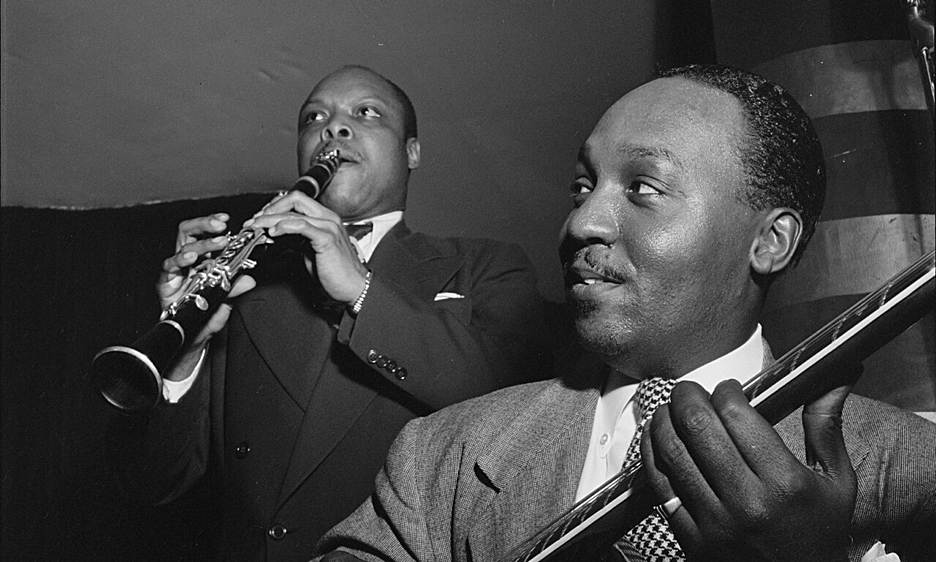
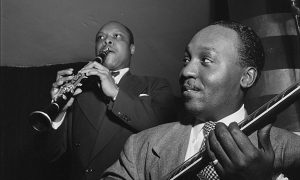
Courtesy William P. Gottlieb
When I would hear Eddie soloing, it was like taking this crazy journey back in time to what it must have been like to stand next to Coleman Hawkins! He had this big, old sound, with a wide vibrato, and he loved outlining all the chord changes. His improvising was very arpeggio-driven, harmonically sophisticated, and deeply rooted in that earlier tradition.
—Joey Cavaseno
As he told Phil Schaap from the stage of the West End in the summer of 1979:
"I played alto for about 50 years because all the bands I ever played with needed a lead alto player. I was envious of guys like Ben Webster and Coleman Hawkins, Lester Young and Don Byas. I would sit in the band playing lead alto and they got all the solos. In these last years of my life, I'm going to play the tenor which I've always wanted to play."
Barefield said of his first inspiration:
"If I ever get rich, I'm going to build a monument to Coleman Hawkins because he started all this tenor playing before everybody else. Coleman Hawkins was the daddy of all tenor players and jazz music ... one of the first starters of it that got us all into this trouble."
Alto saxophonist Don Byas sat next to Barefield inIllinois Jacquet's Big Band in the 1980s and recalled in an email to the author:
"When I would hear Eddie soloing, it was like taking this crazy journey back in time to what it must have been like to stand next to Coleman Hawkins! He had this big, old sound, with a wide vibrato, and he loved outlining all the chord changes. His improvising was very arpeggio-driven, harmonically sophisticated, and deeply rooted in that earlier tradition."
Barefield was a physically fit man throughout his life, with very strong feelings about how to maintain health and fitness. Cavaseno reported:
"One day, I asked Eddie, "What's the secret to staying so healthy and living so long?" To my complete surprise, he whipped out a sheet of aloe vera pills, and he instructed me:
"Take these every day! One per day! Swallow them with your food if you have to, but this is the key! It'll keep all your insides and organs straight!"
According to Mike Lattimore, who sang and played trumpet with Barefield in pianist Shorty Jackson's group from 1987 until his death:
"Eddie once told me that he had an uncle, or some other older person who told him, when he was about 14, "Your body is a temple." This influenced him greatly and he was very into physical fitness and also yoga and meditation."
Lattimore recalled Barefield's personality: "Eddie was a perfectly affable and very nice guy. At the same time though, you didn't want to cross him for any reason. He had that "I don't back down to no man" quality, only he really had it, in spades."
"I heard from Leonard Gaskin a story from the 70s in which Eddie, in his tuxedo for a gig, was accosted by several sanitation workers. There probably were racial slurs involved. Eddie took the three workers on by himself, according to Leonard, and he put all three of them on the ground, by himself."
In fact, Eddie Barefield's first ambition was to be a fighter. In an interview by Ira Gitler for the Rutgers University Institute of Jazz Studies Oral History Project he recalled that his father taught him how to box at a very young age, and that he was a fan of Jack Dempsey and kept a scrapbook of Jack Johnson, the first black heavyweight champion. Barefield told Lattimore that he acted as strongman in a carnival in his teens, taking on "all comers" (he also worked as a musician in that carnival). He later taught Marlon Brando how to box while A Streetcar Named Desire played on Broadway, and as we have seen, he was able to put his skills to good use when he was confronted by some ill-mannered New York City sanitation workers many years later.
Eddie Barefield was born December 12th, 1909, in a town that is now part of greater Des Moines, Iowa. He told Phil Schaap, "My people were mostly coal miners." He started on piano at the age of nine, and at twelve, he found himself at a community center where a C-melody saxophone caught his eye.
Barefield said in a 1987 Roots of Jazz lecture, which is available in the Phil Schaap Jazz Collection at Vanderbilt University:
"Christmas morning when I woke up, under the Christmas tree was a York alto saxophone. [My mother] found a teacher, and I went to him for one lesson, and he taught me the chromatic scale.
So, every Saturday, my mother gave me 50 cents to go get my lesson. I would leave my horn in the drug store or the pool hall, and go to the movies. But I was practicing every day. The first records that I listened to were Fletcher Henderson [with] Coleman Hawkins. He was a very raucous, slap-tonguing tenor player, which at that time was the fad, and he was the best at it. And I started copying Coleman Hawkins' solos. And my mother would say, Is that your lesson? I said, Yes, that's my lesson. In a couple of months, I was playing pretty good, just by ear."
While still of school age, Barefield was playing around Des Moines, and traveling by train as far south as Galveston, Texas. A planned trip to California was thwarted when his mother tracked him down the night before he was to leave.
When he reached Chicago around the age of seventeen, he got a job trucking ice, for $28 a week.
"[When] I got in Chicago, the first thing I did was write to my mother and told her that I wasn't running off. I just knew she wouldn't let me go. And I wanted to get out and do for myself. Because every job I got in Des Moines, she would come and get me and make me go back to school and she'd say, Wait till your little wings get a little stronger. She wrote me a very nice letter back. She said, OK, if you think that's what you must do. I used to send money home to her for my brothers and sisters." (Barefield's father died in 1921 when he was eleven.)
A job followed with the Virginia Ravens, and Hawkins became the star of the band, due to his facility playing in the (early) Hawkins style. However, the hole in his musical education became glaring at one rehearsal:
."This particular tune had a six-bar introduction and a two-bar tenor break at the end of the introduction. Well, when we got down to this break the band stopped and I stopped [laughs]. So the conductor, Lee Langster, said, You got a tenor break there on the last two. So, I went back and I came out with a slap-tongue solo that would knock you out. He said, The notes are there! You mean to tell me you've been in this band for two weeks and couldn't read? Well, if you can't read, I have to fire you.
And when I started out of the hall [the manager of the group] said, He can't fire you. You're the star of the band. What I had been doing, I had been breaking it up, you know, playing and falling down on the floor and slap tonguing and all that [laughs]. So I went back and started to take my horn out and he said, Well, okay then I'll have to teach you how to read.
And so my head had gotten this big then. So I said, I can play, I don't have to learn how to read. And I said, If you fool with me, I'll punch you in the nose. You know what I'm saying? So he got afraid of me,and the fellas kept agitating, [saying] Go get him, Barefield. Because we were all teenage kids, you know?
I was just walking down the street one day and it hit me [and] my mother's voice came to me and said, Well, Eddie, you're not really acting the way we taught you. This man is trying to help you, you should go and take him up on it and learn how to read.
So I went and knocked on Lee's door. And he opened the door, he saw it was me, and he put his foot in the door. And he said, What do you want? I said, I want to take you up on teaching me how to read. He spent an hour with me every day for about two weeks. And I began to learn how to read, so then they switched me over to the lead alto."
By 1927, Barefield decided he wanted to start to compose and arrange songs, inspired first by Frankie Trumbauer's "Singin' The Blues."
"It took me about six months to make my first arrangement because I didn't know what I was doing. I had a good ear and I could fake it. So I would write down the lead on my alto, I'd write it from my alto and write the lead, then I'd have the other saxophonist come in and play it while I faked the harmony and I'd write that down and so on. Finally, I was able to write a whole arrangement like that, you know, for what it was worth. And we used to take these things off the record."
In the winter of 1927-28, Barefield was working in Bismarck, North Dakota in the Spencer Hotel house band. The Young Family Band, with Lester Young playing alto saxophone, was then operating out of Bismarck.
"One day I got a knock on the door when I was listening to"Singin' The Blues" and I opened the door and it was Lester Young. He says, Who's that playing the saxophone? I said, That's Frankie Trumbauer . So he came in and [then] he used to come there every day to listen. So he says, Can I borrow that record? I said, Yeah and he used to go and practice and learn the solos himself."
It was a foundational turning point in the career of the man who would become known as "Pres." Soon, Young left his father's band and picked up the tenor saxophone. "Trumbauer always told a little story," Young later said. Barefield's copy of "Singin' The Blues" was never returned; allegedly it stayed in Lester Young's saxophone case for years afterward.
In 1932, Ben Webster invited Barefield to jam with the Bennie Moten Kansas City Orchestra at a hotel in Chicago, and Moten invited Barefield to join the group, which featured Count Basie on piano, Eddie Durham on trombone and guitar, Walter Page on bass, and Oran "Hot Lips" Page on trumpet. After Moten's premature death in 1935, the group formed the core of what became the Count Basie Orchestra.
In a November 16, 1979 interview on WKCR-FM, Barefield recalled to Phil Schaap:
"Bennie Moten had one of the great jazz bands of that era. This is what you call a real jazz band where the arrangements were never the same every night. Every night when they went on the bandstand to play, the arrangements were always different. [Eddie] Durham made a lot of arrangements, I made some. And Basie used to work with Durham on a lot of arrangements. But there was never a night that we played those arrangements the same way; it was always different. Sometimes Hot Lips Page would get up and play about 50 choruses on St. Louis Blues, and we'd have to set a riff after each chorus. Every night it was always a different thing, you never knew what to expect."
As great as the group was, Barefield told Schaap how the band scuffled from one gig to another, often stranded in different cities and towns from Kansas City to Ohio and on toward Philadelphia, where a prime gig was waiting:
"We finally got to Philadelphia and we were going out and drinking and having a ball and jamming. We're gonna do a week at the Pearl Theater. Well, this was the thrill of the whole trip, that we were gonna have some money to spend. We were tabbing this and tabbing that, tabbing our rent and our booze. And at the end of the week when we were supposed to get paid, [the owner of the Pearl Theater] took all the money. He confiscated the money and took the bus and everything because Bennie had owed him some money [that had been previously advanced] for uniforms. And there we were, left out in front of the Pearl Theatre with our instruments and bags, stranded again."
"The guys worked hard, although every night when they got through and we didn't get paid, they would be kind of down and then they'd go out and get juiced up. Poor Eddie Durham used to collect his arrangements up every night and say, I'm going back to Kansas City [laughs]. And the next night he'd come out and pass them all back out and we'd play them again [laughs]."
In December, 1932, the Bennie Moten Kansas City Orchestra recorded 10 tracks in a converted church in Camden, New Jersey. The session included one of Barefield's own compositions, "Toby." The featured recording was "Moten's Swing" (later just "Moten Swing"), which became one of the best known standards of the era. Barefield's enduring memory of his first recording session: "We didn't get paid."
In 1933, Barefield was with McKinney's Cotton Pickers, playing again in Baltimore, where his alto solo on "Memories of You" caught the attention of Cab Calloway, who offered Barefield a job.
By this time, Barefield's arranging skills had improved drastically. He told Gitler, "Cab gave me some things to make arrangements on ("Little Town Gal" and "Harlem Hospitality") and I brought the arrangements back the next day which he thought was fantastic. By that time I had learned how to just sit down and write [arrangements]."
Calloway's bands had great musicians including Ben Webster, Chu Berry, Jonah Jones , Dizzy Gillespie, Doc Cheatham , TTyree Glenn and Milt Hinton. They were well-paid and traveled by Pullman car when outside of New York, but in exchange for the first-class treatment, they were expected to work.
"Our first show at the theater would probably start at about 11 o'clock in the morning. We'd do four shows and we'd get to the Cotton Club about 12 A.M., which started the first show at the Cotton Club and the second show at two and we'd finish there at four, hang out in the joints until it was time to go to the next and we'd sleep between shows on cots."
In January 1934, Calloway's group headed to Europe, with a recording session planned before their departure.
"At that time we used to record in groups of four sides. We did three sides and we didn't have a fourth side for him to sing. And so Cab said, Let's do Moonglow. So we did three choruses of Moonglow. He told me to take a solo on the second chorus, which I had never done before. We just did one take and walked out of the studio.
We came back from Europe, and we were down in Texas getting ready to play a dance and while we were unloading, this record was playing. I've always been a Benny Carter fan, and everything that Benny Carter played at the time, I always got a hold of it and tried to imitate him because I thought he was one of greatest alto players that ever lived. And I said, Guys, it sounds like Benny Carter. And I asked, Whose record is that? And the guy playing the records said, Don't you know your own record? It's Cab Calloway, "Moonglow." So I had to buy the record and learn the solo off the record so we could play it on the stage in the theaters [laughs]."
Barefield appeared in several movies during this time with Calloway, including "The Singing Kid" with Al Jolson. In 1936, Barefield chose to stay behind in California, due to an ulcerated stomach. His connection to Calloway would continue for fifty years; he regularly wrote arrangements for him, and served as Music Director in the 1950s. According to Mike Lattimore, sometime in the 1980s, Barefield's "I don't back down to no man" attitude resulted in a gunshot through a wall toward a bothersome tenant. Calloway paid his bail and arranged legal representation; Barefield stopped renting out floors in his brownstone.
In California, Barefield found he could make more money writing arrangements for artists like Red Norvo and Jimmy Dorsey. He also formed a big band that featured Don Byas:
"When I found Don in California he was playing alto and I started him to play tenor in my band. Now he's one of the guys that I listen to the most."
About a decade later, Barefield played on 52nd Street with a small group that included Byas on tenor sax. Their friendship endured through to Byas' death. According to Con Chapman's Don Byas Sax Expat (Mississippi University Press, 2025), clarinetist Kenny Davern recalled seeing "the two men encounter each other by chance in the 1960s, take out their horns, and spontaneously run through Frankie Trumbauer's C-melody saxophone chorus from "Singin' The Blues." 'Everybody knew that chorus,' they told Davern, laughing."
In Los Angeles in 1937, Barefield combined his big band with that of Les Hite's and won a competition during the Labor Day parade in Los Angeles. The prize was an appearance in Every Day is a Holiday with Louis Armstrong and Mae West. Armstrong played and sang in front of a parade, with Barefield holding a trombone behind him.
Barefield also appeared in "Bargain with Bullets," the first Hollywood feature-length movie with an all-African American cast. Barefield told Phil Schaap that his group provided the music for the film about the Harlem underworld.
Also in the late 1930s, Barefield followed his idol, Coleman Hawkins, in playing with the Fletcher Henderson Big Band; this marked his exit from California. In December 1950, he was at Cafe Society with the Fletcher Henderson Sextet for what was Henderson's last gig before he suffered a stroke. Barefield played clarinet while Lucky Thompson took all solos on tenor saxophone.
He told Schaap:
"[I have four top tenor players]: Don Byas, Coleman Hawkins, Ben Webster and Lucky Thompson. I named them in order, because it was the Hawkins School of course. Don Byas I think went a little bit beyond [Hawk] as far as ideas and technique were concerned. And Lucky Thompson followed around behind Don Byas. Ben could play a ballad better than anybody I ever heard. He had the sound and the feeling, he incorporated a little Johnny Hodges and a little of Benny Carter and Hawk all mixed up."
In 1939, Barefield was back in New York where he received an offer to join Chick Webb's band, which featured Ella Fitzgerald. He chose to avoid a series of one-nighters and planned to join when the group returned to the Savoy in New York City. Webb died of spinal tuberculosis on that trip, and the group returned under Ella's leadership. Barefield worked with the group for a few months and later, he rejoined as Ella's music director. However as Fitzgerald's gig schedule slowed down, Barefield found he had to recruit and rehearse a virtually new group for each engagement, and he chose to leave Ella's employ.
On Schaap's Jazz at One show in February, 1978, Barefield bemoaned how the Cabaret Tax helped separate singers from bands, to the detriment of both jazz musicians and the listening public:
"During the forties, the whole music scene had been a jazz scene built around dancing. And every town in the United States or every little village had a dance hall, and when the government put a 20% tax on all dance halls for dancing, they all closed up. So they started sending the singers around by themselves and they just forgot about the musicians. All the musicians had to go out and scuffle for themselves because the booking agents saved a lot of money by doing that.
But before that, it was the band, and the singer was singing with the band. Nowadays, it's a million singers, and nobody ever listens to instrumental music anymore. The listening public has degraded themselves that much. If you don't sing the words, they don't understand music at all."
In 1942, Barefield helped to integrate the ABC radio network. Benny Carter told Barefield about an opportunity at CBS, but Barefield was too late to be considered. John Hammond told him that there would be an opening at ABC shortly, and Barefield spent four years on the staff and as an arranger at ABC. He also worked on the "Endorsed by (Jimmy) Dorsey" show on WOR.
Also in the 1940s, Barefield completed his high school diploma, and then enrolled at Julliard. Loren Schoenberg, a saxophonist/pianist/jazz historian who played with Barefield many times at the West End, recalled in an email that "a friend of a friend" was selling a brownstone in the NE Bronx which had been purchased from Barefield's widow. Invited to rummage around items that were left behind in the basement, Schoenberg found "practice books and etudes that only someone who was very serious about playing the clarinet, studying classical-level clarinet playing would have." He recalled that Leon Russianoff, a famed classical clarinet teacher who sometimes worked with Benny Goodman, had also been a teacher to Eddie Barefield.
In 1943, Duke Ellington came to The Hurricane in New York City in need of a clarinetist, as Chauncey Haughton, who had taken Barney Bigard's place, was going into the army. After the six week engagement was up, Ellington assumed Barefield would go on the road. But Barefield thought he had a lifetime job at ABC and recommended Jimmy Hamilton, who would stay with Ellington for the next 25 years.
Barefield told Schaap, "I wish I had gone with Duke then, because I would have made a bigger name for myself." Yet Barefield also said to Ira Gitler, "Now I think differently, because I didn't want to be a clarinetist in the first place (laughs)."
In 1947, Barefield was hired as music director for the Broadway production of Tennessee Williams' A Streetcar Named Desire. The group consisted of Barefield on clarinet, Dick Vance (who played with Barefield in the Fletcher Henderson Orchestra) on trumpet, pianist John Mehegan (who later recorded with Kenny Dorham) and a drummer named Dennis Strong. The music was "the old jazz tunes like "Tin Roof Blues.""
Barefield recalled to Phil Schaap in 1987:
"At first, we used to play from the side of the stage in rehearsal and we covered all the lines up. They didn't know how to do it, so I thought about broadcasting. I said, Why don't you just take us up in another room and broadcast us to the stage, you know, with a microphone. And I set up the whole thing where we had the mics there and would have a light. They'd buzz us, and we'd get in position to play. And then when the light came on, we'd play. When they wanted to fade us out, they'd fade us out and cut the light off. And it worked.
We set up a gym in the basement of the Barrymore Theater and I was giving [Marlon] Brando boxing lessons. And we used to go down and box between the scenes because we would play and then we'd have maybe 20 minutes off. And he'd come back on the stage so out of breath that he couldn't say his lines. So Jessica Tandy put up a protest and they stopped him from doing that."
One day I couldn't get down [there] to box with him and we had a stagehand who was about six feet two inches tall, a great big guy. And Marlon was strong, but he just didn't know how to use his fists. He put on gloves with this stagehand and he swung at him and knocked him down. The guy gets up angry and throws a one-two at him, catches him right on the nose and breaks his nose. So, he was out of the show for about six weeks."
Eddie Barefield knew Louis Armstrong from about the age of twenty, but whenever Louis asked him to join his band, he was never able to "get with Joe Glaser on the money." When Cozy Cole joined Armstrong in 1949, Barefield was hired to write two arrangements:
"Pops comes in for this rehearsal, and he hadn't read any music for years, and when they got down to a certain part in this arrangement, there was a high note, and Pops missed it. Cozy hit on the rim of his drum: tap, tap, taptaptaptaptap [laughs]. Pops gets his hanky [and] he starts to wipe the sweat off his brow and he starts off again and he gets down to this same spot and Pops misses the note again. Cozy whacked on the drums again and they stopped the band and so finally they started it one more time and before Pops got to this note this last time, he threw his horn down and his handkerchief down and he said, The hell with this thing! The hell with Joe Glaser, the hell with Cozy and he said, Barefield, due respects to you, the hell with you, too [laughs]! I got paid for the music, but that was the end of the rehearsal."
The 1950s were a good period for Dixieland jazz, and Barefield made several LP recordings on clarinet, most notably with old friend Roy Eldridge's Swing Goes Dixie (Verve, 1956).
As mentioned previously, Barefield always preferred playing the tenor saxophone, and he resumed playing tenor at a little-remembered amusement park, Freedomland ("The Disneyland of the East"). The park, located in the north Bronx, was a regular source of gigs for jazz musicians. Barefield was hired to play tenor in one of the groups employed there one summer. Stars like Lionel Hampton, Count Basie and Coleman Hawkins also played at Freedomland, sometimes for extended engagements.The park closed in 1964 after five seasons and shortly thereafter, Co-Op City was built on the site.
Starting in 1971, Barefield performed with Ringling Brothers Barnum & Bailey Circus at Madison Square Garden and the Nassau County Coliseum. He told Schaap, "it's like working the coal mine" but as Loren Schoenberg pointed out, it was a time when musicians, especially older ones, took the gigs that helped pay the bills.
Also in the 1970s, Barefield made several recordings as a leader, usually playing tenor. He was recorded on tenor sax on Famous Door (The Indestructible E.B. (1977 and reissued as Eddie Barefield Sextet by Progressive in 2012)).
That album included a slow blues composed by Barefield, "For Grandma Webster." On a December 1980 broadcast of Jazz Session (WNYC-AM), Barefield explained his inspiration to Phil Schaap:
"When Ben [Webster] and I were with Bennie Moten's band in Kansas City, we saw some pretty rough times, although we were enjoying ourselves and having a lot of fun hanging out and drinking and all that. Ben Webster's grandmother used to make the most delicious strawberry pies. She used to bake a whole pie just for me. And I'd get a quart of milk and sit down with Ben sitting on the other side of the table from me and eat it up and wouldn't give him any [laughs]. And Ben, he would call me Bull, he'd always say, She made Bull a whole pie [laughs]. So I just thought I'd dedicate this to Ben Webster's grandmother. Of course, Ben was like a brother to me, and I miss him very much."
In 1980, Famous Door issued Butch Miles Salutes Chick Webb (reissued by Progressive in 2003) which featured Barefield's tenor sax and arrangements. The recording is the only trace of a short-lived show Barefield organized in 1978 at Michael's Pub in New York City. Barefield said the show had a tremendous audience response, but it coincided with a NYC newspaper guild strike, and the show could not get the press it needed to be successful. Dave Panama Francis played drums in the show, but Norris Turney, on alto saxophone, and Barefield on tenor were the only holdovers from the group that played at Michael's Pub to appear on the recording.
Also in 1980, a Japanese label released the ironically titled Introducing Eddie Barefield (Discomate). Barefield considered it to be his most successful recording, and six of the eight songs on the record can be heard in the 71st Birthday Party Interview that is part of the Phil Schaap Jazz Collection.
Barefield expressed to Phil Schaap how much he enjoyed being part of Sammy Price's Two-Tenor Boogie at the West End, and in particular playing with Percy France:
"Not having played tenor all my life and playing it now, when I play with another tenor player, it gives me ideas to go home and work on and practice and get to the real tenor thing."
"Percy France to me today is one of the fine tenor players. He reminds me of Don Byas a lot because he has marvelous ideas and he's from the, say, semi-bebop school and the rock school [all] mixed up and I love his work. I think he has marvelous tenor ideas."
Here is a rare performance of the Bill Doggett R&B instrumental, "Honky Tonk." It was normally a feature for France in the Two Tenor Boogie, but here both France and Barefield take strong solos. Leader Sammy Price is heard on piano and the drummer is Ronnie Cole. The date was August 23, 1979.
Two Tenor Boogie at The West End (8/23/1979), Phil Schaap Jazz Collection, Special Collections Library, Vanderbilt University, Nashville, TN
From the same appearance at the West End, a terrific, "greasy" "Lil' Darlin,'" from the pen of Neal Hefti and first recorded by Count Basie on The Atomic Mr. Basie (Roulette, 1958):
Two Tenor Boogie at The West End (8/23/1979), Phil Schaap Jazz Collection, Special Collections Library, Vanderbilt University, Nashville, TN
In the early 1980s, Illinois Jacquet formed his Big Band, and Eddie Barefield played tenor and wrote arrangements. In 1984, a seventeen year old Joey Cavaseno had just started to play around New York City with Barefield's old friend Doc Cheatham, when he was invited to audition for Jacquet. Meeting and playing with Eddie Barefield was a formative experience for the alto saxophonist who would soon take the nickname Joey "G-Clef" Cavaseno:
"Eddie was always super supportive and encouraging. It was obvious that he took a liking to me right away. Maybe he sensed that I had studied the old records and genuinely appreciated his contributions to jazz. I think that meant something to him.
"Eddie was a master lead alto player, and helped me understand how to lead a saxophone section. He taught me about phrasing, correct timing, bending notes while maintaining intonation, and how to really attack the notes percussively. That last part is important. His concept of lead alto was different from what a lot of later lead alto stylists were doing. He emphasized that rhythmic attack, that sense of precision and propulsion."
Illinois Jacquet was well known for being tough on musicians, and during one rehearsal, Cavaseno took a memorable blast from the bandleader:
"Jacquet held his rehearsals in the basement of his house in St. Albans, Queens. He called it Count Basement Studio. One time, Illinois stopped the band and yelled at me:
"GET THE FUCKIN' WHITE OUT YO ASS!"
HAHA! I mean, what am I supposed to do with THAT?
But Eddie immediately jumped to my defense. He yelled back even louder:
"THAT'S Barney Bigard!!!!"
And as quick as you could imagine, Jacquet shouted:
"BARNEY BIGARD WAS WHITE!!!!"
Eddie just scowled at him and waved him off. It was unbelievable. It showed that Eddie wasn't afraid of Illinois Jacquet, and he would stand up for me if he believed I was doing something musically legitimate.
Jacquet could be very rough on musicians, but never Eddie. With Eddie, Illinois always seemed almost like a child somehow. He looked up to him with this extraordinary reverence. His respect for Eddie was total and it was completely different from the way he treated just about anybody else in the band.
Cavaseno wrote about Barefield's arrangements:
"He had such complete command of harmony, orchestration, and the instruments themselves that he could conceive music directly on the page. He wasn't just a great saxophonist. He was really an all-around master of music. And he was generous about sharing that knowledge with a young musician like me."
In 1988, Atlantic released Jacquet's Got It! It featured several of Barefield's arrangements, including his own composition, "Three Buckets of Jive" which he first recorded in 1947 as leader of his own quintet. Cavaseno took note of another arrangement Barefield wrote for Jacquet's book, "Stompin' at the Savoy":
"It featured this very complicated saxophone soli passage, full of arpeggiated figures and harmonic movement. To me, that arrangement was really an extension of how Eddie himself played. His improvisational thinking and his arranging were inseparable. You could hear the same musical personality in both."
During the 71st Birthday interview, Barefield had noted that at the end of "Laura" on Introducing Eddie Barefield, he had inserted "something Coltrane might have played." He remarked to Schaap:
"I listen to everybody. Try to extract a little from here and a little from there. I think that's the only way, that's the way everybody learned to play by listening to others because someone has to plant the idea and then you take it from there."
Cavaseno himself witnessed how Barefield's musical ears had always been open:
"One day, I was playing a gig with Eddie at Sonny's Place out on Long Island. Theo Wilson, the son of the great pianist Teddy Wilson, was playing bass. We were on a break in the back room, and Theo was going off with all these old-timey opinions about Charlie Parker and bebop. He was preaching to me and the other musicians about how bebop had ruined music and all that crap.
So we're sitting there listening to this, and suddenly Eddie walks into the room. He hears what's going on, physically pushes his way right in front of Theo, and exclaims at the top of his lungs:
"MAN, SHUT THE HELL UP! BIRD WAS A GENIUS!!!!!!"
Here was Eddie Barefield, a man who was practically Theo Wilson's Daddy's age, defending Charlie Parker and bebop against Teddy Wilson's own son! Eddie came from an entirely earlier generation, yet his ears were more modern and open-minded than Theo's! He never closed himself off to musical innovation. He recognized genius when he heard it, regardless of what generation it came from."
Barefield's first inspiration, Coleman Hawkins, famously kept his ears open also, and in 1946, he recorded "Bean and The Boys." A bebop contrafact to "Lover Come Back to Me," the recording featured such young stalwarts as Fats Navarro, J.J. Johnson, Milt Jackson and Milt Jackson.
Here is "Bean and The Boys," broadcast from the West End, December 13, 1981, with Eddie Barefield, tenor saxophone and leader, Irv Stokes on trumpet, Bill Wuertzel on guitar, Jim Roberts on piano, Aaron Bell on bass, and Earl Williams on drums:
Eddie Barefield at The West End (12/13/1979), Phil Schaap Jazz Collection, Special Collections Library, Vanderbilt University, Nashville, TN
 FOLLOW Daniel Gould
and get notified whenever a new article published.
I came to Jazz after rejecting the pop music of the 1980s - just in time for the CD reissue boom.
About Eddie Barefield
Tags
PREVIOUS / NEXT
Become a Sustaining Member

Since 1995, All About Jazz has championed jazz as an art form and supported the musicians who create it. Over three decades, it has grown into one of the world's leading jazz resources, serving hundreds of thousands of readers, musicians, presenters and industry professionals each month.
Help Build the Future of All About Jazz
Your support helps us continue building All About Jazz for the next generation—expanding our editorial coverage, preserving jazz history, developing new community features and creating better ways to discover the music and the people behind it.
Become a sustaining member for as little as $20 per year and you'll immediately enjoy an ad-free experience along with access to subscriber features and future articles for a full year.
Together, we're not simply sustaining All About Jazz—we're building its future. Thank you for being part of the journey.