Home » Jazz Articles » Live Review » Big Ears 2026
Big Ears 2026
Courtesy Cora Wagoner
Knoxville, TN
March 26-29, 2026
Another year, another jam-packed festival lineup. The Spotlight presentations included SUSS Presents Across the Horizon, an ambient country experience; films and performances related to Ethiopia's musical legacy; and David Byrne's Who is the Sky? Polish pianist/composer Hania Rani offered an ambient concert and the North American premiere of her piano concerto; returning saxophonist/composer John Zorn was featured in a 12-performance series; and there were several performances by Laurie Anderson, including a repeat installation of Lou Reed Drones (featuring several of Lou Reed's guitars and a carefully arranged group of amplifiers).
Guitar spotlights included three shows by Marc Ribot; a performance of Nels Cline's Lovers, making good on a 2018 snowstorm-canceled performance; and Pat Metheny's Side-Eye III+. Ragamala offered a full-day series of South Asian classical music, including a performance by legendary violinist L. Shankar; Robert Plant appeared with Saving Grace and Suzi Dian; and the Los Angeles quintet SML had a three-night, six-show residency. The classical collective Wild Up was featured with concerts and a one-day residency; and the percussion ensemble Sō Percussion played three concerts, including Steve Reich's minimalist landmark Drumming.
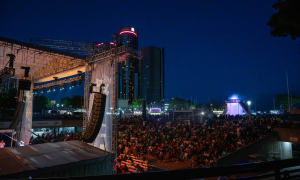
The Byrne and Plant shows were separately ticketed, a return to a practice first tried at the 2024 festival. There were also some new venues, the most notable being The Greyhound, Knoxville's iconic Magnolia Greyhound Bus Terminal, which was opened in 1959 and celebrated for its mid-century design. It offered the possibility of fully immersive experiences.
Thursday, March 26
Pat Metheny Side Eye III+
Guitarist/composer Pat Metheny has used his Side Eye trio projects to highlight impressive younger players and to keep his own playing fresh. Side Eye III is Metheny plus pianist/keyboardist Chris Fishman and drummer Joe Dyson. The plus came from Metheny's desire to augment the trio with additional players for the recording sessions of the album Side Eye III+ (Pat Metheny Go-Fwd, 2026); for the tour, the trio was joined by bassist Jermaine Paul and percussionist/vocalist Leonard Patton. The concert began with the band members processing through the darkened hall, playing drums (like a Brazilian samba school during Carnival). As they approached the stage, Metheny began playing acoustic guitar offstage, joining the group onstage when they had assumed their positions. He switched to electric guitar, which led to vocals, a terrific synthesizer solo, and a drum solo. Metheny introduced his early standard "Bright Size Life." On the next tune, he backed away from the center stage for Fishman's solo and fell over the monitor speaker. He laughed it off and continued playing while sitting on the floor. Afterward, Metheny introduced the band and praised Big Ears. "Urban and Western" from the album found Paul switching to electric bass. A solo nylon string ballad followed, with Portuguese vocals: a Milton Nascimento song? The Pat Metheny Group song "Phase Dance" was played by the core trio, followed by Ornette Coleman's "Broadway Blues," which also featured a few Orchestrion modules (a mechanical device that allows the guitar to operate several other instruments, which Metheny has used for full solo concerts in the past). The encore began with Metheny on acoustic guitar, moving from "America The Beautiful" to "This is not America," a subtle political statement aided by reharmonization. The show concluded with "Last Train Home' with the full band: a beloved tune, and an energetic final statement.Marc Ribot's Shrek
Guitarist Marc Ribot recorded Shrek (Avant, 1994) with a group including two guitars, two drums, and a bassist. It was a kind of hardcore/avant-garde fusion. This version of the band included Ribot, bassist Sebastian Steinberg, drummers Ches Smith and Chad Taylor, and guitarist Mary Halvorson. At one point during the performance, Ribot observed that the original album had sold about 20 copies, and apparently, all 20 purchasers were in the hall. The show opened with Ches Smith playing chords on vibes over Steinberg's double bass ostinato. "Hoist the Bloody Icon High" prompted Ribot to say, "let's hear the Ronnie Spector beat," which recalled her hit song "Be My Baby." Call-and-response led to harmonic and melodic riffs. After introducing the band members, Ribot said that all the music took the band a while to learn. He was thrilled to see so many at their Shrek reunion (even if it did involve a mostly new band), and the set concluded with a version of Jimi Hendrix's "The Wind Cries Mary" (or possibly it was overlaid on a Ribot composition).Friday, March 27
Tim Berne with John Hébert, Tom Rainey and Gregg Belisle-Chi
Saxophonist/composer Tim Berne brought a new quartet, which he introduced at the beginning: double bassist John Hébert, drummer Tom Rainey, and guitarist Gregg Belisle-Chi (who famously auditioned for the gig by recording a solo album of Berne compositions). The first tune "Twelve" had a long, convoluted theme, played rubato (a frequent Berne ploy). Berne said that the title of the next piece might cause a riot, so he refused to reveal it (except to purchasers of the CD). "No Whiteout" began with unaccompanied guitar chords. Gentle and ballad-like, it featured arco bass and drums played with brushes. "Ara-Yikes III" featured an unaccompanied drum solo after the head. Berne confessed that he talks to rest. "Sorry—No Ballads" was another medley, with a relentless ostinato for an ending. "Loose" opened with an unaccompanied double bass solo, followed by a long rubato melody. "Yikes II" was the closing tune. Berne was killing time, announcing the band members again while also mentioning the CDs he had for sale.Marilyn Crispell and Harvey Sorgen
Pianist Marilyn Crispell has had a long and varied career in avant-garde jazz. She spent many years playing with saxophonist/composer Anthony Braxton, where her fiery playing often drew comparisons to pianist Cecil Taylor. She has also recorded several albums for ECM, which feature a calmer, more introspective side. Nothing Ever Was, Anyway: Music of Annette Peacock (ECM, 1998) found her taking a deep dive into Annette Peacock's music. Her duets with drummer Harvey Sorgen drew on her whole range. Sorgen began the show by announcing, "basically, we're going to play some music." The first piece began with low piano notes with lots of space. After the drums entered (playing rubato), Crispell introduced a rippling piano figure, followed by declamatory chords, rhapsodic arpeggios, and a lyrical melody with a dissonant undercurrent. Later, assertive piano figures (with active drum accompaniment) gave way to roiling solo piano, reminiscent of Keith Jarrett, concluding with a repeated rhythm echoed by the drums. For the third piece, Crispell put something on her music stand: music, or text? Sorgen began reciting, with piano responses, then added drums to the mix.Fred Frith's Fremakajo
Art-rock icon Fred Frith brought a new quartet of Bay Area musicians (assembled through his Mills College teaching). Frith's electric bass and violin were joined by drummer Jordan Glenn, saxophonist Kasey Knudsen and accordionist Marié Abe. Judging by the sound, this was a project emphasizing Frith as composer, often in the ethnic World Music mode he has favored throughout his career. Although he is best known as a guitarist, he has often played bass on recordings, and his playing here was very strong. The first tune sounded like an Eastern European dance, and the next had a Turkish groove. Frith introduced the band members, and the following piece had texture over a groove in a more avant-garde mode. They next played a reel (with vocals) as a homage to a Scottish folk band. Frith said "time for the ballad," introducing a tune with a serpentine saxophone melody and a strange, electronically treated bass solo. "For Tom Ze" from an earlier album was a tribute to the Brazilian experimentalist. "Coming and Going" included a pizzicato violin solo, and after a screaming saxophone solo, there were abstract electronic sounds to end. After re-introducing the band, Frith launched into a jagged Thelonious Monk-like head.Thurston Moore & Shabaka Hutchings
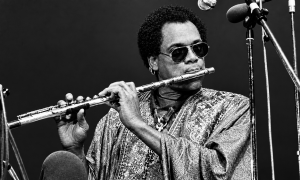
Guitarist Thurston Moore is best known for cofounding the band Sonic Youth, but he has also been an avid collaborator, adding unusual tunings, atonality and noise to a wide range of settings. This first meeting with the British musician Shabaka Hutchings promised exciting new sounds. After concentrating on the flute exclusively for a time, Shabaka returned to the saxophone in 2025. Moore provided bell-like sounds, and Shabaka entered on tenor saxophone, a treat for fans of his saxophone playing. After a few minutes, he switched to a C flute (the standard Western concert instrument). When Moore changed the texture to feedback, Shabaka played keyboard (bell sounds again). Moore added looped guitar figures. Shabaka played a couple of different-sized bamboo flutes, more keyboard, and returned to the saxophone. So it went: Moore providing texture (mostly) and Shabaka providing melody (mostly). Moore prepared his guitar by sliding a drumstick under the strings, giving him a new rhythmic vocabulary. At the end of the set, there was a tenor sax and a light guitar texture produced by tapping with a metal rod. Moore loaded string scrapes into a looper, Shabaka played C flute, and Moore introduced light feedback. After 45 minutes, the players embraced, and that was the end of the set. Since the show was scheduled to run for 75 minutes, the audience was surprised. But sometimes in improvisation, you need to know when to stop.Fred Frith, Simon Hanes, Max Jaffe, Jordan Glenn Quartet
This quartet was made up of Fred Frith, electric bass; Simon Hanes, guitar; and Max Jaffe and Jordan Glenn, drums. They began with a loud blast. Hanes began singing along with his guitar riffs, and the band settled into a hard rock groove. Frith vocalized a bit, and the band shifted into a new groove every few minutes. A rubato section with a slow bass ostinato came to a thunderous climax, then went down to a pointillistic texture before building up again. Finally, the guitar went into a machine-gun rhythm; there was shouting and chanting, and Hanes cued the first full stop (just over half an hour into the set). He introduced the band, and they played another short improvisation featuring a slow walking bass pattern. Saying "we're called the Californians, because we're all from there," he called alto saxophonist Nora Stanley to the stage to sit in. Her playing was mainly rhythmic at first, then she moved on to long, sustained tones, and finally to melody. Hanes played a melodic guitar solo in response before going into more mayhem: first beating on his guitar, then playing it with a bottle. The final piece was built on a loud rock riff, with a jazz saxophone solo on top. Hanes began singing and got Frith to join in before cuing the end.Laurie Anderson & John Zorn
The first piece began with long, looped violin tones by Laurie Anderson; John Zorn joined in with an alto saxophone solo. Anderson began playing pizzicato, which Zorn echoed by tapping his saxophone keys percussively. Next, Anderson's low legato bowing was interrupted by saxophone disruptions. The second piece began with a looped violin line, then Anderson began reciting in the late William Burroughs' voice (or something programmed to sound like him). The text was about loving the stars: "we can't count them, burn them, or blow them up. But we are reaching for them." If the words were not by Burroughs, they certainly sounded like something he might have said. She continued "Another Day in America" from Homeland (Nonesuch, 2010) with a keyboard chorale. "America, we tipped it over, then sold it. How do we begin again?" The final piece had processed violin sounds, accompanied by imitative saxophone sounds. And then the concert was over, Anderson and Zorn embracing. Another short show: 38 minutes instead of the scheduled hour. The possible collaborative possibilities wound up being Anderson with Zorn accompaniment. But they both looked like they were having a great time.Hania Rani Presents Chilling Bambino
Polish pianist/composer Hania Rani played two shows during the festival. Chilling Bambino presented her while she played ambient music in real time. In the round, surrounded by synthesizers (and an upright piano). It was a loud, immersive experience in a dark room, with lights suggesting a rave. Rani was clearly way into it, swaying while manipulating the synthesizers to produce a throbbing aural experience, including powerful sub-bass content.SML
This was the last show of Los Angeles improvisational quintet SML's residency to feature the core group without guests: bassist Anna Butterss, synthesist Jeremiah Chiu, saxophonist Josh Johnson, percussionist Booker Stardrum, and guitarist Gregory Uhlmann. Chiu made that announcement, then polled the audience for a show of hands from everyone who had been present at earlier nights. It was a lot, indicating that the band may have made some new fans. The set began with percolating sounds from drums, bass and synthesizer. After it dropped into a regular groove, Johnson added saxophone riffing on top. After a stop for an unaccompanied drum solo, Butterss played a grooving bass solo and Uhlmann added processed guitar textures. About a half hour in, there was a major shift into a group soundscape. Chiu brought in a rhythmic sequencer part: his contributions seemed more significant than was audible in the band's recordings. The synthesizer was sometimes a lead instrument, as well. The guitar finally played a more conventional rhythmic riff, followed by a melodic saxophone solo. As the end-of-hour set limit approached, the drums cued a full stop.Sunday, March 29
Sō Percussion: Drumming
Acclaimed percussion quartet So Percussion was augmented by Knoxville's own Nief-Norf ensemble for a performance of Steve Reich's landmark composition Drumming (a nod to the composer's 90th birthday year). The instruments were set up on the floor in front of the Mill & Mine stage, giving the performers plenty of space to move around (as required by the instrumentation changes in the score) and lending the performance a communal atmosphere. The piece began very minimally, with two tuned bongo drums playing the rhythm on which the whole work is based. But it became frenetic as two more drummers joined in and phase-shifting patterns emerged. The shift from drums to marimbas (about 20 minutes in) was just as dramatic as it was when I heard a recording in 1974. The final section, which uses the entire ensemble (bongos, marimbas, glockenspiels, female voices, whistling and piccolo), built to full intensity, ending with a bang. Drumming is a classic that still packs a punch.Nels Cline & Knoxville Jazz Orchestra: Lovers
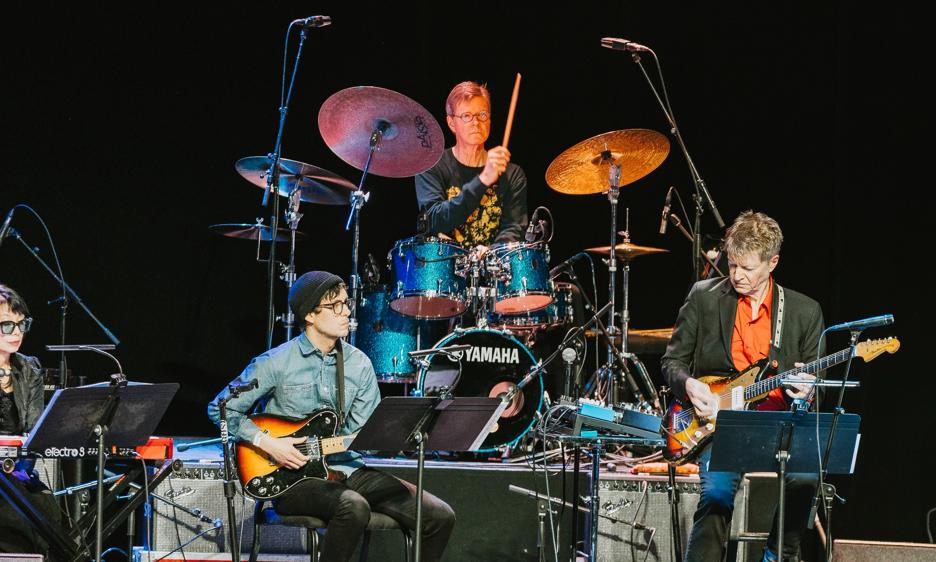
Guitarist Nels Cline intended Lovers (Blue Note, 2016) to be a darker take on atmospheric "mood music." With a chamber orchestra arranged and conducted by Michael Leonhart, it blended jazz standards and music by Sonic Youth, Annette Peacock, Arto Lindsay and Cline himself. Celebrating its tenth anniversary in 2026, this performance made good on a 2018 Big Ears performance that was canceled by snowstorms. The album is structured like a classical suite, and this performance honored that intention by performing the entire program, mostly in the original order. Given Cline's prominence as a soloist, it can also be seen as a kind of guitar concerto (although several other players also had their time in the spotlight). Cline is known for his creative use of electronic effects, but on the opener "Introduction/Diaphanous" he played a lyrical solo in traditional jazz guitar style. He used a similar sound to play the head of the standard "Glad to Be Unhappy," which also featured a lovely muted trumpet solo by conductor Leonhart. When Cline stopped to address the audience, the first thing he said was, "This is really happening." He back-announced the earlier songs and went on to mention the inspiration behind some of his song choices. "Secret Love" was inspired by the late guitarist Jim Hall (who died just as the recording was being completed, so he never heard the tribute), and "Beautiful Love" came from the playing of the late guitarist John Abercrombie. On modern jazz selections like Jimmy Giuffre's "Cry, Want" and Gabor Szabo's "Lady Gabor" Cline let his noisier side loose, playing solos with glitching, delay and looping. Cline eventually thanked each of the players by name, but featured ones included bassist Chris Lightcap, drummer Alex Cline (Nels' twin), guitarist Gregg Belisle-Chi, and saxophonist Greg Tardy. Speaking as someone who was disappointed by the 2018 cancellation, I can say that it was worth the wait.Dave Douglas GIFTS Quintet
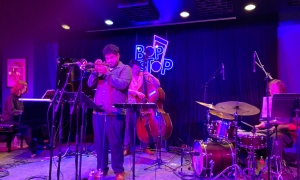
On the original GIFTS album (Greenleaf Music, 2024) trumpeter/composer Dave Douglas was joined by guitarist Rafiq Bhatia, saxophonist James Brandon Lewis and drummer Ian Chang. For the forthcoming Transcend (Greenleaf Music, 2026), cellist Tomeka Reid joined, making the group a quintet. Neither band had a bassist. But Reid was capable of riffing with the horns, soloing, and occasionally providing a bass function. On the first piece, I heard Bhatia use a bass doubler on his guitar while Reid played background riffs. A powerful trumpet solo was followed by an equally strong tenor sax solo (the first of many). Later, Reid played pizzicato, which sounds like a double bass, even though it was in the wrong register. The piece concluded with a cello/drum duet, with Chang switching over to electronics. The second piece began with an ominous riff (sounding a bit like a James Bond movie theme). It had a swing feel, with the cello providing walking bass. Bhatia's guitar solo demonstrated his proficiency in mainstream jazz guitar. After introducing the band, Douglas commented on the festival's atmosphere. "There should be a festival like this in every city in the United States. It unites us." The new album includes three pieces from Duke Ellington's Sacred Concerts, and Douglas talked about the reconciliation between faith, craft and community they represent: something we need now. The next tune had a chorale-like head, followed by a trumpet/drum duet, and ended with Chang's unaccompanied drum solo. The final piece began with Reid playing unaccompanied, using a delay unit, with lots of glissandi. It was a big sound for one player. She was joined by drum electronics and guitar before the horns entered with the head. Bhatia contributed a fuzz guitar solo reminiscent of Robert Fripp, then drums and electronics brought the concert to an end. This quintet is among the best groups that Douglas has led. They have a unique collective sound, and each of them is excellent at both soloing and ensemble playing.Regrets, I had a few...
As usual, I conclude with my regrets: shows I wanted to attend but couldn't squeeze into my schedule. On Thursday: David Byrne, Yagody and Ches Smith Clone Row. On Friday: Masada I, Tomas Fujiwara: Dream Up, Miles Okazaki Trickster, Brandon Seabrook and the John Scofield Trio. On Saturday: Nik Bärtsch's Ronin, Sō Percussion Stay On It, Mary Halvorson: Canis Major, Richard Thompson, L. Shankar, Patricia Brennan Septet, Rafiq Bhatia: Environments, and Nate Smith. On Sunday: Either/Orchestra, The Westerlies Play Bill Frisell, Matt Mitchell's Zealous Angels and Electric Miles Band. That's another whole festival, at least.About Nels Cline

Tags
PREVIOUS / NEXT
Become a Sustaining Member

Since 1995, All About Jazz has championed jazz as an art form and supported the musicians who create it. Over three decades, it has grown into one of the world's leading jazz resources, serving hundreds of thousands of readers, musicians, presenters and industry professionals each month.
Help Build the Future of All About Jazz
Your support helps us continue building All About Jazz for the next generation—expanding our editorial coverage, preserving jazz history, developing new community features and creating better ways to discover the music and the people behind it.
Become a sustaining member for as little as $20 per year and you'll immediately enjoy an ad-free experience along with access to subscriber features and future articles for a full year.
Together, we're not simply sustaining All About Jazz—we're building its future. Thank you for being part of the journey.
Near

Knoxville Concerts