Home » Jazz Articles » Live Review » David Murray, Amina Claudine Myers and Matthew Shipp At ...
David Murray, Amina Claudine Myers and Matthew Shipp At The Long Play Festival
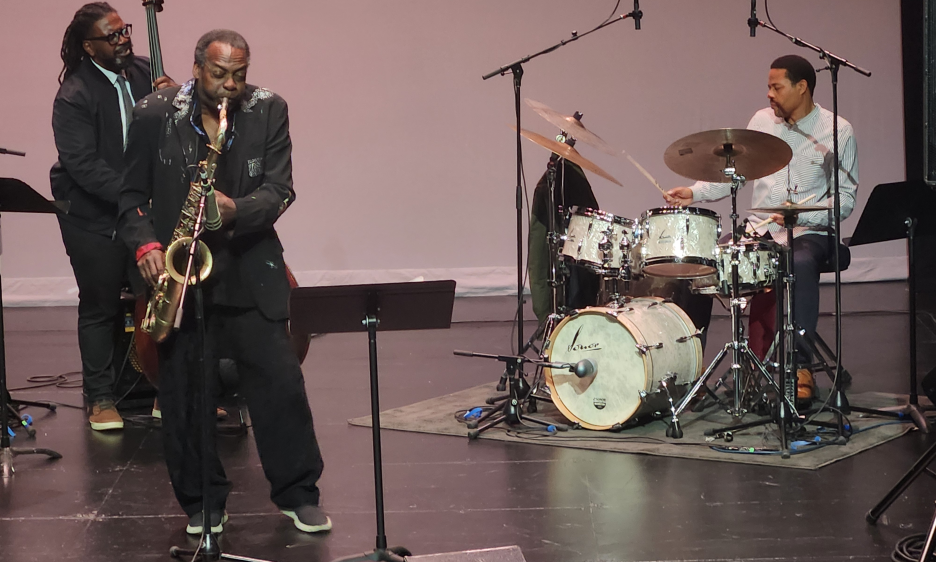
Courtesy Paul Reynolds
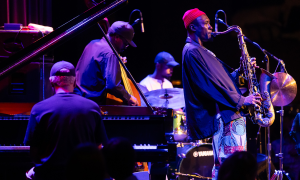
After fine solo piano sets from Amina Claudine Myers and Matthew Shipp came the the day’s highlight – a superbly balanced set by saxophonist David Murray's trio.
Theater for a New Audience
Long Play Festival
New York NY
May 2, 2026
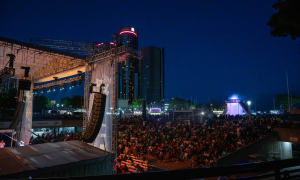
As the first full day of the Long Play Festival, Saturday offered the event's usual diversity of offerings, with 25-plus performances ranging from New-Music ensemble Bang on a Can All-Stars through avant-garde classical harp to music rooted in ancient Moroccan spirituals.
And Long Play's wide artistic palette also brought jazz, to Brooklyn's Theater for a New Audience. There were two afternoon solo-piano sets, along with a predictably driving set from a tenor saxophonist who has spent decades at the intersection of the jazz avant-garde and more 'inside' traditions.
The performance by Amina Claudine Myers showcased the pianist-singer's unique artistic identity. As a longtime member of the Association for the Advancement of Creative Music, Myers has a strong affinity for improvisational freedom, as she demonstrated in her stunning duet with fellow AACM member Roscoe Mitchell in January at the Unity Jazz Festival 2026 at Jazz At Lincoln Center.
Yet Myers' music has always been heavily steeped in the folk and religious traditions of her homelands of rural Arkansas and Texas. When dissonance and harmonic adventurousness arose in Myers' set, then, they came within deeply spiritual or blues—based structures. Early in the set, she sang wordlessly and plaintively over a piece that was hymn-like but also featured occasional jazz harmonies. Hearkening back to her album Salutes Bessie Smith (Black Saint, 1988), she performed Smith's "Standin' in the Rain."
Myers' vocal style is very different from Smith's brassy bray, or from the forceful blues styles of other jazz singers—Dinah Washington, for example. Free from vibrato, Myer's singing is built for expressiveness and vulnerability more than power or muscular technique—the vocal sound of late-career Abbey Lincoln comes to mind.
Yet, like Billy Hart at his festival concert a few days earlier (Billy Hart Quartet and BlankFor.ms with Jason Moran and Marcus Gilmore at the Long Play Festival), Myers proved to be a veteran who remains vital in her mid—80s. Her steady right hand work during the set demonstrated that.
Following Myers to the Theater for New Audience stage was Matthew Shipp, a pianist who has belonged even more fully than her to the avant-garde school. He played a continuous solo set that ranged from fairly conventional modern jazz harmonics to dense dissonant and percussive clusters. During the latter, he'd often dart his long arms back and forth from the keyboard, creating a visual counterpart to the music.
In a chat after the performance, Shipp said he chooses to perform continuously because "I'm not a showman. If I stopped from time to time, I'd have nothing much to say, So I prefer to just keep going." Shipp described his creative process through such sets as "deciding when it's time to reset, and move to something different. I figure when I'm tiring of a particular approach, the audience will be as well."
Shipp's set never came across as meandering. It had a sturdy structure, and he never faltered in finding a diverting new idea at each of the transitions. He ended the 50-minute performance by moving into a boogie-woogie section that felt like it might have been a planned conclusion. "No, it wasn't," he said. "I never really plan anything."
Fine as the solo piano sets were, the day's highlight was a superbly balanced set by saxophonist David Murray's trio. Perhaps it was the 6.30 pm timing and attentive crowd, but Murray's playing—entirely on tenor—was less consistently fiery than his high-flying wee-hours quartet set in January (Nels Cline and Others At 2026 Winter Jazzfest's Manhattan Marathon). His Long Play performance included the customary passages of Murray in overdrive, but his relative moderation for much of the program beautifully brought out the range and nuance of his playing.
The lean but supportive accompaniment might have contributed to Murray's restraint. The crystal-clear, driving bass of Dezron Douglas was a fine foundation for Murray's powerful playing; Douglas's drive helped fill the musical space left within a trio that lacked a chording instrument. Nasheet Waits created a lot of sound, too, though selectively and never with obtrusiveness.
Murray was generous with the spotlight. Each player also contributed a fine original composition to the set. Murray's wife Francesca Cinelli also sang two pieces, the best of which was the Brazilian-flavored encore.
 FOLLOW Paul Reynolds
and get notified whenever a new article published.
FOLLOW Paul Reynolds
and get notified whenever a new article published.
Journalist and programmer in jazz, folk, country and other musics
About David Murray

Tags
PREVIOUS / NEXT


Become a Sustaining Member

Since 1995, All About Jazz has championed jazz as an art form and supported the musicians who create it. Over three decades, it has grown into one of the world's leading jazz resources, serving hundreds of thousands of readers, musicians, presenters and industry professionals each month.
Help Build the Future of All About Jazz
Your support helps us continue building All About Jazz for the next generation—expanding our editorial coverage, preserving jazz history, developing new community features and creating better ways to discover the music and the people behind it.
Become a sustaining member for as little as $20 per year and you'll immediately enjoy an ad-free experience along with access to subscriber features and future articles for a full year.
Together, we're not simply sustaining All About Jazz—we're building its future. Thank you for being part of the journey.