Home » Jazz Articles » Live Review » William Parker's Pocketwatch at Loove Annex
William Parker's Pocketwatch at Loove Annex
Courtesy Fran Kursztejn
AFA Residency
New York City April 8, 15, 22, 29, 2026
Before beginning his final set of the night, William Parker took a moment to explain the name of his 'Pocketwatch ensemble, a rotating group of polyphonic masters that have met every Wednesday of April at Greenpoint's Loove Annex. The watch was handed down from Parker's father. It was made of real gold (Mr. Parker points to a facsimile that hangs from his neck, albeit five times the size of the original) but no longer told time. He left it at a watchmaker's on 41st street. A couple weeks later, he returns for the piece. The old watchmaker tells him his store was robbed, the watch too. Parker, at a loss, shrugs, the watchmaker offering a new Timex with a big smile that he cannot help but notice is full of solid gold teeth. The audience laughed, Parker turned to the band, which erupted into Billy Strayhorn's Johnny Come Lately.
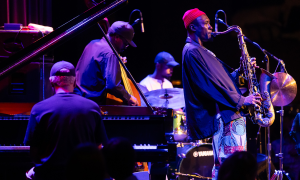
Every night at Parker's residency allowed for a handful of similar stories recounted before, after, and sometimes during a set. The acts were loose, wild and intensely collaborative. Each night was split into three sets, the first or last usually the full Pocketwatch ensemble, and the others freeform, experimental ruminations. The ensemble itself is a rotating repertoire of the city's finest (and often unsung) improvisators. Trailblazers like Rob Brown are given sharp, corrosive solos on alto, and baritone saxophone master Dave Sewelson flexed his impressive, singular polyphony with vocoders, feedback loops, and a traditional harmonica to further agitate the brass' garrulous crooning. Additionally, there are young luminaries: Hans Young-Binter on piano is as virtuosic and intellectual a presence as any working today, and the young bassist Colson Jimenez is more than a match for the loping, gargantuan din of Parker's direction.
Parker's compositional breadth drove the variegated ensemble into melodies as difficult as they were rewarding. Hallelujah and Johnny Come Lately come from the classical repertoire, but countless of Parker's own tunes, often conceived moments before showtime, composed the bulk of any performance. During a set, Parker often stopped, pulled some loose sheet music from an exploding orange folder, and personally delivered the new melody to each band mate. After a few moments of figuring, the band would swerve into this mystery composition, and just as quickly, the leader would thwart that melody, either introducing a new one from his handmade bass, or pointing out a solo that threatens to destabilize the sound. This was not done recklessly, of course, but with full cognizance. What matters to Parker is not the melody itself, but the melody within the melody. In these interruptions, the band either chooses to re-cooperate what is left of the original song, or throw it out completely, grasp at a small strand of the new order and commit to it wholeheartedly. Often, in a band of this size the result is a mix of both. The sound erupted into an atemporal, noisy deconstruction of the original piece. The audience reeled at first, tried to single out a given order in the perceived cacophony, but once their ears and minds adjusted, the immense beauty of Parker's direction was revealed.
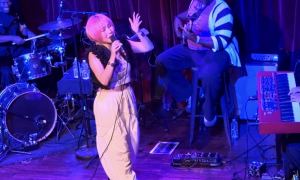
The audience performed as the band does: noticing and amplifying repeated chords, parallel sounds; perhaps the odd thumping of cymbals by Juan Pablo Carletti was not so dissimilar from the syncopated beats of Binter on piano, or the eruptive bleating of Diego Hedez 's trumpet matched the high-pitched ululating of Kyoko Kitamura. Even such small relations as these were enough to fully hypnotize a listener, to engage them fully in the band as if they themselves were playing, so when some composition returned and the din was focused into song again, it was as if they designed it themselves, picked out from the rubble of notes and chords, as much as the musicians themselves.
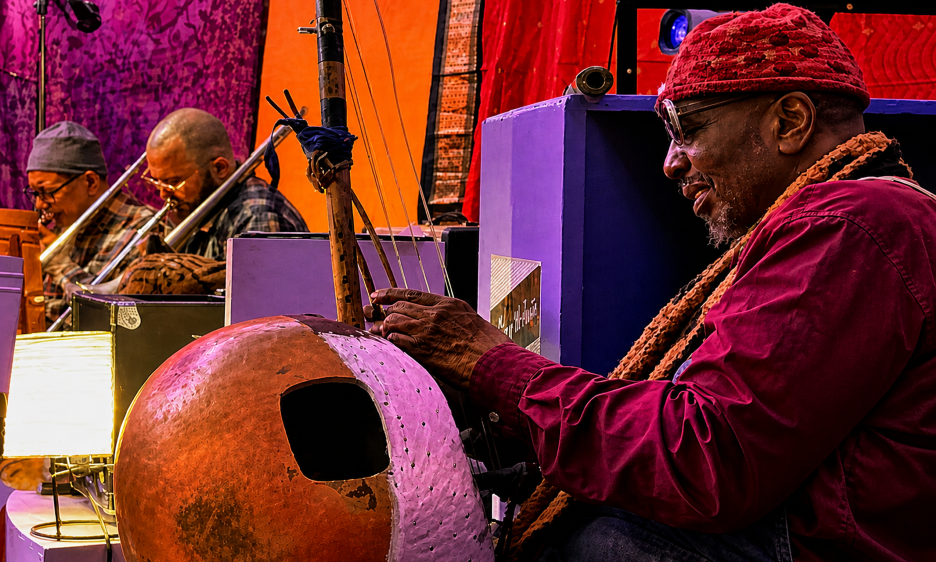
But just as fascinating as the Pocketwatch ensemble itself were those groups that splintered from the band. Miraculous trios and duos, often with limited previous coordination, performed confident, elaborate experiments as if they had played together all their lives. Bass saxophonist Dave Sewelson, hot off the night's big band set, played against legendary percussionist Cooper-Moore. Sewelson belted raspy, punishing licks that built into gliding, discursive shapes, while Moore traipsed in with a combination of lap drums and a single-stringed zither. His sounds were earthy and fierce, agitating the already entropic humming from the saxophone. Mid-way into the performance, Sewelson dropped his saxophone and picked up a pocket harmonica that he filtered through a voice modifier. The odd squawks and croaks swarmed the composition, the zither coiling about in low rhapsody. Sewelson and Moore were able to craft something rather rare, a thing without end, that seems to exist on its own terms.
Vocalist Kyoko Kitamura, violist Melanie Dyer and pianist Mara Rosenbloom introduced their Siren Xypher collective for the penultimate residency. Though Kitamura is the only de facto vocalist of the trio, the performance relied heavily on the interplay of all three's vocal input, even more so than their respective instruments. Kitamura introduced and led an improvised spoken word piece while Rosenbloom and Dyer defined its instrumental basis. Dyer, in deep, melodious rhythms, amplified and agitated Kitamura's vocals, inevitably interrupting the sonic elements of the piece as the viola slowed and deepened into quick jabs. Suddenly, Kitamura introduced found objects: the banging of plates, rubber and steel balls, the manipulation of various fabrics and digital equipment. The piece was further complicated, no longer a game of literature and musical accompaniment, but three sounds colliding and reforming into new designs. Rosenbloom's steady, intelligent playing was the foundation of the work, but her rare, soft vocals compelled even more components for the three performers to play with. What they created was a responsive environment, always changing and re-orchestrating to coax the addition of new elements, new voices and new meanings.
"Keep coming to events [like Pocketwatch]," says Patricia Nicholson Parker, vocalist and head of Arts for Art (AFA). "None of this can happen without you. The music would not be the same without you." The performances reflected this sentiment. More than many other musical events across the city, Pocketwatch urges the audience to interrogate their role in a performance: their breath, their laughter, their faces, the uniqueness of their reactions. Parker is always glancing away at the audience. He is always asking questions, telling stories, waiting for replies. In anyone else, such behavior might betray insecurity or anxiety, but in Parker it is an essential part of his artistic ethos. Across any Pocketwatch performance, one feels universal participation, not just from the band or the audience, but the space itself seems a living member of the orchestra. Pocketwatch is a holistic experience, and in times of immense alienation and anxiety, an essential one.
 FOLLOW Fran Kursztejn
and get notified whenever a new article published.
FOLLOW Fran Kursztejn
and get notified whenever a new article published.
Southern writer, filmmaker, & jazz freak.
About William Parker

Tags
PREVIOUS / NEXT

Become a Sustaining Member

Since 1995, All About Jazz has championed jazz as an art form and supported the musicians who create it. Over three decades, it has grown into one of the world's leading jazz resources, serving hundreds of thousands of readers, musicians, presenters and industry professionals each month.
Help Build the Future of All About Jazz
Your support helps us continue building All About Jazz for the next generation—expanding our editorial coverage, preserving jazz history, developing new community features and creating better ways to discover the music and the people behind it.
Become a sustaining member for as little as $20 per year and you'll immediately enjoy an ad-free experience along with access to subscriber features and future articles for a full year.
Together, we're not simply sustaining All About Jazz—we're building its future. Thank you for being part of the journey.