Home » Jazz Articles » Live Review » Billy Hart Quartet and BlankFor.ms with Jason Moran and ...
Billy Hart Quartet and BlankFor.ms with Jason Moran and Marcus Gilmore at the Long Play Festival
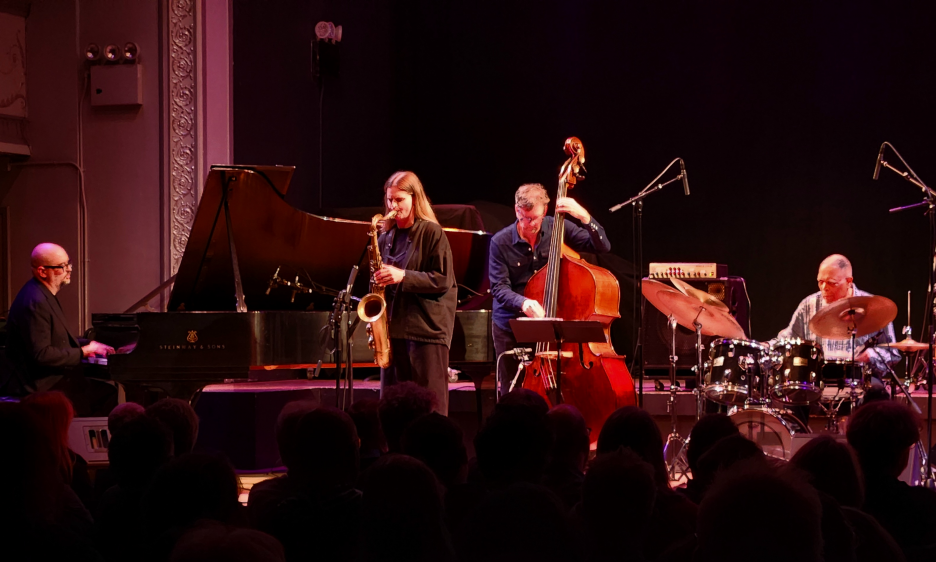
Courtesy Paul Reynolds
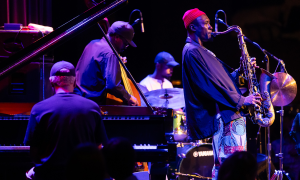
Hart's masterful playing offered an ever-surprising array of percussive accents, often punctuated by a sharp crack on the snare.
Roulette
Long Play Festival
New York, NY
May 1, 2026
It's the "most important classical music festival in New York City," according to the New York Times. Yet the programmers for the Long Play Festival in Brooklyn also have big ears. Woven between Long Play's 40-plus classical performances this year—mostly of the contemporary classical bent of Bang on a Can, the festival organizer—were a smattering of indie rock shows and a dozen or so jazz concerts.
Indeed, the members of the headlining ensembles—including Billy Hart and Jason Moran—at Roulette for the festival's official opening night, had deep jazz credentials, even if one of the groups didn't necessarily spend much time inside that tradition during their performance.
Drummer Hart, who remains an active force at 85, brought his quartet—and 60-plus years of experience with, among others, McCoy Tyner, Herbie Hancock, and Miles Davis.
Hart brought an appealing lightness to this performance. He set that tone with his playful introductions to pieces, which often began with a smiling question. ("Do you know the spiritual name of John Coltrane? I guess you don't," he asked, before launching into a piece by the man before waiting for the answer.) The drummer's masterful playing offered an ever-surprising array of percussive accents, often punctuated by a sharp crack on the snare.
The equally unconventional Ethan Iverson, a long-time Hart collaborator, was a perfect foil for the drummer, and the two drove each other to diverting peaks during the pianist's quirky solos. Rounding out the quartet, and in satisfying sync with the leader and pianist, were tenorist Nicole Glover and bassist Joe Martin.
Hart's own compositions dominated the program, including the gorgeous "Song for Balkis." But the set's highlight was the unnamed Coltrane piece, which began ambiguously and eventually evolved into a slyly disguised "Giant Steps." Iverson began it, prettily and nearly solo, gradually dropping in snippets of Coltrane's melody and chords. Glover's solo followed suit, also teasing the familiar theme. This was clever Coltrane; not once was the entire chord sequence played, let alone the full melody.
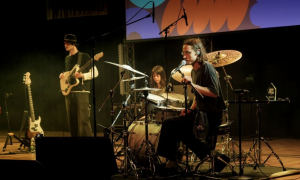
Moran's performance was billed as electronic musician "BlankFor.ms with Jason Moran and Marcus Gilmore." Correspondingly, the leader—seated beyond a boxy device on which he twiddled dials—exerted a heavy influence, sometimes at the expense of showcasing the strengths of his bandmates. The set was best at its beginning and end. At those times, Moran played piano conventionally, by striking the keys, and Gilmore engaged as much with Moran as with Blankfor.ms.
But dominating the middle of the set—which felt longer than it actually was—were repeating rhythms from the electronic device, over which Moran largely played in percussive lockstep, muting the strings of the Steinway to emit toneless rat-a-tat rhythms. During this stage of the set, Gilmore was similarly faithful to the dial-turning leader, only rarely breaking out into diverting counterrhythms.
The set improved as it drew to a close, with Moran teasing snippets of a Thelonious Monk theme as the two other players cascaded rhythms over it. But, overall, one wished that this had been an improvised acoustic duet between Moran and Gilmore. As a 20-something guy sitting behind this reviewer remarked to his companion: "The electronics were too dominant; I wanted to hear more from the other players."
 FOLLOW Paul Reynolds
and get notified whenever a new article published.
FOLLOW Paul Reynolds
and get notified whenever a new article published.
Journalist and programmer in jazz, folk, country and other musics
About Billy Hart

Tags
PREVIOUS / NEXT


Billy Hart Concerts

Become a Sustaining Member

Since 1995, All About Jazz has championed jazz as an art form and supported the musicians who create it. Over three decades, it has grown into one of the world's leading jazz resources, serving hundreds of thousands of readers, musicians, presenters and industry professionals each month.
Help Build the Future of All About Jazz
Your support helps us continue building All About Jazz for the next generation—expanding our editorial coverage, preserving jazz history, developing new community features and creating better ways to discover the music and the people behind it.
Become a sustaining member for as little as $20 per year and you'll immediately enjoy an ad-free experience along with access to subscriber features and future articles for a full year.
Together, we're not simply sustaining All About Jazz—we're building its future. Thank you for being part of the journey.