Home » Jazz Articles » Live Review » Fuchsthone Orchestra featuring Evi Filippou & UMO Helsin...
Fuchsthone Orchestra featuring Evi Filippou & UMO Helsinki Jazz Orchestra featuring Jazzmeia Horn at Jazzfest Bonn 2026
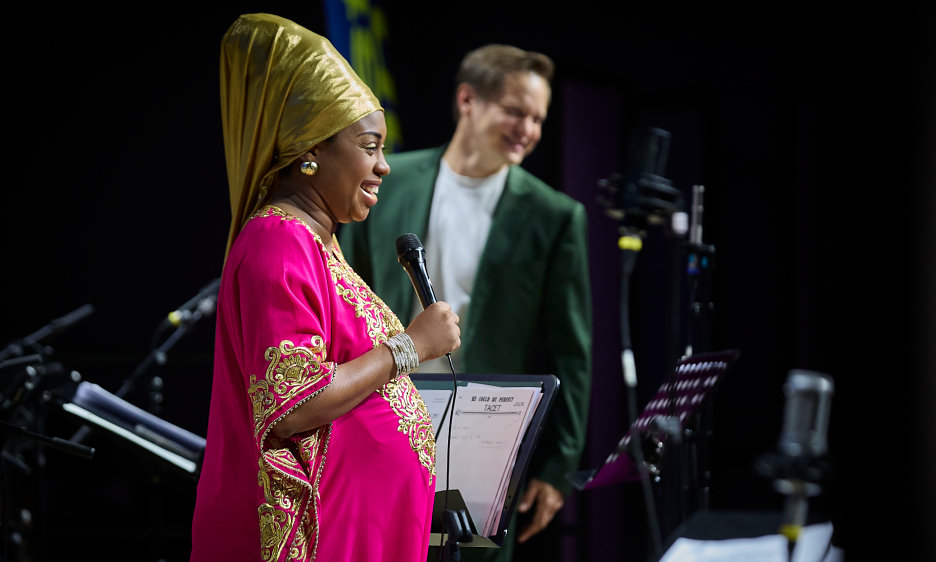
Courtesy Heike Fischer
UMO Helsinki Jazz Orchestra featuring Jazzmeia Horn
Telekom Forum
Bonn, Germany
May 9, 2026
Its host city may lack the jazz pedigree of others, but the truth is that, barely fifteen years old, Jazzfest Bonn has carved out a place among its most prestigious German counterparts—those of Moers, Berlin, Leipzig, and Hamburg. In this 2026 edition, very likely the most complete and compelling in its brief history, the festival offered a stellar lineup including names such as Jan Garbarek, Billy Cobham, John Scofield, Kurt Elling, Donny McCaslin, Shai Maestro and Rabih Abou-Khalil, alongside emerging talents and established new voices from the European and global scenes.
To be sure, the quiet, subtly attractive former capital of what was once called West Germany fights, year after year, to maintain a rich and varied musical offering beyond that associated with its most illustrious son: the city that saw Ludwig van Beethoven born and raised offers an unexpectedly large number of festivals and concerts given its rather modest population (around 325,000), which would give it, were such a metric to exist, an exceptionally high "concerts per capita" ratio. Fabian Junge, Press and Public Relations officer at the festival—to whom we are greatly indebted for the information and photos provided—highlighted the importance of private funding, on which the festival largely relies, though complemented by public support, and in particular of its principal sponsors, among them the venue's owner. Their contribution proved decisive in equipping this year's edition with the resources to design a competitive program open to a wide range of styles and tendencies: from a mainstream accessible to all audiences to free jazz and the most combative post-modernism, taking in electric fusion, world jazz, and blends with more seemingly distant genres such as art-pop.
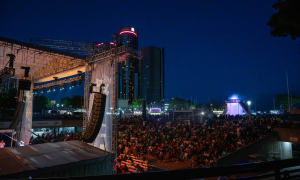
A perfect illustration of this commendable diversity was the spectacular closing night—despite an Esperanza Spalding concert still pending, due to postponement—with a bill that promised to be as explosive as it was brilliant: the exploratory, message-driven Fuchstone Orchestra, featuring groundbreaking Greek vibraphonist and drummer Evi Filippou , followed by Jazzmeia Horn with the UMO Helsinki Jazz Orchestra. The latter appearance marked one of the Finnish big band's rare forays outside its home territory, as confirmed by its Managing Director, Henriika Steidel-Luoto, whom we also thank for her generosity in providing information about the event and handling our requests, very much those of an enthusiast. A double bill (like the majority of the festival's 17 programs) it was also a multi-artist showcase within each set, all at a more than reasonable price in a wonderful setting: the Telekom Forum. Perhaps not the kind of venue one would initially expect for this type of music, it proved generously spacious and magnificently suited to it; among its standout elements, a large screen at the back of the stage offering a carefully produced live feed of the concert, something more typical of other kinds of musical events—at least in our experience.
A Women-Driven Big Band Challenges the Reign of a Manufactured Apocalypse
The Fuchsthone Orchestra takes its name from the surnames of its two extraordinary leaders, German instrumentalists, composers, and conductors Christina Fuchs and Caroline Thon. Based in Cologne but drawing musicians from across Nordrhein-Westfalen—the federal state to which both that city and Bonn belong—their formidable ensemble expands the standard big band instrumentation to incorporate three additional elements (violin, vocals, and electronics) that prove fundamental, alongside a fourth: Filippou's vibraphone, no less decisive in shaping the group's sound and manner. Given this expanded instrumental palette, it comes as no surprise that the long shadow of the Vienna Art Orchestra surfaced more than once during their powerful set. Like that beloved Central European ensemble, the Fuchsthone Orchestra sustains a proud, defiant, radically contemporary outlook—though the ironic, theatrical postmodernity of the former becomes here a deep social, political, and humanitarian conscience—a protest that refuses to silently observe the increasingly unconscionable facts of daily life, instead laying them bare through a musical howl that admits no concessions. In this respect—more through its motivations than its forms and approaches—it connects with ensembles such as Carla Bley Big Band, Maria Schneider's Orchestra or Maya Homburger's and Barry Guy's Blue Shroud Band.This catharsis is built on a refined compositional complexity that sustains a musical perpetuum mobile, alternating furious full-force bursts with spare passages played by smaller portions of the orchestra. The extended sound collages—frequently built from simple motifs that progressively interweave—succeed one another through resounding breaks and deft transitions that, in lesser hands, could easily collapse into pastiche. Needless to say, the demands on the performers are high—both in the intense solos and the razor-edged ensemble stretches—and all of them rose convincingly to the challenge of this ambitious undertaking, though individual voices were on occasion sonically swallowed by the orchestral din. Such was the case, at times, with special guest Filippou, who must be seen live to truly appreciate a performance in which she skillfully combines her main instrument with a compact drum set—sometimes striking the vibraphone bars with metal objects, or bowing them with what appears to be a double bass bow, while distorting the sound through electronics—all in the service not of eccentric display, but of a singular aesthetic and conceptual vision that fits perfectly with the elaborate compositions and arrangements of Fuchs and Thon.
The setlist drew entirely from the band's second album, Peaks & Plots (Unit Records, 2026), which also features the inquisitive Greek artist. Built almost entirely from extended compositions by both leaders—who, despite quite different compositional methods, complement each other exemplarily—they alternated in presenting and directing the pieces each had written. Fuchs opened the night with "Lai Nairs," a piece that evokes its author's creative retreats in the Lower Engadine region of Switzerland, but which—as one might expect—conveyed no bucolic lyricism; instead it was anchored in tribal-like rhythms (incorporating stones gathered in the region), peculiar ostinatos, and more orthodox ensemble episodes led by the versatile voice of Filippa Gojo, who performed like Norma Winstone over a hypercharged Kenny Wheeler orchestration. Particularly striking moments included the opening atonal dialogue between Alex Morsey's superb double bass and Filippou, seasoned with electronics by Eva Pöpplein—a fundamental element in establishing the ensemble's character and weaving its sonic fabric—as well as an effective guitar solo by Andreas Wahl, who closed with atmospheric shadings after an energetic rock-like intervention.
But it was the three pieces inspired by political and social causes that dominated the band's performance. The first, "The Champ"—drawing on the theories of sociologist Pierre Bourdieu to call for a more equitable distribution of resources—crystallized the atmosphere from the very first second, with a controlled initial explosion from the vibraphone, percussion, and electronics. Gojo's distorted voice, like some demonic agitator, harangued the musicians over an ostinato supported—and then developed—by Zuzana Leharová's violin. This gave way to a free-time stretch featuring a supremely concentrated, extraordinary trombone solo by Mathias Schuller—first muted, then open. Emphatic full-orchestra breaks punctuated by Thomas Sauerborn's rock-solid drumming led to a closing passage that gently softened the motif without losing its obsessive-compulsive rhythmic drive.
The second, "Savita," was undoubtedly the concert's high point—a piece dedicated to Savita Diana Wagner, a young woman from Bonn who lost her life in Ukraine in 2022 while working as a humanitarian aid worker, and whose diary of her experiences would later be published in Germany. The presence of her mother in the audience only deepened the already dense emotional weight carried by the introductory remarks, delivered by a visibly moved Thon. The piece opened with ominous harmonies that set the stage for a searing soprano saxophone solo by Roger Hanschel, beginning in an ethnic vein before unleashing lacerating metallic bursts, which eventually yielded to a luminous opening à la Schneider. Gojo's voice emerged—underscored by Pöpplein's astute manipulations—first in lamentation, then leading a climax that plunged the entire hall into an atmosphere of barely bearable rage. In pointed contrast, the painful chaos gave way to a more conventional segment led by Francois de Ribeaupierre's magnificent baritone saxophone, the whole culminating in an evocative singing of the piece's lyrics, which close with the disarming, repeated phrase ... "still so much pain." A tense silence followed before the hall erupted in a thunderous ovation.
The third piece rooted in ideas drawn from complex social reality was "Taksim." Fuchs's composition distills her kaleidoscopic impressions during a stay in Istanbul, where she lodged near the famous square of the same name—a term that also designates an improvisatory introductory instrumental movement in classical Turkish music. The work becomes a soundscape inspired by the effervescent metropolis and its teeming sonic diversity, while also gathering the sensations experienced by Fuchs during the period of political unrest that coincided with her stay. Consequently, it combines widely varied moods and instrumental groupings, lurching frenetically between the festive and the dramatic. The performance opened with a resolute call and response between brass and reeds, from which Filippou emerged steeped in probing abstraction; Leharová shone over a stubbornly repeated motif, Gojo led a few bars tinged with echoes of the Near East, and John-Dennis Renken delivered a meaty trumpet solo answered masterfully by Pöpplein's live samples. Sauerborn's forceful drumming and Laia Genc's piano also enjoyed brief flashes of their own.
While this was probably the evening's most compelling material, there was much more besides—though not quite enough to complete the planned setlist, which would have covered all the tracks from the album. "Don't Forget to Pay Your Bills"—a caustic jab at certain world leaders who seem to treat the planet and its inhabitants like moves in an absurdist game of generative-AI prompting—was left out, but not "Capricorn & Aries," Fuchs's most peculiar take on a love ballad, with certain—dark—Schneider-meets-Gil Evans overtones, nor "Reciprocity," a Filippou composition arranged by Thon, dominated by a hurtling free improvisation channeled through certain formal constraints, in which the vibraphonist stood out with her singular instrumental approach, again backed by Pöpplein's ever-present sonic tapestries.
Is this the future of jazz, as some fervent enthusiasts dare suggest? Let's be honest: unfortunately, very probably not. Is it, on the other hand, one of jazz's many offshoots—as lateral as it is necessary, both artistically and socially? Absolutely. The Fuchsthone Orchestra picks up the sadly dropped baton of glorious ensembles of the not-so-distant past—the Mike Westbrook Concert Band, the Italian Instabile Orchestra, the aforementioned VAO—and does so with a live show that is, by turns, overwhelming, exhilarating, and deeply moving, pressing its well-founded transgressive finger on our sometimes-dormant musical wound. In this it shares a spirit with irreducible ensembles such as the ICP Orchestra or Guy's London Jazz Composers Orchestra, not forgetting younger outfits like Darcy James Argue's Secret Society. All of these—and many more—make up a populous, ferociously resistant orchestral landscape, as wildly luxuriant as it is unforgivably under-known, one that the contemporary jazz audience should not ignore. The Bonn faithful seem to be aware of that.
The Swinging Side of the UMO, Or A Portrait Of The Artist As A Conscious Mother
The UMO Jazz Orchestra also belongs to that contingent of orchestras mentioned above that enjoy venturing, occasionally, beyond established boundaries. While its current output is dominated by contemporary mainstream and some smoothly contoured crossover, its discography includes numerous instances where it has successfully engaged, to varying degrees, with experimentation. Releases such as UMO Plays The Music Of Muhal Richard Abrams (Umo Productions, 1989), Electrifying Miles (A-Records, 1998) and Transit People (Naxos Jazz, 2001) stand as proof.Predictably, given their dazzling guest, this was not the side the UMO chose to show in the evening's second set. Led by Jukka Eskola—who served as emcee, conductor and exuberant flugelhorn soloist—the band presented a program tailored to the extraordinary gifts of its guest vocalist, with a lineup combining established figures and young new talents drawn from Finland's inexhaustible jazz pool. As for Horn, those accustomed to the stylized image of her album covers and promotional photos were in for a pleasant surprise—there were laughs and shouts from the audience—on discovering that her current appearance, while maintaining her refined style, is now defined by an advanced pregnancy that significantly transforms her. Nor was that the only change: the seductive seriousness of her recordings became, onstage, a constant—and hilarious—old-school bid for rapport with a receptive crowd, featuring various—and extended—anecdotes alongside pointed reflections on motherhood, the complicated relationship with children and adolescents, the often-absent role of fathers and the enormous difficulties of balancing all of this with her multifaceted career. Family relationships—past, present or yet to come—ran through virtually all of her remarks and, likewise, the repertoire, skillfully balanced across tracks from all her previous albums.
Whatever her condition and motivations, Horn's stage presence is commanding. Her stylistic evolution has taken her from being repeatedly compared, in her early days, to Betty Carter—an influence as undeniable as it is rewarding—to forging an unmistakable personal language through which she transports standards and others' material into her own peculiar artistic universe, one in which composition and arrangements also occupy a central place. The firm control already present from the first cut of her debut album—that "Tight" which many of us probably missed at this concert—is now clothed in a layer of maturity that doesn't forgo a direct, uninhibited everyday quality, while of course also engaging with emotional and intellectual dimensions of a different caliber, deploying a prodigious voice, overwhelming technique and an endless range of expressive registers. To be sure, certain altissimo phrasings in her scats can sometimes be more showy than purely musical—but weren't there generous doses of showmanship in Lionel Hampton, Dizzy Gillespie, Illinois Jacquet or Rahsaan Roland Kirk? And aren't there, too, in James Carter, Masabumi Kikuchi or the late Esbjörn Svensson Trio? This is a factor intrinsic to the music itself, and one that, as long as it is thoughtfully used, is welcome—and more so live.
For all these reasons, Horn is not just another jazz singer—nor, unlike others so generously labeled, does she need the media to classify her as such for some to perceive her that way. She is, in herself, the most essential and genuine vocal jazz—at least here and now—deliciously concentrated and judiciously evolved: her veins seem to carry the genes of Sarah Vaughan, Ella Fitzgerald, Abbey Lincoln and so many other illustrious women who forged an art sometimes dismissed, condescendingly, as decorative or minor, when in reality many of them went on to create their own idiom and influence their instrumental colleagues—with Billie Holiday as perhaps the most notorious case. And all of this from a starting point of the inherent complexity of using one's own voice as an instrument, and fighting against an omnipresent sexism—and racism. Can anyone imagine what would emerge if one could now orchestrate, in retrospect, a #MeToo reckoning with the jazz scene of the first half of the twentieth century?
The concert opened with "Submit To The Unknown"—that invitation to embrace the risk of the mysterious, wrapped in a spiritual halo, from Messages (Empress Legacy Records, 2024). Some John Coltrane-like harmonies gave way to a brief but seemingly polished German introduction by Eskola, and to Horn's anticipated, somewhat unsteady entrance onstage—though she immediately blew up any impression of weakness with her powerful attack, enhanced by luminous counterpoints from the full orchestra. Petteri Hietamäki's soprano saxophone and an orthodox Héctor Lepe on guitar left their mark in their contributions, and Horn closed with Stevie Wonder-like flair before launching into the first scat of the set.
Here began the vocalist's particular show—her storytelling vividly delivered as if it were another musical piece—though not before making sure a significant portion of the audience understood English. The first two anecdotes, chained one after the other, came from her grandfather, the subject of the next selection of the evening: "Happy Livin,'" an apparently melodic ballad introduced by a very traditional verse, which then transforms into a swing number with echoes of Benny Goodman's small combos featuring Teddy Wilson. The UMO provided an impeccable Count Basie Orchestra-style backdrop, Eskola demonstrated the flugelhorn's possibilities in the upper register, and the American artist rose to the challenge—working the same register in her seductive closing stretch. One of the best thematic and orchestral highlights of the night followed: a very Charles Mingus-like Horn arrangement of Lafayette Harris, Jr.'s "He Could Be Perfect." Max Zenger's baritone saxophone was the centerpiece here—both in the melody and its demanding riffs, and in a notable solo—while the singer flirted throughout with outside intonations, entirely in keeping with the composition's atmosphere.
The previously mentioned allusions to motherhood, family roles and the harsh demands of raising children were not long in coming. The first selection on that theme—recently written by Horn and performed live for the first time that evening—was "For A Nap," in which she evoked Carter in the exposition and displayed a more orthodox scat than her previous ones, with a measured use of altissimo, while the UMO seemed to revisit its early 1978 alliance with Thad Jones and Mel Lewis. Next came one of the most emblematic titles from early-period Horn: a shrewdly arranged "A Social Call" by Bob Mintzer. Inevitably, Carter's spirit flooded the stage again—the genius from Flint had already made this number her own, with her mordant detachment and unmatched vocal inflections, on a 1956 recording with Gigi Gryce's orchestra not released until nearly 25 years later. Horn reworked those disruptive influences through her personal idiom—even more satirical than Carter's—over a highly rhythmic, swinging approach, with a magnificent baritone saxophone contribution from Zenger—fully Pepper Adams—while Kirmo Lintinen's piano brought very welcome traces of Wynton Kelly.
"Tip" followed—a somewhat lightweight work dominated by a humorous mood, featuring a fantastic trombone solo from Mikko Mustonen. Lintinen revisited the mainstream vein mentioned earlier, this time with Oscar Peterson-like manners, while Horn responded with a playful scat. A pair of standards then raised the compositional bar once more. The first, "He's My Guy"—from a record close to Horn's heart, Sarah Vaughan (EmArcy, 1955)—enjoyed a highly rhythmic setting by her in which Markus Ketola's drumming excelled. The Dallas singer channeled Sassy, and Joonatan Rautio's tenor picked up the Paul Quinichette gauntlet (present on the Vaughan album with Clifford Brown), almost in sax battle mode. Nor were Horn's devastating altissimo final notes absent—already present in her recorded version on Dear Love (Empress Legacy Records, 2021)—followed by an inspired scat that soared above Jason Marshall's magnificent orchestration. The second, "The Peacocks," offered what were perhaps the concert's most substantial moments: after a towering introduction from Lintinen, charged with dramatic gravitas, Horn joined in with extreme delicacy—and some presumable hesitation in intonation—navigating the demanding melody, while the band drew on Mintzer's sensational arrangements from a careful sonic distance. A fine alto saxophone solo from Mikko Mäkinen and her apparent fragility—musing, with deeply moving mastery, like a tightrope walker suspended in the heights—briefly installed magic in the hall.
"I Need My Mama & My Daddy Both" marked a return to family motifs and to a canonical mainstream with certain hard bop overtones. Eskola invoked Art Farmer while again displaying his customary command of the flugelhorn at the top of its range; the vocalist followed with a fabulous, highly trumpet-like scat; and the orchestra sailed gracefully through Artturi Rönkä's swinging charts. The ostensibly final "When I Say" once again cast Carter's shadow over the stage, with Eskola and Horn at the center of the frenetic number. The encore needed no coaxing, and in it Horn, without straying too far from her family-centered territory, got sultry—retreating to those intimate moments where, on some—decisive—occasions, children are conceived. She did so via "Let Us (Take Our Time)," from her first orchestral album, the aforementioned Dear Love. It is a song deeply derivative of Neal Hefti's "Lil' Darlin'" with the Basie Orchestra—probably the evening's great touchstone. The UMO transformed into a small combo providing a discreet backdrop to Horn's narration, which turned smoldering, with Jorma Kalevi Louhivuori's muted trumpet and Lintinen's piano as accomplices in the real action, heightened by vigorous thrusts from the singer and the full orchestra.
It was a somewhat odd ending, with the audience torn between asking for one more brief encore and at the same time understanding that, given the American star's condition and the lateness of the hour, pushing things further was not desirable. In any case, Horn triumphed in the never-easy task of connecting with the crowd and making them feel like fortunate participants in a unique, unrepeatable event—but above all in reconciling jazz heft with joy and fun, through a humorous tone that may or may not connect with everyone, yet whose existence is welcome, and more so when accompanied by a critical subtext. The UMO, for its part, showed some slight untidiness at very specific moments in the opening themes, and perhaps lingered more than usual on certain soloists—who, it should be said, were neither introduced before nor acknowledged after their contributions—but these minor details do not diminish what was a splendid performance, full of sensational ensemble and individual highlights. The result: a contagious expression of happiness—none the less valuable for being fleeting—crossed the faces of those leaving the hall as they dissolved into the darkness of the serene Bonn night.
 FOLLOW Artur Moral
and get notified whenever a new article published.
FOLLOW Artur Moral
and get notified whenever a new article published.
An Absolute Listener
About UMO Helsinki Jazz Orchestra
Tags
PREVIOUS / NEXT

UMO Helsinki Jazz Orchestra Concerts
JAZZ-SUOMI 100: UMO Helsinki Jazz Orchestra feat. Selma...
Kulttuuritalo KareliaTammisaari, Finland
Become a Sustaining Member

Since 1995, All About Jazz has championed jazz as an art form and supported the musicians who create it. Over three decades, it has grown into one of the world's leading jazz resources, serving hundreds of thousands of readers, musicians, presenters and industry professionals each month.
Help Build the Future of All About Jazz
Your support helps us continue building All About Jazz for the next generation—expanding our editorial coverage, preserving jazz history, developing new community features and creating better ways to discover the music and the people behind it.
Become a sustaining member for as little as $20 per year and you'll immediately enjoy an ad-free experience along with access to subscriber features and future articles for a full year.
Together, we're not simply sustaining All About Jazz—we're building its future. Thank you for being part of the journey.