Home » Jazz Articles » Interview » Callum Au: Ellington, Basie, Wheeler And Gillespie Were ...
Callum Au: Ellington, Basie, Wheeler And Gillespie Were The Mozarts Of Their Generation
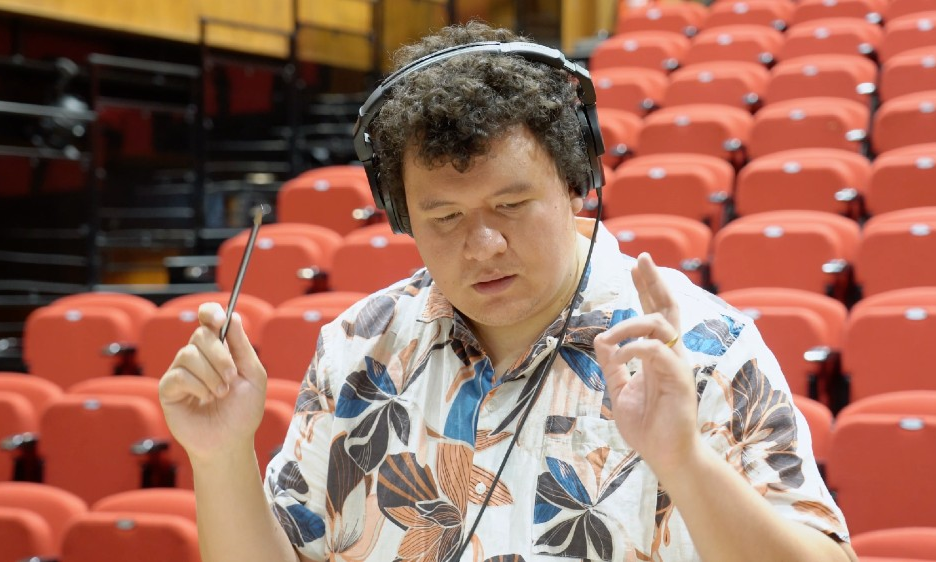
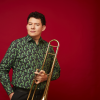
Courtesy Carlo Haltrich
Very few people go out of their way to celebrate the second tenor player or the third trombone but they are the people who are making the soloists sound good.
—Callum Au
All About Jazz: How did you get to the point of being able to release a double album of original big band music?
Callum Au: I've got four hats that I wear as a musician. I am a trombone player both for recording and performing. I am an arranger. I've written for all sorts of people, including Michael Bublé and Josh Groban. I'm a musical director and conductor with various ensembles. And I'm a composer as well. The synthesis of all four of these things is what we have with Sing Seven Seas. I've always got projects on the go for various people, but it's a long time since I actually made time to do my own projects, and up until now, I've never released my own project that is all my original stuff done in exactly the way that I wanted to do it with no limitations beyond my own budgetary constraints. If I think it's worth it, then we're going to do it.
The arranging pays the bills. As a trombone player, I will do the things that bring me joy, and that's a really fortunate position to be in. Not many jazz musicians can do that. I love to play in big bands, so I'll play any big band gig that gets offered to me, regardless of the fee, so long as it's within a certain commuting distance. And I love playing in the studio as well. It's the attention to detail, the conditions, and the players you're playing around. It gives me a bit of a kick. There's no feeling quite like playing a very simple C major chord, say, with a fantastic trombone section where everyone's playing with beautiful core sounds, spot on, in tune, playing it in a great room where everyone can hear each other.
AAJ: You have a Hong Kong Chinese father and a Scottish mother. Did you grow up in either of those places?
CA: No, I grew up in Blackpool in the northwest of England. My dad was a cardiac surgeon. When I was about six or seven, he got a consultant post in Blackpool, and we moved there. I was there until I went to university.
AAJ: How did you get started with the trombone and big bands?
CA: It was slightly accidental. I'm a tall guy, I'm 6 feet 4 inches, and I was a big kid. By the time I was eight, I was definitely one of the bigger kids in the class. A trombone appeared, given to the school by someone or other, and it was brought into the class. I was in the form class of the school music teacher in year four in primary school who said "You're a big lad. Give it a go." And that's that. Honestly, that's why I play the trombone. I also had a really good peripatetic teacher at school, Terry Reaney, who had been the solo trumpet with the Syd Lawrence Orchestra. He had retired to Blackpool and took up the teaching job at my school. I was really lucky with that. That's a connection that you wouldn't necessarily expect in a primary school. It's above and beyond the level of tuition that you would need or even know how to request at that stage. It was he who got me into it.
Then I was with the National Youth Jazz Orchestra (NYJO) from about 2007 to 2011 when I was 18—22. I played all sorts of things with them. I did a lot of arranging for them, too. I wrote tons of fresh arrangements for NYJO. That was really crucial to me because I never went to music college. The exposure that I got at NYJO was to music at volume—and I don't mean volume as in loud. I mean volume as in quantity. When I teach at music colleges sometimes, it strikes me that they've got amazing facilities and staff, but they're not working the kids hard enough. And I mean this with the greatest possible respect because I know there are things that you can and can't get teenagers to do.
I'll give you an example. When I was in NYJO, I did 126 charts for the band from 2007 to 2011. That is about 30 charts a year over four years. That's not very much by my standards now. I have to do an awful lot more than that. I could do 30 in a month if I pulled my finger out and took some time out of sleeping! But 30 in a year is really not very much, but it was a lot for me at that time because I was much slower and I was learning. At the music colleges, they're asking them to do maybe two things in a whole year and I don't think that you actually learn anything by doing that.
I think that you learn by repetition. You learn by getting the reps in, doing things repeatedly until they become second nature. And what I had at NYJO was amazing. There was a band that would play that stuff back to me. Bill Ashton, who sadly died last year aged 88, would bring in either a song that he'd written or he'd come up with some dreadful pun based around one of the band members' names. He'd have something like this every week, and as long as I brought something that he'd asked for before, he'd give me another one. And I'd hear the band play it and I'd hear what was working, what wasn't working, and I'd see as well from their reaction and if they were enjoying themselves, whether it was worth the paper it was written on or not.
Out of the 126 charts that I did for NYJO, I think only three of them would come out on a gig today. But three is more than zero. And that is a testament to how good that process was. I don't think it would happen anywhere else.
AAJ: Let's talk about the album Sing Seven Seas. How did it come together?
CA: Very slowly and then very quickly! The reason why it happened when it did was Chris Traves, the producer. He's a great trombonist as well. I've known him a very long time. During the coronavirus lockdown periods he started working for a big posh school called Lady Eleanor Holles in southwest London. Because the music department needed a way to keep operating during the time of the lockdown, they installed a professional studio in the school, which space- wise, separation-wise and gear-wise, is competitive with somewhere like Abbey Road Studio 2. I booked a week in August when school is out. I had a couple of commercial clients who wanted big band albums so we did those at the same time during the same week. And then I recorded Sing Seven Seas during the rest of the time.
In terms of the writing, there are nine tunes on this record that were totally new for this album. There are two, "Bandwagon Blues" and "The Weaver," that I've recorded before, but these are bigger, more upscale, luxury versions. And there are four that I had floating about in my library that I'd written for people, but I'd never recorded, and that I wanted to record.
AAJ: The two volumes have distinct identities, I think?
CA: They do, yeah. Volume 1 is basically me just doing me. When I'm arranging for someone, I think the most important thing in the arranger's job, other than making the music sound good, is to make the artist's vision and what they are expecting to hear in their head come to life in practice. The artists may not know how to do that. In fact, they probably don't know how to do that, or they wouldn't be contracting an arranger. And that's absolutely fine and normal. We can't do everything. I certainly can't sing.
So Volume 1 is essentially what happens if you replace the artist in that analogy with me. It's a synthesis of all the different types of music that I really love. There's some conceptual stuff there. There are some weird, unusual orchestrations, unusual approaches. It's not your standard big band. There are influences drawn from everywhere because that's really what I am. That's the music that I would write, given no other constraints.
Volume 2 is more of a look at the big band or jazz orchestra as an ensemble. It's a bit of a love letter to large jazz ensemble, I would say. It's putting the ensemble into its historical context, because I think that what we've got with big band music is a fantastic legacy with pretty terrible marketing.
I'll give you another example here. If you look at classical music where Beethoven or Mozart or Tchaikovsky is presented, orchestras around the world treat those composers and that music with something akin to reverence. And rightly so; they are some of the great minds of humanity and it's lucky they were around in a period where what they had to say could be written down and transmitted through the generations.
I believe that people like Duke Ellington, Count Basie, Kenny Wheeler and Dizzy Gillespie are the Mozarts of their generation. What big bands don't do is treat those people with that sort of reverence in terms of concert programming. Everything is always pushing forward, everything is always new, everything is always looking toward the next thing. You don't get to see a Duke Ellington Sacred Concert a hundredth of the number of times that you get to see a Mozart Requiem. And I think that we ought to. I think that putting the big band in the context of its history and celebrating the legacy of the whole thing is something that we should be doing more of.
AAJ: But Volume 2 is nevertheless all original work by you?
CA: There are two things going on there. One is that if it weren't, I wouldn't be able to release it without a bunch of permissions. The other thing is that it feels like re-recording Ellington at this point in time... we're probably not quite there yet. It's not like re-recording Mozart. You can re-record Mozart because there was no original recording of Mozart. But if you're re-recording Ellington, you're kind of trying to imitate, and I don't quite want to imitate. But when I do a big band show, aside from this album launch concert, I never do a big band show where there's not some Ellington and Basie.
AAJ: The artwork for the album—it's you on a little Asian-looking boat with this wall of sea creatures coming toward you, a big nod to Hokusai's "The Great Wave., What's going on there?
CA: I have a very good answer for this. It's because of a bit of a fuck-up. I came up with a great title for this record. It was going to be called Big Fish. This is an 80-piece orchestra but every single one of the 80 players in the orchestra is an amazing soloist. They're an amazing concertmaster. They are a person who would be releasing their own record, and that record would be doing really well. It's a who's who of the British jazz and studio and classical scenes put together. Every single one of those people is a big fish. I sent it off to the artist, it was great, exciting, and then someone pointed out to me that in English the plural of fish and the singular of fish are the same word. So it sounds as though actually that title sounds like a dick-swinging thing. It sounds arrogant. It's like, oh, well, you think you're a big fish too.
So I had to abandon that title and come up with something else. But the art had already been commissioned and made. I still think it's the right picture for what we've got. Every single one of those people on the record is a big fish. This is my project, and I've put it together. But the musicians are extraordinary, and it's really about them as much as it is about anyone else. And it's not just the soloists either. The soloists get to play the flashy stuff; they get to do their thing. It's almost easier to be a soloist and just do you than it is to be a person who has to sit in the section and change your personality depending on the nature of the music.
Every single person on the project, from the second tenor player to the fourth trumpet, every chair has been chosen specifically for what they bring to that chair. I have picked people carefully because of how amazing they are at the thing that they do in a section. I think that is under-celebrated in a way. Everyone celebrates the solos because they're the flashy thing that everyone can hear, but very few people go out of their way to celebrate the second tenor player or the third trombone; they are the people who are making the soloists sound good.
AAJ: You give your recording schedule in the notes of one of the extended versions of the album. It sounds like you recorded different sections every day for a week?
CA: For the orchestral tracks, things like "The Weaver" and "Murmurations," we recorded strings, woodwind, brass and rhythm separately. For the big band tracks, the whole band was recording together. The only exception was the woodwind section that's on "Tethys." I don't like recording woodwinds at the same time as the saxophones and trombones because they get drowned out. But with the big band stuff, I do genuinely think it's better to just do it together.
AAJ: Is there a particular section of one of the numbers that you're particularly pleased with how it came out?
CA: I really like how tenor saxophonist Nadim Teimoori plays the solo on "Galt's Motor." He's been a close colleague for many years. He was in NYJO with me. He's about the same age as me. He sounded like that when we were both 18, and he still sounds like that, and he's incredible. Another bit that I loved was Andy Wood's trombone solo on "Tethys," the really lovely smooth legato one. It's just a melody, but he plays it so beautifully. You can hear just how wonderful a trombone player he is.
AAJ: One of the tracks is called "jazz.ai." Is there any AI in it?
CA: No. AI is the subject matter. The track has a narration by Matt Forbes, a friend of mine, a Canadian singer who lives and works in Los Angeles. The story is based on Disney's "Sorcerer's Apprentice.." I guess it's older than Disney, isn't it? It's Goethe's "Sorcerer's Apprentice." When I was writing this, my kids were absolutely obsessed with the Disney movie Fantasia. The film was playing in the house again and again, and I was thinking about this because, you know, you have to think about something when you're watching Mickey Mouse with the broom for the 300th time. I was thinking how similar it is to what's happening with these AIs in that we're making tools that we don't understand, and we don't know how to control, and things are carrying on from there...
I had a go at writing the story, I got the words together and then I sent those words to Katie Emmerton, a friend of mine who's an author. She's married to tommy emmerton, my guitarist. She took it all, deleted every single one of my words, and made the whole thing work. And that was brilliant.
The reason I wanted to do it as an actual narrated story is because with the kids, we'll listen to "Peter and the Wolf" and the Stravinsky "Soldier's Tale" because they love it. They really engage with the spoken story. I wanted something that they would actively be able to enjoy and experience as well, because I want it to be for everyone. They were really the target demographic.
I did use AI in one capacity. We've got an animated video coming out and I've got an animator who's animated it from scratch without AI. In the same way that I made a crap version of my words to send to the story writer, I made a crap version of the animation to send to the animator so I could show him the sort of thing I had in mind. That's where AI is a useful tool because it lets someone like me with no domain-level expertise whatsoever have a go and get something that tells someone who knows what they're doing the sort of thing that you're after. It saved weeks of back and forth on edits and questions.
AAJ: You said that you've "got to use the whole buffalo." What do you mean by that as a musician?
CA: If you're going to hunt and kill an animal, you need to use every single part of it. Native Americans would use the buffalo meat for meat, they'd use the bones to prop up their tents, they'd use the skins as leather and clothes. You can use the brains of a buffalo to reapply fat to a dried skin to make it supple again. You can use the innards, all the nasty bits that we throw away nowadays, you can feed the animals with them. Everything is a valuable commodity.
I don't want these scores to just be thrown away. I don't want them to be played once on this album and never used again. I'm trying to make sure that we're doing as much as we can with what we've got. So I've made the scores available in the two volumes once again. I've made them with an extensive series of notes that tell you about each track, the process behind the recording—some of the things that were going through my head orchestrationally while I was writing it. It will hopefully be a good resource for students of arranging and composition.
I'm also making all of the music from the album available to buy in sheet music form digitally from my website and also in due course physically. I am hoping to do it with ejazzlines; as well as new music, they are going through old Ellington and Tommy Dorsey and Count Basie libraries, adding the parts by hand to a digitized version, and then they're selling those as well. That's great because it means that if I want to play "Take the A-Train," I can see the "word of God" on that now.
Then we have the albums, of course. Both volumes release physically on June 7, 2026 along with the streaming version of Volume 1. Streaming for Volume 2 is coming in early 2027. There are videos on YouTube. There are a very limited number of T-shirts. I think I'm going to do a play-along series. I've done that for some of my older albums, and they've been quite successful. I'll probably do first trumpet, first trombone, first alto, and drums. That'll take a bit of editing and effort, so it's not going to happen for a little while.
AAJ: You're the only person I've ever seen who thanked their engraver.
CA: People are missing a trick, frankly. When you put something into Sibelius software and press print, it comes out all higgledy-piggledy, with the wrong number of bars on certain lines, loads of things overlapping one another, everything looking difficult and not easy to read. When you have rehearsal time, that's kind of OK because you can deal with it.
But there was not one bit of rehearsal for any of these sessions. The first time anyone saw any of the music was 10 a.m. on the downbeat. It needs to be readable at sight, in a way that you can automatically read it. Any time there's something that might trip you up, it scuppers it. It ruins a take, and then you've got one fewer take to work with in the edit stage.
Phil Knights is someone who was also in NYJO. He's always done my parts for me. The parts he produces are so astonishingly clear. Without him I'd need 35% more session time to get the same stuff done.
AAJ: What's next for you?
CA: I have a project coming up with an American singer whose name's Ryan Peter Murphy, and he's really great -a rising star, one to watch. I've written a piece for the BBC Concert Orchestra and Matthew Lewis. He's a fantastic classical trombonist; it's a sort of mini concerto. And I'm going over to Germany in November to work with the SWR Big Band in Stuttgart.
AAJ: Thank you very much
 FOLLOW Mark McKergow
and get notified whenever a new article published.
FOLLOW Mark McKergow
and get notified whenever a new article published.
Saxophonist, clarinetist and writer living in Edinburgh, Scotland
About Callum Au
Tags
PREVIOUS / NEXT


Become a Sustaining Member

Since 1995, All About Jazz has championed jazz as an art form and supported the musicians who create it. Over three decades, it has grown into one of the world's leading jazz resources, serving hundreds of thousands of readers, musicians, presenters and industry professionals each month.
Help Build the Future of All About Jazz
Your support helps us continue building All About Jazz for the next generation—expanding our editorial coverage, preserving jazz history, developing new community features and creating better ways to discover the music and the people behind it.
Become a sustaining member for as little as $20 per year and you'll immediately enjoy an ad-free experience along with access to subscriber features and future articles for a full year.
Together, we're not simply sustaining All About Jazz—we're building its future. Thank you for being part of the journey.