Home » Jazz Articles » Interview » Ron Carter: Sweet Notes: The Gospel According To An Upright Man
Ron Carter: Sweet Notes: The Gospel According To An Upright Man
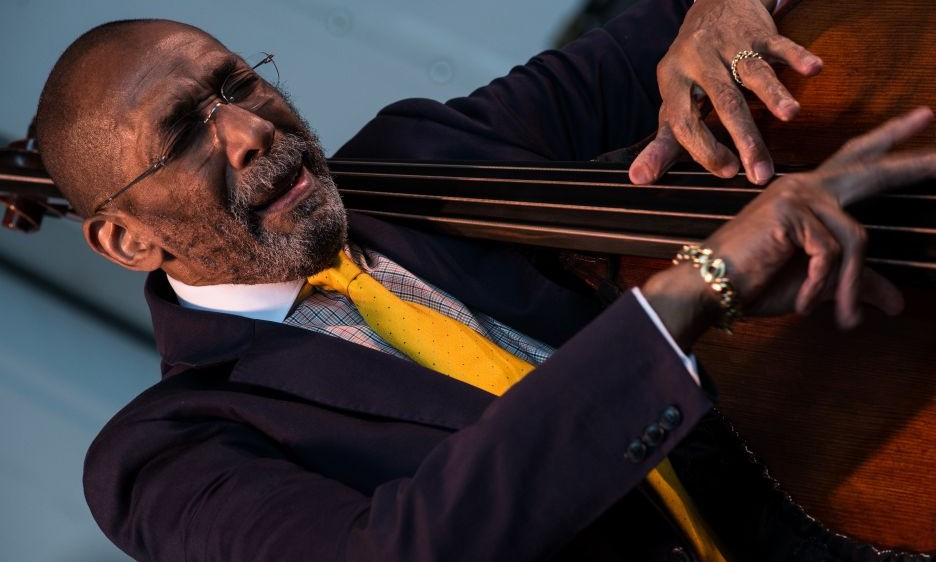
Courtesy Jonathan Chimene / WBGO
I go to work every night looking for something new that's waiting for me to find.
—Ron Carter
It is not just about the quantity of recordings, mind-boggling though the figure is. More significantly, his innovative and adventurous bass playing has had a major impact on the development of jazz in the post-bebop era. From his tenure in the game-changing Miles Davis quintet of '63-'68, to his own highly successful seven-decade career as a leader (with over 60 albums to his name), Ron Carter has left an indelible mark on jazz and music more generally.
He has recounted the key episodes of his life and career in countless interviews over the years, while the recent publication of documentary film and literary biography, not to mention the exhaustive The Smithsonian Interview book have served to remind us of Carter's extraordinary journey, of his immense contribution to jazz, to the evolution of the bass, and by extension, the evolution of jazz ensemble dynamics.
But for this interview with All About Jazz the focus is very much on his current projects. In a candid, open discussion, the multiple-Grammy winner talks about Sweet, Sweet Spirit (Motown Gospel-Blue Note, 2026)—his highly personal foray into gospel music—jazz-tinged, of course—with Ricky Dillard and his celebrated New-G choir. He sheds light on his recent collaboration with Diana Krall that launched Vaulted Pictures, an innovative video project that captures the intimate mechanics of duets. He also invites us to dive deep into the rabbit hole that is The Ron Carter Universe, a wondrous digital discography-cum archive resource that, step by step, is cataloging Carter's huge discography in an entertaining, interactive manner. And with high-profile gigs coming up with Herbie Hancock, he reflects on the nuts and bolts of their very special, decades-long musical relationship.
All About Jazz: Good morning Mr. Carter. Thank you very much for your time. It's an honor and a privilege.
Ron Carter: You're welcome.
AAJ: We're going to talk about some of your current projects, and anything else that you would like to talk about, but I think it would be appropriate, if you don't mind, to talk first about Sonny Rollins who sadly passed the other day. What are your abiding memories of Sonny as a person, as someone you played with?
RC: Well, you know, I have a documentary that came out last year called Finding the Right Notes. If you get a chance, pick it up, sir. It's sold through PBS.
AAJ: Yes, I've seen it. It's a great film.
RC: Okay, at the beginning of the show, the producer asked Sonny Rollins to tell him why Miles hired me. Remember that part?
AAJ: Yes.
RC: I saw that it was it was edited down from what they originally said because it was kind of long. In any event, to have Sonny Rollins say that stuff about me as a new guy on the scene, basically, in 1963, is an amazing tribute to his ability to hear stuff that people, as yet at that time, didn't really understand or didn't hear. He said that I brought a sound to Miles' band, and Miles wanted that sound. Now, I trust his interpretation of it, and no one can ask Miles what he thought because he's out of here, too. He's passed away. But my view of Sonny Rollins after that comment is that he was able to hear the possibilities that I was already looking for.
Yes. I loved him very dearly. We stayed in touch as much as our health issues... because I had my share... could maintain the conversation with each other. He was probably the first guy, the first saxophonist I really heard who was able to command the saxophone like that. I never heard Bird (Charlie Parker—ed) play live, and later on, other guys came along, but no one up to that point had that kind of saxophone command. Yeah, besides that, he was a very nice man.
AAJ: Which is just as important.
RC: My friend Javon Jackson was in much closer contact, so I would talk to Sonny through Javon and I'm sure he's just heartbroken that Sonny's gone.
AAJ: Yes, I'm sure he is. Mr. Carter, you played eight weeks in a trio with Sonny Rollins and Roy McCurdy at the Five Spot in New York in 1962. Now, that's quite an intense period of playing together, certainly by today's standards; what are your memories of that eight-week run?
RC: Well, the first thing would be we had eight weeks to play together and that was not unheard of then. It seems to be unheard of now, by and large. They have what they call the residencies right now, but that was really back in the day when you get a gig for two weeks, and you go home, basically, you know? To work eight weeks with someone like Sonny Rollins with no piano—for a bassist, it's dangerous. Fortunately, Roy McCurdy kept good time and had a good drum sound, so I wasn't fighting over the drum sound to be heard.
And I trusted my growing sense of harmony and resolutions of sevenths and various chords I was trying to hear that Sonny was already playing. A series of two five chords and different keys and sharp fives and sharp nines that I could play, but I didn't know what to do with them because I didn't know where they belonged. But to play with this person who's using his horn as a baton, directing me and Roy McCurdy in his direction was just an incredible sight for me to watch, first of all. To be a one—third of this kind of sound for eight weeks, are you kidding me? Give me that anytime.
AAJ: Thank you for sharing that. You also played some years later, in '78 in a group called the Milestone Jazz Stars with Sonny Rollins, McCoy Tyner and Al Foster. That sounds like an amazing group. Was it as good as it sounds on paper?
RC: Oh, man! I had three things that happened. McCoy was a side man with was another great saxophonist—Trane. (John Coltrane—ed) He played with Trane all those years. And Al Foster was just coming off of a big gig with Miles Davis, and he was really getting into playing just incredible drum sounds without necessarily playing time all the time. And I was understanding what my lines could do—how I could direct the band in the way I thought I wanted them to go physically and musically, because I understood baseline construction, I understood chordal resolutions. I had a really good sound, a constant sound. I was really getting better at what I thought I could hear and making it work every night. So those concerts and those recordings (Milestone Jazz Stars In Concert Milestone, 1979)—for me it was a coming-out party.
Yeah, playing with these equal three giants, man. And knowing that McCoy, when he would lay out, I'm on my own. But they trusted me to do my share of the weightlifting and it was just incredible, man.
AAJ: Thank you very much for sharing those memories of Sonny Rollins. He'll be sadly missed but remembered with love and admiration by millions. Let's come to the present, and several of your projects. The first one I'd like to ask you about is your collaboration with Diana Krall, captured as a film on Vaulted Pictures. It's a very interesting concept with a lot of potential; how did this project come about?
RC: Well, my little company, Retrak Productions, Inc. decided that they wanted to show me in a different setting. For them, a different setting would be me doing a duo. Well, Bill Frisell was unavailable and Jim Hall passed away—because those were my most recent duo attempts—and one of the people knew Diana Krall. I knew who she was, but I never sat down to really pay attention to her as a pianist—as a duo pianist.
So, I was kind of... not hesitant, but my job as a side man is to make someone sound good. This project was basically formed around how two people, who don't know each other socially or musically, two people who never got the chance to do anything more than pass by each other at the hotel or the club and waving hello, 'how are you doing? I've got to go to my set,' you know, that kind of relationship... how they get together to make great music.
She's really a very good pianist, first of all. and I could hear some of that in our warm-ups. But to be sitting next to her, standing next to her, and trying to guide her to what I thought was a better alternate harmony was quite a chore because she's so quick to hearing. I couldn't finish my sentence because she already found the resolutions in her own style, in her own frame of reference. So ,it is a good view for an audience to see how music is made with two people who are saying hello to each other for really the first time.
AAJ: It is a very intimate, up-close-and-personal setting.
RC: Yes. And what they go through. They pick a library. What's the best key? What's the best tempo? Those chords don't work for me, but they work for her and now I have to figure out what to do with them. Really, it's a growing process. All in a short space of time—to put together a performance as stunning as what the audience would hear when they go to this video, yeah.
AAJ: It is fascinating viewing and not a room many people usually get to sit in—to watch two maestros on their respective instruments feeling their way into each other's company and finding a common ground. I doubt many of Dianna Krall's legion of fans have ever seen her work in this way before.
RC: And I would say to you, I got better at playing the bass because I knew where not to be on the instrument to help her sound good.
AAJ: Of course, you do have something in common with Diana, and that is the late guitarist Russell Malone. He played in Diana's group for many years and he also played with you and Mulgrew Miller in The Golden Striker trio. In The Smithsonian Interview you did with Devra Hall in 2011 you said that Malone felt unlike any guitarist you had ever played with before. He did have a special sound, didn't he?
RC: Absolutely, and I can imagine how much fun he had playing with Diana because he had a great sense of humor. And he was what I call a guitar historian. He would call Kenny Burrell, all the guitar players, on their birthdays. He would always have a nice story, a funny story about guitar players. I didn't think about that connection, but Russell and I had such a great time. He'd be pleased, and not surprised, that I had a great time with Diana.
AAJ: Do you have plans to play any gigs with Diana as a duo?
RC: I'd like to do that but right now our schedules are so busy going east or west. She's running around more than I am. I was as busy as she was years ago, but I'm trying to turn myself down to medium right now. We talked about it in general. I'm keeping my date book open and trying to figure out when we can sit down and get a four-night gig somewhere in New York and have really good fun and really enjoy our company together.
AAJ: I think that would be magic. I read on the Vaulted Pictures homepage that the concept, in a way, is to allow musicians the sort of freedom to experiment that they often don't enjoy due to label constraints. That made me think of something that I read in Finding The Right Notes (ArtistShare, 2008)—your biography written by Don Ouellette; it's about your Ron Carter Plays Bach project from quite a few years ago now. Columbia were all hot for that, but then they wanted to add percussion, which you objected to, so then they dropped it. You then took it into your own hands, bought the master tapes and released it in Japan where it was a massive success, selling around 100,000 copies there. Talk about a record company misreading the room!
RC: Yes. The moment I walk onto the stage someone says, 'play the Bach, play the Bach.' I'm just thrilled because I made the right call, and Columbia didn't want to hear it at the time. They actually asked me to call a guy in Boston, and they wanted him to add percussion to it. I said, no, man. The heart of this pulse, I told Columbia Records, is what kind of chords Bach was writing back in those days. And my job with this project is to play those harmonies, to play his pieces and hear the harmonies that they imply. I wasn't going to have anyone come in and tell me one of my chords was wrong, or 'can you turn this down because it's in the way of the bells' and all that shit. No, I wasn't going to do that. Yeah, I'm glad of my choice, and I would do it again.
AAJ: Well, your judgment was absolutely spot on. It's a beautiful recording. Now, I was also very surprised to read in the book as well, and I don't know if this is still true as of today, that the albums Ron Carter Plays Bach (Phillips, 1987) and Ron Carter Meets Bach (EAU Records, 1992) albums were never released in the USA. Is that correct?
RC: Yes. They were only for the Japanese market. The Brandenburg Concerto (Blue Note Records, 1996) was issued in the States. I do the "Brandenburg No.3," I do Handel's "Ombra Mai Fu," a piece for cello quartet and me. It's got a nice library on it. I'm trying to find out, since the company is no longer there, who I can get the master from so I can issue it myself because it's a really wonderful record. Blue Note in New York at the time, they saw the interest but they didn't put the kind of machine behind it as they would have done with other records, I was a little disappointed that it didn't get their attention, but I'm still trying to find out who owns it so I can put my own truck behind it and put it to where it belongs.
AAJ: I wish you the best of luck with that.
RC: Thank you.
AAJ: Diana Krall makes an interesting remark at the end of one of the duets with you when she says that she loves singing with your bass playing as opposed to playing the piano, because just singing frees her up melodically, harmonically. You made a beautiful album with Helen Merrill, Duets (EmArcy, 1989), which was just the two of you, no piano—can you relate to what Diana's saying there?
RC: Yes. She's trusting me to find the right note, the right quarter notes that allows her to sing a half note and not worry about the chord that I'm going to play next. And those kinds of singers who like to trust the bassist, whoever he or she is, to lead them to where they want the next chord to go and make it so clearly articulate that the singer can't miss it—and they can use their breath, their wind, their skill level to make this harmonic transition even more smooth. She's really good at that, man. It's like playing with a horn player who knows when not to play.
AAJ:: Thank you for explaining that. You've played with some of the very greatest singers, Shirley Horn, Sarah Vaughan, Blossom Dearie, Carmen McRae, Sheila Jordan, Nancy Wilson, the wonderful Brazilian singer-guitarist Rosa Passos—not forgetting your album with the great opera singer Jessye Norman. That's quite a list...
RC: ... Lena Horne...
AAJ... Tony Bennett, and we could go on...
RC: I treated all those singer gigs as a free lesson in how people sing because they all have their own way of doing it. Certain of those singers though play piano really very well—like Shirley Horn, of course, and Carmen McRae was really a be-bop pianist. Sarah Vaughan, Blossom Dearie—I had fun working with those people in particular because they were at the keyboard. They knew what they wanted to hear and when they wanted to hear it. They would just hit the chord and give me the sound or something like that. So, they were directing my choices and that was fun because I worried about one thing less, to please them, you know.
AAJ: It was funny at the end of this video with you and Diana on the Hank Williams tune "I'm So Lonesome I Could Cry" that you were both thinking Bill Frisell as you were playing. Frisell has spoken about you and your influence on him quite a lot in interviews, and in the book Playing The Right Notes he describes you as "the backbone of the most inspiring music." Would you be happy with that on your tombstone?
RC: Yes, though don't say tombstone too loud. (laughs)
AAJ: (laughs) Yeah, sorry. Frisell hasn't done too badly himself, has he? He's been a very influential figure.
RC: Yes, and I'm so pleased to have him on my list of people I can call when I need a guitarist in six minutes.
AAJ: Just wrapping up the Vaulted Pictures subject; are there any more duo collaborations similar to the Diana Krall one in the pipeline?
RC: Well, I have a list of three people who I think this kind of process would be interesting for them to tackle. I'm not sure if Vaulted Pictures has contacted them yet, but if they have, and I hear the response, I'll tell them to find out where you are, and you'll be the first to know.
AAJ: (laughs) Thank you very much. Which brings us to Ron Carter's Universe—the incredible digital archive of your recordings. It's quite amazing. How did this come about?
RC: Penny (Kjellberg—Ron Carter's manager since 2017—ed) knew some people who were into that kind of platform and presentation. They were interested in doing a different kind of project, but they didn't know anyone who would buy into it. The general idea was: how can you display how many records I'm on and make it interesting? They came up with this 'universe' idea. It is the kind of site where they're still adding stuff to this archive, this universe. They go in and they add four or five more discs, so it's ever growing. According to Guinness (World Records) they officially acknowledged 2,200 records I'm on, and we found another 300 since.
AAJ: I was going to ask you, because that Guinness Word Record was verified back in 2015. You've been busy since then...
RC It's about 2.500 now.
AAJ: It's something we have in common Mr. Carter, because I'm also a Guinness World Record Holder.
RC: Oh good.
AAJ: I'll show you the certificate. (holds up framed certificate to camera). Can you read that?
RC: Longest pool marathon. 172 hours. What?
AAJ: It was a slack week at work.
RC: I know that game, man. 172 hours? That is amazing. That is just amazing.
AAJ: It was a fundraiser 20 years ago. It's a long story.
RC: 172 hours? Wait 'til my friends know I talked to you man!
AAJ: (laughs). It'll be on my tombstone: 'He played pool for 172 hours,' though don't say it too loud.
RC: (laughs)
AAJ: Coming back to The Ron Carter Universe. The discography starts with Coleman Hawkins' Night Hawk (Prestige, 1960) and there are over 1,000 albums—so far—cataloged up to 2023, with personnel, label, year of release, audio snippets and links to YouTube. Visually, it is very impressive, like a constellation of stars, each little pixel representing a recording date, which when you click on it, it takes you down a rabbit hole.
One of the things I love about it is that the set-up is very jazz in a way; it's very systematic and beautifully organized and yet there is a very strong random element of discovery in the search system. In one search I discovered unissued concerts—there was one of the Miles Davis Quintet in Japan in 1964...
RC: With Sam Rivers...
AAJ: With Sam Rivers, yeah. How long was he in the band?
RC: No more than three or four months.
AAJ: I see. I knew it was a short stint. It's like finding one golden nugget after another. Unissued recordings, high quality radio broadcasts, and every other click throws up a reminder that you have played, not only with an extraordinary cast of jazz musicians that span the music's history, but with a remarkably diverse range of artists. I found records your bass playing is on by the likes of Janis Ian, Paul Simon, Gil Scott-Heron, Roberta Flack, Aretha Franklin, Michel Legrand, Bootsy Collins, Nils Lofgren, M.C. Solar and A Tribe Called Quest... and on and on it goes. It is quite unbelievable. And there are 1,500 recordings still to go up. Are you confident that you will get your entire discography cataloged in this way on the site?
RC: My ego says yes but the reality is no, given how many people have released unissued records that we don't know about and given how many people have recorded the concerts and gigs without telling anybody. So, I am sure we will never be able to capture all of that. But I've never been concerned with can we get them all. Initially, when I started this project, when I started collecting them back in the day—I wanted my sons and my grandsons to know what their father and grandfather did.
The problem was I never knew when the records were going to be released. I make the record and the next day I go to the next record date or the next single or the next gig, so I never was able to keep my finger on the exact date. You know, I didn't know that Plugged Nickel (Miles Davis quintet's live album, recorded in 1965, released in Japan in 1976, worldwide in 1982—ed) was out until a year after it was already out.
AAJ: On the subject of Live at the Plugged Nickel, the Miles Davis At 100: A Global Perspective article I did, you know, asking musicians from 100 countries around the world to share their thoughts on Miles Davis' influence, his legacy, or just their favorite Miles Davis album—well, of the people who spoke about their favorite album, many of them chose Live at the Plugged Nickel; are you aware just how loved and how special that album is for so many people?
RC: No, but I'm feeling the love now as you explained it to me in your research that this album is their number one, two or three favorite album. That's really amazing to me.
AAJ: I'll cut and paste the comments that refer specifically to that album from different people and send them to you.
RC: Thank you. That would be lovely.
AAJ: Another feature of the Ron Carter Universe archival discography is that the number of times you have collaborated with individual artists is listed. And top of that list, with 117 recordings, is your old compadre Herbie Hancock. This August you are playing once again with Herbie Hancock at the Hollywood Bowl. What can you share with us about this special gig?
RC: This is a Miles Davis 100th-year tribute. The program we divide into three parts: Miles plus the Gil Evans kind of sound; Miles plus the band of the '60s—my kind of band; and the last band would be the electric band.
AAJ: You won't be picking up an electric bass guitar, will you?
RC: No, no. I'll be the guy standing up (laughs).
AAJ: I thought so. You've been very faithful to your instrument I have to say
RC: (laughs), Yeah, I have,
AAJ: The Hollywood Bowl gig on August 9 is not the only gig with Herbie Hancock, is it?
RC: I'll be playing with Herbie as a single concert in Monterey later on in the year. So that's my focus point.
AAJ: Will that be a duo, a quartet or what?
RC: Just me and Herbie.
AAJ: Oh man, that'll be something special. You two obviously share a very unique history, but I wonder how many people are aware of the influence you had on Herbie's playing in that Miles Davis quintet? There is a short passage from your biography that illustrates this, where Herbie says, and I quote:
"It was all about Ron's intelligence and the note choices he made... it required me to be a better listener in a way I wasn't accustomed to. Beforehand, with bass players, I could anticipate what they would play. But Ron was more creative, more adventurous... with Ron it was a whole different ballgame. I had to pay attention. I knew from the first time we played together. And it made a difference in my piano playing. It forced me to respond in a way that reflected his influence. From moment to moment it made me shift and develop in a very personal way."That is some testimony. What is it like playing with Herbie as opposed to other piano players, from your point of view as the bassist?
RC: He's one of the few piano players I play with that will allow me to interrupt his thought. He'll play a nice run, but I'll play another note that makes that run no longer necessary, you know. I think we did "Gingerbread Boy" and on piano it's in B flat I think, and on Herbie's solo I'd go into B he's still playing in B flat—it's a great sound. He decided, for the moment, to keep playing in B flat and I was determined to have this B major affect his chord harmony in his solo line. It's a great example of us doing our own thing and still being very compatible. At the downbeat of the 13th we both had a B flat chord and we all understood what was going on.
I tell my piano playing friends, unfortunately, you guys can't hear Herbie at the soundcheck warming up, because his skill level is astonishing. So, to know that this person who also is my dear friend has this skill level to match my notes is quite a warning. And to know that if I take a left turn he will not stop the piano and give me a lecture during the course of the drum solo. I'm going somewhere with this note, man. Just trust me where it's going and meet me on the corner. And he's so graciously doing that, and correctly so, because it has always worked out.
AAJ: Thank you for sharing that. Both you and Herbie have a classical music background, and you have both recorded, to varying degrees, classical music. Wouldn't it be a great project if you and Herbie were to do a classical program, through a jazz prism, of Bach, Debussy, Tchaikovsky, Satie, whoever?
RC: I think that would be something that might appeal. Well, let me sit down and mull it over. Right now, I'm still busy enjoying my last release, which is the gospel record.
AAJ: Let's talk about that album Sweet, Sweet Spirit (Motown Gospel-Blue Note Records, 2026), a joint collaboration with Rick Dillard and his New-G Choir. It's powerful, uplifting music. What are the roots of this project? Was gospel music important to you growing up?
RC: I think most people, most African American people my age—I'm going on 90—back in the '20s, '30s, '40s and '50s the community thrived on gospel songs. That was their way. The churches were a meeting place for the slaves and local communities. The church was a way to get together and complain about the boss and ask help from the man upstairs or the woman upstairs—whatever your preference is. The communication, the camaraderie with the neighbors, neighbors who never saw each other in this kind of non-threatening environment.
When I was seven, eight, nine-years old, we all went to church and learned the hymns that my mother sang in the choir. I grew up hearing these songs until I left Detroit when I was 18 or 19. When my mother had to go to the nursing home my sisters decided that they wanted to have some music with her. They asked me if I could find 10 or so gospel songs that she would know, and put them in a format so that she could play these songs when she felt like it.
So, I bought a computer and a music program, which I didn't know anything about, and I found a gospel hymn book from back in the day—brown pages, half—torn—and I picked out 10 or 11 songs that she wanted to hear all the time. I put it on the format and then sent it to my sister. She bought a boombox back in the day and my mom played this boombox with her favorite hymns by her son, whenever she wanted to.
At some point I decided have someone sing the words. I was working with Gene McDaniels at the time. He was going to take my gospel demo and sing the words over the arrangements that I had written, but he passed away before we could work on it. So, it was on my desk for a long time. And everybody kept asking me about my next record and I would tell them about this, but no one understood what I was asking for until Don Was (President of Blue Note Records—ed) said that maybe he had the possibility of helping us come through.
He knew Ricky Dillard, who's the maestro of the gospel choir community. We had a meeting at my house and talked about what I had in mind and why I wanted to do it. And Mr. Dillard didn't blink, he said, "Well, let's give it a shot." And the record in your hand, the disc in your hand, was one year in getting to the stage, and I was so happy with the results.
AAJ: It sounds brilliant. Will you be touring this album?
RC: Well, we need a kind of big church to do it in. It's in the works. If Ricky Dillard feels we can do this with half the choir—this is 80 voices—if we can find a church with a big enough stage I am hoping we can get it done soon enough. Couldn't be too soon.
AAJ: We wish you the best of luck with that.
RC: Thank you.
AAJ: A couple of final questions, because I don't want to take up too much of your time; a book I like a lot and come back often is Art Taylor's Notes and Tones (Da Capo Press, 1977)...
RC: Yeah...
AAJ: He interviewed you in 1969, apparently in Paris, and you tell him, and again, I quote: "To reach the top level of creativity, you have to be able to control the business end, so you know when you can afford not to work." It seems to me that you're very switched on, and always have been, in taking care of the business side of things, because it's the sensible thing to do. Do you try and get this advice across to your students as well as teaching the music? Is that important for you?
RC: Absolutely. One of the things I tell them, Ian, when they ask me what to do when they go on the road for the first time, is to sit down and figure out how much money you need to stay in New York, and not be in New York. You got to get your rent, you got your utilities, you got your family, you got your groceries, you got stuff that's in New York when you're not there. If you're going to go out of town, man, you got to earn enough money to live on the road, pay the hotel, pay for your own food, and send back home enough money to cover the bills that you know are waiting for you when you get back. Yeah, I stress that to them. Guys, sit down with your accountant or somebody who you trust with your financial information, and put this question to them. They'll tell you the same thing; figure out how much you got to work to stay in New York. And if you leave in New York, if you go on the road, you need an equal amount of money because now you got bills twice as big—on the road bills and your home bills.
AAJ: Sound advice. After over 70 years playing bass, a lifetime playing bass and immersed in music, most people might assume that there's nothing else you can learn on the bass, there's nowhere else you can go on the bass. Do you subscribe to that, or are you still learning?
RC: I go to work every night looking for something new that's waiting for me to find. I know I can't find it in my office, I can't find it at the grocery store. It has to be in my environment, which right now is my quartet, James Green, Payton Crossley and Donald Vega, who are my blackboard, my bulletin board. They have my latest attempts up to find something new to do with the arrangements, tempos, stuff like that. And they let me know if I'm onto something special here by how they respond to my hints and my cues.
I think at this stage in my career, I'd be lost without this kind of outside influence on my thoughts. And, you know, just to go back one page, at some point during Miles Davis' career, there was a rumor out that he was trying to put the band, the quintet together to do one more tour. It never came about because he got sick and passed away ultimately. But I was eager to do it because I wanted to show them how much better I got. I learned the bass better, I had a good amplifying system, I had a good pickup, I had some good strings, I had been around the corner three or four times learning the order of notes and resolutions. I'm right here man! Let's get this party started! Unfortunately, we couldn't get it going and I missed showing off. To answer your question, every night's a chance for me to find something new that I can show off to myself.
AAJ: Well, you know, I'm pretty damn sure that Miles absolutely loved your playing and your contribution to the band back in the day...
RC: I did. (laughs)
 FOLLOW Ian Patterson
and get notified whenever a new article published.
FOLLOW Ian Patterson
and get notified whenever a new article published.
Ian is dedicated to the promotion of jazz and all creative music all over the world, and to catching just a little piece of it for himself.
About Ron Carter

Tags
PREVIOUS / NEXT


Become a Sustaining Member

Since 1995, All About Jazz has championed jazz as an art form and supported the musicians who create it. Over three decades, it has grown into one of the world's leading jazz resources, serving hundreds of thousands of readers, musicians, presenters and industry professionals each month.
Help Build the Future of All About Jazz
Your support helps us continue building All About Jazz for the next generation—expanding our editorial coverage, preserving jazz history, developing new community features and creating better ways to discover the music and the people behind it.
Become a sustaining member for as little as $20 per year and you'll immediately enjoy an ad-free experience along with access to subscriber features and future articles for a full year.
Together, we're not simply sustaining All About Jazz—we're building its future. Thank you for being part of the journey.