Home » Jazz Articles » History of Jazz » The Only Radio Station in the World With a Real Bar: Phi...
The Only Radio Station in the World With a Real Bar: Philly Jazz, The Click, and Other Postwar Ephemera
Courtesy Billboard Magazine
For a few glorious moments in the late 1940s, Philadelphia was one of the jazz radio beacons in the country.
The owner, at least the one who counted, was a gentleman named Frank Palumbo. If the word "legendary" still has any meaning, Palumbo was legendary in Philadelphia and remained so until his death in 1983. A reader in search of an interesting biographical subject could do worse than look into Frank and his wife, "Kippie," because following them would take someone deep into the woods of Italian-American lore in Philly, and into nightlife, politics, the Mob, entertainment, and the entire nous of a generation for whom Ninth Street in Philly would NEVER be the "Italian Market," always Ninth Street. The Click was only one of Palumbo's many ventures, and so, unfortunately, to get to that story, the rest of Palumbo's fascinating life has to be left aside.
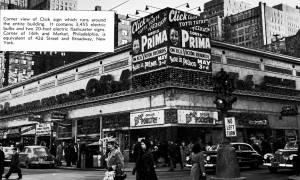
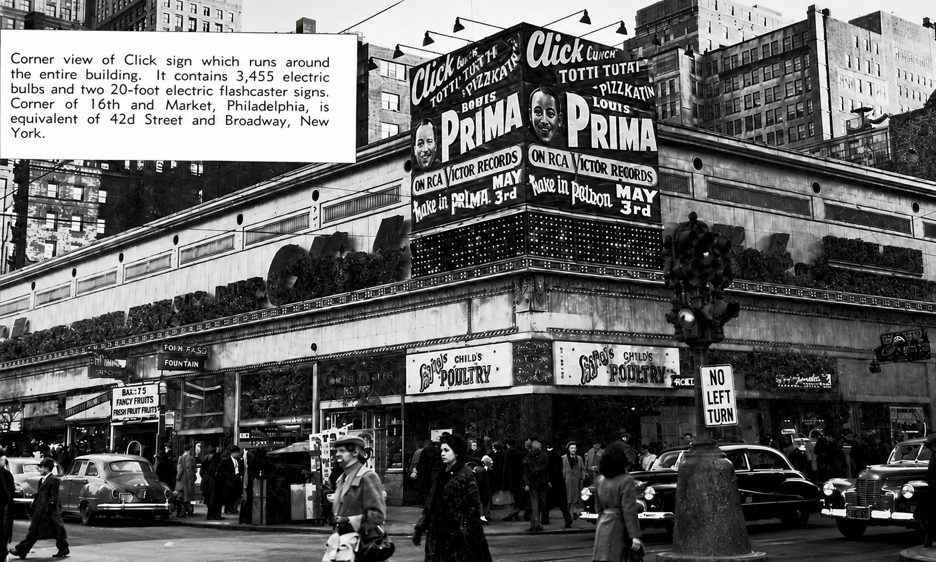
After stateside service in World War II—within a year, precisely—Frank Palumbo opened the Click at 16th and Market Streets, smack in the center of downtown Center City. The date was September 7, 1946. Palumbo had been an experienced restaurateur before the war, from a large family, and making good money, so he presumably had access to legitimate finance (Palumbo was always accused of mob ties, and his CR club was a well-known gathering place for "men of honor"). Also, the Click was an enormous undertaking, so Palumbo must have had time on his hands in the service. This wasn't built in a day. The first opening act was Louis Prima, and it only got bigger from there. The Click had a promotional gimmick that involved a "Click Tune of the Month recording," usually something not too serious. You think Prima did not rate? In 1948, his "Tutti Tutti Pizzicata" was a Click tune on RCA records. And this was big business. The Click Tune of the Month got the Number 1 position on 4,000 juke boxes in the Philadelphia area, and plenty of publicity in the Philadelphia Daily News.
And the club itself was something to see, inside and out. The Club's sign alone ran around the entire building, an art deco affair that contained 3,455 electric bulbs and two 20-foot electric flashcaster signs. And that was the outside. The club itself had a revolving stage that could accommodate two bands, so there would always be someone playing. The room was designed so that no customer was more than 70 feet from the bandstand, even though the house had a capacity of 2,700 people. But the gem, the jewel of the place was—no, not the acoustics—which must have been decent enough, but the bar. According to Frank Palumbo himself, "Directly in front of the bandstand [is] a 373-foot bar [that] runs twice the length of the room, on two levels, capable of seating some 500 people, and of serving some 1,800 at one time. Two other circular bars, one to the front, and on each side of the bandstand, boost the total footage of the bar... to 590 feet." There are some photos of the interior, one in particular, that were sold at the time as postcard souvenirs. If someone has the idea that the idea of the Click was to get people well lubricated en masse, well, that cannot be far from the truth. Having a loose, vociferous and fun-loving crowd was an integral part of the Click's business model, because the place was not primarily made for dancing, but listening. And drinking. And even more to the point, broadcasting.
Perhaps people no longer listen to the radio much, and some automobiles do not include an AM radio—there is an "AM Radio for Every Vehicle Act of 2025"—for one reason or another. But to really understand the history of jazz in the United States, you have to put yourself back into an era in which the radio—not the television, let alone some streaming device—was the center of many households. While television ultimately made a huge impact on the music industry—and on the club scene in particular—this started to happen in the 1950s. Before then, most people got news, sports and music through a radio. It was not only the railroad age. It was the radio age.
Frank Palumbo was nothing, if not a smart businessman. "We have a Wishing Well at one of the exits of the Click into which our patrons drop some secret wish as they leave. I read these wishes carefully... We tried to make it easy for a person to get something to eat or drink and see some first-class entertainment without going home broke." Since there was no admission, no cover, and no minimum, there had to be something else to sustain the cash flow. And this is where the radio came in. Palumbo said that they understood the value of radio as a medium for advertising from the Click, to draw people In those days, a "remote" broadcast" involved running telephone lines to NBC, CBS, ABC and Mutual. As Palumbo observed, they did 20 to 26 remote broadcasts a week to all over the country. Since Philadelphia was not a radio center like New York, a lot of people had never seen a broadcast, so the Click was in part set up to allow people to come in and see what was going on. With enough to drink and someone warming the crowd, Palumbo said, "the patrons here sensed they were becoming part of a center of attraction." The line—and, alas, a recording of it has yet to surface, was "We're going coast to coast over the network, so let's show them across the country that here in Philly we're wide awake and enjoying the music of (say, Tony Pastor, and his band)." People went nuts and one observer called the Click "the only radio station in the world with a bar." Well, who was the talent? In 1948, for instance, Benny Goodman and a sextet (was local Buddy Greco on piano?), Art Mooney, Elliot Lawrence (another local boy made good), Johnny Long, Hal McIntyre, Gene Krupa, Desi Arnaz, Tex Beneke, Carmen Cavallaro, and Louis Prima. You could also see (in other years) Rosemary Clooney, Frankie Laine, Buddy Rich, Terry Gibbs, Vaughn Monroe, Stan Kenton, Harry James, Xavier Cugat, and Frank Sinatra. Yeah, this was Philly in the late 1940s. Smack in Center City. Between September 1946 and April 1948, nearly fifteen hundred broadcasts originated over the networks from the Click, including the Chesterfield Supper Club and the Old Gold Program (yes, smoking cigarettes was encouraged, so do not be shocked).
And that was not all. Palumbo himself knew that radio remotes were not the future, so he was eager to get local television stations, in their infancy then, do shots of, well, beauty queens like Miss Philadelphia from the Click. Philly was a starting point for people like Ed McMahon and Jack Whitaker, when local productions got started at stations like then WCAU. Palumbo also understood that records could be used, and there was a Click Record issued—probably not great music, but they got loaded onto juke boxes and plugged by 41 different radio stations in the metropolitan area, not to mention dozens of disk jockeys. Look at newspapers of the day, a broadcast from the Click was liable to pop up for half an hour once or twice a day. "Since 1946," Palumbo bragged, "we have advertised 32 different bands" in over 112,000 lines of ads. If there was a promotion to be done, Frank Palumbo would do it.
And then, in 1951, The Click was gone. Or at least, Palumbo's concept was gone. Suddenly, advertisements pushed the Click as the "World's Largest Theatre. Yes, Patty Page was singing there in April 1951, but the Click introduced Lee Henderson's Click-ettes, "America's Tallest, Prettiest Showgirls." The venue was opened to parties and banquets. There were reports that the club was sold to a consortium of New Jersey investors, followed by one that it went to a group of New Yorkers. Reports that Palumbo's name bands policy would continue turned out to be false, nor was Palumbo involved in running the place. How could he be? The Click went broke. There was nothing to run.
A brief and depressing notice in late May of 1951 announced "Click, the nightclub at 1526 Market St that enjoyed brief national fame as the local showcase for some of the country's most expensive shows was sued yesterday for nonpayment of rent and other bills. A judgment action of $46,294.18 was entered against its operator, Advance, Inc." Probably, buried in the records of Common Pleas Court No. 6 in Philadelphia, an interested party can find the remains. For jazz historians, at least in this period, the story is distressingly familiar.
Nobody wants to be a wet blanket and start going on about economics and money, but ask any working musician about the subject. Today, scuffling, especially under the weight of technological change, is the order of the day. But technological change was underway in the late 1940s and early 1950s too. Television was revolutionizing the way the majority of Americans got their entertainment. And it was not just television. Between 1936 and 1951, prices in the United States rose by 35 to 40 percent, driven by the lifting of World War II price controls and the outbreak of the Korean War. In 1947 alone, inflation was over 14 percent. Something that cost $100 in 1946 cost $134 in 1951. Inflation did not reach those levels in the United States again until the late 1970s.
How much can you charge someone to hear a good trumpet player? There are limits. How many people can you pack in? There are limits. And as an economist will tell you, prices for services—like music—rise even faster because there is no easy way to reproduce a live performance cheaply. Haydn's trumpet concerto took 15 minutes to perform in 1930. It takes the same amount of time today. But even trumpet players make more now than they did in 1930 for producing the same thing in 15 minutes. Do the arithmetic (Hint: divide a rising number by an unchanged one. The result must be higher.) That is why costs rise. So, undoubtedly, the Click went broke slowly and then all of a sudden—like a lot of other clubs—costs rose faster than revenues.
Frank Palumbo may have been a promotional genius. But genius is one thing. A miracle worker is another. As politicians and airline executives tend to find to their sorrow, prices and costs are going to do what they are going to do. End of story. The Click had a good run—five years—as these things go. But nothing lasts forever.
 FOLLOW Richard J Salvucci
and get notified whenever a new article published.
FOLLOW Richard J Salvucci
and get notified whenever a new article published.
Richard is an emeritus professor of economics at Trinity University.
Tags
PREVIOUS / NEXT

Become a Sustaining Member

Since 1995, All About Jazz has championed jazz as an art form and supported the musicians who create it. Over three decades, it has grown into one of the world's leading jazz resources, serving hundreds of thousands of readers, musicians, presenters and industry professionals each month.
Help Build the Future of All About Jazz
Your support helps us continue building All About Jazz for the next generation—expanding our editorial coverage, preserving jazz history, developing new community features and creating better ways to discover the music and the people behind it.
Become a sustaining member for as little as $20 per year and you'll immediately enjoy an ad-free experience along with access to subscriber features and future articles for a full year.
Together, we're not simply sustaining All About Jazz—we're building its future. Thank you for being part of the journey.