Home » Jazz Articles » Interview » Author George Cole On Miles Davis' Final Decade
Author George Cole On Miles Davis' Final Decade

Miles Davis never ran out of ideas; he just ran out of time to realize them.
—George Cole, Author of 'The Last Miles'
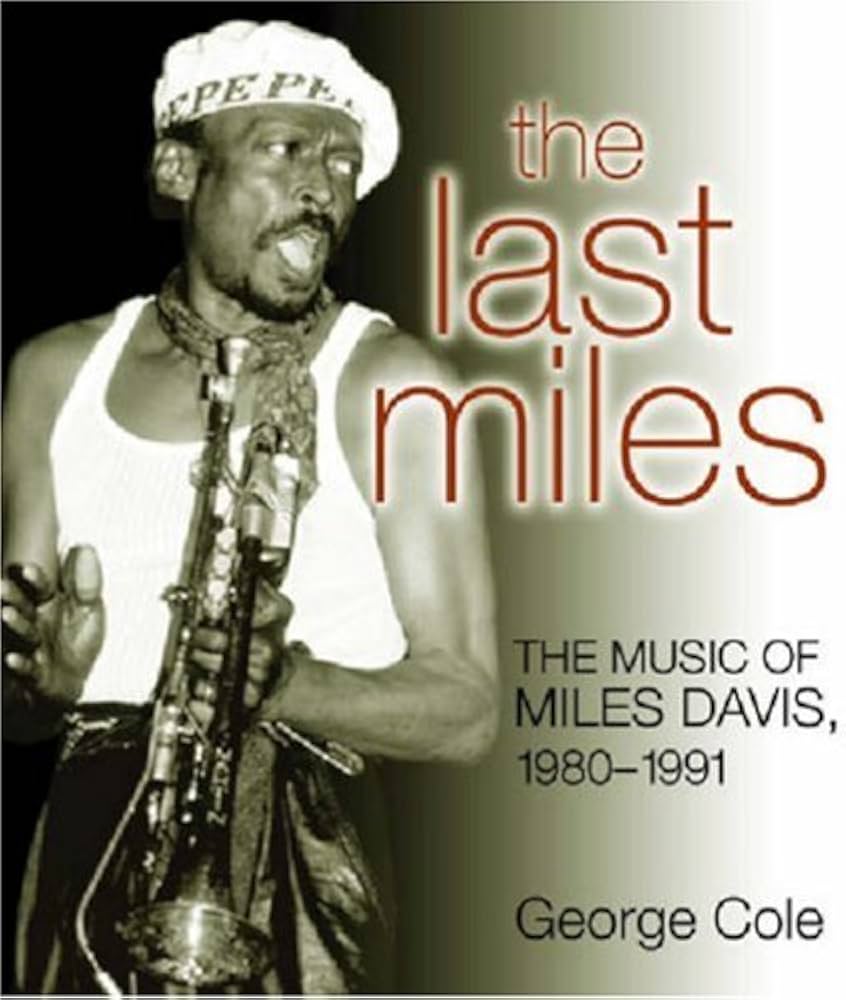 All About Jazz interviews George Cole author of The Last Miles, which concentrates on the final period of Miles Davis' life. Cole also maintains a website with additional interviews and research about Davis' life between 1980 and 1991.
 In these pages John Kelman wrote about The Last Miles: The Music of Miles Davis, 1980-1991, "There simply hasn't been another book published on Miles Davis, in any period that has managed to obtain the wealth of interview material and cover his recorded work and various live tours in such a complete and comprehensive fashion... Engagingly written from start to finish, filled with more facts than you'll be able to remember first time through, "The Last Miles is an essential portrait of Miles' last decade and a strong argument that his music was both valid and perfectly in keeping with a musical philosophy that would ultimately stretch over six decades."
All About Jazz: Are you still having to convince people that there was something worthwhile musically in late-period Miles Davis?
George Cole: A good question! It's hard to believe that The Last Miles was published over 20 years ago. I think a lot has changed over this period regarding the perception of Miles' final decade. I initially wrote my book because—with one or two honorable exceptions—and Miles' biographer Ian Carr was one of them—most people writing about Miles' musical career either ignored the last decade or dismissed it in a few paragraphs, or less.
One author of an 800-page biography of Miles devoted virtually no space to the post-1984 period, dismissing Miles' music in this era as: "kid's music," "freak music," and asserting that it was dominated by "three-chord riff tunes." You might not like albums such as Star People (Sony Records, 1983) Tutu (Warner Bros. Records, 1986), and Amandla (Warner Bros Records, 1989), but I don't think this is a fair description of their musical content.
I didn't write my book because I thought 1980-1991 was Miles' greatest period or even that he was continuing to be a musical trailblazer—although I'd argue that Tutu was a groundbreaking album—but rather that there was value in much of the music Miles made in his final decade.
I've since spoken to many people who tell me that they first heard Miles' music during this period—as I did—and that his '80s era music means a lot to them. I've also noticed more and more people writing positively about this period, and there are many favorable reappraisals of the 1980s albums.
A lot of Miles' magic happened on-stage rather than in the studio, and I think the appearance of more official live albums—especially the Montreux Jazz boxed set—and the large amount of live material you can now find online has helped in this matter. I also feel that, as Miles alumni such as John Scofield, Marcus Miller, Mike Stern, Bill Evans and the late Bob Berg became established jazz artists in their own right, more and more people appreciated the music they made with Miles.
Is everyone convinced about Miles' last decade? Absolutely not, nor will they ever be. But I do feel that many more people now appreciate that Miles' last 10 years are an important part of his musical legacy and that there is music from this period that is of value and well worth listening to. I like to think that anyone writing a new book on Miles today would feel obliged to give the last decade the space it rightly deserves.
AAJ Which album in Davis' later years represents him at his best?
GC: I'm going to cheat and name three albums, because I think Miles' last decade is divided into distinct periods, with the halfway point—1985—neatly dividing them each into segments.
For the first half of the decade, Miles was a Columbia Records artist, a company he was with for 30 years. In the second half, Miles switched to Warner Bros. Records.
For me, the album that represents Miles at his best during the Columbia era is Star People. It has an amazing cast of creative talent, including producer Teo Macero and Gil Evans, who helped arrange much of the album, but never got the credit he deserved. It would be the last time Miles worked with both men in the studio. It's an album that has both Mike Stern and John Scofield on guitar, Marcus Miller and Tom Barney on bass, and the formidable percussion duo of Al Foster and Mino Cinelu. Saxophonist Bill Evans' playing has come on in leaps and bounds.
Miles' playing is much stronger and confident than on the earlier albums, The Man With The Horn (Sony Records, 1989) and We Want Miles (Sony Records, 1982), and he's also the album's sole keyboardist. Miles was also starting to play synthesizers, as well as dabbling in studio technology, using drum machines, click tracks and special processing on Al Foster's drum sound. It's an area he would continue to explore for the rest of his life.
Star People features two superb tracks: "Come Get It" and "Speak," both up-tempo jazz-funk numbers full of fire and fury. It's no coincidence that these are sourced from live concerts.
Miles also plays two long, slow blues numbers—a sign of his growing confidence—the title track, which is almost 20 minutes in length, and "It Gets Better." There are lots of fine solos from Miles, and also by Mike Stern and John Scofield. It really is an album to savor.
For the second half of this period, it would have to be Tutu. No one had ever made an album like this and arguably no one else has since. It's like Bitches Brew (Columbia Records, 1970)—groundbreaking, hugely influential, and yet, no one—including Miles—has ever come close to making another album quite like it. Miles' playing on numbers such as "Tutu," "Portia," and "Full Nelson" is some of his best from the era, and the melodies, harmonies and sonic textures created by Marcus Miller, ably assisted on the last element by synth programmer Jason Miles, are a superb backdrop to the sound of Miles' horn.
Thirdly, I have to mention Aura, recorded in 1985 and issued in 1989, written for Davis by Palle Mikkelborg: completely original and featuring some of Davis' best playing.
AAJ: Marcus Miller had a profound effect on Miles Davis in Miles' last years. Can you comment on that music?
GC: Marcus Miller was the right man at the right time for Miles. He had been in Miles' band for a couple of years, 1981-83, so Miles already knew what a formidable musician he was. Miller had branched out in producing after leaving Miles, and also got heavily involved in synthesizers. He formed a close association with programmer Jason Miles, and they had worked on various projects together.
Miller had also worked with George Benson, Dizzy Gillespie, Lonnie Liston Smith, David Sanborn and Grover Washington, Jr. prior to creating the new music for Miles, so he knew all about jazz harmony and how to craft memorable melodies.
There's no getting away from the fact that Tutu catapulted Miles to a different strata when it came to raising his public persona. It also fused jazz and electronic music in a new and radical way.
I think Tutu is Miles' last masterpiece. It's not perfect, and some of it sounds a little dated, but overall, Miles' trumpet and the electronic soundscapes crafted by Miller and Jason Miles fit his trumpet sound like a hand in glove. The title track is a classic, "Portia" is simply sublime, and "Full Nelson" has a swing and swagger that hits the mark. "Tomaas" has some incredible chord changes, while "Don't Lose Your Mind" has dub music meeting jazz, and features an out-of-this-world violin solo by the late Michal Urbaniak and a Miles solo on open horn.
One often overlooked collaboration between Miles and Miller is the soundtrack to the film Siesta. It contains some of Miles' finest playing from this era, much of it without a mute. Their third and final collaboration, Amandla (Warner Bros. Records, 1989), produced some memorable music, including the title track, "Hannibal" and "Mr. Pastorius," which has Miles returning to jazz-swing rhythm and a reunion with Al Foster.
I enjoy listening to Amandla, but wish the music had a little more grit to it—it's a bit too polished in places for my ears. But overall, I'm glad Miles' executive producer Tommy LiPuma had the foresight and imagination to give Miller the green light to take Miles' music off in a new direction.
AAJ: Describe Davis' final concert in Paris where he played music from his past.
GC: It's often said that Miles never looked back, but that wasn't true. He was well aware of his vast musical legacy, but he always wanted to build on it; to move forward, to absorb the sounds of contemporary music and weave his trumpet sound into them. A lot of people who knew Miles say that his trumpet playing never changed; it was the music around it that changed.
What is true is that Miles never went back—until July 1991. On the 8th July, he played a momentous concert at the Montreux Jazz Festival, where Miles was conducted by Quincy Jones and joined by the Gil Evans Orchestra and George Gruntz Concert Jazz Band. They played the classic Gil Evans arrangements from Birth Of The Cool (Capitol Records, 1957), Miles Ahead (Columbia Records, 1957), and Sketches of Spain (Columbia Records, 1960).
Two days later, on 10 July, at La Grande Halle, La Villette, Paris, Miles played a concert that was simply advertised as "Miles and Friends." No one in the audience had any idea about the spectacle that awaited them.
The concert was a retrospective of Miles' musical career, from the 1950s to the present, and playing with Miles was an amazing cast of past and present musical associates: Jackie McLean, Wayne Shorter,Herbie Hancock, Dave Holland, Joe Zawinul, John McLaughlin, Chick Corea, Steve Grossman, Al Foster, Bill Evans, John Scofield and Darryl Jones. Miles' band members were Kenny Garrett, Foley, Deron Johnson, Richard Patterson and Ricky Wellman. Sadly, Tony Williams and Keith Jarrett declined to participate.
As well as playing contemporary numbers like "Perfect Way," and "Human Nature," and a new Prince tune, "Penetration," with his current band, Miles also performed songs from the past: "All Blues," "It's About That Time," "Out Of The Blue," "Watermelon Man," and "Footprints," and he mixed up the personnel, for example, "It's About That Time" featured Davis, Garrett, Shorter, Evans, Zawinul, Johnson, Patterson, and Foster. "Katia" included both John McLaughlin and John Scofield. From concert footage and the testimonies of those who were on the stage, it was a very emotional experience for Miles, his band, the guest musicians and the audience, and a rare treat to see Miles playing old tunes with past associates. Miles looks thin and frail, and he leaves much of the soloing to others, especially Garrett. But when you think that Miles had less than three months left to live, it's remarkable that the concert came off as well as it did.
The concert ended with a grand finale that had almost everyone—Shorter for some reason didn't appear—playing a rousing rendition of "Jean-Pierre."
Thankfully, the concert was professionally audio and video recorded, and the full concert was broadcast on French radio (later appearing as a two-CD bootleg), and an hour of the concert was broadcast on television. Sadly, getting the rights clearances from all the concert participants (or their estates) has not been possible, and so the full concert has never been officially released on any medium.
AAJ: When you were writing about Miles' final years, what did you learn about his life that surprised you?
GC: The first thing that hit me was how ill Miles was for much of this period. He was constantly in and out of hospital. He suffered from diabetes, sickle-cell anemia, arthritis, and had had a stroke in 1981. Years of drug taking and alcohol had also taken their toll. He was in a lot of pain a lot of the time. What struck me was how often he would go on stage and play a show, despite all the suffering.
The second thing that surprised me was discovering the other side of Miles, which was a world away from the Prince of Darkness, who didn't suffer fools gladly. He was more vulnerable than his public persona suggested. He was also kinder and more supportive towards his band members than I had expected. He had a dark sense of humor. Last, but not least, he really cared about the music, right up until his death. He'd listen to every concert tape and call band members to his room and suggest ways of improving their performance. He liked to stretch and expand songs in concert, or come up with a new arrangement, so the music remained fresh. Even as his body slowed down, he never stopped trying to move forward.
AAJ: Gregory Hutchinson claims to have been influenced by Miles Davis. How does the influence show?
GC: His album, Kind of Now—The Pulse of Miles Davis (Warner Music Group, 2026), has an interesting mix of music from Miles' acoustic and electric periods, although interestingly, there is no music from the post-Bitches Brew era. I think what Hutchinson has taken from Miles is the willingness to stretch out and explore, and take the music to new places.
AAJ: In 2026, how does Miles Davis' influence on jazz show itself?
GC: During his lifetime, Miles fused jazz with different genres—rock, funk, pop, hip-hop, even classical. I think this attitude of not putting jazz into a box or keeping it in a museum, but being willing to try new sounds and explore new directions in jazz is probably his greatest legacy today. Don't be afraid of mistakes, believe in what you're doing and keep on wanting to grow and develop. Don't settle into a groove, however comfortable or financially rewarding it might be. This was the message from Miles, and I think the best jazz players of today grasp at least some of this thinking.
AAJ:Miles Davis was proud that he changed jazz repeatedly. How might he have changed it further if he had been granted more time?
GC: We know from Miles' final recordings that he was beginning to explore the fusion of jazz and hip-hop and I could have seen him working with more hip-hop artists. The rapper/producer Easy Mo Bee, who worked with Miles on his final album, Doo-Bop (Warner Music Group, 1992), said that Miles had plans to go on the road with him.
Miles had planned to record four of Prince's songs on the album that became Doo-Bop, and we might have seen these two musical titans actually collaborating in the studio and creating new forms of jazz-funk.
I could see Miles branching out into trip hop and the various post-rap genres. I can imagine Miles experimenting with jazz, electronica, and hip-hop. Miles would have remained musically curious, and no doubt his new musical adventures would have left some fans and critics behind—probably including me! The author Ron Frankl made one of the best quotes about Miles: "For Miles Davis, music was a lifelong journey, with no final destination. He never ran out of ideas; he just ran out of time to realize them."
About Miles Davis

Tags
PREVIOUS / NEXT


Become a Sustaining Member

Since 1995, All About Jazz has championed jazz as an art form and supported the musicians who create it. Over three decades, it has grown into one of the world's leading jazz resources, serving hundreds of thousands of readers, musicians, presenters and industry professionals each month.
Help Build the Future of All About Jazz
Your support helps us continue building All About Jazz for the next generation—expanding our editorial coverage, preserving jazz history, developing new community features and creating better ways to discover the music and the people behind it.
Become a sustaining member for as little as $20 per year and you'll immediately enjoy an ad-free experience along with access to subscriber features and future articles for a full year.
Together, we're not simply sustaining All About Jazz—we're building its future. Thank you for being part of the journey.