Home » Jazz Articles » Book Review » Cosmic Music: The Life, Art And Transcendence Of Alice Coltrane
Cosmic Music: The Life, Art And Transcendence Of Alice Coltrane
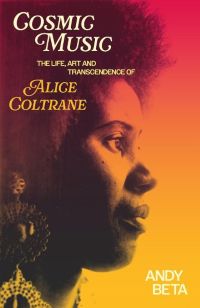 Cosmic Music: The Life, Art and Transcendence of Alice Coltrane
Andy Beta 452 Pages
ISBN: 978 1 3996 2621 7
White Rabbit
2026
As is often the case with marginalized, controversial or divisive figures in jazz, recognition of their achievements tends to come in a rush only after they have passed. Alice Coltrane died in 2007. Since then, contemporary jazz musicians such as Kamasi Washington, Shabaka Hutchings, Brandee Younger, Nubya Garcia, Alina Bzhezhinska and Matthew Halsall have acknowledged her influence—in words and in music. Beyond jazz, rapper Andre 3000, DJ Four Tet and electronic musician Floating Points have all spoken of Alice Coltrane's importance, while her music has been widely sampled. It was not always this way.
During her lifetime, pianist-harpist Alice Coltrane endured stinging criticism. She was accused of defiling the music of her late husband, saxophonist John Coltrane, and of trading on his name. Branded a second-rate composer and musician by some critics, her very status as an artist was downplayed, with reviews of some of her most experimental music dismissive at best, corrosive at worst.
The fact that Andy Beta's Cosmic Music is the first full-length biography of Alice Coltrane's life and career is some indication of the lack of fanfare surrounding her during her lifetime. The negativity, the cynicism and the barely disguised misogyny of some White male jazz critics failed to acknowledge her musical pedigree and her single-minded determination to plot her own course with no regard for musical fashion. Beta's book balances the scales.
Born Alice Lucille McLeod on August 27, 1937, in Detroit, Michigan, she grew up in a family where religion and music were intertwined. The young Alice played piano and organ in the Mount Olive Baptist Church. Throughout her life, Alice related to music through a spiritual prism: "I never really saw music as superficial," she said in a 1982 interview for Keyboard Magazine. "I always heard something that had to come from the composer's heart and spirit and soul, not just his mind."
The author paints a picture of the Detroit Alice McLeod grew up in as a thriving and sophisticated industrial town boasting a progressive education system. The Northern Migration doubled the city's Black population, and the ensuing racial tensions stoked race riots. Despite her musical prowess and a love of classical music, for young Black women like Alice Coltrane a classical career was not an option in such a climate.
Instead, she gravitated toward jazz. Beta describes a vibrant, welcoming jazz scene populated by great musicians. Mentored by Bob Harris, Alice gleaned much from attending gigs in the city and led her own trio as early as 1955. New York beckoned and, though she dreamed of attending Juilliard, economic realities meant she had to work as a secretary. Her musical talents, however, landed her gigs with Johnny Griffin, Kenny Burrell and Lucky Thompson.
She married young, to Kenneth Hagood, a scat singer with a heroin habit. They relocated to Paris, where Alice gigged with Oscar Pettiford and Kenny Clarke. Bud Powell, whom McLeod had sought out, was a significant influence on her development as a pianist. "I just marveled at all the creativity, improvisation, total freedom, and the artistic expression of the music," she said. While in Paris, Alice gave birth to a daughter. With her husband drug-addled, she returned home as a single mother. A recurring motif in the book is Alice Coltrane's stoicism—her determination to keep on going—no matter what life threw at her.
In these early chapters in particular, Beta draws from Franya J. Berkman's 160-page Alice Coltrane biography Monument Eternal: The Music of Alice Coltrane (Wesleyan University Press, 2010).
The author deep-dives into Alice's relationship with John Coltrane, who brought his band to Detroit two weeks after she returned from France. They were soon inseparable. John Coltrane taught Alice to meditate and expanded her religious and philosophical view of the world. He turned her onto the harp—the instrument forever after associated with her—as well as the music of Igor Stravinsky, which the author describes as "a fascination that would last throughout her life."
In all but abandoning her own music career to devote herself to John and their children, Alice unarguably provided the right environment for her husband to focus on his music. It is perhaps a stretch to suggest, as Beta does, that John Coltrane could not have written A Love Supreme (Impulse!, 1964) without the stable home environment Alice provided, but this slight assumption aside, the author's work is grounded in solid research.
When Alice joined John's group, it opened the floodgates of criticism—and cynicism. As Beta points out, her playing was often ignored in gig reviews by jazz critics. Others poured scorn on her contributions. In later years, some would even blame her for the breakup of her husband's classic quartet, which the author likens to the anti-Yoko Ono hysteria that came with the breakup of The Beatles.
If there is a central thread to Beta's portrait of Alice Coltrane, it is the guiding star of her spiritualism. Even the self-harm she inflicted in the wake of John's death in 1967 she rationalized as tapasya—a Sanskrit term that can be roughly translated as purification or reawakening. In her grief she refused to eat for days on end and experienced hallucinations. She burned her hand until her blackened nails fell out. To those closest to her, Beta relates, she appeared to have suffered a mental breakdown.
For readers of a non-spiritual bent, it may be a struggle to digest Alice Coltrane's claims to be able to travel astrally, or to have the ear of God. Indeed, several of her accounts sound fantastic in the extreme. Beta relays these events, so central to her worldview and being, without judgement.
Where assessment of Alice's musical prowess is concerned, the author wisely turns to her contemporaries, avoiding the pitfall, as so many biographers do, of delivering hagiography. Beta's interviews with Terry Gibbs, Bennie Maupin and Kirk Lightsey, amongst others, reveal that Alice Coltrane was widely considered as a notable bebop pianist, a fine vibraphonist, and an organist and harpist of personal stamp.
With an even hand, the author chronicles the chapters of Alice's career as a solo artist—noting the critical successes, such as the widely celebrated Journey Into Satchidananda (Impulse!, 1971), as well as the reviews that savaged her more experimental albums. Perhaps Alice Coltrane was guilty of being ahead of her time. Certainly, her blend of bold avant-garde textures, Indian and Western classical influences, free-jazz improvisation, and spiritual trappings left many jazz critics scratching their heads.
For Archie Shepp, they were missing the point. Just as Alice Coltrane rejected religious dogma, so too she rejected the limitations of musical style or genre: "Because she didn't follow the traditional methods of jazz, as it were, some of the critics missed her brilliance."
The final third of the book relates Alice Coltrane's ever-deeper spiritual journey. She travelled frequently to India on pilgrimages—a disciple of Swami Satchidananda and Sri Sai Baba. She became a spiritual leader in her own right and founded an ashram. A popular misconception is that Alice Coltrane turned her back on music, but as Beta relates, she merely turned her energies to performing in the ashram—on a daily basis—and recording devotional music. In a way, she came full circle, her music a form of offering.
Beta has delivered a balanced, illuminating and thought-provoking portrait of an important figure in 20th-century jazz, experimental and spiritual music. Cosmic Music is also a reminder of the race and gender politics that Alice Coltrane navigated with unfailing dignity and resolve.
 FOLLOW Ian Patterson
and get notified whenever a new article published.
FOLLOW Ian Patterson
and get notified whenever a new article published.
Ian is dedicated to the promotion of jazz and all creative music all over the world, and to catching just a little piece of it for himself.
About Alice Coltrane

Tags
PREVIOUS / NEXT


Become a Sustaining Member

Since 1995, All About Jazz has championed jazz as an art form and supported the musicians who create it. Over three decades, it has grown into one of the world's leading jazz resources, serving hundreds of thousands of readers, musicians, presenters and industry professionals each month.
Help Build the Future of All About Jazz
Your support helps us continue building All About Jazz for the next generation—expanding our editorial coverage, preserving jazz history, developing new community features and creating better ways to discover the music and the people behind it.
Become a sustaining member for as little as $20 per year and you'll immediately enjoy an ad-free experience along with access to subscriber features and future articles for a full year.
Together, we're not simply sustaining All About Jazz—we're building its future. Thank you for being part of the journey.