Home » Jazz Articles » Book Review » Go Where You Look: The Weather and Other Stories
Go Where You Look: The Weather and Other Stories
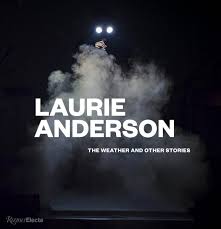 The Weather and Other Stories
Laurie Anderson
320 Pages
ISBN: 9780847840762
Rizzoli Electa
2026
To spend time with Laurie Anderson is to be gently nudged into questioning the very structure of the stories we live by. For over five decades, the 79-year-old artist, musician, and self-described storyteller has operated at the sharp intersection of technology, myth, and American political life. With The Weather and Other Stories—a handsome monograph published by Rizzoli Electa documenting her major mid-career surveys at Washington's Hirshhorn Museum and Stockholm's Moderna Museet—she delivers far more than a routine museum retrospective. It is a field guide to navigating an era of profound cultural turbulence.
The volume frames "weather" not as a casual conversational topic, but as the chaotic, unpredictable atmosphere of modern existence. Conceived against a backdrop of political fractures, state surveillance, and climate anxiety, Anderson treats culture itself as a system of unpredictable storms. Through a hybrid mix of transcriptions, installation photography, and personal diary entries, the book maps her lifelong inquiry into how language can be weaponized, how history gets rewritten, and how personal memory shifts over time. What makes The Weather and Other Stories a critical text within her body of work is its rigorous philosophical interrogation of narrative mechanics. Central to the book's ideological core is the concept that stories are both shields and erasures. In the featured piece "A Story About A Story," Anderson dissects how the anecdotes we construct about our lives gradually displace the original events, effectively flattening traumatic or complex reality into digestible myths. She presents narrative not as a neutral tool for communication, but as a selective technology that determines what a society chooses to remember and what it deliberately forgets.
This critique extends directly into political structures.
Works documented in the book, such as "Habeas Corpus" (2015)—which explores the detention of Mohammed el Gharani, one of the youngest detainees at Guantánamo Bay—confront the brutal intersections of state power and individual identity. Anderson shows how legal and political bureaucracies use language to strip individuals of their humanity, counterbalancing state narratives with intimate, large-scale video projections that restore personal voice to the silenced.
The book pays equal attention to Anderson's uncanny ability to humanize the high-tech. Long before artificial intelligence became a ubiquitous corporate talking point, Anderson was experimenting with algorithmic text generators and digital processing. In The Weather, she showcases collaborations with the Australian Institute for Machine Learning, including "Scroll"—a synthetic "AI Bible" created by feeding her personal writings alongside religious scriptures into a machine-learning model. Rather than viewing AI as a cold replacement for human creativity, Anderson treats the algorithm as an uncanny mirror, reflecting human biases, spiritual longings, and linguistic patterns back at us.
Her approach to space is equally radical. The volume documents room-scale painted installations like "Four Talks," where Anderson painted directly onto museum walls during pre-opening isolation. Transforming static galleries into "walk-in notebooks," she blends aphorisms, drawings, and fables to force the viewer into an active, physical reading process. Meanwhile, kinetic works like "Citizens"—featuring nineteen tiny clay figures relentlessly sharpening knives in dark isolation—act as an unsettling Greek chorus, mirroring the ambient paranoia of contemporary media cycles.
Born in Illinois in 1947, Anderson trained as a classical violinist and sculptor before becoming a central fixture in New York's 1970s downtown avant-garde scene. Her unexpected 1981 chart hit "O Superman" brought experimental performance art into mainstream consciousness, paving the way for monumental stage works like the eight-hour United States I—IV. Over the decades, her accomplishments have spanned landmark albums, feature films such as Heart of a Dog, a stint as NASA's first artist-in-residence, and a Grammy Lifetime Achievement Award.
Her literary catalog reflects this same genre-defying ethos. Landmark volumes like United States (1984) and Stories from the Nerve Bible (1994) function not as traditional memoirs, but as graphic scores and performance transcripts. Her 2018 volume, All the Things I Lost in the Flood, reflected on the physical destruction of her archive during Hurricane Sandy, turning personal loss into a meditation on the impermanence of material objects and the survival of narrative.
In The Weather and Other Stories, these disparate creative threads converge seamlessly. From early 1970s feminist street photography like "Fully Automated Nikon" to her latest machine-learning experiments, the book stands as an essential artifact. It captures an artist who continues to examine our collective anxieties with humor, precision, and extraordinary grace.
Ultimately, The Weather and Other Stories does not offer neat conclusions or comforting forecasts for our fractured world; instead, it provides something far more valuable—a blueprint for remaining curious, critical, and compassionate amid the chaos. Anderson reminds us that while we may be powerless to stop the political and technological tempests gathering around us, we retain total authority over how we interpret them. By treating narrative as an active, living shelter rather than a fixed historical monument, she encourages us to keep listening to the quiet frequencies beneath the noise, finding light and absurd humor even as the barometer drops.
 FOLLOW Nenad Georgievski
and get notified whenever a new article published.
For as long I can remember music has been a focal point in my life.
PREVIOUS / NEXT
About Laurie Anderson

Tags
Become a Sustaining Member

Since 1995, All About Jazz has championed jazz as an art form and supported the musicians who create it. Over three decades, it has grown into one of the world's leading jazz resources, serving hundreds of thousands of readers, musicians, presenters and industry professionals each month.
Help Build the Future of All About Jazz
Your support helps us continue building All About Jazz for the next generation—expanding our editorial coverage, preserving jazz history, developing new community features and creating better ways to discover the music and the people behind it.
Become a sustaining member for as little as $20 per year and you'll immediately enjoy an ad-free experience along with access to subscriber features and future articles for a full year.
Together, we're not simply sustaining All About Jazz—we're building its future. Thank you for being part of the journey.