Home » Jazz Articles » Book Review » Jörg Leichtfried: Solo Concepts for the Left Hand in Modern Jazz
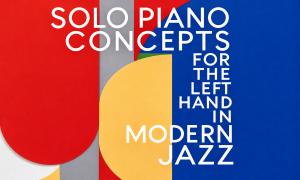
Jörg Leichtfried: Solo Concepts for the Left Hand in Modern Jazz
The devices here are truly about rhythmic orchestration, and the power of using relatively simple voicings to generate compelling rhythmic interplay, essentially endlessly.
—Glenn Zaleski
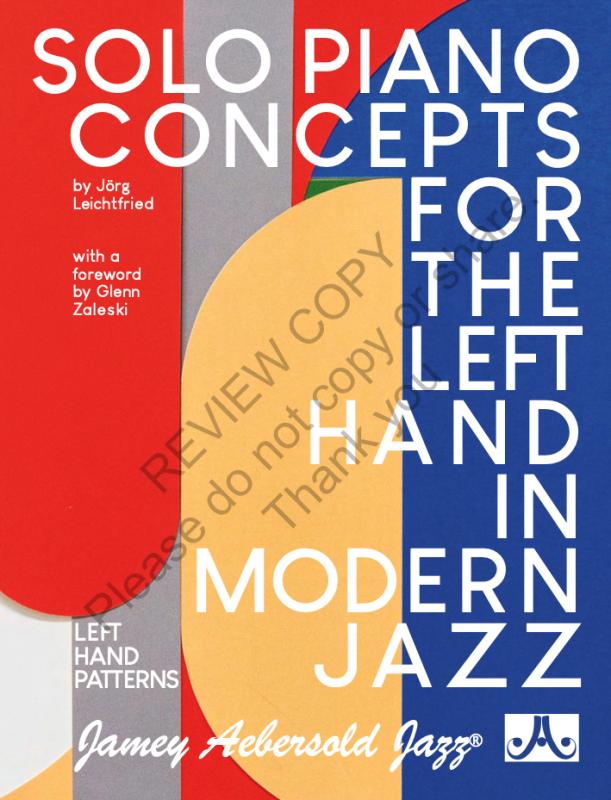 Solo Concepts for the Left Hand in Modern Jazz
Jörg Leichtfried
44 Pages
Jamey Aebersold Jazz
2026
Solo jazz piano presents a pianist with many significant challenges, making it the most technically demanding role for a jazz pianist. In a solo performance, the jazz pianist must provide the melody, rhythm, improvisation, accompaniment, and the bass activity, so much of which is handled by other players in a trio, quartet, or quintet setting.
Early solo jazz piano styles were rooted in the popular ragtime tradition, which was fairly constrained: the left hand played a bass note and a chord while the right hand played syncopated chords and melodies, but it lacked improvisation. Stride pianists used some of the foundational left-hand figures from ragtime, but they did what the Dixieland groups were doing—they embraced the improvisatory approach, and with that, stride became the first style in the now long tradition of solo jazz piano.
Stride is where most young jazz piano students start out—stride provides students with a well-known framework within which to start interpreting jazz repertoire. It is not easy, but it is easily defined: The left hand plays a bass note, usually on a strong beat, and a chord on the weak beat. The right hand plays the melody, usually with chords and flashy fingerwork, and improvises with single-note lines, octaves, and chordal figures. The stride approach produces a full, rich sound from all registers of the piano that swings and sings, and it has all of the musical elements like bass movement, harmony, melody, and improvisation well represented.
Jazz, however, quickly moved on into bebop and beyond, where stride just didn't work very well—it was rhythmically too boxed in for the new style that featured improvisation more prominently. As jazz moved into the '50s and '60s, it relied increasingly on group interaction as well, in which any prescribed and repetitive role was certainly even less welcome.
The new styles featured elements of stride, but reimagined to fit the new approach. For example, McCoy Tyner's thunderous left hand playing open fifths in the bass, followed by aggressively syncopated quartal harmonies (harmony built on 4ths instead of 3rds), defined a new era in jazz piano—the stride roots are there, but it is not stride. Or consider Bill Evans' "broken stride," where the familiar stride pattern of a bass note followed by a chord is found, but is rhythmically dispersed across the measure, gleefully displacing beats with wild abandon, but always staying true to the form. As with Tyner, Evans reimagined stride and created a new approach to solo jazz piano.
The approaches to solo jazz piano mushroomed over the years, with more classical piano techniques appearing in the music of Keith Jarrett and Brad Mehldau, and in particular the European pianists, like Enrico Pieranunzi, Bobo Stenson, and John Taylor.
All of this presents a real pedagogical challenge—how does one learn a genre that has hydra-headed variations? There are excellent resources, like Jeremy Siskind's Playing Solo Jazz Piano: A New Approach for Creative Pianists (Self-Published, 2022) and Riccardo Scivales' Jazz Piano: The Left Hand: A Guide to Left Hand Jazz Piano Techniques from Ragtime to Contemporary Styles (Self-Published, 2020).
Austrian pianist Jörg Leichtfried joins this august cohort with his new offering, Solo Concepts for the Left Hand in Modern Jazz. Unlike most others, this book does not provide a historical survey of jazz piano styles. Leichtfried's approach is entirely focused on the challenges found in contemporary solo jazz piano, where traditional styles effortlessly merge with elements from classical, pop, Latin, and other genres. This is revealing—it is a tacit acknowledgment of the astonishing proliferation of approaches that coexist in the modern era in solo jazz piano.
As previously mentioned, the left hand in solo jazz piano carries a heavy load—it must provide accompaniment that includes harmony, rhythm, and bass movement. In a trio or quartet, separate players handle these elements, but here they fall to the five fingers of the left hand, creating a formidable technical challenge.
Regardless of the approach, the requirements are not optional—there must be bass-register notes, mid-range chords, and rhythmic propulsion that is varied enough to accompany the right-hand melodic figures in an interesting and captivating manner, without, however, drawing too much attention. This is a tall order, and Leichtfried's excellent new contribution to the left-hand piano pedagogy literature offers a robust array of solutions to these challenges that is well organized and easy to implement.
He has created dozens and dozens of short left-hand exercises that meet all the necessary requirements in myriad ways that are fun to play and infinitely variable to suit different styles and hand sizes. Some of them are standard root followed by shell voicings (3rd and 7th of the chord) from Bud Powell, while others are standard root followed by rootless chords à la Bill Evans.
So, there is a nod to the tradition, which makes it helpful for beginners. But where Leichtfried really excels is in the majority of exercises in which the left hand must sustain pitches while a staggered second voice enters above, below, or in the middle of the sustained chord. This presents some technical challenges—of course, these must be rhythmically accurate, but they also require subtle touch variations that imply a contrapuntal texture and voice leading.
In modern solo jazz piano (and in jazz piano in general), the left hand is no longer the same as it was in decades past. The shell voicings and stabbed chords from the 1940s quickly progressed to the rich, rootless chords of Bill Evans, Herbie Hancock, and many others in the 1950s and '60s. These players accessed their classical training and brought that into jazz, and in doing so, brought increasing levels of sophistication to the left hand's chords. This trend continued in the ensuing years, with players like McCoy Tyner, Keith Jarrett, and Chick Corea bringing "touch" to the forefront. ("Touch" in this left-hand context involves playing three-or four-note chords, with each note in the chord being played at a different volume, usually with the top note being the loudest.)
This has intensified in recent decades, with players like Brad Mehldau focusing on left-hand figures that are so technically challenging that one would swear he is using multi-tracking, but he is not. Leichtfried has given jazz pianists exercises to increase left-hand activity by turning it into a more internally nuanced, mildly contrapuntal, and more colorful accompanimental voice.
Another area in which Leichtfried excels is in providing exercises that work with different hand sizes. Players with a large hand will be able to play, for example, a 10th with the pinky and the thumb, and grab the fifth or seventh, or both, with the other fingers. Players with smaller hands can do that as well, but will require some careful pedaling to keep the 10th sounding for as long as possible; there are also many examples that do not require a 10th.
The book is in two large chapters—Chapter 1 features 4/4 time signature exercises, and Chapter 2 features 3/4 time signature exercises. For modern jazz, which is becoming increasingly enamored with odd meters, it would be nice to find some 5/4, 7/4, or mixed-meter examples as well, but the examples given could also easily be revised by the player into odd or mixed meters. In any case, this would be a welcome addition to the second edition of this fine text.
Leichtfried has provided pianists with a valuable collection of left-hand exercises that address the technical demands of contemporary solo jazz piano in a practical and well-organized manner. The exercises offer more than additional chord shapes—they encourage the pianist to develop the touch, independence, and rhythmic flexibility that make the left hand a more active and nuanced accompanimental voice. For anyone working toward a more independent and expressive left hand, this fine text deserves a place at the piano.
Solo Concepts for the Left Hand in Modern Jazz is an e-book available only at Jamey Aebersold Jazz.
 FOLLOW Kurt Ellenberger
and get notified whenever a new article published.
Kurt Ellenberger is a pianist/composer/author who enjoys listening to a wide variety of music while making his own excellent wine, and tending to his small flock of sheep.
Tags
PREVIOUS / NEXT

Become a Sustaining Member

Since 1995, All About Jazz has championed jazz as an art form and supported the musicians who create it. Over three decades, it has grown into one of the world's leading jazz resources, serving hundreds of thousands of readers, musicians, presenters and industry professionals each month.
Help Build the Future of All About Jazz
Your support helps us continue building All About Jazz for the next generation—expanding our editorial coverage, preserving jazz history, developing new community features and creating better ways to discover the music and the people behind it.
Become a sustaining member for as little as $20 per year and you'll immediately enjoy an ad-free experience along with access to subscriber features and future articles for a full year.
Together, we're not simply sustaining All About Jazz—we're building its future. Thank you for being part of the journey.