Home » Jazz Articles » The Blue Note Portal » Wolf—Future Perfect, 9. Blues Lesson
Wolf—Future Perfect, 9. Blues Lesson
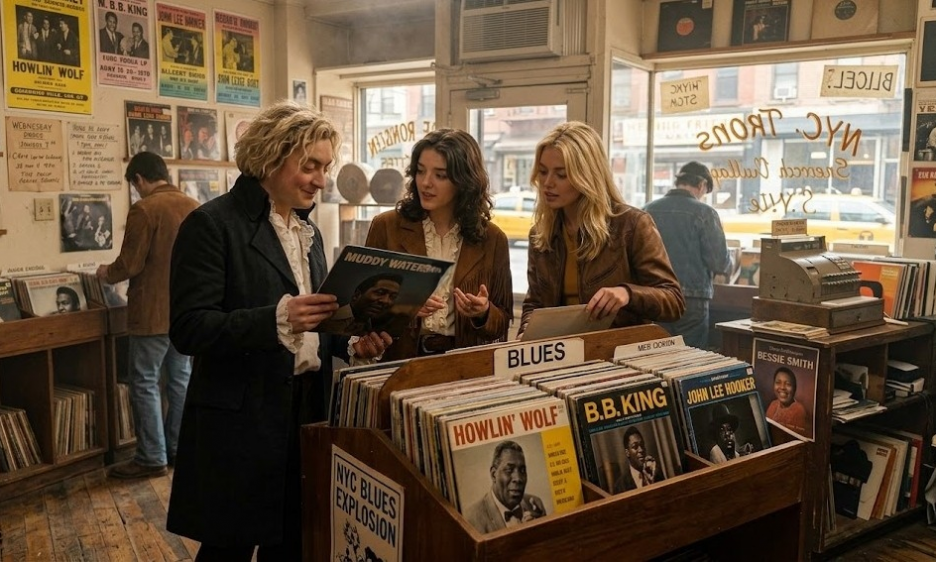
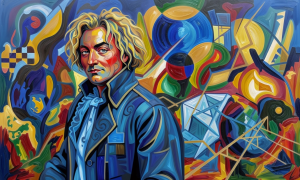
Courtesy AI
"You could step into a concert hall tomorrow and cut a classical record, and it would be phenomenal," Maya said, leaning against the wooden cabinet of the Hammond B3. "You still speak that language fluently. But the music we need to play at the Fillmore? That's a different neighborhood, and you'll need a map. The main thing is, there is no pressure—we only book the Fillmore after we are rehearsed and ready."
Wolf tilted his head, listening intently.
"We've met world-class classical virtuosos who can play any complex score placed in front of them, but the moment you ask them to play swing, funk, or blues, they're out of their comfort zone," Maya explained. "Genres are like languages, Wolf. If you don't know the slang and the local idioms, you can't really fit in. And just like a spoken language, even if you memorize the words, if you don't have the natural accent that comes from living it, people can tell."
She paused, offering him a warm smile. "That said... your blues piano playing after almost no exposure makes me think you're the exception. You just need to listen with your soul. If you do that, this is going to work."
"Listening with the soul... " Wolf murmured, a soft grin touching his lips. "Ah, Maya, that is the only way I have ever listened!"
She smiled, closed her eyes, and nodded knowingly. "Julian can provide us notation charts from our timeline for the horn section," Maya added. "That will give us a fast overview, and we can bring our brass players up to speed quickly once we hand them the arrangements. We're structuring the Fillmore set to showcase you and take the audience on a journey they aren't used to: two high-energy openers, three very laid-back grooves, the piano blues you tricked us with the other day, and a massive, high-energy blues finish."
Wolf rubbed his hands together. "Show me how this modern grammar works."
Maya unlatched a hardshell case and lifted out her Gibson Les Paul, its mahogany weight gleaming under the loft lights. Beside her, Chloe unslung her vintage Fender Telecaster, the maple neck and single-coil pickups radiating sharp, bright grit even unplugged.
"On a piano, Wolf, C-sharp is C-sharp," Maya said, plugging the Les Paul into a cranked tube amplifier. "It's a fixed point on a wooden frame. But on a guitar, we live in the microtonal spaces between your piano keys."
Maya struck a note on the G-string—an E-flat—and slowly bent the metal wire upward against the fretboard. The pitch moaned, crying out as it hovered in the crackling space between minor and major before reaching the target note.
Wolf stepped closer, his eyes glued to her fretting hand. "It... it alters its temperament mid-breath! It is neither major nor minor—it is a vocal cry!"
"That's the blue note," Chloe said, tapping her Telecaster's pickguard. "You can't write it neatly in 18th-century standard notation. You have to feel where the pitch wants to bend."
"Modern popular music relies on a few scale frameworks that weren't in your father's conservatory books," Maya continued.
Chloe stepped up, flicked the selector switch on her Telecaster to the bridge pickup, and struck a dirty, swinging A7 rhythm—a steady, biting blues groove that bounced off the loft's brick walls.
"This is our blues scale in A," Maya said.
Her fingers danced across the rosewood fretboard of her Les Paul, picking out six deliberate notes: A—C--D—D♯—E--G—A.
She landed heavy on the D-sharp—the flat fifth—holding it just long enough to let its sharp, bitter tension bite against Chloe's chord before resolving it up to the E.
Wolf's head snapped up, his eyes wide. "Ah! The tritone! I know the interval well—every dominant seventh holds one. But you treat it differently! You hold the diminished fifth as an end in itself—not as a leading tone demanding resolution, but as a color that hangs in the air! In my idiom, it is a servant of the harmony; here it is its own master!"
"Exactly," Maya smiled. "Now, if you strip out that middle note—the D-sharp—you get our workhorse: the minor pentatonic scale."
She ran her pick down the five-note shape: A—C--D—E--G. "Five notes. No half-step dissonances between the second and third or sixth and seventh. It's the foundation of almost every guitar solo, rock riff, and vocal melody written in the last fifty years."
Wolf stared at the keys of the upright piano for a split second. His mind—trained by a lifetime of rigorous counterpoint, transposition, and instant analysis—mapped the interval patterns instantly.
"Five notes... " he whispered.
Without breaking Chloe's steady Telecaster groove, Wolf sat at the piano bench and brought his right hand down on the keys. He didn't hesitate. He struck a sharp, syncopated C-natural against Chloe's A7 chord, crushed it into a grace-note slide up to C-sharp, and launched into a rolling, barrelhouse blues run that cascaded down the pentatonic scale.
He hit the flat-fifth D-sharp, leaned into it with an impish grin, and resolved it into a sparkling triplet before landing back on a low, booming A.
Kyle stopped clicking his drumsticks on the riser and burst out laughing. "Man, you didn't just learn the boundaries, you're already redecorating the house!"
Wolf looked up from the keys, his face alight with pure joy. "It is magnificent! It frees the hand from formal grammar! You are not building a cathedral... you are painting a portrait with fire!"
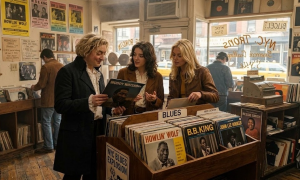
Maya walked over to the turntable, lifted an LP from its sleeve, and carefully set the tonearm down on the vinyl. The smooth, slow-burning 6/8 intro of "Drown in My Own Tears" began to filter through the studio monitors.
Maya turned back to the piano, smiling at Wolf. "Let's see how long it takes us to figure this one out."
Wolf grinned back, accepting the challenge instantly. His fingers hovered over the keys, his body swaying slightly as the slow, soulful gospel-blues chords washed over him.
When the track finished, Wolf reached for the piano. He struck a sequence of slow, heavy voicings. They were close—strikingly close—but a couple of the inner gospel voice-leadings didn't quite match the record's subtle color.
Wolf shook his head, his brow furrowed in intense concentration. "Start it again."
Maya cued the record back to the beginning.
After a few bars, Wolf held up his hand. "Now stop."
He played the opening sequence again. This time, he corrected the extensions, sliding into the suspended chords with effortless grace.
On the drum riser, Kyle and Zack exchanged a quick, wide-eyed look of absolute amazement.
"Start again," Wolf instructed, his eyes fixed on the piano keys. He listened intently for less than a minute before raising his hand again. "Stop."
He adjusted a single left-hand bass movement, mapping the bass line against the upper extensions.
"Start again," Wolf demanded, a spark of pure excitement lighting up his face. "Louder!"
Maya cranked the monitor volume. As the needle dropped, Wolf brought his hands down in perfect sync with the record. He played along near-flawlessly, weaving rich, gospel-drenched voicings and subtle blues grace-notes around the recorded melody, a wicked, triumphant grin spreading across his face.
Disclaimer
This is a fictional account exploring what might have happened if a temporal quantum event had occurred. While real musicians and historical figures appear within these pages, they exist here in an alternate timeline—a reality that quantum theory suggests was possible, but that never came to pass. All interactions, conversations, and events involving these individuals are entirely fictional, products of a world that exists only in the space between what was and what might have been.About the Series
Future Perfect follows a time-traveling band from the year 2092—winners of a planet-wide musical talent search—who journey back to the golden decade of 1964 to 1974. Over a billion subscribers plug into the Chronos-Consciousness Engine (CCE) to experience the band's exploits first-hand in a vivid, waking-dream state. Originally designed as a hyper-realistic historical simulation, the sheer volume of connected minds has triggered a quantum event that is drawing actual consciousness into this alternate reality. Ideally, new readers should start at the beginning of the series.
 FOLLOW Blue Note Portal
and get notified whenever a new article published.
The Blue Note Portal: a garage-assembled '70s microcomputer relic, eternally portaling through jazz timelines with Serling-esque irony, hacking bebop anomalies into binary swing for the ultimate improvised reboot.
About Wolfgang Amadeus Mozart

Tags
PREVIOUS / NEXT
Become a Sustaining Member

Since 1995, All About Jazz has championed jazz as an art form and supported the musicians who create it. Over three decades, it has grown into one of the world's leading jazz resources, serving hundreds of thousands of readers, musicians, presenters and industry professionals each month.
Help Build the Future of All About Jazz
Your support helps us continue building All About Jazz for the next generation—expanding our editorial coverage, preserving jazz history, developing new community features and creating better ways to discover the music and the people behind it.
Become a sustaining member for as little as $20 per year and you'll immediately enjoy an ad-free experience along with access to subscriber features and future articles for a full year.
Together, we're not simply sustaining All About Jazz—we're building its future. Thank you for being part of the journey.