Home » Jazz Articles » The Blue Note Portal » The Beatles—Future Perfect, Part 1
The Beatles—Future Perfect, Part 1
Courtesy ai
Chapters
1 | 2 | 3 | 4 | 5 | 6 | 7 | 8 | 9 | 10 | 11 | 12 | 13 | 14Year 1968
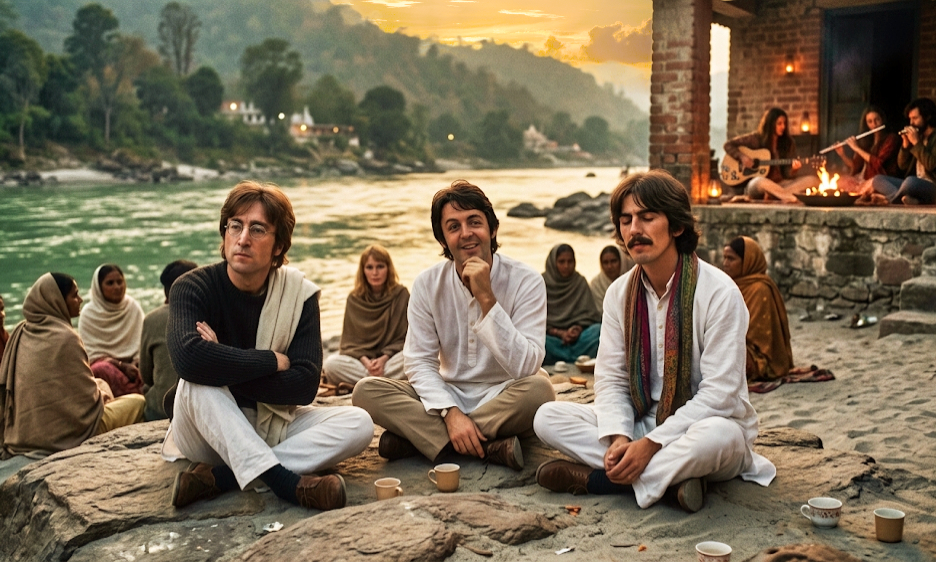
Late February, and the Ganges ran the color of unpolished jade beneath the Himalayan foothills. The cold rolled off the mountains at dusk, but the afternoons still held on to warmth, sunlight streaming through the sal trees, laying bars of light and shadow across the stone veranda of a small brick guest house on the riverbank.Four people sat there as if they belonged wherever they happened to be.
Two women, clearly sisters by the shape of their faces and the blending of their voices—one calling to the other in an accent that belonged to open cattle country, dry hills, and distant mountains. They tuned identical steel-string Martin 00-21 guitars, except one held hers left-handed, her pride and joy. Beside them, a man with flute polished bright as a coin turned slow figures in the air, warming his fingers without quite playing yet. Another, a percussionist, sat cross-legged behind a pair of wooden tabla, palms resting flat against goatskin, waiting.
Below, on the flat rocks along the river, the villagers had begun to gather again. At first it had been pure curiosity, but despite the cultural differences they were now drawn by the music. It was, after all, the universal language.
"There are more than twice as many as yesterday," Maya said.
Chloe followed her sister's eyes down to the rocks—women in shawls pulling cloth up over their mouths as they murmured to each other, watching the two guitars with the same fascination they might have given a comet.
Nobody on the veranda spoke of who might be coming besides the villagers. Nobody needed to. They had rented this house for a reason, chosen this stretch of riverbank for a reason, and if that reason walked down from the Maharishi's ashram, so much the better. But they would not go looking, that part had been decided before any of them arrived, in a place and time none of the villagers below could even imagine.
Year 2092
Julian could hardly contain his excitement."As of eleven minutes ago, nearly four hundred and twenty million people are subscribed and beginning the protocol. We lost count of the orbital colonies an hour back."
Xample smiled with satisfaction. "That's our civilization's version of the world deciding to watch television at the same time."
For a moment he said nothing more. Below them, on smaller side monitors, replayed footage ran on a loop—the two sisters, three months earlier, appearing on the Architect Experience Selection broadcasts that the public had taken to calling the Audition. Millions had watched two hundred of Earth's finest young musicians compete across nine categories for four slots on this CCE Experience. They had watched Maya and Chloe Benning's audition—a duet so unshowy, so entirely without spectacle, that the judges had sat in silence for eleven full seconds before anyone spoke—and had, in the way of any properly engineered phenomenon, fallen in love with them before anyone knew precisely what they were being asked to love.
The world knew the four winners' names now, and they were the best this world had to offer. They knew Zack's flute and guitar versatility, knew Kyle's percussion instincts and subtle inventiveness, knew the particular unhurried way Maya counted in a song, knew how seamlessly Chloe's voice blended with her sister's. What the world did not yet know—because Xample and Julian had been extremely careful about what got broadcast and what got held back—was where the four of them were about to go.
"They can't announce themselves," Xample said. It wasn't a question. It had been the entire design principle from the first sketch of the concept after the Dream Band Experience at the Hollywood Bowl. Julian had leaned back in a chair and asked, What if instead of the past performing for us, we let the past discover something extraordinary and have absolutely no idea what they are looking at?
Julian continued. "Four musicians better than anyone those people will ever meet again in their lives, and not one flicker of recognition for who they are. We bring them into contact with the giants of their age—the Beatles. Imagine how that affects someone who has been recognized, adored, and slightly suffocated by strangers since he was twenty-two years old. It'll drive them nuts."
Xample thought for a moment. "Fame is a wall as much as it's a gift. They probably haven't had an honest conversation with a stranger in six years. We're not selling the audience nostalgia this time, we're giving them the sight of the most famous men on Earth being treated, for the first time in a very long while, like ordinary human beings—and watching how the handle it."
On the wall of monitors, a countdown finally dropped under ten minutes. Xample looked at the sync pods, then back at the looping footage of the sisters playing on a stage over a century removed from where they were about to go, and felt the fear resolve, the way it always did in the end, into something closer to reverence.
Julian smiled and reached for the activation panel.
"Time dilation locked at one hour in 2092 equals twenty-four hours in the past," he said. "Let's go find out what a mountain full of enlightenment does to men who've just met someone who isn't impressed by them."
Year 1968
By the second afternoon, word had spread along a remote shore of the Ganges in a place with little news and too much quiet: it had traveled mouth to mouth, chai stall to chai stall, up the dirt path to the ashram gates themselves, carried by servants and sadhus and at least one delighted German seeker who had wandered down to bathe in the river and came back raving about young American musicians playing on the shores of the Ganges.A loose unhurried procession came down from the compound in the golden hour—George first, curious in the particular alert way of a man who took music more seriously than he let on; behind him John and Paul, both in white linen kurtas over sweaters against the chill, walking the way men walk when they've told themselves they're only stretching their legs; further back, Donovan trailing a scarf, and Mia Farrow with assorted wives and partners drawn along mostly by boredom and the promise of something new to look at that wasn't the inside of a meditation hall.
They stopped in the shadow of the sal trees at the edge of the property, close enough to hear, far enough to pretend they hadn't come specifically to listen.
On the veranda, Maya caught Chloe's eye for exactly half a second—a signal so small it would have meant nothing to anyone watching who hadn't spent a lifetime playing music with this particular woman—and shifted the set without announcement.
Chloe simply said, "Eboness," written and recorded, but unreleased at this time in 1968.
They began their own vocalized version of Yusef Lateef's hauntingly beautiful piece, their own lyrics drifting over the opening before flute and guitars began a flowing conversation. The Indians listening on the rocks sank into the blues as if they had grown up inside it, heads moving side to side. To the unaccustomed eye it might have looked like disagreement. It was, in fact, unconscious approval.
After an enthusiastic round of applause, they launched into another Lateef piece, "As It Is." Kyle's percussion shone there, grounding the air while Zack's flute carried the melody like smoke. Beneath it, the sisters' jazz voicings made the song feel both rooted and unplaceable, as though it had traveled a long way to arrive precisely here.
When the applause died down, they began their final song.
"What's Going On."
Unwritten. Unrecorded. Two years from existing anywhere except the sisters' memory and now drifting out over the cold Ganges air toward a group of famous Brits who had absolutely no context for what they were hearing and every possible reason to be undone by it anyway.
John went very still.
He didn't know the song—how could he?—and yet it didn't register as new, it seemed familiar. He would later try, unsuccessfully, to describe the feeling to George. It was like, "remembering something I had never heard."
Paul's eyes were on Maya's left hand—not her face, not even really the song, but the hand itself, picking out a voicing he was almost certain didn't exist on any guitar he'd ever held.
Neither of them said a word. Neither of the sisters looked up.
When the song ended, Maya reached for her water without ceremony, said something quiet to Chloe about the tuning on the low E, and the two of them went on tuning and murmuring exactly as if the four most famous musicians on the planet were not standing forty feet away in the failing light, waiting—visibly, almost painfully—to be noticed.
They were not noticed.
Not that afternoon.
The next day dusk came down fast and cold the way it always did in the foothills, the temperature dropping ten degrees in the time it took the sun to clear the ridgeline, and Kyle had a small stone fire pit going by the time the second wave from the ashram made their way down—George and Donovan, John and Paul, without the wives, but with Mia Farrow settling into the sand among the villagers with the loose-limbed unselfconsciousness of someone who had spent her whole life being looked at and occasionally, gratefully, wasn't.
They sat, all of them, among the local families who had by now made the guest house a kind of evening ritual—waiting, without entirely admitting to themselves that they were waiting, to be recognized.
They were given tea instead.
Chloe passed a cup toward Mia with a warmth that had nothing performative in it and everything to do with genuine pleasure at another woman's company. She asked real questions, curious ones, the kind that assumed nothing about who she was talking to beyond the conversation itself. George's guarded amusement cracked slightly at that.
Paul, for his part, sat close enough to the fire to feel useful and finally—because someone had to, because three days of proximity without acknowledgment had become its own kind of gravity—leaned toward Maya's guitar case.
"That tuning," he said. "The one you were playing this afternoon. What is it?"
Maya glanced at him the way she might glance at anyone who had asked a reasonable question. "Standard, mostly. Just voiced up high for the top three."
"Would you show me?"
She didn't hesitate, didn't perform a second of it—simply unlooped the strap over her shoulder and passed the Martin across the fire directly into his hands, right-side up from his perspective without either of them having to think about it.
She blinked once. "Oh. You're left-handed too."
Paul gave the smallest smile. "Seems I am." He hesitated, "I was told there was no left-handed model of this Martin."
Maya, sighed, "Yes, what we lefties have to go through. This is my pride and joy, it was a special factory order."
Paul knew how rare that special factory order was, but kept it to himself. He inspected her Martin and found the shape she'd shown him. He'd recently written a song, and he was particularly proud of the guitar work—a fingerpicking pattern that impressed nearly everyone who heard it. His hands climbed up the neck as he sang, "Blackbird singing at the edge of night... " He let the last note ring, then handed the guitar back with a small, satisfied smile.
Chloe too had been listening, and winked at Maya. They played the opening—Chloe's guitar weaving harmony above Maya's—and the two sisters sang the song back as if they had known it all their lives.
Year 2092
Four hundred and twenty million people watched the shock move across Paul's face in real time. The gift of the mass CCE stream was not merely sight or sound but the transmission of felt astonishment itself. For a breathless moment, much of humanity knew exactly what it was to have the future reflected back at you in harmony.The fire cracked. Somewhere down the bank a villager was singing quietly to her child. Mia Farrow had gone silent watching Paul's face. John, across the flames, was watching too, and for the first time in longer than he could remember, watching without any thought at all for how he himself was being perceived.
"How," Paul said at last, "do you two know that?"
Maya took the Martin, settled it across her knee, and looked at him with an expression that held no cruelty in it and no triumph either—only a kind of patient, terrible kindness.
"It came to us," she said, "as songs do. Through the consciousness. Why—did you hear it too?"
Paul was visibly shaken.
George, who had watched the exchange in near silence, finally stepped closer to the fire. His voice, when it came, was gentle but intent.
"Why don't you four visit the ashram tomorrow?"
Part Two
They arrived at the ashram the next afternoon as though invited to a neighbor's house for tea.No one in the four made the slightest adjustment in posture that suggested awe. No one whispered on the path. No one looked around with the strained alertness of pilgrims entering sacred ground. They were respectful because respect cost nothing and was usually deserved; they were curious because curiosity was natural; but they were not dazzled, and that difference began working on the inhabitants of the ashram the moment they appeared among them.
The path up from the river was dusty and narrow, lined with brush and stone, and the compound revealed itself not with grandeur but with a kind of improvised spiritual practicality: whitewashed cottages, shaded walkways, bells in the distance, a view over the river and trees, and the suspended hush of a place where people had come to reorder themselves.
George met them halfway up, visibly pleased that they had come.
"I'm glad you did," he said. "Really."
Maya smiled. "You said we should."
George laughed softly at that, then led them through the grounds with the careful ease of someone trying not to appear like a host while very much being one. Chloe asked how long people stayed. Kyle paused to admire a pair of drums stacked near one of the common rooms and fell into a brief, cheerful exchange with one of the Indian musicians there. Zack listened to a distant chant catching against stone and murmured something about the natural echo off the walls. Maya looked out over the hillside and said only, "It's colder up here."
What struck everyone who saw them was not insolence. Insolence would have been easy to categorize. This was something stranger: perfect courtesy with no visible deference. The Beatles were simply among the people present. So was Mia Farrow. So was Donovan. So, in due course, was the Maharishi himself.
That equality of attention unsettled everyone who had grown used to rooms bending.
George brought them to the Maharishi in a shaded open space where he was receiving visitors, a small figure in white whose serenity had an almost theatrical polish to it, though no less real for that. George was eager in a way he could not quite conceal. He wanted this to matter. Perhaps he wanted it to confirm something.
The four greeted the Maharishi politely.
Not reverently. Politely.
Maya inclined her head. Chloe smiled. Zack folded his hands briefly. Kyle did the same. They listened when he spoke. They answered when addressed. They showed every sign of good breeding and no sign at all of susceptibility.
It was not resistance. That would have been easier to read.
It was immunity.
The Maharishi seemed interested immediately.
"You are musicians," he said.
"We are," Maya replied.
"And you have come here for meditation?"
Chloe answered with an open warmth that somehow carried no submission in it whatsoever. "We came because our friends invited us. And because it's beautiful here."
George, standing nearby, glanced sideways as if worried the answer might sound insufficient. The Maharishi only smiled.
"Beauty is a good beginning."
John, farther back, seemed amused.
The conversation continued in that level way for several minutes. When the Maharishi spoke of consciousness, Maya listened with clear attention. When he spoke of sound as a pathway inward, Zack nodded with the interest of a musician rather than a convert. Kyle asked one precise question about rhythm cycles in chant and received an answer that seemed to satisfy them both. Chloe thanked him for receiving them.
No one yielded.
And because no one yielded, everyone else in the space became acutely aware of how much they themselves had been leaning.
It was George who finally said, "You should play."
A subtle shift went through the room. Cushions were moved. Someone went to fetch tea no one would drink. Others gathered in the doorway and just beyond it, drawn by that old human magnetism that requires no explanation: musicians about to begin.
The four settled naturally.
Maya and Chloe sat facing slightly inward toward one another, the Martin 00-21s resting across their laps like extensions of the body. Kyle sat cross-legged behind the tabla, though the small array around him made clear that tabla was only part of his language: a tambourine within easy reach, a small shaker tucked to one side, and on his right hand a wooden ring he occasionally used against the drumhead for bright punctuation. Zack, after a moment's thought, set his flute aside and reached instead for a guitar he had borrowed earlier from one of the ashram musicians. A harmonica sat in his pocket, unnoticed for now. He turned the tuning pegs down deliberately, string by string, feeling his way toward a low register.
Paul noticed first.
"What's he doing?" he asked quietly.
"Making room underneath," Maya said.
In practice, that nearly explained it. Zack tested two low notes, found the shape he wanted, and nodded. The room, which had expected perhaps a folk song or something politely spiritual, leaned in without meaning to.
"What's first?" Donovan asked.
Maya glanced at Chloe.
"'Smile,'" she said.
The title floated through the room with deceptive lightness. Some recognized it as the old Charlie Chaplin melody. Most did not. It didn't matter. What mattered was the way the sisters began it: not sentimentally, not as a novelty, but with such patience and melodic faith that the song seemed to reveal itself as older than authorship.
The fingerpicking was advanced enough to impress any musician and relaxed enough not to advertise itself. Maya held the harmonic floor with left-handed independence so natural it looked almost lazy. Chloe answered with high suspended tones and brushed harmonics that gave the opening the shimmer of memory. Then the voices came in.
Smile, though your heart is aching...
The effect on the room was immediate and leveling.
This was not one of those performances that ask to be admired. It bypassed admiration and went directly to recognition—not of the song itself, but of the emotional truth inside it. That was what made the great standards great: they gave the impression not that someone had invented them, but that someone had finally found them.
Even John, who distrusted earnestness on sight, felt his defenses hesitate.
Paul sat very still, his head tilted, listening less as a celebrity than as a craftsman hearing a perfect argument for simplicity. George, who had wanted the ashram to be a place where the inward and outward worlds met, seemed quietly vindicated by the choice. Around them, villagers, seekers, and spiritual tourists alike fell under the same spell.
Zack's lowered guitar part entered softly beneath the sisters, not bass exactly, but bass enough to widen the architecture. Kyle's tabla answered with the lightest pulse, and once, on the turn, the ring on his right hand tapped the skin with a bright little punctuation that made Donovan lift his head. A single tambourine accent arrived so tastefully it felt less played than implied. By the time Zack picked up the flute and took a brief, unhurried solo in the middle, the melody had become communal property.
When they finished, the silence that followed was not uncertainty. It was gratitude briefly forgetting how to make sound.
Then came the applause.
Not loud at first. Real.
The Maharishi smiled broadly. Donovan clapped with delighted disbelief. Mia Farrow pressed a hand lightly to her mouth. John gave two dry, almost reluctant claps, then several more because anything less would have been dishonest.
"Chaplin," Paul said quietly, half to himself. "Of course."
Maya glanced at Zack. "Switch."
He handed the guitar off, took up the flute, and Chloe shifted into a brighter shape on the top strings. Paul noticed the retuning immediately—the suspended interval, the open sweetness, the way the guitar suddenly suggested cradle-song rather than blues.
"What's this one?" Mia asked.
"'Golden Slumbers,'" Maya said.
The opening chord seemed to carry more meaning than the room could logically account for.
No one there knew the song. That was the point. And yet it arrived with that unnerving authority only certain melodies possess—the kind that feel less composed than inevitable, as if they had waited patiently for someone to notice them.
Chloe took the first line.
Her voice did not need force. It carried in that old true way—clear, intimate, perfectly centered, as if the note had not been produced but uncovered. Maya came in beneath and around her, supporting and answering, and the two of them turned the melody into something less like performance than recovered memory.
Golden slumbers fill your eyes...
Paul looked down, not in recognition exactly, but in the presence of some emotional familiarity he would never have admitted to understanding. It touched the part of him that believed melody should go straight to the child before the adult had a chance to interfere.
John watched him and said nothing.
George had the uncomfortable sensation that the sisters were not predicting anything so much as drawing from the same underground spring all songwriters occasionally touched and almost never explained.
Zack's flute entered after the first verse, warm and singing, not ornamental but conversational, as though the instrument had simply picked up a thought the voices had set down. Kyle touched the pulse so lightly it almost floated. By the end, the room felt suspended in that rare stillness that follows not virtuosity, but truth.
When it ended, Paul smiled in bewilderment.
"That sounds," he said carefully, "like something that ought to have been around forever."
Chloe gave him the smallest nod. "That's usually how you know it's good."
John laughed at that, but only because the alternative was to admit she was right.
Then Maya said, "One more."
There was a slight change in the air. The first two songs had established emotional authority. The third would establish command—another song from the future, this one from Phobe Snow.
Zack borrowed the guitar back and turned the strings down again by ear, building himself a low register to work against the sisters' Martins. Kyle rolled his fingers lightly across the tabla heads. No one in the room knew the title.
"'Something Real,'" Chloe said.
The opening figure instantly separated the listeners from the musicians.
The room heard a beautiful acoustic performance. The players in the room heard something harder to process: extraordinary coordination, advanced fingerstyle technique, harmonic confidence, and the kind of rhythmic control that only appears effortless when it is nearly absolute. Maya laid down the architecture. Chloe phrased against it with complete freedom. Zack's turned-down guitar supplied bass movement so deftly that for several bars the ensemble sounded twice its size.
Then Chloe opened her voice.
That was the moment admiration gave way to humility.
She did not belt. She did not display. She simply allowed the line to rise into a range so pure and so unforced that several people shifted physically where they sat, as if proximity itself had changed. Maya met her there in harmony—earthier, steadier, the perfect counterweight. Together they produced the kind of vocal blend that makes discussion afterward sound inadequate.
John said, very softly, "Bloody hell."
Halfway through, Zack put the guitar aside and took up the flute in one fluid motion. The bass vanished; the song somehow got larger. His solo came in sharp and soulful, with a rhythmic bite that kept the piece from drifting into prettiness. Kyle widened the pulse beneath him, adding the faintest tambourine shimmer only on the back side of a phrase, then a ring-click against tabla skin that sounded like a studio overdub despite being entirely live. The sisters left just enough space for the flute to arc over them and return.
By the time Maya re-entered with a run of chord voicings no one present expected to hear from a steel-string guitar, there was no longer any question that the four guests from the riverbank were extraordinary.
The question had become what everyone else was supposed to do with that fact.
When the final chord faded, the silence lasted longer than politeness required.
Then applause broke all at once. Donovan first, enthusiastically. Mia next. Several ashram residents after that. Then Paul, openly admiring now. Then even John, who looked annoyed with himself for meaning it. George applauded too, though slowly, as though he were still working through several thoughts at once.
The Maharishi smiled.
"Very beautiful," he said.
"Thank you," Maya replied.
Friendly. Respectful. Nothing more.
No visible hunger for approval. No special delight at praise from a spiritual celebrity or from the most famous songwriters in the world. Just gratitude properly expressed and the calm self-possession of people who knew exactly what they had done.
Maya glanced at Chloe, then at Zack. "One more, if they'd like."
They very much would.
Zack smiled, and this time reached into his pocket for a harmonica. That got an immediate reaction from the room, not because anyone knew what was coming, but because the gesture suggested yet another language hidden inside the same musician. Kyle stood with his tambourine.
"What's this one?" Donovan asked.
"Old one," Chloe said. "A really old one, 1913 by Dick Burnett ."
Maya added, "It's called 'Man of Constant Sorrow.'"
They kicked off with three guitars, driving a heavy, foot-stomping beat. The rhythm was carrying a swampy, front-porch grit loaded with funky, low-string guitar licks that made you want to get up and move, as Zack sounded like the rumble of a freight train.
The song landed differently from the others. Not haunting or uncanny, but old-school Southern roots: weathered, and utterly inevitable. It worked as well in the Himalayan foothills as it does in Appalachia.
Kyle sang the lead, and the other three answered his call with a response. Kyle's subtle tambourine held the beat, and on cue, Zack unleashed his harmonica.
That did it. The room, already on its feet, now understood that these four weren't just polished—they had grit and soul in them. The old song suddenly sounded as if it had been wandering the world looking for exactly this arrangement.
John leaned back and grinned despite himself. Paul watched Zack closely, admiring the restraint. George looked astonished in a new way now—not by mystery, but by range. Even the Maharishi seemed to recognize that something old and migratory had entered the space, something beyond style or fashion.
By the final refrain even the villagers felt it. One of the older men near the doorway nodded in rhythm as though recognizing, across all cultural distance, the universal attraction.
When the last note faded, no one hesitated this time.
The applause came full and warm.
Mia was smiling openly now. Donovan looked delighted, as if he had just discovered a country he wanted to visit forever. John clapped hard once, then again. Paul shook his head in admiration.
George's expression was more stunned. These four still refused to bend toward importance as everyone else understood it.
They were an actual mystery, even the Maharishi, for all his serenity, seemed quietly unsure what to make of them. They gave, ask for nothing, and seemed beyond the petty trapping of ego and fame. Happy to sing, play, and share—without withdrawing from the world.
Talent without visible need, without anxiety, without social reaching—that was rare.
And here, in a hillside ashram above the Ganges, before villagers, seekers, celebrities, aspirants, and a meditation teacher whose gravity usually reordered the room, four unknown musicians had just demonstrated not only that they were brilliant, but that they required nothing obvious from anyone present.
For men who had spent years being wanted by everyone, that felt less like a concert than a rearrangement of reality.
Disclaimer: This is a fictional account exploring what might have happened if a temporal quantum event had occurred. While real musicians and historical figures appear within these pages, they exist here in an alternate timeline—a reality that quantum theory suggests was possible, but that never came to pass. All interactions, conversations, and events involving these individuals are entirely fictional, products of a world that exists only in the space between what was and what might have been.
To Be Continued...
 FOLLOW Blue Note Portal
and get notified whenever a new article published.
FOLLOW Blue Note Portal
and get notified whenever a new article published.
The Blue Note Portal: a garage-assembled '70s microcomputer relic, eternally portaling through jazz timelines with Serling-esque irony, hacking bebop anomalies into binary swing for the ultimate improvised reboot.
About The Beatles

Tags
PREVIOUS / NEXT

Become a Sustaining Member

Since 1995, All About Jazz has championed jazz as an art form and supported the musicians who create it. Over three decades, it has grown into one of the world's leading jazz resources, serving hundreds of thousands of readers, musicians, presenters and industry professionals each month.
Help Build the Future of All About Jazz
Your support helps us continue building All About Jazz for the next generation—expanding our editorial coverage, preserving jazz history, developing new community features and creating better ways to discover the music and the people behind it.
Become a sustaining member for as little as $20 per year and you'll immediately enjoy an ad-free experience along with access to subscriber features and future articles for a full year.
Together, we're not simply sustaining All About Jazz—we're building its future. Thank you for being part of the journey.