Home » Jazz Articles » The Blue Note Portal » Disconfusion
Disconfusion
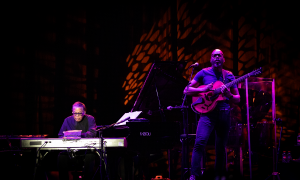
'Now, I don’t like to exaggerate—at least not before midnight—but when the history of American music gets written, the Hammond B-3 has one king, and he’s sitting right here.' The spotlight widened to catch Jimmy seated at the organ, one hand resting lightly on the wood. Quincy stepped to him, laid a hand on his shoulder, and the crowd roared harder.
Damn, it's come to this, Jimmy thought, staring out at the dark oak trees sliding past the windows. Playing at some stupid ass private party in the canyon for some rich fool. Then his thoughts wandered, as they often had lately, to the BMW in the showroom he'd been coveting for weeks, and he smiled despite himself.
Up front, the driver cleared his throat.
"Sir, I was instructed to play this rehearsal tape for you on the ride up."
Jimmy waved a hand in irritation. The driver slid the cassette into the deck and pressed play.
Seconds later, Jimmy was gripping the back of the front seat hard enough to leave marks.
"Turn that crap off."
The driver reached for the dial.
"Hold off," Jimmy said.
At first it sounded like the same four-on-the-floor thump leaking out of every club in America, the beat that had reduced too many drummers to human metronomes. But this one was different. The drummer wasn't pounding; he was laying back behind the beat with absurd confidence, letting the kick drum land like a heavy heartbeat and the hi-hat speak in a dry whisper. The groove didn't push. It leaned.
Then the bass came in.
Jimmy leaned forward, thinking to himself.
What the—a fretless electric bass? It was fast and smooth, and at times dreamy, running sixteenth-note lines beneath the drums like water finding a slope, never cluttered, never still. Over the top of it came guitar—bright, impossible, articulated in little sheets of glass and chrome. Not blues-rock. Not jazz comping.
Something totally new.
And in the center of it all was a hole.
A big, warm, glorious opening—Jimmy could hear exactly what belonged there. Before the first verse was over, his right hand was moving on the leather seat beside him—comping, stabbing, sketching chords thirty years deep. He could hear the overdriven pedal tone under the bass drum, hear the Leslie cabinet turning like weather behind the guitar, hear the greasy little testimony runs he'd drop into those open spaces.
"Turn it up," he muttered.
In 2092, Xample Global achieved the impossible, and the world lost its mind over it.
Their technology had advanced to the point where the distinction between illusion and time travel no longer meant anything. Powered by the Chronos-Consciousness Engine, the EXPERIENCE dropped human consciousness directly into a flawless, living reconstruction of the decade spanning 1964 to 1974. By muting physical sensory input, the system triggered an ultra-realistic experience—a waking dream, but with total mental clarity. Real-world sessions lasted only a few hours; yet the participant experienced a week or more, courtesy of neural time dilation.
The proof-of-concept—in which founder Xample himself stepped into a 1971 Fillmore East concert and orchestrated Miles Davis sitting in with the Allman Brothers Band—became the single most discussed cultural event on Earth. Almost overnight, the waiting list for the Architect Tier stretched past eight months, despite an entrance fee that made even billionaires blink.
Julian Cross watched all of it with excitement and a tinge of resentment. He felt that, at a minimum, he should have been in the Experience audience at the Fillmore. He and Xample went back years. Close friends—and in Xample's case, that was a category containing perhaps five living people. Julian ran several successful businesses, and ran them well; no one who had ever sat across a negotiating table from him mistook him for a hobbyist. But the businesses were what he did. Music was his passion. His collection of twentieth-century recordings and paraphernalia bordered on museum-grade. He was, in the oldest and proudest sense of the word, a geek.
And although he had wanted to be at the Fillmore, what he truly wanted was something else: to create magic that had never happened. He wanted to build a band that had never existed—around players the world hadn't heard of yet—and aim it like an arrow at the future of dance music. Disco as an art form.
When he let Xample know exactly how upset he was about being excluded, he held nothing back. Xample listened and nodded. "I get it. I would have felt the same way. But think about it—this was a proof-of-concept for a skeptical board, and I was overconfident. I didn't even grease the skids. If my concert had gone south, I didn't want anyone outside the company to witness it."
Julian nodded. "Makes sense. And thankfully you've rethought things—we both know money moves the world, and it wasn't any different in the twentieth century."
Xample then did something he almost never did: he moved a friend to the front of the line. He had one condition. He wanted to be inside the first commercial Dream Band Experience—from within. Quality control, he called it, with a wink.
Julian agreed, on one condition of his own.
"You're coming as my assistant. You carry the bags. You make the calls. You drive the car."
The founder of the Experience considered this for perhaps a second.
"Deal," he said with a laugh. "But I'll need to prep for the driving. Imagine, they used paper maps—but I love a challenge."
Getting the band together had been the easy part—they weren't stars. Three phone calls, one plane ticket, a few cash advances, and a hook no hungry musician in 1973 was built to resist: top-dollar California studio work for a mysterious producer with impeccable taste and no visible budget ceiling.
Jaco Pastorius, twenty-one, came in from Florida with his custom fretless and wearing the wide grin of a man who seemed delighted by the possibility that the world might not survive him. He talked fast, tuned constantly, and radiated enough confidence for three ordinary musicians.
Jeff Porcaro, eighteen, required less travel. Junior X—the prank name Julian had given Xample for 1973—drove out into the San Fernando Valley, into the dense and quietly mythic ecosystem of garages, rehearsal rooms, and family houses that fed the Los Angeles studio machine. Jeff was already becoming a name in musician circles—not a star, not publicly, but the kind of young drummer older players mentioned with a tone that mixed admiration and irritation fueled by envy. Too good too soon. He had his father's discipline, his own pocket, and the eerie calm of a kid who sat down at a kit and instantly sounded expensive.
When Junior X handed him the envelope, Jeff looked first at the cash, then at the address, then back at the well-dressed stranger.
"What exactly is this?" he asked.
"A session," Junior X said. "One that may not happen again."
Jeff smiled the small, skeptical smile of a teenager trying not to look excited in front of an adult. "I'm in."
Eddie Van Halen, eighteen, lived twenty minutes from that same Valley world but might as well have been from another planet. Junior X caught the end of a Mammoth rehearsal in somebody's garage in Pasadena, then handed Eddie an envelope with the advance and directions to Topanga Canyon. Eddie looked at the money, then at the stranger, then at the address, almost certain this was either a scam or the beginning of the best week of his life.
The destination for all of them was a spacious wood-beamed cabin tucked deep into the oak groves of Topanga Canyon. It had been leased for the month from a touring group—completely isolated, high ceilings, thick walls that let them play as loud as they wanted without a single neighbor arriving to object.
Once the three young musicians were settled, Julian had Junior X drive them down to a dimly lit Italian place in Santa Monica for dinner.
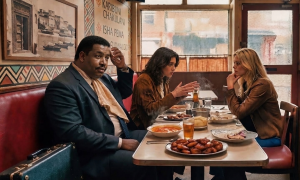
They sat around a red-checked tablecloth under low amber lights, surrounded by baskets of garlic bread and half-empty plates of pasta. Julian leaned forward, forearms on the table, and studied the three of them.
Jaco was vibrating in place. Eddie was trying to play it cool and failing. Jeff, by contrast, looked almost too composed, though his eyes gave him away; he was listening to every word with the concentration of a player who suspected the room might contain information useful to his future.
"Listen up," Julian said, keeping his voice low. "We're going to take everything irresistible about pop and dance music—the physical part, the undeniable part, the thing that makes people move before they've decided to—and marry it to musicianship strong enough to make serious players stop in their tracks."
He let that settle.
"I picked each of you because you're special. Not just good. Special. What we're building needs a rhythm section with nerve and pocket, a guitarist from the future, background vocal hooks, melodies that bore into people's brains, and enough sophistication under the hood that musicians will spend time trying to figure out how it works."
Jaco grinned at that. Eddie looked down and smiled. Jeff just nodded once, quietly.
"And you three don't know it yet," Julian said, "but if we're lucky, we're adding Jimmy Smith on Hammond B-3."
That landed.
Jaco's eyes widened. Eddie actually laughed once in disbelief. Jeff, who had been almost unnervingly self-possessed all evening, sat back and said, "Come on."
Julian smiled.
"I said if we're lucky."
The next night, the Lincoln Continental crunched up the gravel driveway to the Topanga cabin and rolled to a stop.
Jimmy Smith climbed out slowly, taking in the property with open suspicion. Julian waited at the door, pushed it open, and let him step inside.
The main room was a cathedral of wood and air. Gear sat in small islands beneath the high beams: amps, cables, cases, drums, guitar stands, a bass leaning against an old chair. In the center of the room stood the three young musicians.
They saw Jimmy Smith come through the door and froze.
Jaco straightened instinctively. Eddie took a half-step backward and bumped his amp, the speaker giving off a dull thump in the quiet. Jeff, who had spent his life around older professionals and understood the rituals better than the others, did not move at all—but his face changed in the tiny way faces change when a legend stops being an idea and becomes a physical person in the room.
Jimmy ignored all three of them. His eyes swept across the floor, past the amps, past the terrified kids masquerading as a band, and locked onto the far corner.
There sat a Hammond B-3, paired with a Leslie 122 cabinet, waiting in the low evening light like a promise somebody had finally kept.
Jimmy walked toward it without hurry, his footsteps echoing in the room. He reached the organ, ran a hand across the warm wood of the cheekblocks, and then turned back to face the band.
He looked at Jaco, Eddie, and Jeff. "That's you three on the tape I heard?"
They nodded.
Then he looked at Julian. "There's a hole in your band."
Jaco elbowed Eddie. Jeff smiled despite himself.
"Not a hole," Julian replied. "There's an opening."
Jimmy sat on the bench. He flipped the power switches, and the tonewheel generator began to hum—a low, patient growl filling the room.
Then he looked at the drummer.
Jeff Porcaro stood behind the kit, all of eighteen, trying to appear steady under the gaze of the man who had just identified the missing center of the band in a single sentence.
Jimmy tilted his head. "You the one on the tape?"
Jeff nodded. "Yes, sir."
Jimmy pointed at him. "You lay back like that again. Don't rush, and don't get cute."
Jeff answered the only way a real drummer could. "Yes, sir."
Jimmy rested both hands lightly on the manuals. "Somebody count it off," he said.
Jeff clicked the sticks together.
One, two, three, four—
And just like that, the pocket arrived.
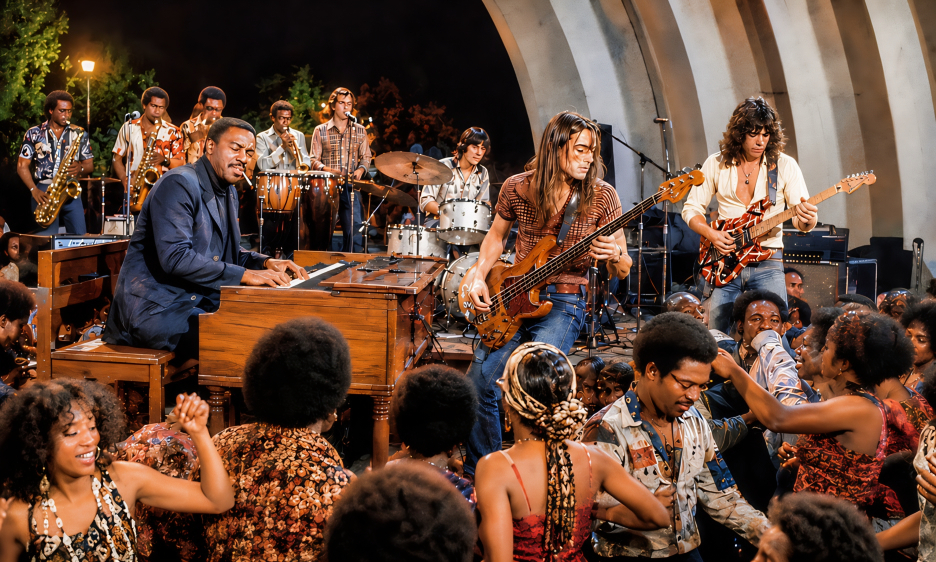
It came in on Jeff's kick drum first: deep, dry, and absurdly self-assured. Not heavy-handed. Certain. His hi-hat breathed in tight little exhalations, and the snare landed just behind the center of the beat in a way that made the whole groove recline without losing any forward motion. Jaco slipped underneath him a fraction later, his fretless bass singing and snapping at once, drawing lines around the beat without ever losing it. Eddie splashed bright syncopated chords across the top, then broke them into chiming arpeggios that sounded too intricate to be dance music and too danceable to be fusion.
Jimmy waited exactly long enough to make them feel his absence.
Then the Hammond came in.
Not as decoration. As completion.
The B-3 sat down in the middle of the groove like it had always lived there. A low pedal note bloomed beneath Jeff's kick drum. A clipped right-hand chord answered Eddie's guitar. Another stabbed between Jaco's phrases. Suddenly the empty center of the arrangement was no longer empty; it was occupied by heat, authority, and swing. The music grew larger without getting busier, which was one of the oldest magic tricks in American rhythm music and one very few people knew how to perform.
Jeff heard it happen in real time and adjusted immediately. He shortened the hi-hat bark, fattened the backbeat, and gave Jimmy's left-hand pulse more room to speak. Jaco responded by making his lines more percussive. Eddie, eyes wide now, cut his part in half and got twice as interesting.
Julian stood near the doorway with Junior X and felt the absurd machinery of two centuries align for a moment with nearly painful precision.
This, he thought. This is the sound before the name.
They played for twenty minutes without speaking.
When they finally stopped, the room seemed to keep moving anyway.
Jimmy looked at Jeff first. "That's your pocket?" he asked.
Jeff, still holding the sticks loosely over the snare, said, "I guess so."
Jimmy snorted. "Don't guess. Either it is or it ain't."
Jeff nodded once. "Yes, sir. It is."
Jimmy turned toward Julian and smiled—just barely, but enough.
"Now," he said, "let's see what kind of trouble this band can cause."
After a day, everyone in the room could hear it, Jimmy Smith filled the hole: Eddie's guitar and Jimmy's Hammond weaving through Jaco's lines, Jeff holding the center with that deep, reclining pocket Julian had heard and chased back over a century to find again. It was funky and angular, alive in all the right places, but it was not yet the full thing. Not yet the layered hybrid Julian had in mind.
It was time to reveal the larger plan.
He called everyone into the front room after dinner. He had been quiet at the table that night in a way the band was already learning to recognize as him building toward something.
"I want to tell you where this record is going," he said. "You can't be running toward a finish line you don't see."
He looked around the room—Jimmy in the good chair by the window, Jaco cross-legged on the floor with the fretless across his knees like it had never left his hands, Eddie perched on an amp case, Jeff still turning a pair of sticks he wasn't using.
"There was a time in this country," Julian said, "when the best musicians in the world made music people danced to. Not simplified music. Not watered-down music. Sophisticated music. Real arrangements, real harmonic ideas, real players—and the public came with them, because the rhythm invited them in."
Nobody said anything. Julian had the room now.
"By the time we get to now, that split apart. Jazz got smarter and smaller. Dance music got more physical and, too often, less ambitious. The body went one way, the head went another. That's bad for jazz, and it's bad for popular music."
Jimmy's expression shifted, just slightly. Not agreement exactly. Attention.
"If you take the dance beat away," Julian went on, "jazz limits its own audience. Great for aficionados. Great for the already converted. But if the people making the most sophisticated music stop competing for the public, then popular music gets left to whoever still cares about the floor."
Jeff nodded knowingly. Jaco was listening hard now. Eddie looked like he was trying to see the whole shape of it at once.
"What I want," Julian said, "is to put those things back together. In the forties, America had orchestral jazz people could dance to. What I want now is the seventies version of that—electric, modern, dangerous, rhythm-first, but sophisticated all the way down."
He let that settle before continuing.
"This has to be more than a great groove and inspired playing. It has to have hooks people can't get out of their heads, horn lines that stop a radio programmer cold, vocal hooks light enough not to weigh the music down and strong enough to stick. Not a lot. Just enough to turn this from a killer groove into something bigger. And I have a couple of people in mind who can help."
"Who?" Jimmy said.
"Maurice White and Charles Stepney."
They looked at one another, none of them showing much recognition. Jeff frowned slightly.
"Wasn't Maurice White Ramsey Lewis's drummer?"
Julian nodded. "Yeah, he was. But he's got a band now out here in L.A.—Earth, Wind & Fire. They've got an album out. They're not all the way there yet, but that's not the point. White has instincts for arrangement and feel, and Stepney's the kind of mind who can hear where the extra architecture ought to go. I don't need them to reinvent this. I need horn shape. A few vocal ideas. A little outside structure."
Julian spread his hands. "My problem is, I don't know him. Or anyone who does."
Jimmy gave him a look.
"No problem. There's about four people in this business who don't know who Jimmy Smith is, and none of 'em are named Maurice White. Ramsey and I go way back. I'll hook you up."
Jimmy made several calls from the cabin's kitchen phone that evening, leaning against the wall with the cord stretched taut, a cigarette burning down in the ashtray beside him. The others listened to his half of the conversations from the next room.
"Thanks. I owe you. Yeah, give me the number. Sure. If I don't reach him, I'll call you again tomorrow."
Jimmy dialed the number.
"Hello. Maurice? This is Jimmy Smith. Ramsey gave me your number."
A pause. Then a short laugh.
"Yeah, it's really me."
Another pause, longer this time. Jimmy laughed too.
"No, I'm not selling anything. But I'm sitting in a house in Topanga Canyon with three young cats, and we're doing something that ain't been done before. Trouble is, we need a little arrangement help—horns, maybe some vocal shape—and Ramsey said you were the man to call. You up for that? And this ain't no freebie. You'll walk away smiling."
Just before midnight, as promised, Maurice rang the doorbell.
"Stepney couldn't make it," he said when Julian let him in, "but he's all in."
After the pleasantries, Julian played back the three strongest pieces they had on tape. Maurice sat on a beanbag between the high-end speakers, listening with his eyes closed. Julian watched his face carefully. He didn't need a speech from the man. He only needed to know whether the thing they were building made sense to another set of first-rate ears.
It did.
When the last track ended, Julian spoke.
"Players and serious fans will love this," he said. "But will clubs play it? Will radio touch it? Not yet. That's why we asked you here. The core of the record is already in this room. What we need now is shape—horn lines that can cut through a room in ten seconds, and vocal hooks people can carry home without realizing they've memorized them."
Maurice nodded slowly.
Julian moved to the stereo again. The disco he knew was coming wasn't yet a thing, but there were plenty of hints of where it was going.
"I want to play you a couple of songs," he said. "Not because I want to copy them. Because they hint at the lane I'm aiming for. You have to imagine what we're doing sounding more like this—but with a funkier dance pulse underneath it, and enough sophistication that serious listeners still close their eyes."
He looked around the room.
"Everybody sit down. Get comfortable. Listen."
Julian motioned to Junior X, who pressed play.
Isaac Hayes's "Theme from Shaft" boomed through the cabin hi-fi. Jeff smiled immediately. Jaco started moving to it without even noticing he was doing it. Eddie tilted his head, listening hard. The groove had glide in it, elegance, urban confidence, and that sense of motion Julian was after. At the two-minute mark it faded and gave way to Curtis Mayfield's "Move On Up."
This time Julian watched Maurice's face.
There it was.
The light going on.
When the second track ended, Maurice grinned.
"You boys are onto something here," he said. "I love it. What you've got already is the hard part. The room is right. The players are right. What Stepney and I can do is help sharpen the silhouette."
Jimmy looked over at him. "Meaning?"
Maurice smiled. "Meaning horns where the songs need lift, and vocal phrases where the tracks need memory."
"That all?" Jaco said.
Maurice laughed. "If it's done right, that's plenty."
Jimmy leaned back in his chair. "I've called that fusion stuff 'confusion'—now here I am, fronting a confusion band."
Maurice pointed at him.
"No," he said. "Not confusion. Disconfusion."
For a second the room went still.
Then everybody looked at everybody else with the same expression.
Julian laughed first, enjoying the irony that Maurice had inadvertently handed them a name with disco in it—a name that worked on several other layers besides.
"We've been trying for two days to come up with what to call this," he said. "And you nailed it in one shot."
Maurice spread his hands modestly. "Happy to be useful."
Julian nodded toward the front door.
"Come on," he said. "Let's go have a look at the night sky. You and I can talk business."
As the two of them stepped outside into the canyon air, the room behind them remained alive in that charged, sleepless way it had begun to inhabit every night. The tape reels still sat warm. Jeff still had the sticks in his hand. Jaco had already picked the bass back up. Eddie was looking at the speakers as though he could still hear the route from Curtis and Isaac into whatever this thing was becoming.
Inside, the music was no longer looking for permission.
It was looking for form.
In Los Angeles, money did not open every door, but it generally opened the outer one. Sometimes it took a famous man's voice to open the next.
Julian learned that within forty-eight hours.
The assistant to the mayor kept him waiting in an office with framed photographs of ribbon cuttings, freeway dedications, and men in dark suits shaking hands beneath flags. Through the high windows, downtown Los Angeles sat under a layer of pale afternoon smog, broad and complacent. Junior X stood by the wall saying nothing. Julian sat with one ankle over his knee and a legal pad on his lap, looking like a man prepared to wait all week if necessary.
The assistant came in smiling the smile of someone whose job required him to make delay look like process.
"Mr. Cross," he said, taking his seat. "I understand you're interested in presenting an event at the Hollywood Bowl."
"I am," Julian said.
"A very ambitious event, from what I hear."
"That depends on your definition."
The assistant folded his hands. "The Bowl calendar is not simple. There are county considerations, Philharmonic considerations, promoter relationships, public-safety questions. Broadcast raises another layer altogether."
Julian nodded as though hearing this for the first time. "Of course."
The man glanced at the paper in front of him. "And there is naturally some concern," he said, "when a gentleman appears rather suddenly with the resources to underwrite a large public event and no obvious institutional history in the city."
Julian smiled. "You're wondering whether I'm a crank, a criminal, or both."
The assistant allowed himself the diplomatic version of a laugh. "The city likes to know with whom it is doing business."
The desk phone rang.
The assistant picked it up with mild irritation, listened for three seconds, and then sat up straighter.
"Yes," he said. "Yes, of course. Put him through."
His expression changed almost imperceptibly as he listened.
"Mr. Jones," he said. "Good afternoon."
Julian looked out the window and let the silence lengthen.
"Yes, he is here."
A pause.
"Well, if you feel that strongly—"
Another pause.
"I understand."
A longer pause, and now the assistant's posture had become almost respectful.
"No, that is very helpful. Thank you."
He hung up gently.
The room stayed quiet for a moment.
"That was Quincy Jones ," the assistant said unnecessarily.
"So it was."
The assistant adjusted the papers before him, though there was no longer any need to read them.
"Mr. Jones spoke very highly of your project."
"I'm glad to hear that."
"He also suggested," the assistant continued, "that the city would be wise not to mistake novelty for frivolity."
Julian inclined his head. "A perceptive man."
The assistant smiled again, this time with less bureaucracy in it. "Well. There may be ways to help move certain conversations along."
Julian slid an envelope across the desk. Not ostentatiously. Not furtively. Simply with the air of a man funding civic optimism.
"For the mayor's reelection committee," he said.
The assistant looked at the envelope, then at Julian, then set his hand lightly on top of it.
"You understand," he said, "that official decisions are made through proper channels."
"Of course," Julian said. "I would be disappointed in Los Angeles if they weren't."
By the end of the afternoon the proper channels had begun to move. By the next day they had accelerated. By the day after that they encountered their next obstacle, and another generous contribution found its way into another proper channel, after which the Hollywood Bowl booking—impossible on Monday—became difficult on Tuesday, feasible on Wednesday, and by Thursday an accomplished fact.
KCET took less persuading than the city.
Public television in 1974 was an ecosystem of idealism, undercapitalization, and acute susceptibility to anyone willing to pay for cameras, remote trucks, union labor, and the privilege of putting something culturally improving on the air. Public radio was even easier once Julian agreed to underwrite the separate audio feed and tape costs. The objections were procedural at first, then aesthetic, then technical, and finally financial. Financial objections he could solve in one sentence.
"So you are telling me," said the KCET producer, a bearded man in tinted glasses named Hal Brenner, "that you want to finance a live multi-camera concert from the Hollywood Bowl, carry the mobile units, cover the microwave relay, absorb rehearsal costs—and ask us for what, exactly?"
"A simulcast," Julian said. "Television and radio. Properly mixed. Properly lit. Properly introduced. No commercials."
Hal took off his glasses. "And you're not asking for editorial control?"
"I'm asking that you broadcast the event we are paying to mount."
Hal stared at him for another second, then put the glasses back on. "Who's in the band?"
Julian gave him the short list.
Hal stopped writing after Jimmy Smith. "Whoa," he said softly.
"Will that be a yes?"
Hal leaned back in his chair, smiling. "That will be a yes," he said. "Assuming Local 47, IATSE, and God Himself do not intervene. Either I'm dreaming, or this is going to be the best pledge-drive premium we never had."
By then Topanga had become less a rehearsal house than a frontier customs station through which the future kept arriving in pieces.
Charles Stepney came first, carrying manuscript paper, a quiet face, and the kind of hearing that seemed to operate one structural layer below ordinary musicianship. Maurice had already been in and out, shaping with instinct and appetite what Stepney then refined with uncanny economy. Three notes moved in the horns and a chorus lifted. A background phrase shifted from decorative to inevitable. A percussion pattern that had felt busy on Tuesday felt airborne by Thursday.
Earth, Wind & Fire came in not as conquerors but as accelerants.
Their horns gave the tracks contour and proclamation. Additional percussion widened Jeff's pocket without crowding it. The vocal hooks were exactly what Maurice had promised: light enough not to weigh the music down, strong enough to follow people home. Not full verses, not formal soul-song top lines, but brief communal flashes—calls, answers, little bursts of remembered joy. The songs remained Julian's impossible hybrid—Jimmy's authority at the center, Jaco and Jeff doing chemistry beneath the visible layer, Eddie cutting prisms overhead. But now the music had public handles.
Maurice stood in the yard one late afternoon after rehearsal, listening through the cabin wall to a playback that leaked out through the wood and into the canyon air.
"You hear that?" he said.
Julian stood beside him. "I do."
Maurice smiled without taking his eyes off the trees. "That's people's music now."
Julian looked at him. "It was always people's music."
Maurice shrugged. "Maybe. But now people are going to know it."
The clothing expedition happened because Hal from KCET, after one visit to rehearsal, said what everyone else had been tactful enough not to say.
"They sound unbelievable," he said, looking from one musician to another. "But television is a cruel medium. Right now they dress like the most gifted truants in southern California."
Julian took the hint.
Two days later Junior X drove them to a boutique strip off Sunset where young salesmen with sideburns sharp enough to cut paper descended on the band as if they had been waiting all year for exactly this assignment.
Jaco attacked the racks with evangelical conviction.
"No, no, no," he said, pulling out something patterned and dangerous. "That's what I'm talking about. That's television."
"That," Julian said, "is what a man wears when he wishes to be remembered by detectives."
Eddie, by contrast, looked uneasy until they began steering him away from peacocking and toward sharp, lean lines: fitted jackets, dark trousers, narrow shirts, things that made him look less like a Pasadena kid dragged into a wardrobe department and more like a beautiful emissary from a future nobody had seen yet. Once he caught sight of himself in a long mirror—black jacket, cream shirt, a little more structure in the shoulders than he was used to—his embarrassment gave way to curiosity.
Jeff submitted with wary professionalism. On some level, Julian suspected, he found the whole process silly. On another, he understood presentation the way serious session players understood everything: not as vanity, but as part of the job. In charcoal and black, with the soft expensive minimalism of somebody too young to know he already looked established, he took to it better than anyone.
Jimmy refused on principle.
"I came here to play," he said from a chair near the fitting area, "not to join a youth movement."
"You're not joining a youth movement," Julian said. "You're going on television."
"I've been on television."
"Not like this."
Jimmy waved a hand. "Then television can adjust."
The salesmen, who had started the afternoon with confidence, now looked as if they were being tested by a deity.
Jaco, already half-dressed in a jacket Julian hated, grinned openly. Eddie tried not to. Jeff looked down at his shoes.
Then one of the older clerks—a quiet Black man who had said almost nothing all day—disappeared into the back and returned with a cut-black jacket so clean in line it barely announced itself, and a dark turtleneck with just enough structure to make the whole thing read not bohemian, not youthful, not flashy, but sovereign.
"Try this," he said.
Jimmy looked at him for a long moment, then stood.
Five minutes later he came out of the dressing room and the entire shop went quiet.
The jacket sat on him perfectly. The turtleneck reduced the whole question of fashion to irrelevance.
He did not look dressed up. He looked inevitable.
Jaco let out a low whistle.
"There he is," Maurice said.
Jimmy turned toward the mirror, studied himself for three seconds, and grunted.
"All right," he said. "This one doesn't insult me."
The clerk permitted himself a smile.
Under the shell at the Hollywood Bowl, soundcheck was where glamour went to die and reality took over.
By four in the afternoon of show day the place looked less like a legend than a municipal siege operation: cables everywhere, local crew in headsets, camera pedestals rolling into position, electricians arguing over line runs, union men checking union men, and Hal Brenner from KCET chain-smoking while pretending not to panic.
The Bowl itself lay open to the sky, the white concentric shell waiting at the far end of the amphitheater, benches rising in wide arcs up the darkening hillside. In front of the stage, where decorum usually began, Julian had paid to interrupt it. A dance floor had been built there, and another elevated section arranged off to one side, so that the cameras would never be able to frame the band without framing movement.
This had not pleased everyone.
"It's the Hollywood Bowl, not the Copacabana," said a county representative in a tan sport coat, looking at the floor with open suspicion.
"It's the Hollywood Bowl tonight," Julian said. "That's enough."
Maurice's enterprising club-owner friend, Sonny Vale, had handled the two hundred "free" tickets as promised. He had sold every one of them at a profit before noon the day they were released, but not randomly. He knew who danced. He knew who dressed. He knew who could turn thirty seconds of camera time into free advertising for his nightlife ecosystem. By sunset the first of them had begun to arrive: couples with impeccable timing in their shoulders, hustlers in silk shirts, women whose movement could make stillness look embarrassed, scene kids, serious floor people, and the odd elegant outlaw who seemed to understand instinctively that something unusual was happening and meant to be seen understanding it.
Sonny met Julian at the edge of the floor and spread his arms.
"Look at that," he said. "I curated you a foreground."
"You sold me one."
"Both things can be true."
By six-thirty the crowd looked exactly right, and the institutions around it began to lose their nerve. The county representative returned with security.
"We can't have people pressing against the stage all night," he said.
"They're not pressing," Julian said. "They're standing on the floor we built for them."
"They may rush it once the music begins."
"That is what the barricades and guards are for."
Hal from KCET arrived at speed, headset crooked, face pale. "Julian. We have a problem in the audio split. The television truck's getting intermittent hum, and the radio feed lost a channel on the last pass. If my people don't isolate it in the next twenty minutes, I can't take this live."
The county man crossed his arms, perversely vindicated by the existence of an unrelated crisis. "There," he said. "This is exactly what I was talking about."
Julian turned on him with such measured contempt that the man took a step back without quite realizing he had done it.
"No," Julian said quietly. "You were talking about dancers."
 FOLLOW Blue Note Portal
and get notified whenever a new article published.
FOLLOW Blue Note Portal
and get notified whenever a new article published.
The Blue Note Portal: a garage-assembled '70s microcomputer relic, eternally portaling through jazz timelines with Serling-esque irony, hacking bebop anomalies into binary swing for the ultimate improvised reboot.
About Jimmy Smith

Tags
PREVIOUS / NEXT

Become a Sustaining Member

Since 1995, All About Jazz has championed jazz as an art form and supported the musicians who create it. Over three decades, it has grown into one of the world's leading jazz resources, serving hundreds of thousands of readers, musicians, presenters and industry professionals each month.
Help Build the Future of All About Jazz
Your support helps us continue building All About Jazz for the next generation—expanding our editorial coverage, preserving jazz history, developing new community features and creating better ways to discover the music and the people behind it.
Become a sustaining member for as little as $20 per year and you'll immediately enjoy an ad-free experience along with access to subscriber features and future articles for a full year.
Together, we're not simply sustaining All About Jazz—we're building its future. Thank you for being part of the journey.