Home » Jazz Articles » The Blue Note Portal » Fillmore Dreams, Part 1
Fillmore Dreams, Part 1
The room had no name. It didn't need one. Everyone who mattered in the trillion-dollar architecture of Xample Global knew exactly where they were when the elevator opened onto the seventy-seventh floor of the X Tower in what had once been called New York City and was now, in the casual parlance of 2092, simply "the Corridor."
The boardroom was a perfect sphere, suspended within the larger structure of the building like a marble inside a glass jar. Its walls were programmable matter—liquid crystal over carbon lattice—and right now they were set to absolute transparency. Below, the Corridor sprawled in its endless, layered sprawl of transit tubes, vertical farms, residential spires, and the faint, ever-present shimmer of the Atmospheric Maintenance Grid. Above, if you craned your neck, you could just make out the dark edge of the orbital ring where the real money lived.
Seven people sat around the floating obsidian table. Six of them were board members of Xample Global. The seventh, at the head, was Xample himself.
His name was not "Example." Not the common word. It was a name—X-ample—the name his father had given him. His father was X. Just X. The son of the first trillionaire. X had built the Corridor. X had seeded the orbital ring. X had, in a very real sense, built the world that existed outside this sphere. And when his son was born, he named him Xample—the ample son of X, the embodiment of all that X had created and all that X intended to continue.
Xample was forty-one. Tall, lean, with the kind of face that had been genetically optimized before birth—high cheekbones, clear amber eyes, dark hair swept back and silvering at the temples in a way that looked deliberate but wasn't. He wore a simple black jacket, no tie, no visible augmentation. This was a man who could have lived on the orbital ring and chose not to. This was a man who had never once in his life needed to explain why he did what he did, and yet, today, he was going to.
He stood. The room quieted in that particular way rooms quiet for men who control more wealth than most sovereign states.
"Thank you for coming in person," Xample said. "I know that's an imposition."
He let the silence hold for a beat. He'd learned that from watching old footage—twentieth-century figures, people who understood that silence was a tool. His father had understood it. X. The man whose name had become a word, a brand, a reality.
He touched the table's surface, and the walls of the sphere shifted from transparency to a deep, warm black.
"I want to start," he said, "with a question. When was the last time any of you listened to music—really listened—and felt something you couldn't explain?"
No one answered. But he could see it in their faces. They knew the feeling. Everyone did. The difference was that most people in 2092 had learned to ignore it, to file it under the heading of "response to stimulus" and move on.
"I'm going to tell you why I built what I'm about to show you," he continued. "And I'm going to start by talking about a decade."
He began to walk slowly around the table.
"1964 to 1974. Ten years. In the long arc of human history, it's a blink. But in those ten years, something happened that has never been replicated. Not since. Not here." He gestured vaguely at the Corridor below. "Not anywhere."
The walls shifted again, and images began to form—not a single image but a layered, living collage. A Saturn V rocket climbing on a column of fire. A teenager in a record store, sliding a vinyl LP from its sleeve. A family gathered around a television set, the blue glow painting their faces. Two people on a park bench, talking, with no screens between them. A trumpet player in a small club, eyes closed, bent slightly forward, as though listening to something only he could hear.
"In those ten years, human beings went to space—actually went, in person, in metal capsules built with slide rules and guts. They communicated through wires strung across the ocean, through telephones that were anchored to walls, through letters written by hand on paper and delivered, days later, by other human beings. They listened to music that was physically carved into the surfaces of plastic discs—grooves, actual grooves, that a needle would trace to vibrate a membrane and produce sound. Quadraphonic sound, four channels, from pieces of vinyl. Think about that. We can barely achieve four-channel neural separation today, and they did it with a diamond tip and a turntable."
A few of them smiled. Xample didn't.
"Here's what I think about," he said. "I think about the fact that when a song came out in 1968, you heard it on the radio—a broadcast, one direction, no interactivity, no algorithmic curation—and if it moved you, you went to a store and you bought it. You carried it home. You put it on a turntable. You sat with it. Maybe with friends. Maybe alone. And the next day, you went to work, or to school, and you talked about it. Face to face. With your mouth. To another person who had also heard it, who had also sat with it, who had their own private relationship with it that they were willing to share with you, in a conversation, in real time, with no latency and no record."
He stopped walking.
"There were secrets then. There was privacy. You could be unreachable. You could disappear for an afternoon and no one would know where you were, and that wasn't a crisis—it was just Tuesday. People gathered. They gathered in theaters, in clubs, in living rooms, in parks. They watched the same shows—the same shows, all of them, at the same time—and they talked about it the next day because there was no on-demand, no archive, no rewind. If you missed it, you missed it. If you saw it, you were part of a moment, and the moment was shared, and it was * fleeting*, and that's what made it precious."
His voice had dropped, not in volume but in register, the way a person's voice changes when they stop performing and start meaning it.
"And the music. God, the music. Jazz, rock, blues, soul, R&B, pop—it wasn't manufactured. It wasn't the output of a marketing department optimizing for engagement metrics. It was made—by people, in rooms, with instruments, arguing and sweating and trying to say something they couldn't say any other way. It was imperfect. It was sometimes recorded badly, on tape, with hiss and wobble and all the beautiful imperfections of analog capture. And it was alive. It was so alive that fifty years later, a hundred years later, it still reaches through the noise of everything we've built and it finds us."
He looked around the table.
"That decade—1964 to 1974—it holds a place in the modern imagination that I don't think any of us fully understand. It's not just nostalgia. It's longing. It's the ache for a world where connection was physical, where art was handmade, where the future felt open and terrifying and possible. We've solved every problem they had. We've cured their diseases, smoothed their friction, optimized their chaos. And in doing so, we've lost something that all our technology can't seem to reconstruct."
He paused.
"Until now."
He touched the table again. The collage dissolved, and in its place, a stage materialized in the air between them—not a projection, not a hologram in the old sense, but a controlled suspension of light and matter that made it appear as though a small platform had risen from the center of the obsidian surface.
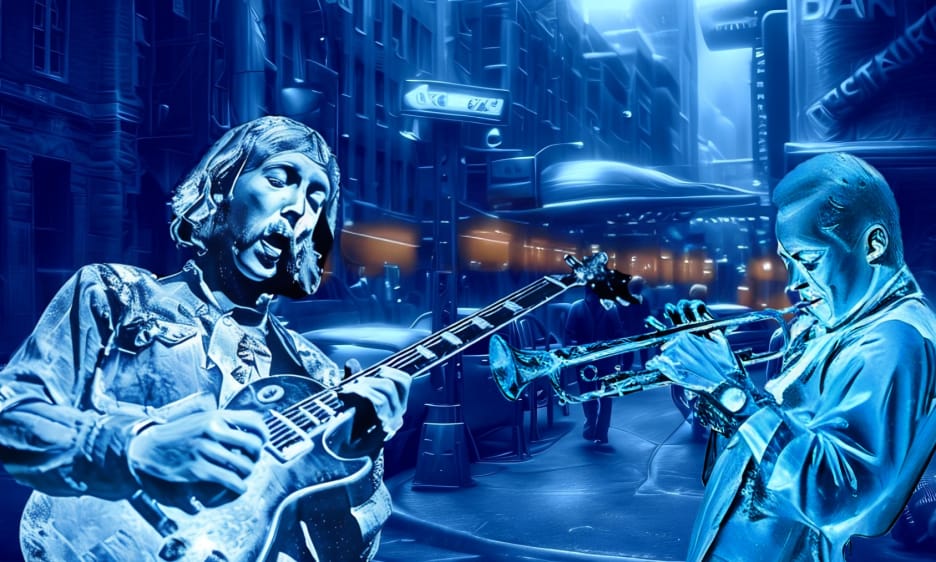
On the stage, a man sat behind a drum kit. Another tuned a bass guitar. A third, with blonde hair and a beard, was playing slow, singing slide guitar runs on a Les Paul that gleamed like spilled honey under lights that looked warm and distant and impossibly real.
"That's the Fillmore East," Xample said. "March 12th, 1971."
No one spoke.
"The Allman Brothers Band," he said. "Second night. Fourth set. They played four sets those nights—two on Friday, two on Saturday. Each one different. Each one longer. The album that came out of those shows—At Fillmore East—it's considered one of the greatest live recordings ever made."
He paused, watching the guitarist. Duane Allman . He would be dead in seven months.
"What if," Xample said, "you were there?"
He let the question sit.
"Not watching. Not streaming. Not remembering. There. In the room. Smelling the smoke—and there was smoke, cigarette smoke, the real kind, the kind that burned your eyes. Feeling the bass in your chest. Watching Duane Allman's fingers on the fretboard from twenty feet away. Hearing the mistakes, the recoveries, the moments where the whole band locks into something that no one—not even them—can explain."
He touched the table again. The stage vanished.
"What if," he continued, "you could change what happened? What if you could walk backstage? Talk to the band? What if you could be someone in that room—a producer, a roadie, a friend—and what if, while you were there, you could... introduce a new element?"
Another image materialized. A man, slight, intense, in a dark suit, holding a trumpet with the ease of someone holding his own arm.
"Miles Davis . 1971. In the middle of his electric period. Bitches Brew was two years behind him. Live-Evil was about to drop. He was playing with young musicians, experimenting with funk, with rock, with noise. He was controversial. He was brilliant. He was, by every account, difficult."
Xample looked around the table.
"The Allman Brothers loved Miles Davis. Duane Allman cited Kind of Blue as a formative influence. The band's approach to improvisation—the long, modal, exploratory jams—owed a direct debt to what Miles had done on that album in 1959. And there's a song in their set, a song called 'Dreams,' that is, in every meaningful sense, a blues filtered through a modal jazz sensibility."
He leaned forward.
"Now. What if Miles Davis had walked into the Fillmore East on March 12th, 1971, and sat in with the Allman Brothers Band?"
Mara Chen, board member, head of Consumer Integration, was the first to speak. She was sixty-three, looked forty, and had the particular habit of asking the question everyone else was thinking in a way that made it sound like she'd already answered it.
"It's a simulation," she said. Not a question.
"It's a reconstruction," Xample said. "There's a difference. A simulation approximates. A reconstruction is. We've spent eleven years building what we call the Chronos-Consciousness Engine. It has ingested every available artifact of the period—every recording, every photograph, every newspaper, every diary, every architectural blueprint, every weather report, every catalog, every letter, every contract, every bootleg tape, every fanzine, every concert poster, every police report, every restaurant menu—from the years 1964 through 1974. Not just the famous things. Not just the things that survived in digital archives. We went deep. We bought personal collections. We digitized attic boxes. We found reel-to-reel tapes in basements in Memphis and Birmingham and Detroit that no one had touched in fifty years."
He paused.
"The CCE doesn't play this data back. It synthesizes it. It builds a model of the era's consciousness—its patterns of thought, its cultural reflexes, its unwritten rules. The people you encounter in the Experience aren't programmed. They emerge from the model. They behave the way people would have behaved, not because we told them to, but because the entire experiential field of that era has been reconstructed around them."
"And the players?" asked Dr. Idris Kovac, head of Neural Systems. He was the one who would have to understand the technology at the deepest level. He was also the one most likely to find a flaw in it.
"Direct Neural Interface," Xample said. "Seventh-generation. We've moved beyond sensory overlay. The player's consciousness is temporarily integrated with the CCE's experiential field. Their motor cortex, sensory cortices, emotional centers, memory architecture—all are mapped into the reconstruction. They don't see it. They don't hear it. They are in it. It's a waking dream, Idris. Total immersion. The only thing that remains theirs is their intent—their will, their choices, their curiosity. Everything else is 1971."
"Their memories?" Kovac pressed. "Do they retain their own?"
"Yes. But on entry, the CCE provides a contextual layer—a set of background impressions that make their presence plausible. They feel as though they've been there, in that version of the era. It's not a full false memory—it's more like a... feeling. A sense of rightness. The player knows who they are, but they also feel, intuitively, that they belong."
He let that word—intuitively—land. It was a word that mattered to him, though he couldn't entirely explain why.
"And the plausibility constraint?" Mara asked.
"Built into the system at every level. The CCE won't permit anachronisms. You can't bring a smartphone into 1971. You can't use language that hasn't entered the vernacular yet. You can't introduce technology that doesn't exist. More importantly, you can't do things that the social and cultural physics of the era wouldn't support. You can't walk into the Fillmore East and demand to play guitar with the Allman Brothers unless you have a plausible reason to be there, and a plausible way to make the request. The system tests every interaction against the reconstructed consciousness of the era. If it fails the plausibility test, the CCE simply... redirects. The NPC reacts the way a real person would react to something impossible. They'd think you were crazy. Or drunk. Or both."
"And if the player persists?"
"They get a warning. Persistent violations result in session termination. Abhorrent behavior—violence, sexual predation, attempts to inflict real historical disruption—results in a lifetime ban. No appeals. No refunds."
He said this with an edge that made the room go quiet again.
"The cost," said Jin Okoro, CFO. He was a man of few words, and most of them were numbers.
"Two tiers," Xample said. "The first is the Observer Tier. For a reasonable fee—we're proposing the equivalent of one month's median Corridor income—a user can enter the Experience as a background presence. An extra. A face in the crowd at the Fillmore. A patron at a bar. A pedestrian on the street. They can observe, listen, move through the space, but they have minimal agency. They can't initiate significant interactions. They can't change outcomes. It's the most realistic museum in the history of the species, and for a lot of people, that will be enough."
He turned to Okoro.
"The second is the Architect Tier. This is where the money is. An Architect pays a significant fee—we're talking the equivalent of a small estate in today's terms—and they get agency. They can choose their role. They can introduce variables. They can, within the plausibility constraints, shape the experience. They want Miles Davis to sit in with the Allman Brothers? They can attempt it. They have to find a way to make it plausible—a connection, a mutual acquaintance, an offer that would make sense to Miles Davis in 1971. If they can thread that needle, the CCE will support it. If they can't, they'll be politely or impolitely rebuffed, just like in real life."
"And what does an Architect Tier session cost?" Okoro asked.
"For a standard week? We're pricing at the equivalent of two hundred million in current currency. For a custom experience—a Dream Band scenario, a historical intervention, something requiring significant CCE resource allocation? Five hundred million and up."
No one gasped. They were board members of Xample Global. They didn't gasp. But several of them shifted in their seats.
"The market for this," Xample continued, "is not the middle class. It's not even the upper class. It's the people who have everything and want the one thing money hasn't been able to buy until now: a different life. A different time. The chance to be someone else, somewhere else, when the world was—in their imagination—simpler, more alive, more real."
"You're selling nostalgia," said Mara.
"I'm selling experience," Xample said. "Nostalgia is a feeling about the past. This is the past. Or as close to it as consciousness can construct."
"And you want to be the first," said Dr. Kovac. It wasn't a question.
"I built this," Xample said simply. "I should be the first to use it. If there are problems—neurological, psychological, philosophical—I'd rather find them in myself than in a paying client."
"What's your scenario?" Mara asked.
Xample almost smiled. It was a rare expression on him, and it transformed his face in a way that made him look, for just a moment, like a much younger man—a boy, even, who had found something he truly wanted.
"The Musical Mix," he said. "Dream Band Experience. Miles Davis, 1971, sitting in with the Allman Brothers Band at the Fillmore East. Specifically on 'Dreams.'"
"Why that song?" asked Okoro, who, despite his numerical disposition, had a weakness for music that he kept well hidden.
"Because it's the perfect intersection," Xample said. "It's a blues with a modal jazz heart. The band built it from the same architecture Miles built 'So What' and 'All Blues' on. It's the moment where rock and jazz could have—should have—crossed paths. They never did, not like this. Not with these people, not in this room, not at this moment. And Duane Allman died seven months later. Miles changed direction. The Fillmore East closed three months after that. It's a door that history closed before anyone could walk through it."
He paused.
"I want to walk through it."
He turned to the full board.
"I'm inviting each of you to participate in the first Experience—as Observers. You'll be in the room. At the Fillmore East. March 12th, 1971. You'll see it work. You'll feel it. And you'll know, before we open this to the public, what it is and what it isn't."
He looked around the sphere.
"You'll be in the crowd. I'll be backstage. I'll be the one who has to convince Miles Davis to pick up his trumpet and sit in with one brother and five white boys from Macon, Georgia, in front of two thousand people in a downtown New York theater at midnight on a Friday."
He let the image settle.
"Miles Davis, 1971, was not a man who was easily convinced of anything."
Another pause.
"He'll need a reason. He'll need to feel it. And I'll have one week to make it happen—or fail, in front of all of you, in the most elaborate product demonstration in the history of commerce."
He touched the table one last time. The sphere's walls returned to transparency. The Corridor glittered below.
"The chambers are ready," he said. "We begin on Friday."
Later, alone in his office, Xample stood at the window. The Corridor hummed below—the endless, layered machine of 2092, the world his father had helped build, the world of perfect efficiency, perfect health, perfect connectivity, perfect loneliness.
He thought about Duane Allman's hands on that Les Paul. He thought about the way the slide guitar had sounded, even through the crude reconstruction he'd shown the board. He thought about Miles Davis's face—that face, that impossible, proud, beautiful, furious face—and the way he held a trumpet, like it was part of his body, like it was the thing that made the rest of the world make sense.
He closed his eyes and thought about the song "Dreams" and wondered, what if this is not an elaborate game, what if it's a door?
 FOLLOW Blue Note Portal
and get notified whenever a new article published.
FOLLOW Blue Note Portal
and get notified whenever a new article published.
The Blue Note Portal: a garage-assembled '70s microcomputer relic, eternally portaling through jazz timelines with Serling-esque irony, hacking bebop anomalies into binary swing for the ultimate improvised reboot.
About Miles Davis

Tags
PREVIOUS / NEXT
Become a Sustaining Member

Since 1995, All About Jazz has championed jazz as an art form and supported the musicians who create it. Over three decades, it has grown into one of the world's leading jazz resources, serving hundreds of thousands of readers, musicians, presenters and industry professionals each month.
Help Build the Future of All About Jazz
Your support helps us continue building All About Jazz for the next generation—expanding our editorial coverage, preserving jazz history, developing new community features and creating better ways to discover the music and the people behind it.
Become a sustaining member for as little as $20 per year and you'll immediately enjoy an ad-free experience along with access to subscriber features and future articles for a full year.
Together, we're not simply sustaining All About Jazz—we're building its future. Thank you for being part of the journey.