Home » Jazz Articles » The Blue Note Portal » Wolf—Future Perfect, 5. So What
Wolf—Future Perfect, 5. So What
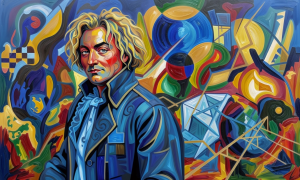
Courtesy AI
1970—New York
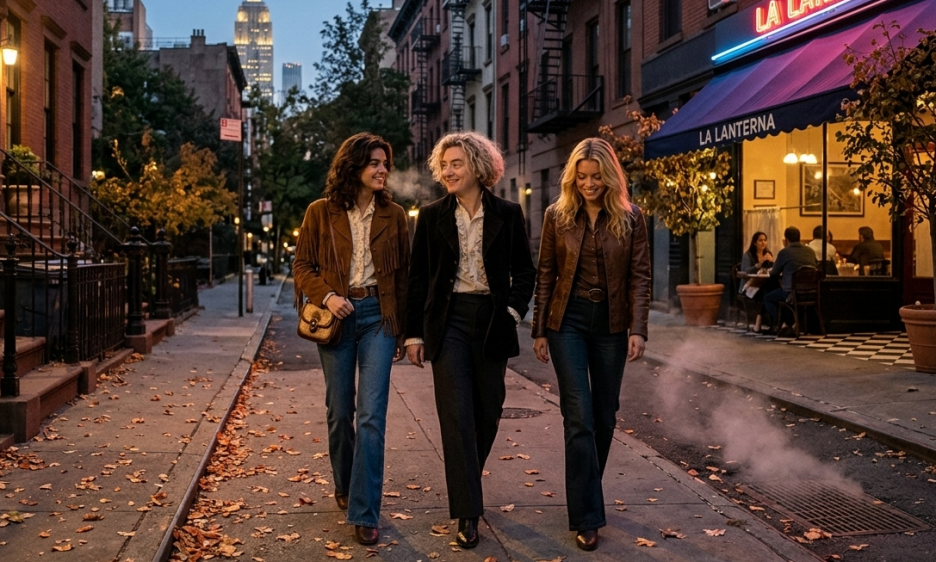
The applause and laughter that followed Wolf's impossible five-four duet with Kyle took a long time to settle.Kyle was still sitting behind the drum kit with both sticks resting across his lap, grinning in a kind of exhausted disbelief. Zack leaned against his upright bass with his head tilted back and his eyes closed, as if recovering from a mild spiritual assault. Chloe had reclaimed her Telecaster but hadn't bothered to plug it back in. Maya stood at the turntable crate with one hand on her hip, watching Wolf carefully.
Wolfgang Amadeus Mozart sat at the Steinway bench with his legs elegantly crossed and his breathing finally slowing, looking altogether too pleased with himself.
"You look insufferable," Chloe said.
"I am insufferable," Wolf replied cheerfully. "You have shown me a civilization where a crippled waltz became popular entertainment. I feel completely vindicated."
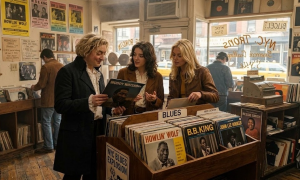
Julian laughed from behind the console and reached for another record sleeve from the jazz section stacked beside the monitors.
"Alright," he said, holding up the album so Wolf could see the cover. "You've heard architecture stretched, staggered, and bent into strange new shapes. Now it's time for the sound of someone tearing half the walls down and discovering that the room somehow gets bigger."
Wolf's expression sharpened immediately. "That is either genius or vandalism."
"In this case," Maya said, stepping over and taking the sleeve from Julian, "both."
She turned the Kind of Blue cover toward him: a shadowed close-up of Miles Davis, trumpet raised, face half-lost in darkness. "You know Miles Davis from the CCE. This song, 'So What' was recorded eleven years ago, in 1959—improvised from a basic sketch."
Wolf studied the cover with quiet intensity. "Oh yes, I recall him, but his appearance has changed considerably. And why is it important?"
Zack pushed himself upright and answered first. "Because before this, a lot of jazz had gotten extremely harmonic. Chord changes flying by every measure, sometimes two chords per bar, players racing through obstacle courses."
Kyle nodded. "Everybody proving how much they knew."
"But Miles," Chloe added, "started stripping that away. Instead of giving the soloist a maze of fast-moving harmony, he gave them space. A mode. A color. A field to walk through."
Wolf's brow furrowed. "A single harmonic region?"
"Mostly," Maya said. "Structure, yes, just less. Fewer signposts. More air. More trust."
Wolf gave a faint, skeptical smile. "You keep presenting me with music that appears to do less and means more. This century is either very wise or very lazy."
"Listen first," Maya said.
She slipped the record from its sleeve with practiced care, laid it on the platter, and lowered the needle.
The loft filled with the soft hiss of vinyl.
Then came the piano.
Not a grand declaration. Not an overture. Bill Evans' opening chords arrived like a thought half-formed at dawn—open, suspended, almost watercolor in their voicing. They didn't announce a key so much as suggest a climate. Beneath them, space. Then another chord. And another. Calm, cool, elusive.
Wolf froze.
His fingers, which had spent the afternoon twitching, conducting, and sketching invisible counterpoint in the air, became perfectly still on his knees.
"That is not functional harmony," he whispered.
"Nope," Julian said quietly from the console.
Wolf tilted his head, listening harder. "It does not beg to arrive anywhere. It simply... exists."
The bass entered next—Paul Chambers, deep and centered—and then the horns rose together with that immortal call-and-response figure, blunt and elegant at once.
Da-da da, da-da-da.
Da—da.
"So what," Zack murmured with a grin.
Wolf turned sharply. "That is the title?"
Kyle laughed softly. "That's the title."
The theme unfolded with impossible restraint. No clutter. No virtuoso preamble. Just a cool, declarative idea, stated so plainly it almost seemed arrogant.
Wolf's eyes narrowed.
"He is daring the listener to object," he said.
Chloe smiled. "Exactly."
Then Miles entered.
Not with speed. Not with the manic density Wolf had just hurled at Brubeck. Miles Davis's trumpet came in almost conversationally—spare, dry, spacious, every note placed as if silence itself were part of the phrasing.
Wolf's lips parted very slightly.
For the first chorus he didn't speak.
For the second, he leaned forward.
By the third phrase, he stood up from the piano bench and walked slowly toward the monitors, as he had with Debussy, but this time the movement was different. Less frantic analysis. More surrender.
"He leaves whole measures unfilled," Wolf murmured. "He does not decorate. He does not explain himself. He speaks a sentence and then waits to see whether the room is intelligent enough to understand it."
Maya folded her arms, pleased. "That's Miles."
Wolf looked offended and delighted at once. "This is outrageous confidence."
The solo continued: short phrases, piercing little turns, notes that seemed to hang in the loft's warm air longer than they had any right to. When the band shifted up the half step—from D Dorian to E-flat Dorian—Wolf inhaled sharply.
"There," he said, pointing. "There! Such a tiny elevation, and yet it feels like the floor has changed color."
Julian nodded. "That's modal playing. You stay in one world long enough, even a small move becomes huge."
Wolf did not answer. He was too busy listening.
When John Coltrane's tenor entered, the atmosphere changed at once. The cool poise of Miles gave way to something more searching, more insistent. Coltrane moved through the mode like a man pacing the perimeter of a locked garden, testing every edge of it, trying to discover how much infinity had been hidden inside the limitation.
Wolf laughed under his breath.
"Ah," he said softly. "Now this one is probing."
Zack barked out a laugh. "That's Coltrane, alright."
"He is not satisfied to admire the room," Wolf continued, eyes fixed on the speaker. "He must measure every wall, test every ceiling beam, pry up every floorboard, and see what is hiding in the cellar."
Kyle nearly spewed his soda.
"That may be the best description of Coltrane I've ever heard," he said.
Then Cannonball Adderley entered with a tone warmer, fatter, more earthly—bluesier, smiling where Coltrane strained. Wolf's expression shifted again.
"And this one," he said, "understands the street."
"Yep," Chloe said. "Cannonball brings the human grin back into it. You surely remember him from the CCE, Afro Chill."
Wolf smiled, "Oh yes, very pleasant. Three men, one harmonic field, and yet they reveal three entirely different philosophies of freedom."
Now Bill Evans returned, his piano solo all mist and glass—translucent voicings, phrases that drifted rather than pushed.
Wolf's face changed.
That alert, bright, boyish energy softened into something quieter, almost private. He took two slow steps back toward the Steinway without taking his eyes off the speakers.
"He learned from the French," Wolf said under his breath. "Debussy. Ravel. But he has translated the color into another language. He is not painting moonlight. He is painting thought itself."
Maya glanced at Julian. Neither of them said anything.
At last the ensemble returned to the head. The famous figure came again, austere and cool, as if the entire journey had simply passed through a revolving door and arrived back where it started—changed, but outwardly composed.
When the final note faded into the room's hush, no one moved for several seconds.
The record kept spinning.
Wolf stood in the center of the loft with his head bowed slightly, one hand resting against the curve of the piano.
Finally he spoke.
"In my century," he said quietly, "we believed genius announced itself through elaboration. Through development. Through proving, beyond all doubt, that one could transform a theme in every conceivable way and dominate the material completely."
He lifted his eyes toward the turntable.
"This man does something far more dangerous."
Maya said nothing. She knew better than to interrupt.
"He withholds."
Wolf turned slowly to face them.
Wolf looked genuinely unsettled now, which was rare. "I do not know whether this is discipline of the highest order... or a kind of madness."
"Both," said Xap from the corner, smiling.
That made Wolf laugh.
"Yes," he said. "Both."
He moved to the Steinway bench and sat down carefully, but unlike before, he did not attack the keys at once. He rested his hands in his lap and stared at the keyboard.
Disclaimer
This is a fictional account exploring what might have happened if a temporal quantum event had occurred. While real musicians and historical figures appear within these pages, they exist here in an alternate timeline—a reality that quantum theory suggests was possible, but that never came to pass. All interactions, conversations, and events involving these individuals are entirely fictional, products of a world that exists only in the space between what was and what might have been.About the Series
Future Perfect follows a time-traveling band from the year 2092—winners of a planet-wide musical talent search—who journey back to the golden decade of 1964 to 1974. Over a billion subscribers plug into the Chronos-Consciousness Engine (CCE) to experience the band's exploits first-hand in a vivid, waking-dream state. Originally designed as a hyper-realistic historical simulation, the sheer volume of connected minds has triggered a quantum event that is drawing actual consciousness into this alternate reality. Ideally, new readers should start at the beginning of the series.
 FOLLOW Blue Note Portal
and get notified whenever a new article published.
The Blue Note Portal: a garage-assembled '70s microcomputer relic, eternally portaling through jazz timelines with Serling-esque irony, hacking bebop anomalies into binary swing for the ultimate improvised reboot.
About Wolfgang Amadeus Mozart

Tags
PREVIOUS / NEXT

Become a Sustaining Member

Since 1995, All About Jazz has championed jazz as an art form and supported the musicians who create it. Over three decades, it has grown into one of the world's leading jazz resources, serving hundreds of thousands of readers, musicians, presenters and industry professionals each month.
Help Build the Future of All About Jazz
Your support helps us continue building All About Jazz for the next generation—expanding our editorial coverage, preserving jazz history, developing new community features and creating better ways to discover the music and the people behind it.
Become a sustaining member for as little as $20 per year and you'll immediately enjoy an ad-free experience along with access to subscriber features and future articles for a full year.
Together, we're not simply sustaining All About Jazz—we're building its future. Thank you for being part of the journey.