Home » Jazz Articles » The Blue Note Portal » Wolf—Future Perfect, 8. Blues & the Abstract Truth
Wolf—Future Perfect, 8. Blues & the Abstract Truth
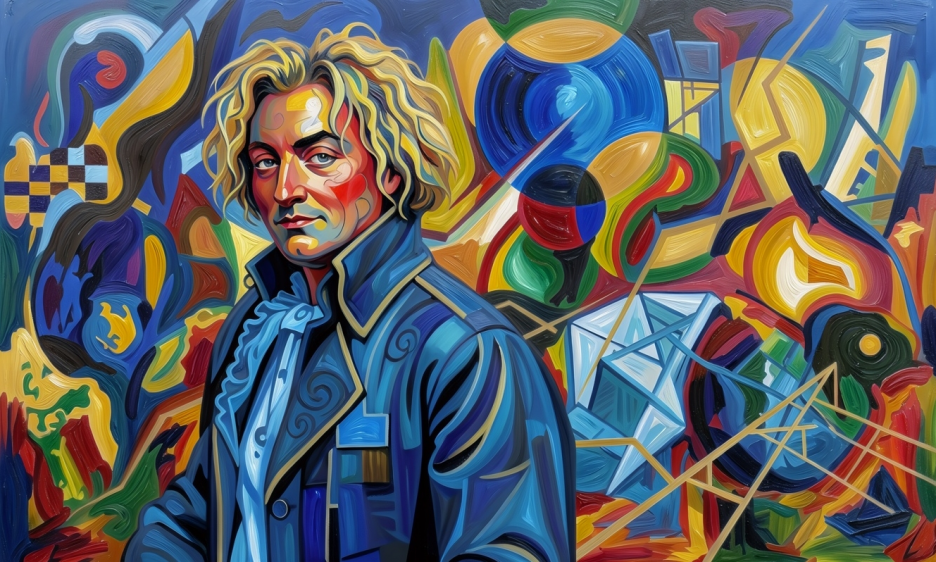
Courtesy AI
1970—Manhattan, New York
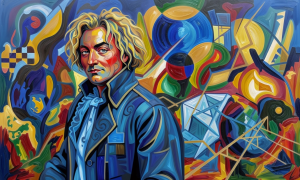
Ten days passed inside the West 26th Street loft. For Wolfgang Amadeus Mozart, time had ceased to be an enemy. Over the course of a week and a half, he had eagerly surveyed nearly two centuries of human expression. The band quickly realized that, much like their encounter with George Harrison, Wolf was a sliver of his higher consciousness. Yet clearly the two centuries had rendered him exceptionally potent. He was not just a temporal spirit on the edges of a waking dream; he was an integrated physical presence, and in consciousness able to speak with Kiran in 2092.Between long listening sessions, he would wander the loft, his slight frame wrapped in his tweed jacket, marveling at the sheer mundane miracles of twentieth-century life. But above all, he was consumed by the democratization of art.
One afternoon, Maya found him sitting cross-legged on an equipment trunk, an oversized hardcover art monograph balanced on his knees. His pale, slender thumb was tracing the bold, brooding lines of a self-portrait.
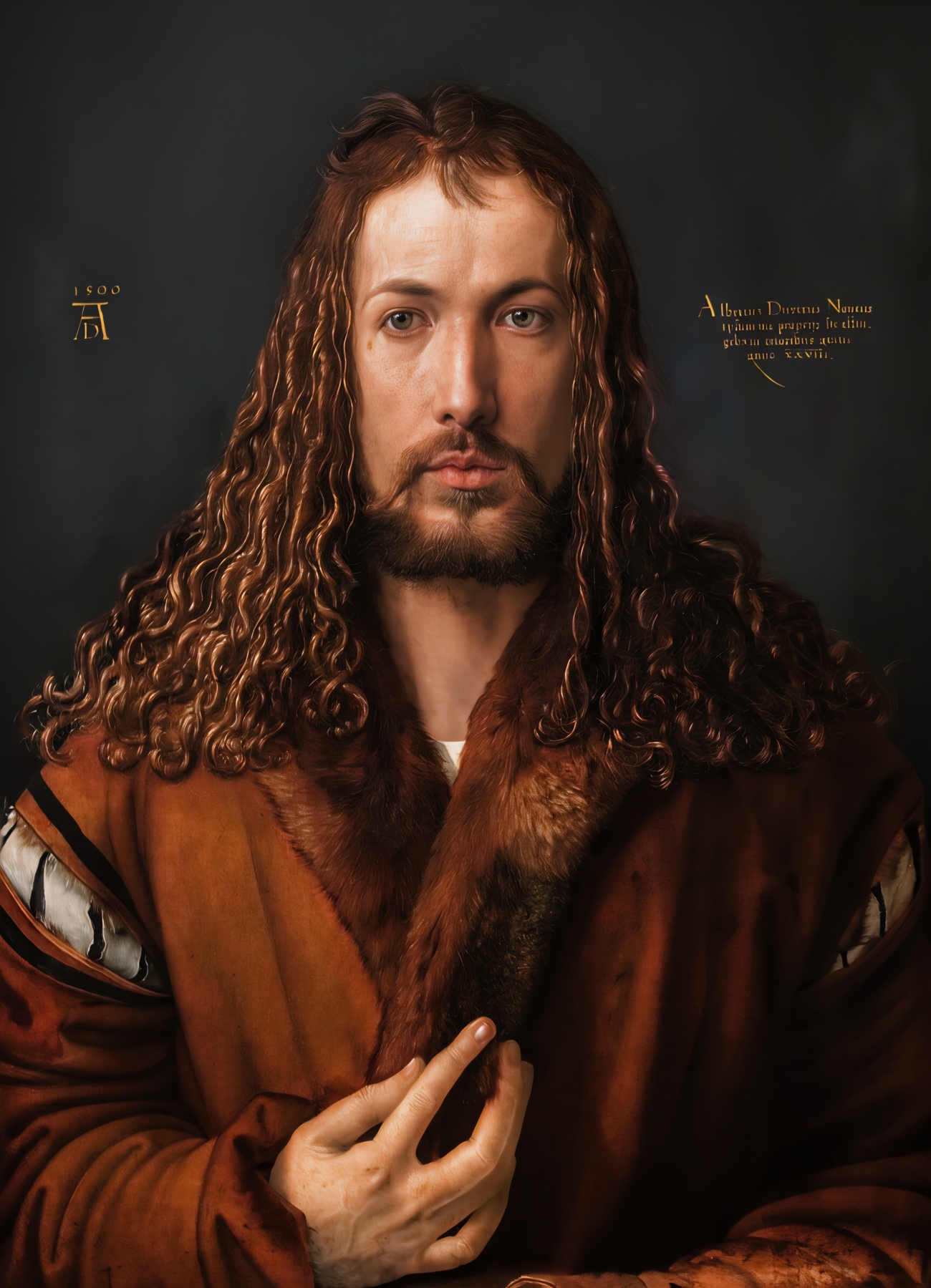
"Albrecht Dürer," Wolf murmured, looking up as Chloe and Maya approached. "1500 AD. Half a millennium ago, and yet he looks directly through you, does he not?"
"He looks like quite a rascal," Chloe said, leaning over his shoulder with a warm mug in hand.
"He was the first truly modern artist," Wolf declared, tapping the glossy page. "Do you know what made his era miraculous?"
Chloe shook her head with a faint smile, waiting.
"The printing press," Wolf said, his eyes alight with an educator's fire. "Before him, an artist survived on the whims of a Duke, an Emperor, or an Archbishop. You painted an altar, you bowed low, and you prayed they liked the blue pigment you bankrupted yourself to buy. But Dürer had been trained as a goldsmith. He knew engraving; he understood metal, ink, and wood. His mind was relentlessly agile. He realized that if he carved his visions into blocks of wood, he could reproduce them by the thousands for pennies. He sold them directly to ordinary people, allowing them to pin his art to their humble walls."
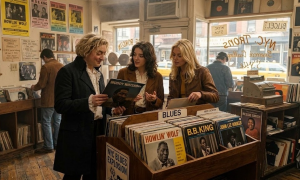
Wolf reached down, picked up a vinyl LP from the floor, and held it up against the afternoon light coming through the tall factory windows. He ran his index finger around the black microgrooves, a reverent smile touching his lips.
"This," he said softly, "is the musician's woodcut. You press your soul into lacquer, stamp it into vinyl, and a workman in Brooklyn can sit in his parlor and hear a performance fit for an emperor. It gave artists financial freedom. It gave them the power to follow their creative impulses without groveling for a stipend. No more Archbishop Colloredo dismissing you like a scullery maid!"
He set the record down and looked at his hands, his expression shifting into a rare, quiet humility.
"People often speak of my gifts as if they belonged to me," Wolf continued, his melodic accent softening. "They did not. I was merely an open conduit. God's creative power flowed through me, and I struggled frantically to capture the lightning on paper before it burned away. Thanks to the relentless diligence of my father, I possessed the craft to catch it. God forgive me, I hated the man's severity at the time—the endless metronomes, the scales, the traveling cages. But without that iron cage, the lightning would have destroyed me. It was part of the gift."
He stood up, brushing off his trousers, and turned to face the entire room. Zack was tuning his upright bass; Kyle was sorting through stick bags on the riser; Julian sat perched on the console armrest.
"I have listened to French impressionists' mist," Wolf announced, pacing the floorboards with theatrical authority. "I counted your Turkish tempo math, your cool modal space, your tropical carnival in two-four time, and the glorious circus opera in copper wire. Now, I want to be your next project."
Kyle chuckled from behind the drums. "What do you have in mind, Wolf? Want to draft an electric symphony for quadraphonic sound?"
Wolf shook his head vigorously. "No. I want to be like Dürer. I do not want to hide in an ivory hall or write pleasant divertimenti for the wealthy. I want to reach the masses with something that speaks directly to their souls, something urgent, exciting, and modern. But I am an eighteenth-century creature. I need your guidance to understand how, and what."
Maya smiled, stepping forward with genuine reverence. "Maestro, it would be the honor of our lives to help you build it. If we do this, it's a yin and yang proposition: mass appeal on the outside, undeniable masterwork on the inside."
Wolf blinked, tilting his head with an impish squint. "Yin? Yang?"
Maya laughed. "Ancient Chinese philosophy. The concept of two opposing, complementary forces creating a complete whole. Commercial accessibility and profound artistic depth. The street and the court, dancing together."
"Ah!" Wolf's face illuminated with understanding. "The Magic Flute! A ribald, lowbrow fairy tale for the suburban theater crowd, woven through with sacred Masonic counterpoint! Yes, exactly that!"
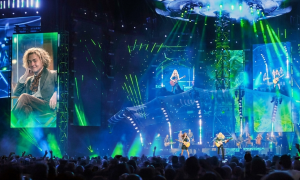
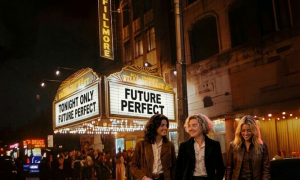
"If you want to feel the crowd breathe, you can't just make records in a vacuum," Chloe chimed in, leaning against a flight case. "You have to play live. Down the avenue in the East Village, there's an old movie palace called the Fillmore East. It's the absolute cathedral for this generation's rock and soul culture. They've been begging us to do a live run for months, but we prefer to do our film concerts. But since it is in the neighborhood, we could work up a tight set right here in the loft, and they will clear a slot for us."
"Four of us pick two songs each—covers, originals, blues, rock, jazz, high-wire funk—whatever works. All four of us sing, so the textures will keep shifting. And right up front, Wolf, we set you up with an absolute monster: a Hammond B3 organ run through a pair of spinning Leslie speakers."
Wolf's eyes sparkled. "An organ? The king of instruments? But without the church! What wonders!"
"Without the church, but with all the soul," Chloe grinned. "We'll have our buddy Monty come by to walk you through the drawbars, the percussion settings, for now you don't need the foot pedals. Monty doesn't know about our 2092 timeline, so as far as he's concerned, you're just our eccentric, savant keyboard friend from Europe."
Wolf rubbed his palms together, practically vibrating with excitement. "A test of fire before the living populace! Yes! This is how an artist discovers what moves the human heart. Maestro Kyle," Wolf turned dramatically toward the drum riser, sweeping a low, mock-chivalric bow, "what say you? To what sonic trial do you summon me first?"
Kyle broke into a broad grin, jumped off the riser, and headed straight for the milk crates.
"I don't need two picks, Wolf. I only need one," Kyle said, sliding an LP out of a faded cardboard sleeve. "Because when we get to the Fillmore, we're going to take this tune, open it up into a twenty-minute burner, let Maya and Chloe trade guitar fire, let you rip that B3 apart, and turn every kid in the lower mezzanine into an instant Mozart fan."
He brought the sleeve over.
"It was written and arranged by an absolute genius named Oliver Nelson," Kyle explained. "The track is from his masterwork, The Blues and the Abstract Truth, but this particular cut is a blistering big-band burner he arranged for organ titan Jimmy Smith."
Julian took the heavyweight vinyl, slid it onto the turntable, and cued the studio monitors.
Kyle added with a wink, "We'll have to bring in our brass section to do it justice live. But for now, listen to what happens when big-band architecture meets the blues."
Julian lowered the tonearm.
A soft, crackling stereo hiss gave way to a sudden, explosive punch.
The track tore open not with polite harmony, but with an angular, shouting blast of brass—stabbing, dissonant modern chords stacked like jagged modernist skyscrapers. The voicings were audacious, leaping across unusual intervals that sat somewhere between a blues lament and a twentieth-century harmonic manifesto.
Wolf's entire body gave a violent jolt. His spine straightened as if someone had run an iron rod down his back. His eyes bulged in pure, stunned exhilaration as the horn lines interlocked in savage, jagged counterpoint.
"The voicings... " Wolf gasped aloud, clutching the armrests. "It is chromatic, it is bitter... but it struts!"
And then Jimmy Smith's Hammond B3 organ kicked in.
The organ entered with a snarling, percussive slide, the tone fat, smoky, and saturated with roaring tube distortion. It drove the rhythm like an iron locomotive, the drawbars dialed into a searing gospel scream, locked into a heavy, swinging groove that practically sucked the air out of the room.
Wolf let out an involuntary, breathless cry of delight. He lunged forward and grabbed Maya's wrist, his grip iron-tight, his eyes wide and unblinking as the spinning Leslie speaker churned out waves of rich, Doppler-swelling fury.
"Oh yes," Wolf whispered, a radiant grin breaking across his face as the organ tore through a sequence of filthy, syncopated blues riffs against the crying horns. "Oh, yes! It is not an instrument at all... it is a roaring beast inside a wooden box!"
He leaned back, his chest rising and falling, his eyes drifting shut as the music tore through the studio monitors. His hands danced in mid-air over imaginary keyboards, instinctively working the ghost drawbars, completely surrendered to the furious, beautiful, abstract truth of the swing.
Disclaimer
This is a fictional account exploring what might have happened if a temporal quantum event had occurred. While real musicians and historical figures appear within these pages, they exist here in an alternate timeline—a reality that quantum theory suggests was possible, but that never came to pass. All interactions, conversations, and events involving these individuals are entirely fictional, products of a world that exists only in the space between what was and what might have been.About the Series
Future Perfect follows a time-traveling band from the year 2092—winners of a planet-wide musical talent search—who journey back to the golden decade of 1964 to 1974. Over a billion subscribers plug into the Chronos-Consciousness Engine (CCE) to experience the band's exploits first-hand in a vivid, waking-dream state. Originally designed as a hyper-realistic historical simulation, the sheer volume of connected minds has triggered a quantum event that is drawing actual consciousness into this alternate reality. Ideally, new readers should start at the beginning of the series.
 FOLLOW Blue Note Portal
and get notified whenever a new article published.
The Blue Note Portal: a garage-assembled '70s microcomputer relic, eternally portaling through jazz timelines with Serling-esque irony, hacking bebop anomalies into binary swing for the ultimate improvised reboot.
About Wolfgang Amadeus Mozart

Tags
PREVIOUS / NEXT
Become a Sustaining Member

Since 1995, All About Jazz has championed jazz as an art form and supported the musicians who create it. Over three decades, it has grown into one of the world's leading jazz resources, serving hundreds of thousands of readers, musicians, presenters and industry professionals each month.
Help Build the Future of All About Jazz
Your support helps us continue building All About Jazz for the next generation—expanding our editorial coverage, preserving jazz history, developing new community features and creating better ways to discover the music and the people behind it.
Become a sustaining member for as little as $20 per year and you'll immediately enjoy an ad-free experience along with access to subscriber features and future articles for a full year.
Together, we're not simply sustaining All About Jazz—we're building its future. Thank you for being part of the journey.