Home » Jazz Articles » The Blue Note Portal » Wolf—Future Perfect, 7. Sgt. Pepper
Wolf—Future Perfect, 7. Sgt. Pepper
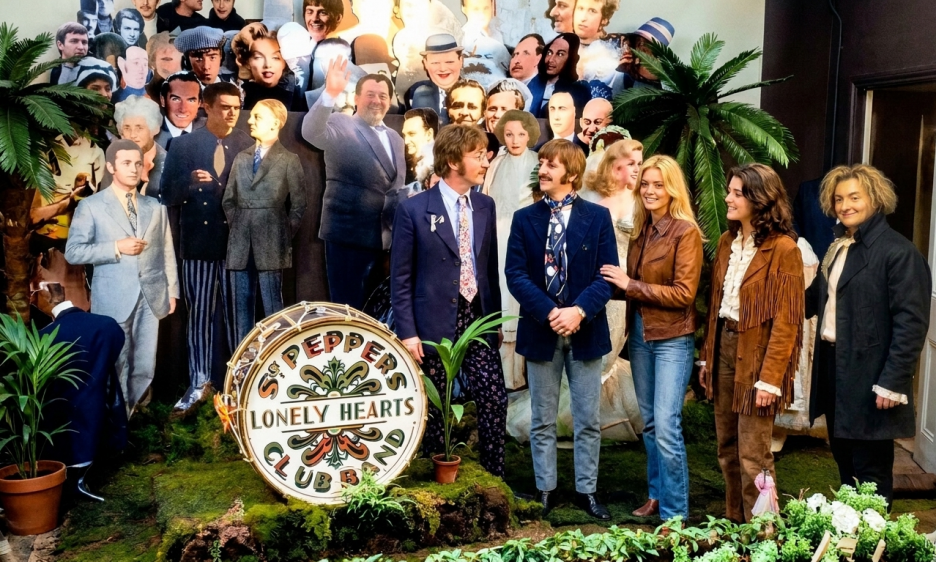
Courtesy AI
1970—New York
Dinner at their favorite Italian spot down the avenue had been a triumph, if slightly bewildering for their host. Wolfgang had ordered the osso buco in flawless, florid 18th-century Tuscan—addressing the bewildered native Neapolitan owner as if he were a court dignitary in 1770s Milan. By the time the owner realized he was being serenaded in the Italian of Goldoni plays and papal courts, he had beamed, poured extra wine, and refused to let them pay for dessert.When they returned to the studio, the space was dim, illuminated only by the warm, amber glow of the vacuum tubes on the mixing console and the soft lamplight pooling over the vintage sofas...
Wolfgang Amadeus Mozart sank into a deep, worn leather armchair with a contented sigh, resting a cup of dark roast coffee on the armrest.
Maya tossed her jacket over a flight case and leaned against the edge of the mixing desk, looking over at Wolf. "You know, Maestro, the music we've played you so far—Debussy, Brubeck, Ravel, Miles, even Mendes—they were all snapshots of specific eras. But by the middle of the 1960s, something fundamental was shifting in popular music."
"Shifting how?" Wolf asked, tilting his head. "Did the dance steps become even more impossible?"
"No," Chloe said, sitting on the edge of the sofa with a small smile. "People stopped dancing as much, or at least, the dancing changed. Popular music stopped being just a three-minute tune meant for a jukebox or a ballroom. It became an album culture. The recording studio itself became an instrument. Production—using technology to capture, manipulate, and build entirely imaginary acoustic spaces—became just as important as the notes on the page."
Julian nodded, "The artists started treating the record as a complete listening experience. A place to experiment, to construct soundscapes that could probably never be played live on a single stage, and to surprise the listener at every turn."
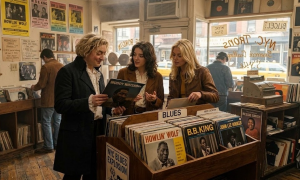
Maya walked over to the record crates, pulling out a bright, densely packed folded sleeve bursting with color, famous faces, and intricate costumes.
"Friends of ours recorded this next piece, they are self taught, no formal training" Maya said, her tone carrying a quiet reverence."
Julian interrupted, "Wolfgang, you know them from the CCE, The Beatles, John, Paul, George, and Ringo."
Wolfgang nodded, "Oh, yes, yes, of course."
Maya smiled, "I forgot you have followed our exploits. Well when this was first released, it was so radical and bizarre that a lot of their audience didn't know what to make of it. Critics were baffled. Some disliked it at first. But after a few listens, it burrowed into your brain and became something entirely unforgettable. That immediate polarization followed by deep devotion was pretty unique to that decade."
She pulled the heavyweight vinyl from its sleeve and slid it onto the platter.
"So we're going to play it for you tonight," Maya continued, positioning the tonearm. "Let it ruminate in your thoughts overnight. Sleep on it. And tomorrow evening, when you've had time to digest it, listen to it again, and then you can give us your impressions. Just remember, they are untrained self taught musicians from working class families."
Wolf raised an eyebrow, a flicker of aristocratic curiosity crossing his face. "I've used a few melodies from the streets myself. What is the title of this musical riddle I'm supposed to ponder?"
Maya lowered the needle.
"It is called Sgt. Pepper."
The speakers filled with the uncanny, sound of a live audience murmuring, tuning instruments, and coughing in a concert hall—the sound of a crowd gathering before the curtain rises. Then, a low, groaning bass chord bled into existence, followed instantly by the crisp, biting distortion of electric guitars, French horns cutting through the air like brass razors, and Ringo Starr's driving drumbeat launching into the opening title track. The CCE had attuned him to the rock sound.
Wolf did not jump to the piano this time. He sat entirely still in the leather armchair.
His eyes drifted shut as the dense, multi-tracked vocal harmonies soared out of the monitors, dripping with psychedelic swagger and theatrical British wit. He listened in absolute silence through the cascading transition into "With a Little Help from My Friends," letting the strange, surreal world of the record wash over the room.
When the second side finally spun into the run-out groove, Wolf opened his eyes. He looked around the circle of musicians, his expression unreadable, a strange mix of profound bewilderment and deep fascination.
The Next Morning
The loft was bathed in morning light when Wolf returned to his seat. He didn't touch the piano, and he did not want to wait to hear the album again. Maya, wondered, maybe he just want to get this over with and move on.
When Maya dropped the needle for a second consecutive listen, Wolf didn't flinch. He absorbed every sonic detail—the tape loops of "Being for the Benefit of Mr. Kite!," the Indian classical instrumentation of "Within You Without You," the harp on the hauntingly beautiful, "She's Leaving Home," the orchestral crescendo of "A Day in the Life" that built into a deafening, multi-piano E-major chord ringing out into eternity.
As the final, infinite piano chord faded into the vinyl crackle, Wolf turned to face them. His face was alive with a brilliant, triumphant intensity.
"You called it an album," Wolf began, his voice ringing clear and steady through the quiet loft. "And I understand why. This is not a collection of songs. This is an entire opera staged inside a copper wire."
He took a step toward the console, gesturing broadly with his hands.
"In my time, when we wrote an opera or a mass, we were bound by the physical realities of the theater and the orchestra pit. But these Englishmen... " Wolf laughed, shaking his head in sheer disbelief. "They created a canvas of illusion. They wrapped the whole thing in a theatrical masquerade!"
"You like it, then?" Zack grinned.
"Like it?" Wolf's eyes flashed with fierce admiration. "It is an absolute triumph of audacity! They took the high-minded ambition of a court symphony and smuggled it into popular culture wearing the costume of a circus barker. It is deeply sophisticated, and yet it is having a magnificent joke at the listener's expense."
"I must admit, when I first heard it last night, I thought it was madness," Wolf admitted, a boyish grin breaking across his face. "A chaotic collision of kitsch, avant-garde noise, and exquisite melody. But a great work of art should disorient you before it invites you in. By the second listening today, the architecture revealed itself. It is a hall of mirrors, and every time you turn a corner, you find a new color."
He walked over to the Steinway, lightly running a single finger across the high register without pressing the keys down. Then he sat, looked at Zack and said, "Imagine if our French impressionists had heard this melody. He closed his eyes, and as if he were channeling Debussy, he spontaneously played the Beatles "Fixing a Hole" as he imagined they might.
He took the hook of "Fixing a Hole" and dissolved it into light. The melody was unmistakable, but it floated without a rigid beat, drifting through whole-tone scales and delicate, cascading runs in the highest register that sounded like water refracting through glass. He shifted from major to minor not with a formal cadence, but like a cloud passing across the sun, letting the voicings linger in the air until the room felt entirely weightless.
Chloe looked at Maya and mouthed the words, "Oh my God!" It was slow, meandering, and dreamy, without a conscious beat, evocative voicings—the melody was recognizable, but this was something truly inspired. Inspiration of the highest order, leaving no doubt as to his genius.
He turned back to the room, looking at Maya, Chloe, Zack, Kyle, and Julian with a look of profound kinship.
"If this is what happens when you let musicians lock themselves in a room with electricity and tape," Wolf declared, "then I must confess... I was born two centuries too early. Oh what I could do with such a studio."
Disclaimer
This is a fictional account exploring what might have happened if a temporal quantum event had occurred. While real musicians and historical figures appear within these pages, they exist here in an alternate timeline—a reality that quantum theory suggests was possible, but that never came to pass. All interactions, conversations, and events involving these individuals are entirely fictional, products of a world that exists only in the space between what was and what might have been.About the Series
Future Perfect follows a time-traveling band from the year 2092—winners of a planet-wide musical talent search—who journey back to the golden decade of 1964 to 1974. Over a billion subscribers plug into the Chronos-Consciousness Engine (CCE) to experience the band's exploits first-hand in a vivid, waking-dream state. Originally designed as a hyper-realistic historical simulation, the sheer volume of connected minds has triggered a quantum event that is drawing actual consciousness into this alternate reality. Ideally, new readers should start at the beginning of the series.
 FOLLOW Blue Note Portal
and get notified whenever a new article published.
The Blue Note Portal: a garage-assembled '70s microcomputer relic, eternally portaling through jazz timelines with Serling-esque irony, hacking bebop anomalies into binary swing for the ultimate improvised reboot.
About The Beatles

Tags
PREVIOUS / NEXT
Become a Sustaining Member

Since 1995, All About Jazz has championed jazz as an art form and supported the musicians who create it. Over three decades, it has grown into one of the world's leading jazz resources, serving hundreds of thousands of readers, musicians, presenters and industry professionals each month.
Help Build the Future of All About Jazz
Your support helps us continue building All About Jazz for the next generation—expanding our editorial coverage, preserving jazz history, developing new community features and creating better ways to discover the music and the people behind it.
Become a sustaining member for as little as $20 per year and you'll immediately enjoy an ad-free experience along with access to subscriber features and future articles for a full year.
Together, we're not simply sustaining All About Jazz—we're building its future. Thank you for being part of the journey.