Home » Jazz Articles » The Blue Note Portal » Wolf—Future Perfect, 10. Mozart at the Fillmore
Wolf—Future Perfect, 10. Mozart at the Fillmore
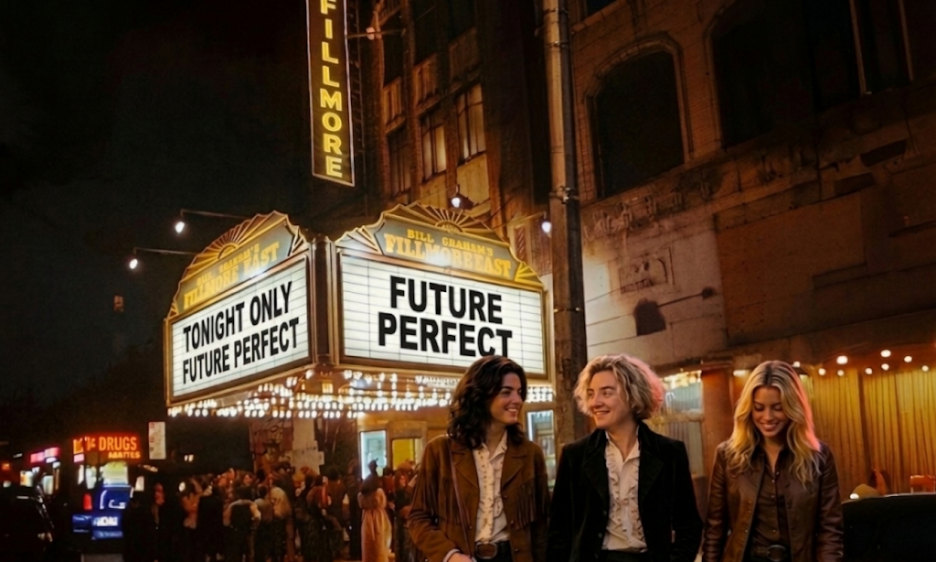
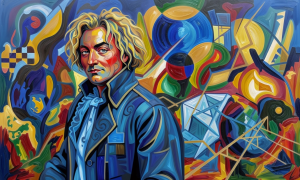
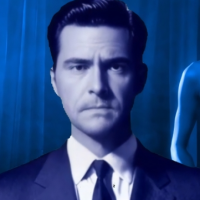
Courtesy AI
1970 New York
Only hours now until Mozart would join Future Perfect at the Fillmore East. A week had passed since Xap had visited Bill Graham at the Fillmore East with the offer for Future Perfect to perform a set. Although the Allman Brothers were Graham's favorite band, he didn't hesitate for a minute to bump them to make room for Future Perfect. This was surreal for Xap as his inaugural CCE experience had been with Miles Davis and the Allman Brothers.Xap had been spending a lot more time in 2092, Mozart's entry into the CCE had stunned the planet. The CCE subscriber base had swollen to now over 2.6 billion. Watching Wolfgang Amadeus Mozart play and interact with people from 2092 drew even the haters and skeptics into the CCE, and most were now avid experiencers. Mozart was beloved in a way that was difficult to describe, watching him felt like experiencing a true miracle. This CCE was tailored to the 2092 timeline and the CCE subscribers, thus there was no need for a film that might reach tens of millions in 1970.
The true hottest tickets in town were 100 NPC concert attendees from 2092 who would be scattered among the Fillmore audience. These tickets were not sold, they were won in a lottery in which millions participated. In 1970 no one had any idea they would be watching Mozart, their excitement centered around Future Perfect. Yusef Lateef, Cannonball Adderley, and Miles Davis got backstage passes, but they too were in the dark. Maya and Chloe could hardly believe Miles had even showed up for them as headliners.
Back stage Wolf went unnoticed by the jazz royalty, he was just a quirky effervescent white guy who was a little over the top for their tastes. Xap had actually managed to gain control of the lighting at the Fillmore for their set. The house lights were to be low, with purple spot lights and black lights on stage, but shielded from the audience. Everyone on stage wore something white, or a black accessory, Kyle had white drum sticks.
After the rehearsals, any doubts about Wolf being ready for modern music had vanished. He was jaw dropping, the horn players had been floored by what they experienced—word was out in the city that this would be big. Wolf had a solid command of the Hammond B3, it was described as "otherworldly" to other musicians. Expectations were higher than high.
Twenty minutes before showtime, the Allman Brothers were backstage, Bill Graham made sure of that. They were more excited by Miles Davis and Cannonball than Future Perfect, but still friendly when Maya and Chloe thanked them of allowing them to have their slot.
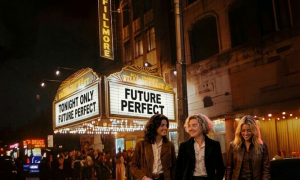
The lights dimmed and the spotlight was on Bill Graham, "We've got a very special show for you tonight, for one night only, a band you've only seen on the big screen so far with the Beatles and Elvis, please welcome, Future Perfect."
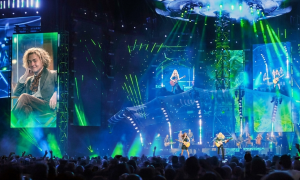
The black light came on as the band, the horns, and the three African percussionist took the stage to thunderous applause. The usual Fillmore East projection screen was hidden tonight behind a heavy, matte-black canvas tarp hung high above the stage floor. Across the dark fabric, the band's name—FUTURE PERFECT—was stenciled in sharp, clean block lettering using fluorescent white day-glo paint. Under the purple wash of the overhead UV floodlights, the letters burned with a piercing, electric blue-white luminescence, cutting through the haze and anchoring the room before a single note was played.
Chloe walked to the microphone, "Tonight we're joined by a very dear friend of ours on piano and Hammond B3, please give a warm welcome to our dear friend Wolf!"
Wolf bounded up to the stage center with Maya and stood between the two sisters their arms raised, each waving a white handkerchief.
Their instruments were readied by the crew, Maya went to the mic, "This first piece was on the great Jimmy Smith's album, Hoochie Coochie Man, which was produced by the very talented Oliver Nelson, who wrote and arranged this tune, "Blues and the Abstract Truth." To navigate use the control in the middle of the screen, or click here to open an overview of the set list on YouTube.
The side-stage shadows were thick with tobacco smoke and heavy attitude. Miles Davis leaned against an amplifier casing, his arms crossed over his leather jacket, dark sunglasses reflecting the stark purple UV glow of the stage. Next to him, Cannonball Adderley held a half-empty glass, tilting his head as the band took their positions.
"Hmph," Miles rasped, his voice a low, gravelly scrape that barely carried over the roar of the Fillmore crowd. "Flakey little white dude coverin' Jimmy Smith. This should be good."
Cannonball chuckled softly, taking a slow sip. "Word's out around town he's on another level, Miles. Heard soundcheck blew the brass players right out of their shoes."
Miles didn't flinch. "Talk is cheap."
On stage, the brass line took a collective breath and blasted open Oliver Nelson's arrangement. It was a Wall of Sound—tight, punchy, and dripping with mid-century jazz swagger. The three African percussionists locked into Kyle's heavy, swinging backbeat while Zack laid down a thick, thunderous bass line that anchored the entire groove, leaving Wolf free to roam wild across the keyboards.
Then Wolf took the wheel.
He didn't just play the Hammond B3; he attacked it like a man possessed by a lightning bolt. With Zack holding down the low end, Wolf's hands flew across both manuals in a fury of counterpoint and raw soul. He wasn't mimicking Jimmy Smith—he was using Smith's drawbar registrations to channel three centuries of harmonic genius.
Wolf hit the swell pedal, unleashing a roaring, Leslie-cabinet spin that filled every inch of the Fillmore. He pulled off a blinding downward palm-slide, landed on a dirty, squawking tritone, and held it right on the edge of dissonance before resolving it into a cascade of lightning-fast triplets.
Beside the stage, Cannonball stopped mid-sip. His eyebrows shot up toward his hairline, a wide, disbelieving grin spreading across his face. "Lord have mercy," he muttered, leaning forward. "Did you hear that voice-leading? He's playing the B3 like a pipe organ in a burning church!"
Miles didn't say a word. He slowly reached up with two fingers, tilted his dark sunglasses down his nose, and stared directly at Wolf's flying fingers.
Wolf was grinning like a madman on stage, leaning his head back, his white shirt catching the blacklights as he bent an altered chord, slapping the drawbars mid-phrase to change the tone from a smooth, creamy hum to a biting, metallic scream.
Miles pulled his glasses back up, but his posture had completely changed. He uncrossed his arms and stepped two inches closer to the monitor edge, his eyes locked on the B3.
"That ain't no flake," Miles growled softly under his breath, a faint, rare trace of awe cutting through his gravelly tone. "Cat's got fire."
As Wolf brought his organ run to a screaming climax, he slammed down a sustaining chord and pointed a finger straight at Chloe.
Chloe stepped up to the edge of the stage, her vintage Fender Telecaster hanging low. She channeled pure, electric sophistication. Flipping her pickup switch, she hit a series of blinding, lightning-fast triplet runs that snaked up the neck, slicing through the horn arrangements with sharp, biting clarity. She grabbed a cluster of chords, digging her pick deep into the strings, then instantly lightly tapped the fretboard to throw off a cascade of shimmering natural and pinch harmonics—notes squealing into high, bell-like overtones that hovered over the venue before snapping back into a driving, muscular rhythm.
Behind her, Maya stepped out from the darkness, her Gibson Les Paul slung across her chest, its mahogany body gleaming under the purple spots.
The two sisters locked eyes and closed the gap between them. What followed was a masterclass in guitar dialogue. Chloe threw down a dirty, swinging blues phrase; Maya answered instantly, twisting it into a thick, singing Les Paul bend. They began trading licks back and forth—four bars, two bars, then single-measure jabs—before locking together into a soaring, synchronized harmonic run. Their fingers climbed up their fretboards in parallel thirds and sixths, accelerating straight toward the ceiling, building a massive wall of guitar energy that matched the power of the entire horn section behind them.
Off in the wings, Duane Allman and Dickey Betts were standing shoulder-to-shoulder, completely transfixed. Duane had a unlit cigarette hanging out of his mouth, his eyes wide as he watched Chloe's fingerwork.
"Look at her hands on that Tele, Dickey," Duane muttered, shaking his head in absolute disbelief. "She's pulling artificial harmonics out of thin air while running triplets at that tempo! That's witchcraft."
Dickey Betts leaned against the side curtain, a low laugh escaping his chest as Maya and Chloe finished their climbing harmonic run in perfect unison. "And the way they're trading licks? Glad we're not gonna have to follow that tonight."
Duane just grinned, pushing his hair back from his face as the Fillmore crowd went absolutely wild. "Hell, I just want to stand right here and watch 'em burn the roof off."
The final, triumphant half-step modulation hit like a tidal wave. Wolf, Maya, Chloe, and the entire brass section smashed into the top-register resolution in absolute sync, Kyle crashing on his cymbals as the African percussionists brought their rapid-fire polyrhythms to a roaring crescendo.
The Fillmore East exploded.
The crowd went wild, a sea of raised arms, whistling, and cheering cutting through the thick, purple-and-blacklight haze. Backstage, Bill Graham leaned against the monitor console, a rare, beaming grin breaking across his face. Miles Davis didn't say a word, but the look he gave Cannonball said everything.
On stage, Chloe stepped back from the mic, wiping a light sheen of sweat from her forehead, her Telecaster still humming against her hip. She looked over at Wolf, who was beaming from ear to ear, his eyes shining with pure joy.
Maya walked up to the center microphone, waiting a beat for the thunderous applause to settle into a warm, expectant rumble.
"Thank you, New York," Maya said, her voice smooth and grounded through the monitors. "We're going to dial it back just a bit now. Take a breath with us."
She gave a nod toward the drum riser. Kyle winked. Beside him, Zack shifted his stance, his fingers resting lightly on the fretboard of his bass, ready to let the pocket breathe.
"We structured this next stretch for a very specific reason," Maya continued, turning slightly to gesture toward Wolf, whose hands were already hovering gently above the keys of a grand piano . "To take you back to a simpler time. This next song made it to number five on the charts way back in 1951, and then five years later Ray Charles recorded it with the great producer Jerry Wexler... "
She paused, turning toward stage left to point directly at Duane Allman with a warm smile, ... "and had a massive hit with it. We also love what Johnny Winter did with it on his debut album last year—if you don't have it, get it. His brother Edgar's piano turned it into a killer gospel version. Tonight, you'll hear our dear friend Wolf's version."
The audience roared in approval, but Maya raised a hand to keep building the moment.
"Most of you know Zack from our films as a great bass, dobro, flute, and lap steel player. But you don't know him as a singer—that's the price of backing Lennon, McCartney, and Elvis. Tonight, you have the treat of hearing what a great voice he truly has. Here is Zack taking the lead on 'Drown in My Own Tears'!"
Kyle laid down the beat with delicate, rhythmic taps on the ride cymbal, the metallic sizzle floating lightly over the quiet room. On the drum riser beside him, his stick work on the snare was soft and sparse, just a subtle whisper on the backbeat that let the room breathe.
Wolf leaned over the grand piano. He brought his left hand down hard into the deep bass register, striking a low, booming octave, while his right hand reached up to the high keys, laying down lush, gospel-drenched voicings that hung suspended in the air. He slid through the inner voice-leadings with absolute grace, crushing the minor third into the major third just like Edgar Winter had done on the record, but with an added classical nobility that made every chord swell like a choir.
Zack stepped up to his microphone, holding his bass loosely against his hip. He let the piano chord ring out, took a breath, and sang.
His voice was a revelation—a warm, rasping, soul-drenched baritone that carried immediate, unforced authority.
"It brings a tear... to my eyes... " Zack rasped, his voice soaring over the quiet room. "When I begin... to realize... "
Zack's bass guitar walked slowly alongside Wolf's piano. They weren't fighting for the low end; they were locked in a graceful dance. Every time Wolf dropped a heavy piano bass note, Zack's basslines met it in perfect, breathing synchronization, creating a rich, resonant foundation that vibrated through the floorboards.
The horn section entered softly in the background, playing a deep, velvet arrangement that swelled beneath Zack's vocals, giving the soul ballad a heavy, cinematic weight.
Off in the wings, Cannonball Adderley leaned against a stage monitor, his head slowly bobbing to the 6/8 sway. "Listen to that boy sing," Cannonball whispered, shaking his head. "And that pianist... he isn't playing the chords, he's preaching 'em."
Miles Davis stood motionless in the shadows, his eyes narrowed, watching Wolf's right hand dance across the upper register like a hawk. He didn't speak, but his head tilted slightly—he was listening to every single extension Wolf pulled out of the keys.
Wolf was completely lost in the music. His eyes were closed, his body swaying to the slow, heavy pulse. He played with a delicate, vocal elasticity—letting the high chords linger just a fraction of a beat behind Kyle's cymbals before resolving them into a cascade of sparkling gospel grace-notes.
As the song reached its emotional peak, the band shifted into a deep, slow-burning groove for the final climax. Maya and Chloe leaned into their vocal mics, joined by Kyle singing right from behind his drum kit, their three voices blending into a rich, soaring gospel harmony.
"Drown in my own tears... " Maya, Chloe, and Kyle sang in tight, emotional call-and-response.
Zack leaned into his microphone, his voice breaking with raw, soulful emotion: "Oh Lord, I believe I'm gonna... "
"Drown in my own tears!" the three of them answered, higher and full of passion.
"Yeah, I said I believe I'm gonna... " Zack called back, stretching the phrase as Wolf slammed down a massive, high-register gospel chord that rang out like a bell.
They repeated the sequence three times, building the tension higher and higher until Wolf brought his hands down for one final, slow-descending gospel run. He resolved the final chord with a soft, lingering suspension that hung in the silence of the Fillmore for two full seconds before the last cymbal ring died away.
For a beat, the entire theater was dead quiet—captivated by the spell.
Then the Fillmore erupted into a roar.
Maya smiled as the applause for "Drown in My Own Tears" washed across the stage, letting the lingering silence settle before stepping back up to the microphone.
"Our next song is appropriately titled... " Maya began, pausing to give a gracious, sweeping bow to the sea of faces in the dark auditorium, ... "'A Song for You.'"
A small ripple of warm recognition ran through the Fillmore crowd.
"Leon Russell wrote this absolute masterpiece in about ten minutes, and it appeared on his debut album earlier this year," she said, before turning back to face the band with a mischievous twinkle in her eye. "Are you all noticing a theme?"
On cue, the entire band yelled in near-unison into their mics: "If you don't have it, buy it!"
The audience erupted into laughs and cheers. Maya grinned, turning to point directly at Wolf, who sat poised at the grand piano, looking entirely in his element.
Wolf brought his hands down, initiating the iconic, descending piano intro.
Back in the loft, the band had played two very different interpretations for Wolf: Leon Russell's raw, unpolished original, and a promotional pre-release recording of Donny Hathaway's version. They had explicitly warned Wolf not to copy Hathaway's arrangement, but rather to use it as a benchmark—to hear how a master vocalist could stretch time and how the piano could breathe around that kind of soul power. Tasked with crafting his own unique arrangement, Wolf had absorbed the modern phrasing at staggering speed, but the true breakthrough had come from Maya's voice. As they rehearsed, her soulful, unvarnished singing became his compass, showing him precisely where classical complexity needed to yield to modern emotional space.
They had chosen to keep the performance stark and minimalist: just Wolf's piano, Maya's lead vocal, Zack's flute, and Kyle providing delicate, ambient percussion at key moments.
Wolf played the opening run with a staggering blend of classical nuance and pure, heart-wrenching soul. He didn't treat the rubato time like a rigid tempo; he let the music breathe, lingering on the suspensions just long enough to make the air in the Fillmore feel heavy.
Maya leaned into the microphone, her voice dropping into an intimate, velvety register:
"I've been in so many places in my life and time... "
Zack stood quietly to the side, bringing his silver flute to his lips. He blew a low, breathy, floating counter-melody that wove around Maya's vocal like smoke, providing a subtle, haunting harmonic shadow. On the riser, Kyle put down his sticks entirely, using his palms and fingers to lightly brush a hanging wind chime and a soft frame drum, dropping tiny, sparkling textures only when the emotional weight of the verse called for it.
In the wings, Miles Davis leaned his head back against the backstage wall, his eyes closed. He didn't say a word to Cannonball this time—he just listened to the way Wolf framed Maya's voice, using dynamic drops and lush, weeping chord extensions that bridged three centuries of keyboard history in a single phrase.
As Maya reached the chorus, her voice soaring into a raw, emotional crescendo, Wolf matched her note-for-note with a cascading, gospel-tinted arpeggio that sounded less like a piano and more like a heart opening up on stage.
As the last note of "A Song for You" faded into a warm, lingering silence, the audience remained completely spellbound. Maya took a quiet step closer to the center microphone, bathed in a soft amber spotlight.
Then, a wave of deep, enthusiastic applause swept through the Fillmore—not the wild roar of a rock finale, but a warm, reverent ovation, punctuated by whistle calls and gasps of appreciative calls from people who knew they were witnessing something special.
Maya smiled, letting the applause wash over her and fade before taking a quiet step closer to the center microphone, bathed in a soft amber spotlight.
"This last piece in our quiet stretch comes from two absolute masters of modern American songcraft—Burt Bacharach and Dionne Warwick," Maya announced softly. "It's a song called 'Here I Am.'"
Behind her, the stage layout shifted into something intimate, dreamy, and exquisitely delicate.
Wolf sat back at the grand piano, his posture poised. Off to his right, Monty stepped up to the Hammond B3, pulling a custom set of drawbars to transform the organ into something nearly unrecognizable—a shimmering, atmospheric drone that mimicked a lush string section, swelling and receding like a gentle tide.
Kyle stayed on his wire brushes, creating a soft, sweeping rhythm across his snare drum that sounded like ocean waves on smooth sand. Zack anchored the low end with understated, melodic basslines, while Chloe picked up an amplified acoustic guitar, her fingers moving across the fretboard with the understated grace of a top-tier West Coast jazz session player.
Maya sang the opening line with a dreamy, effortless elegance, her voice floating over the complex, shifting meters of Bacharach's score.
Bacharach's composition was notorious among musicians for its odd-meter measures and sudden, subtle time signature shifts, but Wolf didn't flinch. Having mastered the intricate counterpoint and irregular phrasing of 18th-century classical music, he mapped Bacharach's harmonically nuanced pop with absolute ease. He mirrored the signature piano voicings, peppering the gaps between Maya's vocal phrases with bright, sparkling flourishes that sounded like light catching water.
On the side of the stage, Miles Davis crossed his arms, his eyes fixed on Wolf's hands as the band glided through a smooth metric modulation.
"Look at the way he handles those bar changes," Cannonball murmured under his breath, shaking his head in admiration. "Most rock players would trip all over a Bacharach arrangement. That cat isn't counting beats... he's swimming in 'em."
Monty worked the swell pedal on the B3 with breathtaking precision, keeping the organ's tone warm, airy, and gossamer-thin, ensuring it supported Maya's voice without ever overwhelming the fragile, sparse acoustic space.
As Maya held the final, soaring note, Wolf executed a quiet, ascending piano run that resolved into a lush, unresolved chord, floating off into the venue as Monty slowly backed off the B3's swell pedal.
The room held its breath for a long, silent second before the Fillmore audience broke into a sea of warm, appreciative applause—winning over a crowd that had every reason to reject Bacharach as the ultimate establishment square, the ultimate Hollywood playboy married to a starlet. But the sheer beauty of the music had completely obliterated their cynicism.
"We live in an electrified world," Chloe said, her voice ringing clear through the monitors. "When we think of the blues, we naturally think of the electric guitar. But when the blues first started moving people, the piano was the absolute king. Thanks to the mass produced upright piano, every backwater juke joint had one, and pioneer bluesmen were their own little orchestra wherever they traveled—playing loud enough to be heard over a roaring crowd and keep everyone dancing."
She turned, gesturing toward Wolf, who gave the audience a modest nod from behind the piano bench.
"This next song is by one of those genuine pioneers," Chloe continued. "A lesser-known cat named Booker T. Laury, a close friend of Memphis Slim. The original is stripped down, but tonight we're going to use our horn section to back Wolf on this one. Monty is sitting in on drums, because our own drummer, Kyle, is stepping out from behind the kit to sing 'Big Legged Woman' for you. You're in for another treat."
The crowd cheered as Kyle walked out to the front mic, holding the stand with effortless swagger, while Monty settled behind the drum set, laying down a heavy, foot-stomping barrelhouse shuffle.
Maya and Chloe kept their guitars intentionally restrained, staying out of the way of the acoustic space. Every so often, on a heavy breakpoint or a syncopated turn, they would strike a sharp, biting chord in exact sync with Wolf, adding a sudden splash of electric grit before stepping right back out of the mix.
Wolf was absolutely on fire.
He didn't just play the barrelhouse rhythm; he lived it. His left hand pumped out a ferocious, rolling 12-bar bass line that rattled the grand piano's wood casing, while his right hand unleashed jaw dropping cascades of crushed grace-notes, triplet runs, and raw, crying blue notes. He leaned over the keys, his face alight with sheer joy, driving the groove like a locomotive.
Kyle leaned into the mic, his voice raspy, soulful, and dripping with Memphis blues grit as the horn section hit punching, syncopated accents behind him.
Looking toward the wings, Maya caught sight of a movement in the shadows. Yusef Lateef, Cannonball Adderley, and Gregg Allman had all drifted out from backstage, creeping right up to the edge of the stage floor. They stood side-by-side in absolute disbelief, their eyes fixed on Wolf's flying fingers as he ripped through a jaw-dropping piano chorus, effortlessly blending classical technique with raw, unadulterated juke-joint grease.
The applause went on and on, a continuous wave of thunder that rattled the balcony of the Fillmore East. Wolf stood up from the piano bench, genuinely moved, and offered a deep, formal 18th-century bow to the cheering crowd. As the ovation refused to die down, he caught Maya's eye, grinned, and stood a second time, bowing sweeping and lower, bringing a laugh from the front rows.
Back near the drum riser, Chloe slung her Telecaster over her shoulder, wiped her brow with the back of her wrist, and winked at Maya.
"That was a blast from the past!" Chloe said with a wicked grin.
Maya laughed, her Les Paul still humming against her hip. "Two centuries out of date and he's got the Fillmore ready to tear the roof off!"
Off to the side, Gregg Allman was still shaking his head, pointing out Wolf's left-hand barrelhouse work to Dickey Betts, while Miles Davis gave a single, firm nod of approval before melting back into the backstage shadows with Cannonball.
Maya stepped up to the center mic, waiting for the thunderous crowd to settle just enough so she could be heard over vibrating energy of the room.
"We've got one last piece for you tonight," Maya announced, her voice booming through the monitors. "It's another oldie, 'Little Queen of Spades' written back in 1938 by the great Robert Johnson. I think if he were here tonight, he might just approve."
Future Perfect launched into a fierce electric blues arrangement and supercharging it with a wall of extended horns. Monty stepped back up to the Hammond B3, laying down a roaring, organ-drenched foundation alongside Zack's thunderous bass line and vocal, while Wolf sat heavy in the mix on piano, slapping out syncopated, fiery blues accents that drove the tempo into overdrive.
Then Maya and Chloe took center stage for the climax.
With Maya playing left-handed and Chloe right-handed, the two sisters stood shoulder-to-shoulder, their guitar necks forming a perfect, mirrored V-shape under the ultraviolet lights. What followed was a wild, breathtaking show of force—trading blinding lead rounds back and forth, matching lightning-fast pentatonic runs, screaming pitch bends, and cascading harmonics in a dizzying display that would make any guitarist in the room want to slink right out of the building. Thankfully, no one had to follow them tonight.
They brought the song home in a staggering, multi-instrumental crescendo, crashing into the final chord as the Fillmore East erupted into complete bedlam.
For four continuous minutes, the venue shook with nonstop cheering, stomping, and deafening applause. Finally, the band reappeared under the flashing stage lights.
Maya walked back to the microphone with a joyous, radiant smile. Motioning for Zack to step up beside her, she used her left-handed position to frame the mic stand perfectly as they shared it.
"This one is from the great Bo Diddley!" Maya shouted to the roaring crowd.
They launched straight into the iconic, shuffling Bo Diddley chuck-a-chuck-a-chuck chuck-chunk beat, Maya and Zack trading off lines in a gritty, electrifying call-and-response:
"I walk forty-seven miles of barbed wire!"
"I use a cobra snake for a necktie!"
"I got a brand new house on the roadside!"
"Made from rattlesnake hide!"
As the rhythm pulsed through the auditorium, Maya and Chloe began motioning for their friends and fellow musicians to join them from the wings and stage edges. The Allman Brothers, Cannonball Adderley, Yusef Lateef, and the stage crew all flooded out onto the wood, clapping along and moving to the infectious groove.
Then came the moment that caused the band to rubber neck.
From the deep shadows off stage left, Miles Davis stepped out. He moved slowly through the crowd on stage—and to everyone's absolute shock, a genuine, rare smile broke across his face.
To the band's utter amazement, Miles walked directly over to the grand piano, reached out, and wrapped his arm firmly around Wolf's shoulder.
Wolf looked up from the keys, his face lighting up with a brilliant, triumphant grin as the Fillmore East—and 2.6 billion subscribers in 2092—watched the legendary prince of darkness embrace Wolfgang Amadeus Mozart.
Epilogue—The Wolfpack
Dinner had stretched well past midnight.At the trattoria down on 8th Avenue, the owner, Signor Bellini, had practically barricaded the front door against the brisk autumn wind so no ordinary patrons could disturb his guests. Wolfgang had spent two hours holding court in theatrical, courtly Italian, toasting the bread, the Chianti, and the veal shank with gestures broad enough to conduct an opera house. By the time they finally spilled out onto the street, bellies full and coats pulled tight against the chill, Bellini had kissed Wolfgang on both cheeks, pressed a paper bag of fresh cannoli into Chloe's hands, and shouted into the empty street that the house belonged to the maestro forever.
Now, the heavy wooden door of the West 26th Street rehearsal loft swung shut behind them, cutting off the distant thrum of late-night Manhattan traffic.
Inside, the room was cool, resting in that sacred, dusty stillness that only follows days of relentless noise. The scent of roasted espresso hung in the air, mingling with the faint iron odor of resting transformers. The Steinway baby grand caught the yellow slice of a streetlamp through the tall industrial windows, black and silent as a sleeping whale.
Wolfgang immediately slipped out of his tweed jacket, tossed it carelessly across the arm of an equipment flight case, and dropped onto the piano bench. He didn't play. He simply rubbed his palms together, his boyish face flushed with residual wine and lingering electricity.
"I cannot sleep," Wolf declared, his eyes bright in the gloom. "My blood is behaving like seltzer water. What is the plan? Do we dissect the Italian's magnificent garlic sauce, or do we construct a symphony for three accordions and a kettle drum?"
Julian smiled quietly from behind the dark mixing console. He didn't take off his coat. Instead, he reached over to a heavy gray flight case sitting on the floor beside the patch bay, flicked the butterfly latches, and pulled out an enormous ten-and-a-half-inch reel of heavy magnetic tape.
"Neither," Julian said.
Maya, leaning against the edge of the riser with her boots kicked off, raised an eyebrow. "Julian... what did you do?"
"Before we went on tonight," Julian said, resting his hand on the metal rim of the reel, "I slipped backstage to the sound booth. I ran balanced snake lines from Bill Graham's master mixer straight into our Ampex four-track recorder. I told Eddie to keep the heads clean, monitor the input levels, and let the reels spin until the theater went dark."
Wolfgang's head snapped up. His eyes darted from Julian to the machine, then back again.
"You... you captured it?" Wolf's voice dropped, stripped entirely of its theatrical bombast. "The noise? The lightning? The whole monster?"
"Every dirty note," Julian nodded. "Would you like to hear it, Wolf?"
Wolfgang jumped off the bench so fast his leather boots scuffed the floorboards. "Would I like to hear it? Would I like to breathe? Julian, you absolute scoundrel, if you do not thread that machine this instant, I shall write a canon about your nose and have it sung in every public square in Christendom!"
Kyle burst out laughing, dropping his sticks onto the snare. "Careful, Julian. He'll actually do it."
"Alright," Maya said, clapping her hands softly. "If we're going to do this, we do it right. No sitting at the desk staring at needles and dials. That's for engineers. This is for the ear."
Zack stepped forward, grabbing the corner of a heavy vintage leather club chair. "Circle formation?"
"Circle formation," Chloe agreed.
They hauled five deep, worn leather armchairs into the dead center of the open floorboards, setting them in a tight ring with their backs pressed close together, facing outward toward the four dark corners of the loft. No faces to read. No body language to distract. Just five sets of ears pointed outward into the acoustic space.
Chloe moved across the room, striking a match and lighting a trio of thick pillar candles on a low wooden table beside the brick wall. One by one, Julian killed the overhead industrial lamps until the cavernous room dissolved into warm shadows and long amber pools of flickering wax light.
Wolf climbed into the center-facing armchair between Maya and Zack, sinking into the leather with an eager, almost terrified reverence. He tucked his legs under himself, clutching a white porcelain mug of cold coffee with both hands, staring out into the dark space where the Steinway slept.
Across the room, Julian flipped the power switch on the big studio playback monitors. A soft, high-frequency hiss drifted from the speakers—the velvet breath of blank tape riding across hot playback heads. Then, the heavy clunk of the Ampex transport engaging.
The tape rolled.
First came the room sound: a cavernous, terrifying rumble. Thousands of bodies shifting in wooden seats, the clatter of beer bottles, the nervous chatter of the Fillmore East waiting for a miracle. Bill Graham's voice crackled through the public address system, distant and sharp, introducing them.
Then came the opening crack of Oliver Nelson's brass fanfare.
Wolfgang's spine snapped straight against the leather.
The speakers blasted the loft with a sheer physical wall of sound—the roaring, dirty shriek of the Hammond B3 catching fire, Zack's walking bass pacing like an angry lion beneath it, and Kyle's snare cracking through the room like dry birch snapping in winter.
Wolf did not breathe.
For forty-five minutes, nobody spoke. The tape unspooled with relentless, terrifying fidelity.
They heard the manic Hammond sweeps of Blues and the Abstract Truth, the crowd roaring as Wolf bent the drawbars; they heard the hushed, aching church-house silence that fell over the auditorium when Zack's raw baritone led them into Drown in My Own Tears; they heard Maya's intimate, heart-stopping vocal on A Song for You, floating weightless over the breath of Zack's flute and Wolf's weeping piano suspensions.
When the tape reached the wild, barrelhouse stomp of Big Legged Woman, Wolf's fingers began twitching against the leather armrests, tapping out the frantic syncopations in the dark. And finally, the monstrous, electrified fury of Robert Johnson and Bo Diddley—the two sisters trading screaming lead runs, the crowd screaming in rhythmic ecstasy, and the sudden, unmistakable sound of thousands of people losing their minds as the groove locked into eternity.
The tape hissed into the empty run-out leader.
The Ampex transport gave a sharp clack, the spinning metal reel freewheeling until it drifted to a gentle stop.
Silence descended on the loft. Not cold silence, but a thick, pulsating quiet, heavy with the phantom ring of amplifiers and the smell of cooling candle wax.
For a long minute, no one moved.
Then Wolfgang slowly leaned his head back against the top of the leather chair, looking straight up into the dim shadows of the industrial rafters.
"In Vienna... " Wolf began softly, his voice trembling slightly, devoid of any accent or affectation, ... "when an opera was a triumph, they clapped."
Maya shifted in her chair, turning her head slightly toward the sound of his voice. "Polite clapping?"
 FOLLOW Blue Note Portal
and get notified whenever a new article published.
The Blue Note Portal: a garage-assembled '70s microcomputer relic, eternally portaling through jazz timelines with Serling-esque irony, hacking bebop anomalies into binary swing for the ultimate improvised reboot.
About Wolfgang Amadeus Mozart

Tags
PREVIOUS / NEXT

Become a Sustaining Member

Since 1995, All About Jazz has championed jazz as an art form and supported the musicians who create it. Over three decades, it has grown into one of the world's leading jazz resources, serving hundreds of thousands of readers, musicians, presenters and industry professionals each month.
Help Build the Future of All About Jazz
Your support helps us continue building All About Jazz for the next generation—expanding our editorial coverage, preserving jazz history, developing new community features and creating better ways to discover the music and the people behind it.
Become a sustaining member for as little as $20 per year and you'll immediately enjoy an ad-free experience along with access to subscriber features and future articles for a full year.
Together, we're not simply sustaining All About Jazz—we're building its future. Thank you for being part of the journey.