Home » Jazz Articles » The Blue Note Portal » Fillmore Dreams, Part 2
Fillmore Dreams, Part 2
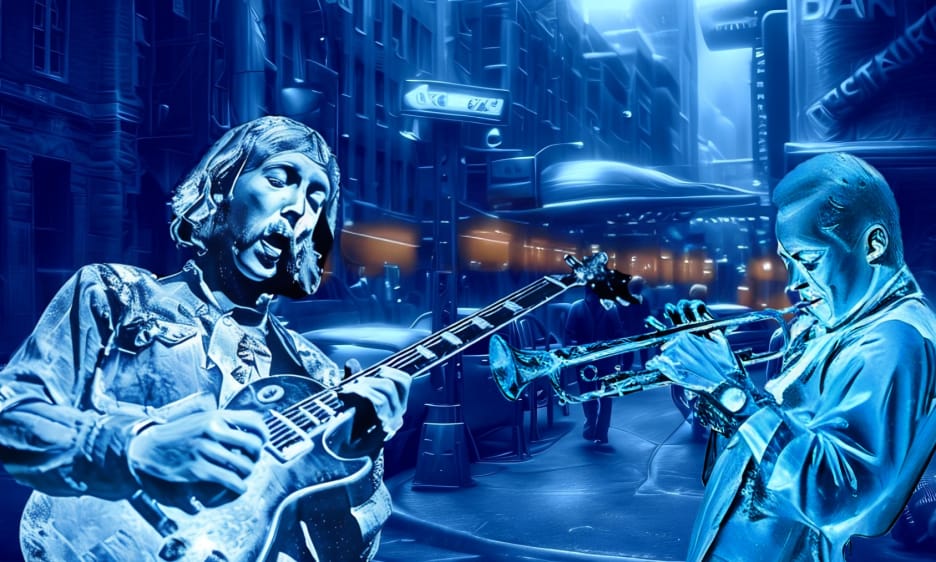
Miles Davis was there, wearing a dark jacket, open, no shirt beneath it, his chest was visible. His body was lean and angular and alive. He held the trumpet the way the archives showed — close to his body, tilted slightly up, the horn an extension of his arm, his arm an extension of his intent. The sound coming out of it was not a sound any archive had ever fully captured. It was physically present in the room.
The transition was not at all what Xample expected. Dr. Kovac had walked him through the neural integration protocol multiple times. He had read the technical documentation—all 1,400 pages of it. He had sat in the chamber on the seventy-seventh floor, felt the interface nodes calibrate against his temporal lobes, felt the gentle heat of the mapping sequence as it built a model of his sensorium. He had closed his eyes. He had expected darkness, then light, then a gradual resolution—the way a hologram stabilizes.
Instead, he opened his eyes and he was standing on a sidewalk.
That was it. No transition. No fade. One moment he was in the chamber, and the next he was here—standing on a street corner in what he recognized as Manhattan.
The first thing he noticed was the smell.
Nothing in 2092 smelled like this. The Corridor's atmospheric systems maintained a sterile, faintly ozonic baseline. This was exhaust fumes—the kind that came out of tailpipes and hung in the air like a bruise. This was cold air carrying the ghost of garbage from the curb. This was cooking—somewhere, a restaurant or an apartment, garlic and oil and something under it, something organic and warm and human. This was a dog turd on the sidewalk ten feet to his left. This was car rubber on wet asphalt. This was two hundred years of microbiology and no filtration.
He stood on the corner and it hit him. A bus groaning past on Avenue A, air brakes squealing. A radio in an open window somewhere above him. A man across the street yelling something to someone in a doorway, and the someone yelling back, and neither of them caring whether anyone else heard. A jackhammer three blocks away.
He looked down. He was wearing clothes he had never seen before and yet recognized. A sheepskin-lined denim jacket, broken in but not ratty. Beneath it, a flannel shirt. Jeans—real denim, stiff, the kind that would take weeks to soften. Boots, scuffed, broken in by someone else's feet. He reached into the jacket's pocket and found a set of keys, a wallet in his pocket, and a matchbook from a restaurant called Ratner's. In the other pocket, a small notebook with a pen clipped to it, and a slip of paper with an address: 327 East 5th Street, Apt. 4B.
He was now Alex Mercer, and the contextual layer was there—it was not like an explicit memory, it was more like—a knowing. He knew where the apartment was. He knew he'd arrived in New York three days ago from San Francisco. He knew he had some connections in the music business—loose, tenuous, the kind of connections a young producer might have if he'd worked a few sessions, carried a few cables, been in the right room at the right time often enough to have a name people half-remembered. He knew, vaguely, that he was supposed to be at the Fillmore East sometime this weekend.
He started walking, but the city was not the city he knew. This was a city in the process of rotting and growing at the same time, buildings with fire escapes that looked like rusting sculptures, storefronts with hand-painted signs, graffiti on subway cars that he could see through a grate as a train rumbled beneath him.
No one looked at him, and this was the first thing that truly registered as strange—and then, immediately, as wonderful. He walked past a dozen people in half a block. Not one of them registered his face. Not one of them adjusted their path to accommodate him. Not one of them—and this was the thing that would have been unthinkable in the Corridor—recognized him. In 2092, Xample could not enter a room without the room knowing. His face was on every screen, his name was a brand, his net worth was a matter of public record, and every person he encountered had already formed an opinion about him before he opened his mouth.
Here, he was a man in a denim jacket walking down a street. That was all.
He found the apartment. 327 East 5th Street. A kitchen the size of a closet with a stove that looked like it had been manufactured during the Eisenhower administration. A radiator beneath a window that clanked like a prisoner dragging a tin cup across bars. A mattress on a metal frame, a chair, a table. A telephone—an actual telephone, beige plastic, rotary dial, plugged into a jack in the wall.
He stood in the middle of the room and felt something he had never felt before.
He felt anonymous. Not the strategic anonymity. This was the real thing. This was the anonymity of a person whom no one—not one single person on the planet—was currently thinking about. He was, for the first time in his forty-one years, unobserved.
The Fillmore East sat at the corner of Second Avenue and East 6th Street, an incongruous triangle of a building that looked like what it had been before Bill Graham turned it into a cathedral—a movie theater. Xample found it at noon on Friday, walking the twelve blocks from his apartment in the cold, taking his time, letting the city sink in.
He read the marquee,
THE ALLMAN BROTHERS BAND FRI & SAT MAR 12-13—8 PM & 12 AM ALSO APPEARING—ELVIN BISHOP GROUP, and COUNTRY JOE McDONALD
He stood across the street and looked at it for a long time. The letters on the marquee were hand-placed, and slightly crooked. The poster in the glass case by the door was a two-color print—blue and orange—with a photograph of the band that he recognized instantly, because it was in every music history archive.
The door was open and a roadie was carrying cable through it. Xample crossed the street.
Inside, the Fillmore East was a theater—a real theater, with a sloped floor and a balcony and a stage that was bigger than he'd imagined. The seats had been removed on the main floor, replaced with folding chairs and standing-room sections. The sound system was being assembled—columns of speakers on either side of the stage, a mixing board in the center of the floor that looked primitive enough to make him smile. Bill Graham's people were everywhere—lighting techs, stagehands, a woman with a clipboard who looked like she could manage a military campaign.
He followed the cable down a narrow staircase at the side of the stage, into the basement. The air changed—cooler, damper, the smell of concrete and old wiring. At the bottom of the stairs, a room. In the room, a man.
He was crouched behind a backup portable recording console—an Ampex MM-1000, eight-track, the kind of machine that had been state of the art in 1971 and was now, in 2092, in a museum. He was checking levels, his hands moving across the board with the unconscious ease of a man who had been doing this for longer than Xample had been alive. He was stocky, balding, with glasses and a calm, focused expression that made him look less like a technician and more like a surgeon checking his instruments before an operation.
He was sure, Xample knew the face, he was Tom Dowd.
He'd watched every available interview, read every profile, listened to nearly every recording Dowd had engineered. There he was—crouched, breathing, adjusting a pot on the console with his thumb, muttering something to himself about the left channel.
Dowd looked up and asked, "Can I help you?"
"I'm Alex Mercer," Xample said. The name came easily. "I'm in from San Francisco. Jerry Rosen said I should look you up if I was in New York this week."
Jerry Rosen was a name the CCE had provided—a West Coast A&R man with loose Atlantic connections, a plausible enough link that Dowd would recognize the name without knowing the person. The plausibility constraint, doing its work.
Dowd considered this. He had the manner of a man who was constantly approached by people claiming to know someone he might know, and who had learned to neither embrace nor reject these claims until he had more data.
In a friendly voice Dowd said, "So you know Jerry Rosen, how is he doing?"
"He's good, he said you'd be down here with the rig."
Dowd smiled—a quick, warm smile that reached his eyes. "How about you, do you know recording?"
"I know enough to stay out of the way."
That made Dowd laugh. "That's more than most people in this business know. You want to make yourself useful, there's a coil of XLR cable in the flight case by the wall. I need it run from the stage inputs down to the board. You know XLR?"
"Three-pin. Balanced. Yeah."
"Good" Dowd said as he turned back to the console. "And don't step on anything."
The cable run took an hour. Xample hauled the coil up the stairs, across the stage, and back down, connecting stage inputs to the Ampex in the basement. It was physical work—his hands got dirty, his back ached, and at one point he skinned his knuckles on a metal edge. He felt the sting and saw his own blood, it was bright red, real. He paused and looked at it. The CCE was rendering capillary damage, it almost made Xample laugh.
When he came back down, Dowd was on the phone, arguing with someone about a microphone placement. He hung up, saw Xample, and nodded.
"Good work, you have run cable before?"
"At the Paramount, in San Francisco. A few sessions, but nothing like this."
Dowd studied him for a moment, and asked: "What do you think of the band?"
It was a test. Not a hostile one—Dowd didn't do hostile—but a real question from a man who cared about the answer.
"They're the real thing," Xample said.
Dowd's expression didn't change, but something behind it did. "Yeah," he said. "They are. You know what I mean by that?"
"I think so."
"Most people don't. Most people hear two guitars and think it's a rock band. It's not a rock band. It's a conversation. Those two kids up there—Duane and Dickey—they talk to each other through their instruments. I've been recording for twenty years. I've recorded Coltrane. I've recorded Cannonball. I know what it sounds like when musicians listen to each other. These kids do that. Duane especially. That boy hears things most people can't."
Xample felt the weight of what he knew. Duane Allman would be dead in seven months, from a motorcycle accident in Macon, Georgia. He wanted to warn Dowd, but he knew it was impossible.
"I've been thinking about something," Xample said. "You've worked with Miles Davis."
Dowd's eyebrows went up slightly. "I have. Not in a while, but yeah. I was at Columbia for the Kind of Blue sessions. Well—some of them. I wasn't the primary engineer on that, but I was in the building."
"What if Miles sat in with these guys?"
The room was quiet except for the hum of the Ampex. Dowd looked at him.
"That's a hell of a thought," Dowd said.
"The band plays 'Dreams.' Blues, but it's modal. It is built on the architecture Miles built. If Miles walked into this room and played on that song, it would be a circle made whole."
Dowd was quiet for a long time. He had the look of a man turning something over in his mind—not skeptically, but seriously. The way an engineer thinks about a problem that has a solution, if he can find the angle.
"Miles doesn't sit in," Dowd said. "Miles doesn't do favors. Miles doesn't show up because someone asks him to."
"And you can't pitch Miles. He smells a pitch the way a dog smells fear. The moment he thinks you're selling something, you're done."
"I know that too."
"So what are you thinking?"
"I was just thinking you know him. I'm thinking he respects you, and not because you're a nice guy, which you are, but because you were in the room when the music happened. You were there for Coltrane. You were there for Aretha Franklin . Miles knows that. And I'm thinking if you told him to come down here and just listen—not play, not commit to anything, just listen—he might do it. Not for me. For you."
Dowd removed his glasses, cleaned them on his shirt, put them back on. It was a gesture Xample recognized from the interviews—a stalling tactic, a way of buying three more seconds to think.
"It would have to be tonight," Dowd said. "He's playing somewhere downtown with his band. I can find out where. But I can't go—I've got the rig to monitor, and if anything goes wrong with the tape stock during the first set, I'm the only one who can fix it in real time."
"I could go," Xample said.
Dowd looked at him. "You don't know Miles."
"No. But I know music. And I know what I'm asking. If he says no, he says no. But if he says yes—even just to come and listen—Tom, this could be the night."
Dowd was quiet again. Then he reached for the phone.
"Let me make a call."
The call took twenty minutes. Dowd spoke to three people—a club manager, a record label contact, and someone whose name he didn't say but whose tone he softened for. What Xample didn't know—what he learned when the call ended and Dowd turned to him with a particular expression that was equal parts excitement and caution—was that the third call had been to an Atlantic Records executive named Jerry Wexler, who had been in the building.
Wexler appeared fifteen minutes later. He was shorter than Xample expected, compact, with dark hair and the energy of a man who processed the world in terms of opportunity. He came down the basement stairs like he owned them, looked at Dowd, looked at Xample, and said: "Tom says you want Miles Davis at the Fillmore tonight. And just who are you?"
"Alex Mercer. I've been helping Tom with the rig."
"Do you have any relationship with Miles?"
"No, none at all."
"Any relationship with the band?"
"Loose. I know people who know them."
Wexler looked at Dowd. Dowd gave a slight nod—not an endorsement, but an acknowledgment that Mercer had been useful and hadn't said anything stupid.
"Here's the thing," Wexler said. "If Miles Davis walks into the Fillmore East and sits in with the Allman Brothers Band, that's not a gig. That's a moment. That's a thing people will talk about for fifty years. And if Atlantic Records is the label that made it happen, that's not just good press—that's history." He paused. "But if we send some kid downtown to bother Miles Davis and Miles Davis gets annoyed, it doesn't blow back on the kid. It blows back on Atlantic. It blows back on Tom. And Miles holds grudges the way other people hold drinks."
"I understand that," Xample said.
"Do you? Because Miles Davis is not a guy you can charm. He doesn't care if you're smart. He doesn't care if you're connected. He doesn't care if you're brave. He cares about music, and he cares about whether you're real. And he can tell. I've seen him look at people and just know."
"I'm not going to charm him. I'm going to tell him what's happening in this building this weekend, and I'm going to ask him to come listen. That's all."
Wexler studied him for a beat. Then he turned to Dowd. "You trust this kid?"
Dowd paused. "He runs cable like he means it," he said. "And he talks about music like he's listening to it, not like he's selling it."
Wexler made a decision the way executives make decisions—quickly, once the calculus was done.
"We'll send a car. Atlantic's limo. I'll have it downstairs by nine. You go to the club, you find Miles, you tell him what's happening, and you bring him back if he'll come. If he won't come, you come back alone and we never mention it again." Wexler pointed at him. "Don't be clever, just be honest. With Miles, that's the only play."
He went back up the stairs.
Dowd looked at Xample. "Are you sure about this?"
"No," Xample said. "But that's never stopped me before."
Dowd laughed—a real laugh, warm and unguarded. "You might be all right, Mercer."
Xample, however, knew something he had not mentioned: he knew the setlist from those dates, and they did not play "Dreams" during that run. He looked at Tom Dowd, "What if we get Miles here and they don't have "Dreams" on their set list, is that a problem?"
Dowd laughed. "That's a problem I can handle."
The limo was a black Cadillac Fleetwood, impossibly long, with tinted windows and a driver who looked like he'd been hired for his ability to exist in rooms without being noticed. Xample sat in the back and felt the leather seat against his back—real leather, real cold seeping through the glass—and watched the city move past the window in a way he had never seen a city move, which was slowly, and physically, with traffic.
Dowd had found out where Miles was playing—a small club on the West Side, the kind of place that didn't have a marquee because it didn't need one, because the people who needed to know already knew. The driver knew the address. They pulled up outside at ten-thirty.
The club was called Slade's. It was a basement room on West 46th. You went down a narrow staircase through a door that had no sign. The sound coming up the stairs was electric—not the acoustic Miles of Kind of Blue, not the muted Miles of Sketches of Spain, but the electric Miles of 1971. Wah-wah trumpet over a funk groove, guitar fuzz, a drummer playing a rhythm that sounded like it was being assembled and disassembled simultaneously. Live-Evil era. This was the sound of Miles Davis reinventing music in real time.
Xample went down the stairs.
The room was small, dark, and full of smoke, and it was packed. Maybe a hundred and fifty people, all standing, all facing the band, all listening in that particular way people listened to Miles Davis.
Miles was on stage. Xample saw him and felt the floor shift under his feet—not literally, not a CCE glitch, but the weight of the moment. Miles Davis was there, wearing a dark jacket, open, no shirt beneath it, his chest was visible. His body was lean and angular and alive. He held the trumpet the way the archives showed—close to his body, tilted slightly up, the horn an extension of his arm, his arm an extension of his intent. The sound coming out of it was not a sound any archive had ever fully captured. It was physically present in the room.
He didn't approach yet, he simply listened. He leaned against the back wall and let the music hit him.
With Miles in this period, the distinctions between songs were theoretical, everything bleeding into everything else, the band moving from one groove to the next like a river changing course. The trumpet was extraordinary—angry, beautiful, searching, sometimes falling into silence that was louder than the sound. The band was young, hungry, following Miles the way a wolf pack follows the alpha, not out of obedience but out of trust that the direction would be right.
The set ended—not with a climax, but with a long, slow fade, and Miles walking to the back of the stage as the band faded out behind him. Xample moved through the crowd toward the side of the stage where Miles was standing, drinking water, not looking at anyone. A few people tried to approach him, but the expression on Miles's face shut them down.
Xample reached the edge of the stage and expectantly said, "Mr. Davis."
Miles looked at him. The eyes were dark, sharp, evaluating. He took in the denim jacket, the young face, and the posture, and turned away.
"My name is Alex Mercer. I'm working with Tom Dowd at the Fillmore East. The Allman Brothers are playing tonight and tomorrow, and—"
"I don't care," Miles said. Still not looking at him.
"Tom asked me to come. He couldn't make it himself—he's running the recording rig—but he wanted you to know the band is playing 'Dreams' this weekend, and—"
"I know who the Allman Brothers are." Now Miles looked at him. The look was not warm. "I know what they do. White boys playing the blues. I've heard enough of that."
"You haven't heard these white boys."
Something flickered in Miles's expression. Not interest—not yet. But the flicker of a man who recognized a certain kind of nerve.
"You telling me what I've heard?"
"I'm telling you what's happening tonight at the Fillmore East. Two thousand people and the band is recording live with Tom Dowd. There's a limo outside. Tom wants you to come and listen. Not play. Just listen."
Miles stared at him. The stare lasted five seconds, which was long enough to be a confrontation.
"I don't go to nobody's gig," Miles said. "People come to mine."
It was then that the large man stepped between them.
He was enormous—six-four, maybe six-five, broad, with the build of someone who had been big his whole life and had learned that size was usually enough. He wore a dark jacket and a blank expression. He was not a paid security guard. He was someone in Miles's orbit who handled things without being asked, who removed obstacles before they became problems.
"Time to go," the big man said to Xample. It was not hostile, but it was final.
Xample didn't move. He kept his eyes on Miles. "Tom Dowd said you'd say no. He said you always say no. He also said you'd regret it."
Miles's eyes narrowed. "Tom said that?"
"Tom said you'd say no, and then a year from now, someone would play you the tape, and you'd hear what Duane Allman does on 'Dreams,' and you'd hear structure underneath it, and you'd hear the conversation, and you'd know that you could have been in that room, and you weren't."
The big man's hand closed around Xample's upper arm.
The grip was firm. Not punishing—functional. The kind of grip that said you're leaving now with the same authority that a bouncer uses to eject someone from a bar, which is to say: the assumption was that resistance was not an option.
Xample had been training for this moment for twenty-two years.
He had started martial arts at nineteen—not because he needed to defend himself in the Corridor, where violence had been engineered out of daily life, but because his father had told him that a man who had never been physically challenged didn't know himself. X had said this once, in passing, and Xample had heard it as a directive. He had studied Aikido first, then Brazilian jiu-jitsu, then a combative system that blended the two and added elements of judo and close-quarters striking. He had trained with live partners for two decades, but had never used it outside the dojo.
When the big man pulled, and Xample instinctively moved.
It was not a fight, it was a redirection. The big man's energy was pulling him toward the exit. Xample didn't resist the pull. He joined it—stepped into the direction of the force, let his body flow with the grab, and in the same motion turned his hip and dropped his center of gravity. The big man's arm, extended and committed to a direction that was no longer the right one, became a lever. Xample's hand found the wrist. His other hand found the elbow. The wrist rotated. The elbow followed. The big man's knees buckled—not from pain, but from the simple mechanical reality that his arm was now locked in a position that his body could not move out of without something tearing.
He was on the floor. It had taken less than two seconds.
The room went quiet.
Not the quiet of surprise—it was the quiet of recognition. Everyone in the room, including the band, including Miles, had seen what happened, and what they had seen was not violence. What they had seen was control.
Xample looked up. Miles was staring at him.
The expression on Miles Davis's face was something Xample had never seen in any archive, any photograph, any interview. It was not amusement, not admiration, not gratitude. It was genuine interest. It was the look of a man who boxed at Gleason's Gym, who understood physical courage not as a concept but as a condition, and who had just watched a white kid from the West Coast put his best man on the floor with the cleanest redirection he'd seen in years.
"Tito," Miles said. Not loud. Just enough.
The big man on the floor went still.
"Chill," Miles said.
Tito chilled. Xample released the lock. Tito stood, slowly, rotating his arm, looking at Xample with an expression that was not angry but recalibrating—the look of a man who was updating his model of a situation.
Miles looked at Xample for a long time.
"You ain't from around here," he said.
It was not a question, it was a statement that was true in more ways than Miles could possibly know.
"No," Xample said. "I'm not."
"You know how to handle yourself."
"I've had some training."
"You've had more than some." Miles studied him. Then, in a voice that was still not warm but was no longer closed: "Wise up. Walk around this city looking the way you do, somebody's gonna take your wallet and your teeth. This ain't San Francisco."
"No," Xample said. "It isn't."
Miles looked at the door. Looked at Xample. Looked at Tito.
"You said there's a car."
"There's a Cadillac outside. Atlantic sent it."
Miles considered this. He took a drink of water. He set the glass down.
"I'm not playing," he said.
"I know."
"I'm listening. That's it."
"That's all I'm asking."
Miles picked up his trumpet case. It was worn, scuffed, the leather soft from years of handling. He carried it the way other men carry their hearts—close to the body, always within reach.
"Let's go," he said.
They rode in the back of the Cadillac, Miles and Xample, with the city sliding past the tinted windows. Tito sat in the front with the driver, his arm resting on the door, his expression unreadable.
Miles said nothing for the first ten minutes. He looked out the window. He held the trumpet case on his lap with both hands.
Then, without turning: "What did you say the song was?"
"'Dreams.'"
"Who wrote it?"
"Gregg Allman. It's a blues. Twelve-bar. But the middle section opens up—modal. No changes. Just a key center. Duane plays the melody on slide, and then it opens into improvisation."
Miles said nothing for another five minutes.
Then: "Tom said I'd regret it."
"He said you'd hear the tape in a year and wish you'd been in the room."
"He's probably right." A pause. "He usually is."
The car pulled up in front of the Fillmore East. The marquee was lit. The line outside stretched down the block—kids in denim and leather and corduroy, beards and long hair and fringed jackets, waiting in the cold for a midnight show at a theater on Second Avenue. The sound of a crowd that was alive.
Miles got out of the car. He looked at the marquee. He looked at the line. He looked at the building.
"This is where Graham runs it?" he said.
"This is it."
Miles pulled his jacket collar up. He walked past the line, through the side door, into the building. No one stopped him. No one asked for a ticket. Bill Graham's people knew who he was.
Down the narrow corridor, past the dressing rooms, through the backstage area. The sound of the opening act—Elvin Bishop's group—bleeding through the walls. The floor vibrating with bass.
Dowd met them at the side of the stage. His face, when he saw Miles, did something that Xample would never forget—it opened. Not dramatically. Just the slight widening of the eyes, the half-smile, the nod of a man seeing an old friend arrive at a moment he hadn't dared to expect.
"You came," Dowd said.
"I'm listening," Miles said. "Don't make a thing of it."
Dowd didn't. He led Miles to the wings—stage right, where the sightline was good and the sound was raw, uncolored by the room's acoustics. Miles stood with his arms crossed and his trumpet case at his feet and his face set in that expression that could have been contempt or concentration and was probably both.
Xample stood behind him. Close enough to hear Miles breathe.
The Elvin Bishop Group finished. The stage was cleared, reset. The crowd noise rose—not polite anticipation but impatience, the sound of people who had paid and wanted what they'd paid for.
The Allman Brothers Band came out.
Duane Allman was first. He was twenty-four years old. He was wearing jeans and a work shirt and he carried a Les Paul that caught the stage lights like liquid gold. His hair was reddish-blonde, shaggy, falling past his collar. He was thin, restless, with a beard and eyes that were already somewhere else—already in the music, already in the room where the song lived, even though the song hadn't started yet.
The rest of the band followed. Dickey Betts, lean and watchful. Berry Oakley, slim, his bass slung low, chewing gum. Butch Trucks behind the drums, settling onto his stool with the focused calm of a man preparing for physical exertion. And Jaimoe—Jai Johanny Johanson—who had played with Otis Redding and Percy Sledge, sat behind his kit with the posture of a jazz musician.
They didn't speak to the audience. They didn't need to. Duane counted off with his sticks on the body of the guitar—four clicks, sharp, precise—and the band started playing.
They opened with "Statesboro Blues." The room erupted. Not in applause—in recognition. The crowd knew the song. They knew what it meant. They'd come for this. Duane's slide guitar—a Coricidin bottle on his third finger, the smooth glass cylinder, sliding up the neck of the Les Paul—produced a sound that was not a sound any archive had ever fully contained. It was lyrical. It was a human voice coming out of a piece of wood and wire, and it filled the Fillmore East the way water fills a glass—completely, inevitably, to the brim.
Miles didn't move. He stood with his arms crossed and he watched Duane's hands. He watched the slide. He watched the way the fingers behind it fretted notes that the slide didn't reach, adding harmonics and colors that a lesser player wouldn't have thought to include. He watched Duane's right hand—the picking, the way he dug into the strings with a force that was not aggression but commitment, the absolute physical commitment of a man who believed that the sound he was making was the most important thing in the world at that moment.
The first song ended. The band didn't pause. Dickey Betts leaned toward Duane, said something inaudible, and Duane nodded.
The second song was "In Memory of Elizabeth Reed."
It began with Dickey Betts haunting melody, picked on a Gibson SG, the notes hanging in the air like smoke signals. Then Jaimoe entered, softly, with a Latin-inflected rhythm on the toms, and Butch Trucks joined him with a cymbal shimmer that built like weather. Then Berry Oakley's bass—not a root-foundation bass line but a melodic voice, moving independently, contributing to the conversation rather than supporting it. Gregg Allman's Hammond B3 swelled underneath, adding a warm, organ chordal texture that filled the spaces between the guitars like mortar between stones.
Dickey took the first solo. His style was clean, composed, precise—a angular jazz that was less raw than Duane's but no less musical. He built his solo phrase by phrase, each one growing from the last, a narrative in sound.
Then Gregg's B3 solo. The organ breathed and swelled, the Leslie speaker rotating, the sound shimmering and shifting in the air. It was a voice—not a human voice, but a voice—and it pushed the song into a deeper place, modal and open, the chord structure dissolving into atmosphere.
Then Duane.
No slide. Just fingers on the fretboard, the Les Paul cranked through a amp that was on the edge of breaking up. His solo was different from Dickey's—rawer, more exploratory, built from phrases that searched rather than stated. He didn't play at the changes. He played through them, finding spaces between the chords that weren't written into the composition but existed anyway, the way shadows exist between objects in sunlight. It was a conversation—not with the audience, not with the song, but with the music itself, with the idea of the song, as if he were asking it what it wanted to be and letting it answer through his fingers.
The two solos—Dickey's first, then Duane's after Gregg's organ—were a study in contrast and complement. The same way two speakers at a debate are a study in contrast and complement, each one sharpening the other by virtue of difference.
Miles uncrossed his arms.
It was a small movement. Xample might have missed it if he hadn't been watching. But Miles's arms, which had been folded across his chest like a barricade, dropped to his sides. His hands were open. His weight shifted forward, onto the balls of his feet. His head tilted slightly—the way a dog tilts its head when it hears a frequency it can't place.
The rhythm section beneath the soloists was doing something that no rock rhythm section in 1971 was doing, and Miles heard it. Berry Oakley was not playing a standard bass line—he was walking, in the jazz sense, moving through the changes with a fluidity that referenced Paul Chambers and Ron Carter without imitating them. Jaimoe and Butch Trucks were playing time—not a beat, not a groove, but time, the way jazz drummers play time, with subtlety and breath and a willingness to let the silence between the notes be as important as the notes themselves.
Miles leaned toward Dowd. Dowd leaned toward him.
"That guitarist," Miles said, almost inaudibly. He tilted his head toward the stage. "The one with the Les Paul. The reddish hair."
"Duane Allman," Dowd said.
Miles said nothing for a moment. Then:
"He listens."
It was the highest compliment Miles Davis knew how to give. Not he plays well. Not he's talented. He listens. In Miles's vocabulary, listening was the fundamental act of musicianship—the thing that separated players from artists, technicians from creators, soloists from musicians. Duane Allman listened. He listened to the song, to the room, to the other instruments, to the space between the notes. He listened the way Miles listened—with his whole body, with the entirety of his attention, with the understanding that music was not something you made but something you received.
The song ended. The crowd roared—not the polite, managed applause of a Corridor event, but a physical roar, a sound that came from two thousand chests and throats and mouths and hit the walls and the ceiling and the stage like a wave.
 FOLLOW Blue Note Portal
and get notified whenever a new article published.
FOLLOW Blue Note Portal
and get notified whenever a new article published.
The Blue Note Portal: a garage-assembled '70s microcomputer relic, eternally portaling through jazz timelines with Serling-esque irony, hacking bebop anomalies into binary swing for the ultimate improvised reboot.
About Miles Davis

Tags
PREVIOUS / NEXT


Become a Sustaining Member

Since 1995, All About Jazz has championed jazz as an art form and supported the musicians who create it. Over three decades, it has grown into one of the world's leading jazz resources, serving hundreds of thousands of readers, musicians, presenters and industry professionals each month.
Help Build the Future of All About Jazz
Your support helps us continue building All About Jazz for the next generation—expanding our editorial coverage, preserving jazz history, developing new community features and creating better ways to discover the music and the people behind it.
Become a sustaining member for as little as $20 per year and you'll immediately enjoy an ad-free experience along with access to subscriber features and future articles for a full year.
Together, we're not simply sustaining All About Jazz—we're building its future. Thank you for being part of the journey.