Home » Jazz Articles » Jazz Fiction » Welcome to Jazz City: Pate Street
Welcome to Jazz City: Pate Street
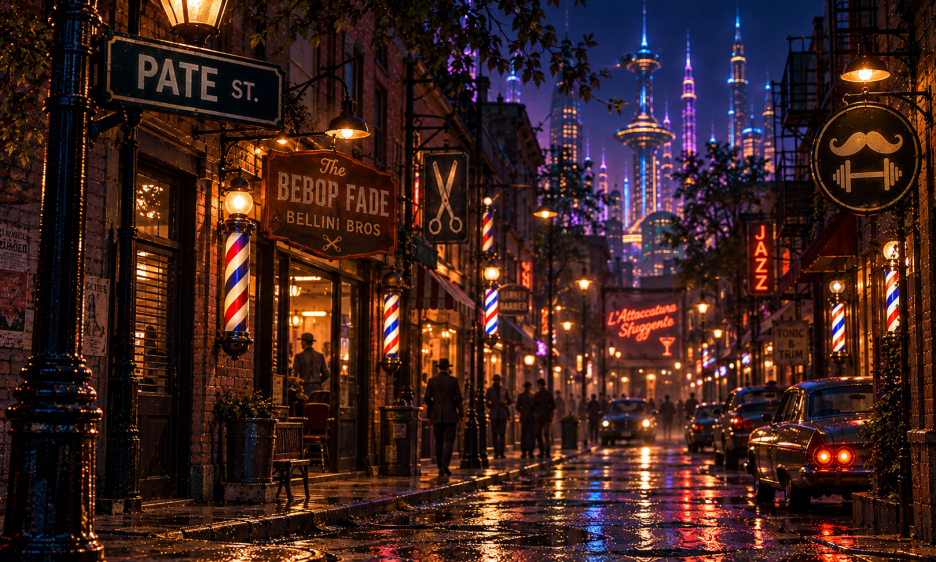
Visitors generally arrive expecting a sort of musical Valhalla, with legendary nightclubs, agreeable bartenders, and musicians who spend their afternoons discussing altered dominants over reasonably priced cocktails. The tourist brochures encourage this impression, although they tend to concentrate on the more photogenic neighborhoods around Ellington Boulevard and Armstrong Avenue.
Pate Street seldom makes the brochures, which is unfortunate, since it offers a rather more intimate view of Jazz City than the one ordinarily available from a hotel balcony.
I had come to write about the city's musical culture, a subject with which I considered myself reasonably familiar. Over the years, I'd interviewed musicians, attended festivals, and acquired sufficient knowledge of jazz history to hold my own at academic conferences. My editor suggested I spend some time away from the celebrated clubs and concert halls, where the music was less likely to be accompanied by a press release.
It seemed a reasonable assignment, although I hadn't anticipated spending quite so much of my afternoon discussing hair.
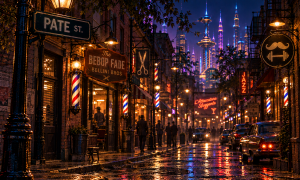
Located three blocks east of Bebop Boulevard, near the Parker Parkway overpass, Pate Street is a modest thoroughfare whose principal industries are barbering, tattooing, and the discussion of music by people who have no immediate plans to play any.
The street has eleven barber shops, seven of which possess working chairs. The remaining four have evolved into informal listening societies, an arrangement that seems to satisfy everyone except the municipal licensing department.
The oldest establishment, The Bebop Fade, belongs to Sal and Sonny Bellini, brothers who stopped speaking in 1983 following a disagreement over the proper tempo of "Cherokee." Their silence has proved remarkably durable, particularly since they continue to work together six days a week.
Sal handles the haircuts, while Sonny manages the shop's selection of knitwear.
"Some people have the hair for bebop," Sal explained during my visit. "Others are better suited to free improvisation."
Sonny, who has apparently exhausted his contribution to the debate, pointed toward a rack of Dave King Trucking Company signature knit caps.
I considered buying one, although I have always felt that a man should earn his knit cap through musical achievement rather than simple retail activity.
The brothers appeared to communicate without difficulty. Sal would gesture toward a customer, Sonny would retrieve a cap, and the transaction would proceed with an efficiency that several businesses of my acquaintance might profitably study.
Across the street is Georgi's Birdland Ink, a tattoo parlor operated by a Bulgarian gentleman of substantial dimensions and unusually refined grooming habits.
Georgi weighs approximately 300 pounds, deadlifts 585, and maintains a magnificent handlebar mustache that appears to receive more attention than most of the tattoos he produces.
His specialty is the inscription BIRD LIVES, which he offers in seventeen typefaces and a choice of black.
"Bird did not need colors," he told me.
This struck me as an interesting aesthetic position, particularly from a man whose shop contains a considerable collection of Bulgarian folk art.
Georgi's musical tastes are difficult to classify. His record player alternates between traditional Bulgarian music and Thelonious Monk, an arrangement he considers perfectly natural.
"Monk understands Bulgaria," he explained.
I was tempted to ask whether he meant Monk's rhythmic displacement, his unconventional harmonic vocabulary, or some less readily identifiable affinity with Bulgarian musical traditions.
Instead, I listened.
Georgi appeared entirely satisfied with this response.
A photograph behind the counter shows Georgi arm-wrestling a gentleman he identifies as Charles Mingus. The photograph is dated 1994, which introduces certain chronological difficulties, but Georgi seems entirely comfortable with them.
I decided not to pursue the matter.
A short walk farther down Pate Street brings one to L'Attaccatura Sfuggente, a tavern whose Italian name translates approximately to The Receding Hairline. The proprietor is Polish, the bartender is Irish, and Bulgarian sausage is served on Thursdays, making the establishment something of an international cultural center.
The house trio has occupied a corner of the room since 1962, although not, of course, with the same personnel. They are reputed to have been playing the same composition throughout this period, a claim I initially dismissed until I noticed that the pianist seemed reluctant to arrive at a cadence.
On the trio's occasional nights off, the management engages a group called The Bald Plus, whose arrangements are said to be considerably thinner.
The walls of L'Attaccatura Sfuggente are decorated with photographs of jazz musicians, several of whom appear to have been photographed elsewhere. One particularly intriguing picture shows a young man standing beside a Buick. The caption reads Possibly Bud Powell.
I ordered a martini and spent a pleasant half-hour considering the possibilities.
The trio continued playing. At one point the bassist introduced a phrase that caused the drummer to laugh, although I could detect nothing particularly amusing about it. A few minutes later, the pianist repeated the phrase, whereupon all three musicians laughed.
I had heard enough jazz to recognize an inside joke when I encountered one, even if I had no idea what the joke was.
The bartender, Dolores, noticed my interest.
"They've been doing that for years," she said.
"Playing the same piece?"
"Laughing at each other."
I found this distinction rather more illuminating than I expected.
It was at L'Attaccatura Sfuggente that I first encountered the local custom known as the Jazz Point.
Readers familiar with jazz photography may have noticed that musicians frequently point at one another, particularly when cameras are present. In Jazz City, this gesture has acquired a significance that residents are generally unwilling to explain.
The Point may indicate recognition, approval, professional solidarity, or a desire to have someone move out of the way. Much depends on the circumstances, and even more on the person doing the pointing.
Georgi is considered something of an authority.
According to Dolores, a visitor once entered his tattoo parlor carrying a record bag and wearing a navy-blue knit cap. The visitor pointed at Georgi, who returned the gesture. Twenty minutes later, the gentleman departed with BIRD LIVES tattooed on his forearm.
Beneath it, in smaller lettering, Georgi had added SO DOES GEORGI.
Dolores assured me that no money had changed hands.
I asked whether this was customary.
"Georgi doesn't point at just anybody," she replied.
This seemed to settle the matter, at least as far as Dolores was concerned.
I understood why Charlie Parker mattered. I was less certain why a Bulgarian tattoo artist had appointed himself the guardian of Parker's immortality.
I knew the history of bebop. I couldn't explain why two brothers who hadn't spoken in forty-three years appeared to enjoy one another's company.
And although I had examined countless photographs of jazz musicians pointing at one another, I had never once been pointed at myself.
I was beginning to suspect that I'd missed something.
I finished my martini and walked back toward Ellington Boulevard. Sal was sweeping the pavement outside The Bebop Fade while Sonny arranged his knit caps in the window. Across the street, Georgi was adjusting his mustache in a small mirror.
As I approached the corner, I noticed a familiar face emerging from The Bebop Fade. It was Chris Potter, the celebrated tenor saxophonist, whose formidable command of his instrument I had admired for years.
I recognized him immediately, although his haircut gave me pause. It was considerably shorter than I remembered, with an angular precision that seemed more appropriate to his musical abilities than his previous arrangement.
Sal paused his sweeping to admire his work.
"Now you look like a tenor player," he said.
Potter examined his reflection in the shop window, smiled, and pointed at Sal.
Sal pointed back.
I considered introducing myself, but the moment seemed complete without my participation.
I had come to Jazz City expecting to write about its celebrated clubs, its musical history, and the considerable achievements of the artists who had made it famous. Instead, I had spent an afternoon among barbers, tattoo artists, and people who seemed to understand one another without the customary assistance of words.
I wasn't entirely certain what to make of it.
I was, however, beginning to wonder what I might find on Armstrong Avenue.
I made a note to return.
 FOLLOW AAJ Staff
and get notified whenever a new article published.
A secret society of jazz writers. Their identities are unknown. Their motives are unclear. Their disdain for self-promotion is absolute.
About Chris Potter
Tags
PREVIOUS / NEXT

Chris Potter Concerts

Become a Sustaining Member

Since 1995, All About Jazz has championed jazz as an art form and supported the musicians who create it. Over three decades, it has grown into one of the world's leading jazz resources, serving hundreds of thousands of readers, musicians, presenters and industry professionals each month.
Help Build the Future of All About Jazz
Your support helps us continue building All About Jazz for the next generation—expanding our editorial coverage, preserving jazz history, developing new community features and creating better ways to discover the music and the people behind it.
Become a sustaining member for as little as $20 per year and you'll immediately enjoy an ad-free experience along with access to subscriber features and future articles for a full year.
Together, we're not simply sustaining All About Jazz—we're building its future. Thank you for being part of the journey.